


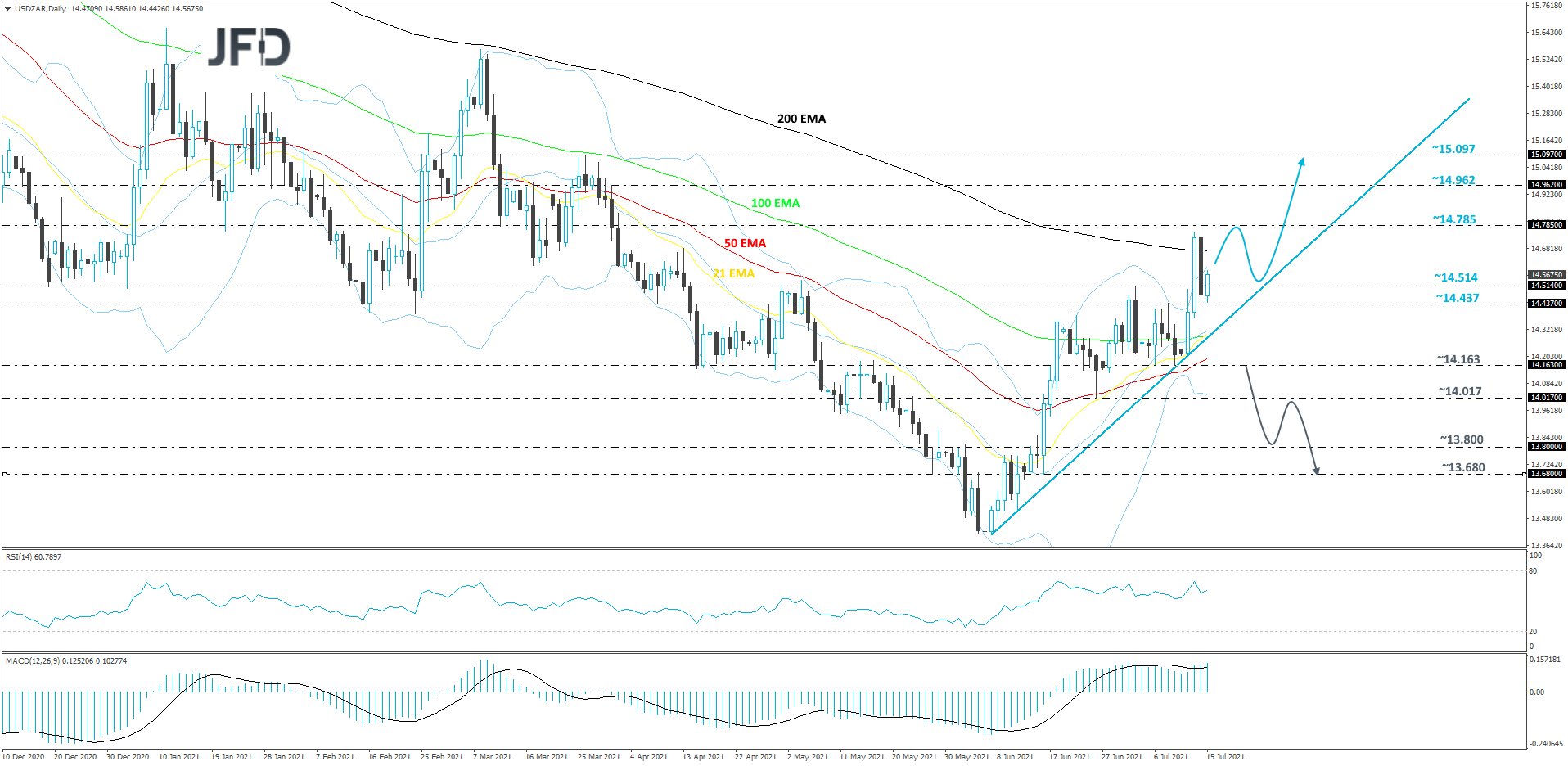
After the weekend, when the unrests broke out in South Africa, the country is now trying to measure the economic damage, caused by people’s looting of businesses. The South African rand took a dive against most of its major counterparts, including the US dollar. Looking at the technical picture of USD/ZAR, we can see that after reversing higher in the beginning of June, the pair continues to form higher lows and higher highs. At the same time, the rate is still sitting above a short-term tentative upside support line taken from the low of June 7th. As long as the pair continues to trade above that upside line, we will stay positive, at least with the near-term outlook.
Another push higher might bring USD/ZAR back to the current high of this week, at 14.785, which may once again provide a temporary hold-up. The pair might stall there for a bit, but if the bulls continue to dominate the field, they could overcome that 14.785 barrier and aim for higher areas. This would confirm a forthcoming higher high and may lead the rate to the 14.962 zone, marked by the high of March 31st. If the buying doesn’t stop there, the next possible target might be at 15.097, which is the high of March 26th.
The RSI and the MACD are currently pointing higher. Also, the RSI remains above 50 and the MACD is still well above zero and continues to run above its trigger line. The two indicators show positive price momentum, which supports the idea discussed above.
Alternatively, if the pair ends up breaking the aforementioned upside line and then falls below the 14.163 hurdle, marked by the current lowest point of July, that could invite more sellers into the game. If so, this may open the way towards the 14.017 obstacle, or to the 13.800 zone, marked near the inside swing highs of May 31st, June 1st and 14th. If the bears stick to the steering wheel, they might drive USD/ZAR to the 13.680 level, which is the low of June 16th.
Disclaimer:
The content we produce does not constitute investment advice or investment recommendation (should not be considered as such) and does not in any way constitute an invitation to acquire any financial instrument or product. The Group of Companies of JFD, its affiliates, agents, directors, officers or employees are not liable for any damages that may be caused by individual comments or statements by JFD analysts and assumes no liability with respect to the completeness and correctness of the content presented. The investor is solely responsible for the risk of his investment decisions. Accordingly, you should seek, if you consider appropriate, relevant independent professional advice on the investment considered. The analyses and comments presented do not include any consideration of your personal investment objectives, financial circumstances or needs. The content has not been prepared in accordance with the legal requirements for financial analyses and must therefore be viewed by the reader as marketing information. JFD prohibits the duplication or publication without explicit approval.
CFDs are complex instruments and come with a high risk of losing money rapidly due to leverage. 75.05% of retail investor accounts lose money when trading CFDs with the Company. You should consider whether you understand how CFDs work and whether you can afford to take the high risk of losing your money. Please read the full Risk Disclosure.
Copyright 2021 JFD Group Ltd.