


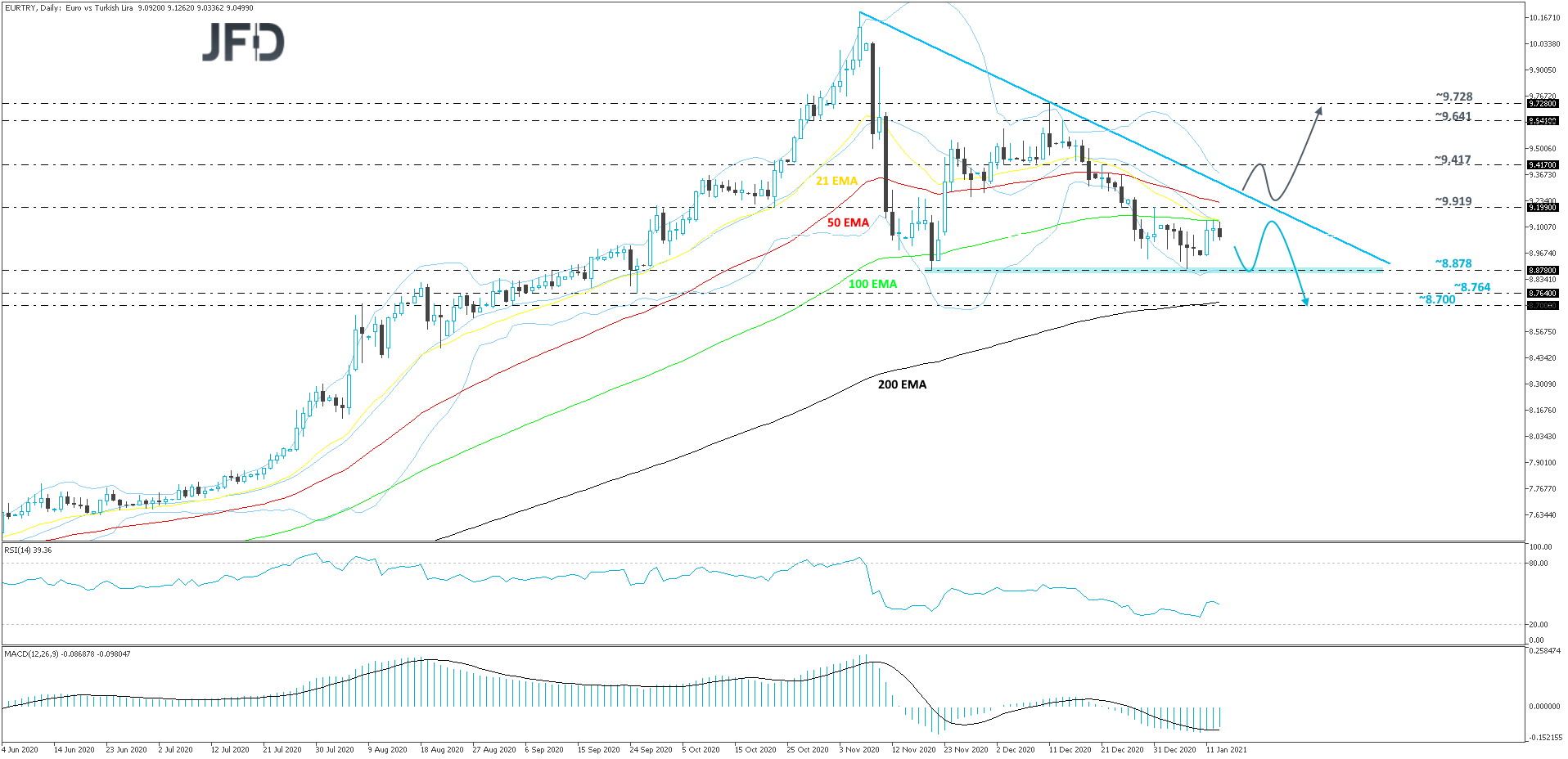
Looking at the broader picture of EUR/TRY on our daily chart, we can see that it has been forming lower highs since peaking in November 2020. That said, so far, the pair is struggling to go for a lower low, as it continues to balance above the 8.878 area, marked near the lowest point of November and the current lowest point of January. The pair seems to be forming a possible descending triangle, which tends to be a bearish formation. Given that the rate is currently stuck inside that pattern, we will take a cautiously-bearish approach for now.
If the aforementioned downside line continues to hold, EUR/TRY might drift to the previously discussed support zone, at 8.878. That zone might initially prove to be a difficult one to break, however, if this time the bears are strong enough to overcome that obstacle, the rate could slide further and aim for the 8.764 hurdle, marked by the low of September 25th. Slightly below it lies another possible support level, at 8.700, marked near the high of August 21st and near the low of September 3rd.
The RSI is currently pointing a bit lower, while continuing to run below 50. The MACD, although pointing fractionally higher and sitting slightly above its trigger line, remains well below zero. The two oscillators are still indicating downside speed. But the fact that the MACD is pointing slightly to the upside, supports the idea of staying cautiously bearish, at least for now.
Alternatively, if the rate travels higher and breaks the aforementioned downside line, this might open the door for a larger move north, as more buyers could see this as a good opportunity to step in. EUR/TRY may then rise to the 9.417 zone, marked near the lows of December 3rd and 9th, and near the high of December 21st. The pair might stall there for a bit, but if the buyers are feeling quite confident, this could result in a further upmove. That’s when we will aim for the 9.641 obstacle, or even the 9.728 level, marked by the highest point of December.
Disclaimer:
The content we produce does not constitute investment advice or investment recommendation (should not be considered as such) and does not in any way constitute an invitation to acquire any financial instrument or product. The Group of Companies of JFD, its affiliates, agents, directors, officers or employees are not liable for any damages that may be caused by individual comments or statements by JFD analysts and assumes no liability with respect to the completeness and correctness of the content presented. The investor is solely responsible for the risk of his investment decisions. Accordingly, you should seek, if you consider appropriate, relevant independent professional advice on the investment considered. The analyses and comments presented do not include any consideration of your personal investment objectives, financial circumstances or needs. The content has not been prepared in accordance with the legal requirements for financial analyses and must therefore be viewed by the reader as marketing information. JFD prohibits the duplication or publication without explicit approval.
CFDs are complex instruments and come with a high risk of losing money rapidly due to leverage. 72.57% of retail investor accounts lose money when trading CFDs with the Company. You should consider whether you understand how CFDs work and whether you can afford to take the high risk of losing your money. Please read the full Risk Disclosure.
Copyright 2021 JFD Group Ltd.