


The FX community traded in a quiet fashion yesterday and today in Asia, with the only exception being the Canadian dollar. In the equity world, EU shares were mostly up, while Wall Street slid after hitting fresh highs. With several European markets closed today, and no major events on the calendar, we give a brief opinion on two themes that could drive, or let’s say continue driving, the markets at the turn of the year.
COVID and Mon. Policy to Stay Among Top Themes for the New Year
The US dollar traded quietly against all but one of the other major currencies on Thursday and during the Asian session Friday. It stayed within a ±0.20% range against all, except CAD.

The quiet trading activity doesn’t show much about traders’ morale, at least those who continued to trade. It just confirms the low activity due to year-end holidays. As for the equity market, most European stock indices traded in the green, while later, all three of Wall Street’s main indices slid, but after the Dow Jones and the S&P 500 hit fresh record highs. Today, only China’s Shanghai Composite is tradable, and, currently, it is higher. The other Asian markets under our radar are closed, with several European ones also scheduled to stay closed today. Only Paris and London will trade for half a session.
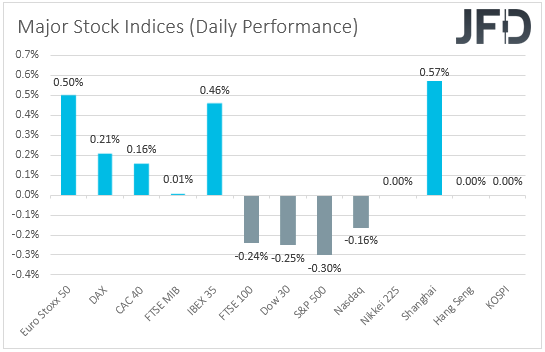
Today is the last day of 2021, and with no major market drivers yesterday, and no important events scheduled for today, we do expect a quiet trading activity. However, let’s not forget that due to thin liquidity, a sudden market-related headline may be enough to cause overstretched reactions. So, it may be best to protect existing positions by limiting your risk.
Now, given that there is no much to say for today, we would like to discuss what may be the main themes on investors’ agendas after the turn of the year and we believe that it could be COVID again, and monetary policy. As far as COVID is concerned, for now, market participants may stay willing to add to their risk exposures, and perhaps push equity indices to new highs, as several nations around the globe held off from imposing fresh lockdowns, despite record infections around the globe the last few days. With the vaccination rates increasing and the new variant being less deadly than the prior ones, governments prefer to keep their economies open. Having said that though, we are far from being experts in medical sciences, and therefore, we don’t know whether more variants will appear and whether infections will accelerate further, to a degree at which health care systems will be severely affected. Any new concerning headlines have the potential to result in decent retreats.
Now, in terms of monetary policy, several central banks have already started removing pandemic-related stimulus, and are expected to proceed with aggressive interest-rate increases in 2022. The RBNZ has already hiked twice, in October and November, and it is expected to continue that process in 2022. The BoE has done so at its December meeting, with the forward yield curve of the UK Overnight Index Swaps pointing to another four quarter-point increases during the course of the new year. The Fed is expected to deliver three hikes, with the BoC anticipated to begin the lift-off process at one of its upcoming meetings. On the other hand, the ECB, the RBA, the BoJ and the SNB, are unlikely to touch the hike button in 2022.
So, with all that in mind, monetary policy divergence may be one of the main drivers in the FX market. The currencies the central banks of which are expected to continue to tighten aggressively are likely to perform better. For example, we see the case for EUR/USD to break the lower end of its recent sideways range in the foreseeable future, and GBP/AUD to march higher. We expect EUR/GBP to continue falling, and NZD/JPY to trend north. That said, there is the risk of unforeseen events changing the agendas of central banks, with those expected to tighten more aggressively having the potential to disappoint the most. In other words, if any of those Banks, like the BoE which is expected to hike almost 4 times, signals that it may not proceed with so many increases, the disappointment could be large and the respective currency could fall notably.
EUR/USD – Technical Outlook
EUR/USD traded somewhat lower yesterday, after it hit resistance slightly above the 1.1335 barrier. That said, the slide was stopped slightly above the 1.1290 level. Overall, the pair remains within the sideways range that’s been in place since November 26th, between the 1.1233 and 1.1375 barriers, but it also trades below the downside resistance line taken from the high of May 25th, which, in our view, increases the chances for a downside exit out of the range, rather than an upside one.
If, indeed, the bears are strong enough to push the pair below the lower end of the range, which is at 1.1233, we may initially see them targeting the low of November 24th, at 1.1185. If they are not willing to stop there and manage to overcome that obstacle as well, this will confirm a forthcoming lower low on the weekly chart, and may pave the way towards the 1.1100 area, which provided support back on June 1st, 2020.
On the upside, we would like to see a decisive recovery above 1.1465, before we start examining the bullish case. The rate will already be above the aforementioned medium-term downside line, and the bulls could initially climb towards the 1.1524 zone, which supported the action back on October 12th and November 5th. If they don’t stop there, we may experience advances towards the 1.1575 barrier, or the 1.1615 zone, marked by the low of November 9th, and the high of November 4th, respectively.

GBP/AUD – Technical Outlook
GBP/AUD rebounded yesterday, after hitting support at 1.8540. However, the advance stayed limited near the key resistance of 1.8630, which has been providing strong resistance since December 13th. Overall, the rate continues to grind higher, respecting the upside support line drawn from the low of December 9th, but in order to get confident on more advances, we would like to see a clear and decisive break above 1.8630.
Such a break would confirm a forthcoming higher high on the 4-hour chart and could pave the way towards the 1.8720 or 1.8768 barriers, marked by an intraday swing low formed on December 2nd, and the inside swing low of December 6th, respectively. If the bulls are not willing to stop there, then we could see them climbing towards the peak of December 7th, at 1.8840.
We will abandon the bullish case upon a dip below the 1.8540 level. This could confirm the break below the aforementioned upside line and may initially pave the way towards the 1.8480 zone, near the low of December 23rd. A break below that barrier could extend the fall towards the low of December 16th, at 1.8415, or the low of December 9th, at 1.8385.

Disclaimer:
The content we produce does not constitute investment advice or investment recommendation (should not be considered as such) and does not in any way constitute an invitation to acquire any financial instrument or product. The Group of Companies of JFD, its affiliates, agents, directors, officers or employees are not liable for any damages that may be caused by individual comments or statements by JFD analysts and assumes no liability with respect to the completeness and correctness of the content presented. The investor is solely responsible for the risk of his investment decisions. Accordingly, you should seek, if you consider appropriate, relevant independent professional advice on the investment considered. The analyses and comments presented do not include any consideration of your personal investment objectives, financial circumstances or needs. The content has not been prepared in accordance with the legal requirements for financial analyses and must therefore be viewed by the reader as marketing information. JFD prohibits the duplication or publication without explicit approval.
CFDs are complex instruments and come with a high risk of losing money rapidly due to leverage. 68.02% of retail investor accounts lose money when trading CFDs with the Company. You should consider whether you understand how CFDs work and whether you can afford to take the high risk of losing your money. Please read the full Risk Disclosure.
Copyright 2021 JFD Group Ltd.