

On Monday we get the US retail sales numbers for the month of June, which are expected to have declined from 0.8% to 0.5% on MoM basis. But the main focus will be on the core retail sales, which play a key part in determining the consumer spending patterns that go into the country’s GDP calculation. The figure for that is expected to drop more than double from the revised 0.9% to the 0.4% for the month of June, which would bring it back to the April number. This makes us believe that the retail sales in the US are getting hit by diminishing earnings that saw a decline in June. Or maybe it’s just seasonality that affects the sales figure, where it tends to drop going into the first month of summer. Overall, it looks like it could be difficult to overcome the previous 0.9% number, so the actual figure could come out lower than that.
On Tuesday, during the early Asian morning, we get New Zealand’s headline QoQ and YoY inflation figures for Q2. The expectations for the QoQ are the same as the previous numbers of +0.5%. For the YoY number, it is projected to have increased to +1.6% from +1.1%. If the figures come out as expected, then this is still below the RBNZ CPI target of 2% on a YoY basis. If we get another low inflation reading, then this pushes further the possibility for the New Zealand central bank to raise interest rates any time soon. The rate currently sits at +1.75%. The low inflation readings could be explained by the recent low inflation of food and imports, together with no increase in wages growth.
Also, the same morning, we get the minutes from the latest RBA policy gathering. We have noted in the past, that meetings of this Bank were proven non-events in recent months, and the last one was no exemption. Officials decided to keep interest rates unchanged and made little changes to the statement accompanying the decisions. The important thing to take from the meeting is that RBA officials are unlikely to hike rates in the foreseeable future. According to the Bank’s latest quarterly Statement on Monetary policy, the cash rate is expected to increase around the middle of next year. Thus, we see that it is unlikely for the minutes to have a surprise element.
From the UK, we get employment data for May. Expectations are for the unemployment rate to have stayed unchanged at its 42-year low of 4.2%, while average weekly earnings including bonuses are anticipated to have risen at the same pace as in April (+2.5% yoy). That said, we expect the market to pay more attention to wages excluding bonuses, the yoy rate of which is expected to have ticked down to +2.7% yoy from +2.8%. At the press conference following the May policy decision, when BoE Governor Carney presented the quarterly Inflation Report, he made it clear that the Bank pays more attention to regular pay, because of the way bonuses distort headline earnings.
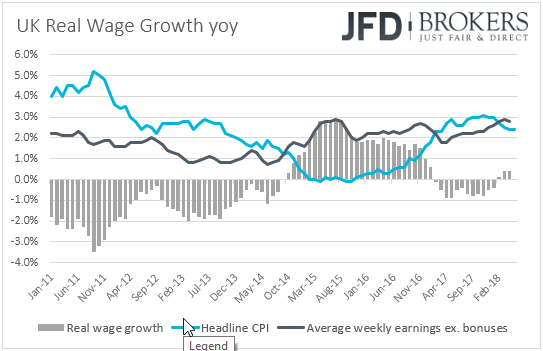
According to the Markit UK Report on Jobs for the month, strong demand for staff and low candidate availability underpinned further increases in starting salaries, with those for permanent workers rising at the steepest rate for three years. In our view, due to this situation, the earning prints are tilted to the upside.
US manufacturing and industrial production numbers are also expected to come out on Tuesday. Even though they might not affect the market overall, nevertheless, it is still good to keep an eye on them. The industrial production (MoM) for the month of May is expected to have increased from the previous negative 0.1% to a positive 0.5%.
The US NAHB housing numbers are due to come out as well. This is a survey of 900 home builders in the US that provide their views on the levels of sales of the single-family homes. The number to come out is expected to have slightly risen from the previous 68 to 69. Just to remind that a reading above 50 gives a positive outlook on home sales and if it is also above expectations, then this works in favour of USD and the bulls could pick up on it.
Also, in the US, the highlight is likely to be Fed Chair Jerome Powell’s semi-annual testimony before the Senate Banking Committee. There is still no official announcement for when he will testify before the House of Representatives’ Financial Services Committee, but usually that happens the following day.
At its previous meeting, the FOMC decided to increase the Federal funds rate by 25bps, while the new “dot plot” pointed at two more rate increases by year end, instead of just one as the previous plot suggested. This was due to the fact that one of the policymakers who previously supported a total of three hikes in 2018 has changed his mind and called for four, which was enough for the median to move 25bps higher. What’s more, the main message we got from the minutes of that meeting was that policymakers are willing to continue hiking rates this year and the next, and that they could allow rates to rise above neutral for some time.
A week after the meeting, at the ECB forum in Sintra, Powell said “With unemployment low and expected to decline further, inflation close to our objective, and the risks to the outlook roughly balanced, the case for continued gradual increases in the federal funds rate is strong.” According to the Fed funds futures, the market currently assigns an 85% chance for the next hike to occur in September, while there is a 55% probability for the Committee to deliver another one in by December. Therefore, investors will be eager to see whether he will maintain his hawkish stance, something that could further strengthen the case for the Fed to end the year with a total of four rate hikes.
Wednesday will also be a busy day news wise and could bring a lot of volatility into the market.
In the UK, we get inflation data for June. The headline figure is forecast to have rebounded, to +2.6% yoy from +2.4%, whereas the core rates are expected to remain the same as the previous at 2.1%. The case for accelerating inflation is supported by the UK services PMI for the same month, which revealed that higher operating expenses resulted in the fastest rate of prices charged since March.
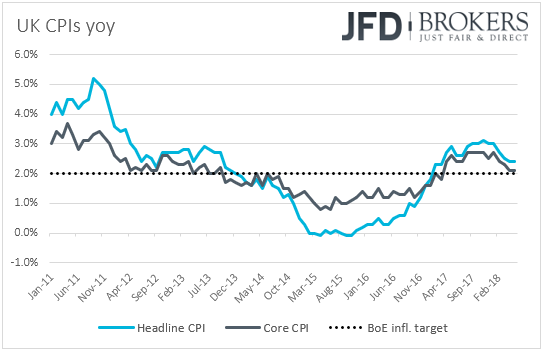
Following the slowdown in Q1, the May and June PMIs suggested that the economy may have turned the corner, something that was also supported by the NIESR GDP model, which pointed to a +0.4% growth in the three months to June. A +0.4% qoq growth in Q2 is in line with the BoE’s view at its June policy meeting, where three members voted for a 25bps rate increase. All these, as well as recent hawkish remarks by Governor Mark Carney, may have kept the market overwhelmed with the idea of a rate increase at the Bank’s upcoming gathering. Thus, accelerating inflation, conditional upon accelerating wages in Tuesday’s data, could further strengthen the case.
Also, after the UK CPIs, we will be getting the Eurozone inflation figures, where both core and the headline YoY numbers are expected to have remained the same, at +1.0% and +2.0% respectively. The last one is in line with ECBs target of 2% for the consumer price index to be at over the medium term.
US building permits are due to come out before the US opening bell, where the figure is expected to have increased for the amount of approvals for new housing. The number is expected to rise slightly from 1.301M to 1.328M, which could be a sign that the housing market continues to move in the right direction.
One more piece of important data to come out US is the crude oil inventories. It measures the change in the number of barrels of crude oil held by US firms. The number is expected to have shifted from the previous -12.633M barrels to -6.182M. This means that there is an increase in the supply of oil, which could affect the price negatively.
Investors will keep their focus on the Jerome Powell’s testimony, which will be slightly different to Tuesday’s, it will be followed by a different Q&A session.
Thursday will be started off with unemployment figures from Australia, where the number is expected to remain the same as the previous at 5.4%, which is relatively low, compared it to the last five years. But there could potentially be a surprise as the employment change figure is expected to come out better, at +16.6k, compared to the previous reading of +12.0k. This would be seen as a positive for the Australian currency, which could strengthen it against some of its counterparts.
During the European morning, the UK is due to release their core and headline retail sales figures for the previous month. Even though the headline YoY number is expected to have remained the same as the previous at +3.9%, the core number for the same period is forecast to have declined from +4.4% to +3.7%. The last one is an important measure, as it excludes autos and fuel, due to their more volatile behaviour.
In the US, we will be watching the Initial Jobless Claims number, which is expected to have slightly increased from the previous +214k to +221k, that could have a relatively negative effect on the US dollar.
Friday’s main news will be from Canada. The country will release its headline and core inflation numbers for the month of June, and also its retail sales figures for the month of May. The headline YoY CPI figure is expected to grow by one tenth of a percent, going from +2.2% to +2.3%. The same story is with the core number (which excludes food and energy), it is expected to grow to +1.4% from the previous +1.3%. Certainly, the numbers are still within the BoC’s range target (from 1 to 3 percent on a YoY basis), but is slightly above the midpoint of that range. The numbers are important for the BoC, as they act as a gauge for deciding on the future of their interest rates.
At the same time, we will get the Canadian headline and core MoM retail sales figures, where both are expected to have improved from their previous ones. The core is expected to rise from the previous -0.1% to a much stronger +0.5% number for the month of May. We have a similar story for the headline May number, where it is expected to increase to 0.0% from -1.2% a month before. We believe that even if these do not meet expectations, but still come out better than the previous numbers, then it could still have a positive effect on the Canadian dollar against some of its counterparts.
Disclaimer:
The content we produce does not constitute investment advice or investment recommendation (should not be considered as such) and does not in any way constitute an invitation to acquire any financial instrument or product. JFD Brokers, its affiliates, agents, directors, officers or employees are not liable for any damages that may be caused by individual comments or statements by JFD Brokers analysts and assumes no liability with respect to the completeness and correctness of the content presented. The investor is solely responsible for the risk of his investment decisions. Accordingly, you should seek, if you consider appropriate, relevant independent professional advice on the investment considered. The analyzes and comments presented do not include any consideration of your personal investment objectives, financial circumstances or needs. The content has not been prepared in accordance with the legal requirements for financial analyzes and must therefore be viewed by the reader as marketing information. JFD Brokers prohibits the duplication or publication without explicit approval.
FX and CFDs are leveraged products. They are not suitable for every investor, as they carry high risk of losing your capital. You should be aware of all the risks associated with trading on margin. Please read the full Risk Disclosure.
Copyright 2018 JFD Brokers Ltd.