


Although EU indices traded mixed yesterday, Wall Street rallied as US President Trump urged Congress to proceed with some standalone stimulus bills, reviving hopes that at least a partial deal could still happen before the elections. In the currency world, the Kiwi came under selling interest following reports that an RBNZ official said that the Bank is “actively working” on negative interest rates.
US Stimulus Hopes Return, Kiwi Slides on Negative-rate Talk
The US dollar traded lower against the majority of the other G10 currencies on Wednesday and during the Asian morning Thursday. It gained only versus JPY and NZD, while it underperformed the most versus SEK, NOK, and CAD in that order.
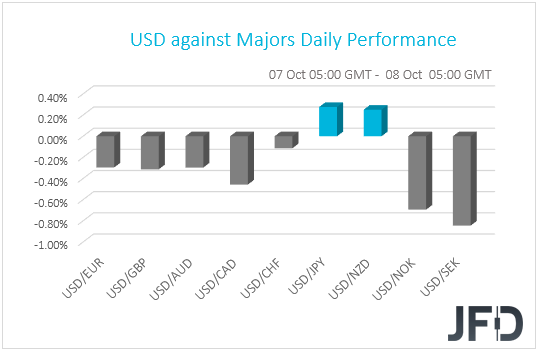
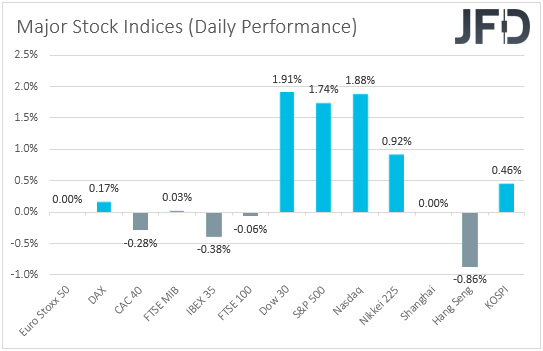
The weakening of the dollar and the yen suggests that investors’ appetite improved again at some point yesterday. That said, the weakening of the Kiwi points otherwise. Thus, in order to get a clearer picture with regards to the broader market sentiment, we prefer to turn our gaze to the equity world. There, major EU indices traded mixed, finishing their session within a ±0.40% range. However, market participants decided to increase their risk exposure during the US session, with Wall Street’s main indices gaining on average 1.84% each. Appetite softened again during the Asian session. Japan’s Nikkei 225 and South Korea’s KOSPI gained 0.92% and 0.46% respectively, but Hong Kong’s Hang Seng fell 0.86%. Chinese markets stayed closed in celebration of the National Day.
After calling off negotiations with Democrats over a fresh stimulus package, US President Trump urged Congress to provide checks for Americans and other support for airlines and small businesses, reviving hopes that, at least, a partial deal could happen ahead of the November 3rd US election. With investors cheering the prospect of some stimulus, the minutes from the latest FOMC meeting passed largely unnoticed. Just for the record, the minutes revealed that, in August, officials agreed unanimously on a new approach to monetary policy, but they were divided in September over how to apply the new principles in practice.
Having said all that, despite equities rebounding again, and even if they continue traveling north for a while more, we will stick to our day-by-day approach. With coronavirus cases keep rising at a fast pace, and the US elections getting closer, we are reluctant to call for a long-lasting recovery. For now, hopes for partial, standalone, stimulative bills in the US may keep investor morale supported for a while more. Equities and other risk linked assets may gain more, while safe havens could stay under pressure.
In the currency world, this means that pairs consisting of a risk-linked currency and a safe haven may perform better than others. Such pairs are AUD/JPY and AUD/USD. Under normal circumstances, we would include NZD/JPY and NZD/USD as choices, but the latest weakness in the Kiwi due to headlines surrounding the RBNZ policy make us cautious on that front. Overnight, reports hit the wires that an RBNZ official said that the Bank is “actively working” on negative interest rates, with another policymaker saying that they would rather do too much too soon than too little too late, confirming that their looking at the prospect of a negative-rates plan. Although the RBNZ has already signaled that negative interest rates are a tool available to be used in case further stimulus is needed, direct talk on that front makes the case even more likely and increases the chances for such a move to take place at one of the upcoming RBNZ gatherings.
Euro Stoxx 50 – Technical Outlook
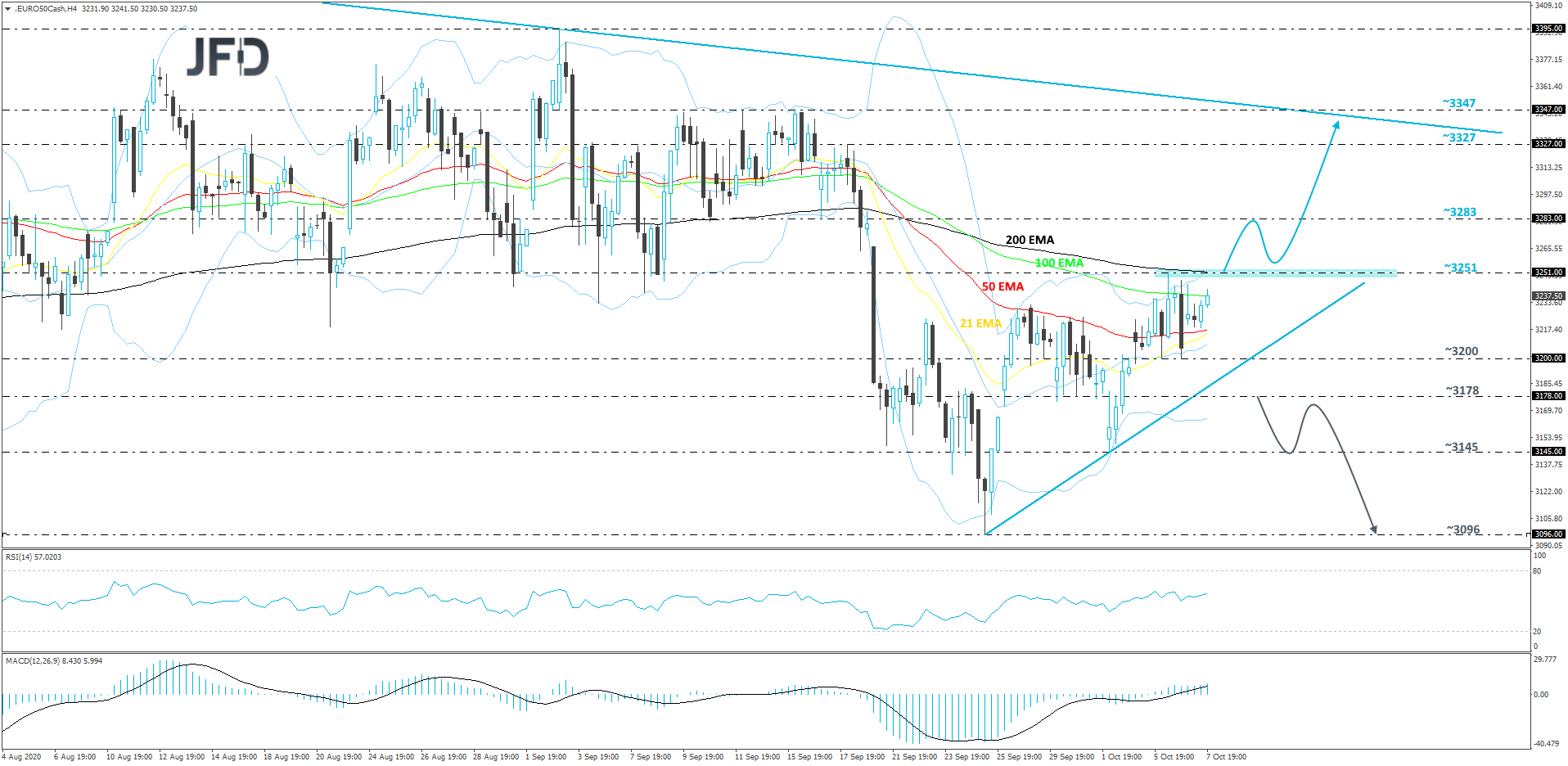
After the reversal to the upside in the end of September, Euro Stoxx 50 is now trading above a short-term tentative upside support line taken from the low of September 25th. From the short-term perspective, the index seems to be willing to move further north, but let’s not forget that from the medium-term perspective it is still trading below a medium-term downside resistance line taken from the high of July 21st, which could still keep the price from moving higher.
In order to aim for slightly higher areas, at least in the short run, we would wait for a break above the 3251 barrier first, which is marked by the current highest point of October. If such a move occurs, that would confirm a forthcoming higher high and place Euro Stoxx 50 above the 200 EMA on our 4-hour chart. This could attract more buying interest, potentially helping the index to rise to the 3283 zone, marked near the lows of September 10th and 17th. If that is still not enough for the bulls, a break of that zone might clear the way to the 3327 level, marked by the high of September 18th, or the aforementioned downside line, which might help temporarily halt the acceleration.
In order to shift our attention to some lower areas, a break of the previously-discussed upside line would be needed. In addition to that, a drop below the 3178 hurdle, marked by an intraday swing low of September 30th and an intraday swing high of October 2nd, could strengthen the bearish case, potentially forcing Euro Stoxx 50 to move towards the 3145 obstacle, a break of which could clear the way to the lowest point of September, at 3096.
NZD/JPY – Technical Outlook
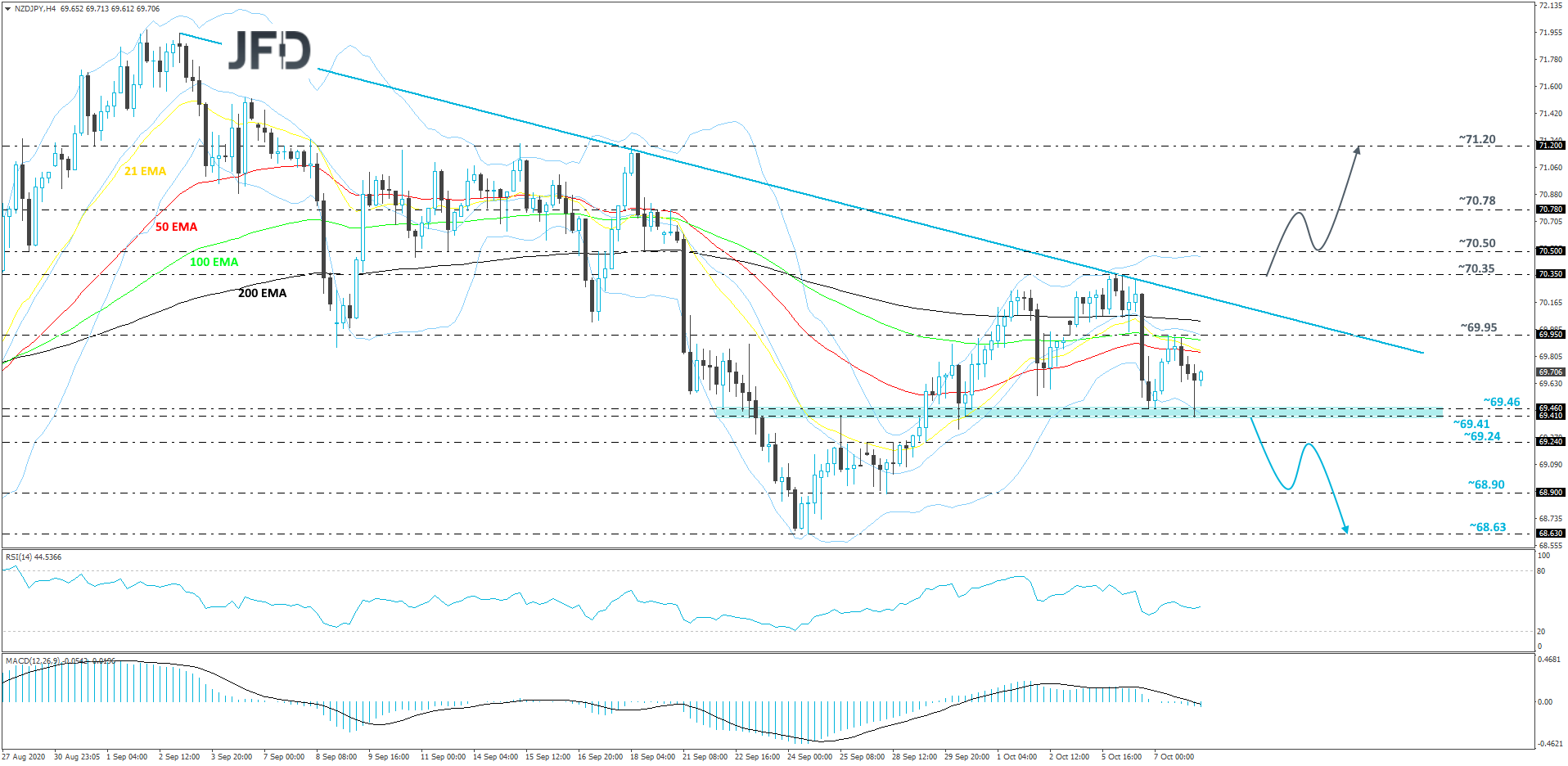
NZD/JPY continues to trade below a short-term downside resistance line taken from high of September 3rd. Recently, the pair found good support near the area between the 69.41 and 69.46 levels, which mark the inside swing high of September 25th and the lows of October 6th. Although the current trend is to the downside, we would prefer to wait for a drop below the above-mentioned support area, before getting comfortable with lower levels.
A drop below the 69.41 zone would confirm a forthcoming lower low, potentially inviting more sellers into the game and this way clearing the path for further declines. NZD/JPY might then travel to the 69.24 obstacle, a break of which could send the rate to the 68.90 hurdle, marked by the low of September 28th. The pair may get held there for a bit, or even retrace back up. However, if the rate struggles to move back above the previously-discussed support area between the 69.41 and 69.46 levels, which now could be seen as a strong resistance, NZD/JPY might drift back down. If this time it is able to overcome the 68.90 obstacle, the next possible support zone may be at 68.63, marked by the lowest point of September.
Alternatively, if the pair moves strongly to the upside and breaks the aforementioned downside line, that may signal a change in the current trend. More buyers could join in if the rate rises above the current highest point of October, at 70.35, marked by the high of October 6th. The pair might test the 70.50 obstacle, or even the 70.78 area, marked by the high of September 21st. If the buying doesn’t stop there, the next target could be at 71.20, which is the high of September 18th.
As for Today’s Events
Today, we get more minutes, this time from the ECB. At the prior ECB meeting, policymakers kept monetary policy untouched, reiterating that they stand ready to adjust all their instruments, as appropriate, to ensure that inflation moves towards its aim in a sustained manner. Bearing in mind that the preliminary PMIs and CPIs for September disappointed, we will scan the minutes for clues as to how willing officials are to ease their policy further in the months to come.
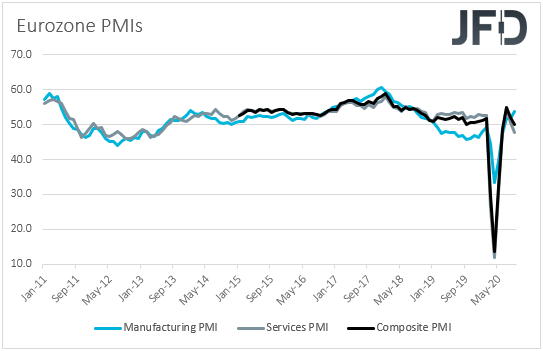
With regards to the economic indicators, Germany’s trade balance for August and the US initial jobless claims for last week are coming out. The German surplus is expected to have risen somewhat, to EUR 18.2bn from EUR 18.0bn, while the US jobless claims are forecast to have decreased to 820k from 837k.
We also have six speakers on today’s agenda: BoE Governor Andrew Bailey, BoC Governor Tiff Macklem, ECB Vice President Luis de Guindos, ECB Executive Board member Isabel Schnabel, ECB Executive Board member Yves Mersch, and Richmond Fed President Thomas Barkin.
The content we produce does not constitute investment advice or investment recommendation (should not be considered as such) and does not in any way constitute an invitation to acquire any financial instrument or product. The Group of Companies of JFD, its affiliates, agents, directors, officers or employees are not liable for any damages that may be caused by individual comments or statements by JFD analysts and assumes no liability with respect to the completeness and correctness of the content presented. The investor is solely responsible for the risk of his investment decisions. Accordingly, you should seek, if you consider appropriate, relevant independent professional advice on the investment considered. The analyses and comments presented do not include any consideration of your personal investment objectives, financial circumstances or needs. The content has not been prepared in accordance with the legal requirements for financial analyses and must therefore be viewed by the reader as marketing information. JFD prohibits the duplication or publication without explicit approval.
CFDs are complex instruments and come with a high risk of losing money rapidly due to leverage. 84.25% of retail investor accounts lose money when trading CFDs with the Company. You should consider whether you understand how CFDs work and whether you can afford to take the high risk of losing your money. Please read the full Risk Disclosure.
Copyright 2020 JFD Group Ltd.