


Wall Street continued to tumble yesterday, perhaps as market participants continued to add to their bets that the Fed may need to tighten its monetary policy faster than previously thought. We believe that this could continue heading into next week’s Fed gathering but given the already elevated expectations over a faster rate path, we see ample room for disappointment.
Risk Aversion Prevails Ahead of Next Week’s Fed Gathering
The US dollar traded higher against all but two of the other major currencies on Thursday and during the Asian session Friday. It gained the most versus AUD, NZD, and GBP, in that order, while it underperformed against JPY. The greenback was found virtually unchanged against CHF.
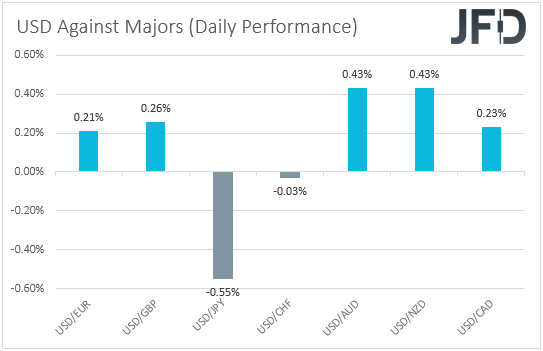
The strengthening of the Japanese yen, the Swiss franc, and the US dollar, combined with the weakening of the risk-linked Aussie and Kiwi, suggests that markets turned to risk-off at some point yesterday. Indeed, turning our gaze to the equity world, we see that European indices traded in the green, but Wall Street extended its latest tumble, with the negative appetite rolling into the Asian session today.
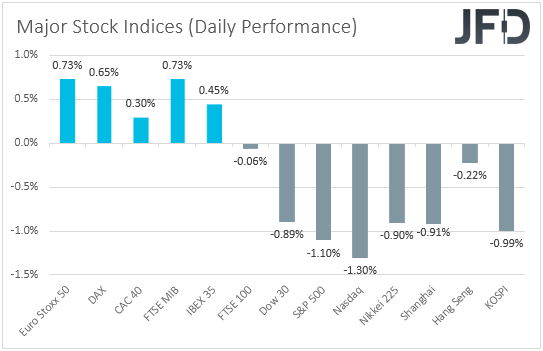
European investors may have taken the torch from the Asian ones, who, yesterday, were encouraged to add to their risk exposures after China cut its mortgage reference rate for the first time in nearly two years. Remarks by ECB President Lagarde may have also helped EU equities. She said that inflation in the Eurozone will decrease gradually over the course of this year, adding that the ECB does not need to act as boldly as the Fed. This may have convinced more market participants that the ECB may not be willing to act this year and that’s why EU shares performed better than their US and Asian counterparts.
Now flying to the US, the story is the same as yesterday, and the day before. Wall Street saw another session of massive selling, with the tech-heavy Nasdaq falling the most, perhaps as US Treasury yields continued to rise. This means that ahead of next week’s Fed gathering, investors are adding to their bets over a faster tightening process by the Fed. Remember that most participants anticipate the first post-pandemic hike to be delivered in March, with some of them holding the view that the Committee should start with a double lift-off in order to restore its credibility.
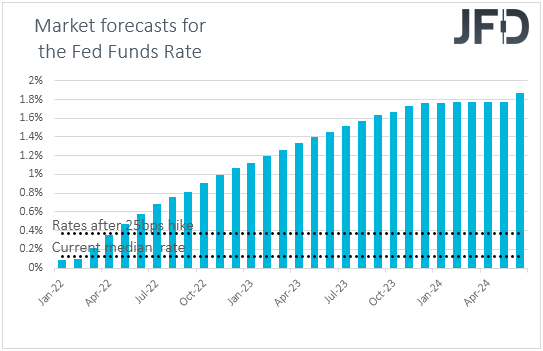
As for our view, we see the case for risk aversion to continue next week as well, ahead of Wednesday, when the Fed will announce its decision. Although the Fed is not expected to proceed with any action at this meeting, we will closely monitor the outcome for clues and hints on whether and how policymakers are thinking to act in March. We do expect policymakers to sound hawkish and highlight the need for higher rates, but bearing in mind the elevated bets on that front by market participants, we see ample room for disappointment. Anything suggesting that they may not proceed as fast as the market currently anticipates could result in a rebound in equities, and a pullback in the US dollar and other safe havens. Even if the outlook matches expectations, we could still experience a “sell the rumor, buy the fact” market reaction. In order for equities to fall notably lower and the dollar to accelerate north in the aftermath of the Fed decision, Powell and his colleagues may need to appear even more aggressive than the current pricing suggests, a case we see as unlikely. According to the Fed funds futures market participants are nearly fully pricing in four hikes by the end of this year, while the latest “dot plot” revealed that the Committee sees three.
Nasdaq 100 – Technical Outlook
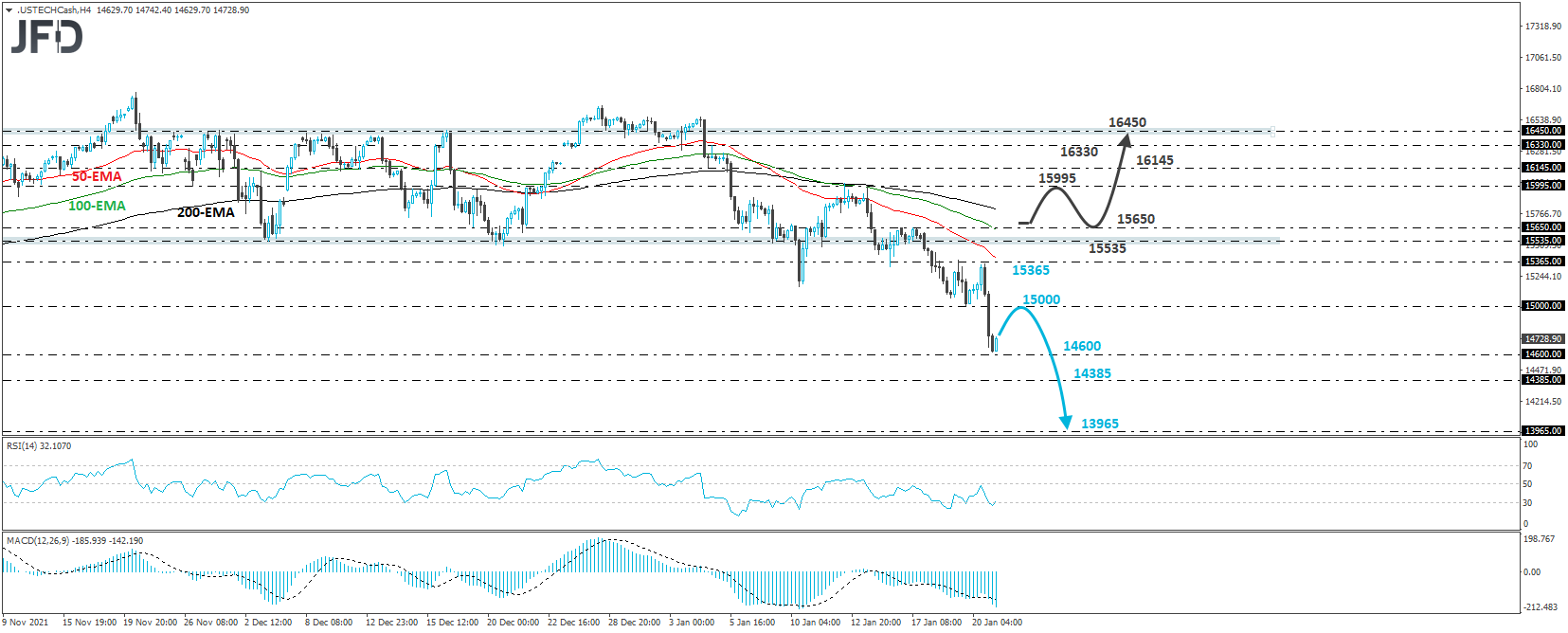
The Nasdaq 100 cash index fell sharply yesterday, extending the tumble began at the turn of the year. The index continues to trade below 15535, which is the lower end of the sideways range that contained most of the price action between October 26th and January 18th and thus, we would consider the short-term outlook to be negative.
Overnight, the index hit support slightly above the 14600 zone, and then it rebounded somewhat. Even if the rebound continues for a while more, we see decent chances for the bears to take charge again from near the round figure of 15000 and push the action back down to the 14600 barrier. A break lower would confirm a forthcoming lower low and may target the 14385 level, marked by the low of October 4th, the break of which could see scope for extensions towards the 13965 zone, marked by the low of June 21st.
On the upside, we would like to see a clear rebound back above 15650, before we abandon the bearish case. This could confirm Nasdaq’s return within the aforementioned sideways range and may encourage some more advances. Investors may first target the 15995 barrier, marked by the highs of January 12th and 13th, the break of which could target the inside swing low of January 4th, at 16145, or the 16330 level, marked by the inside swing low of December 31st. If they don’t stop there, we could see them challenging the upper end of the range at 16450.
NZD/JPY – Technical Outlook
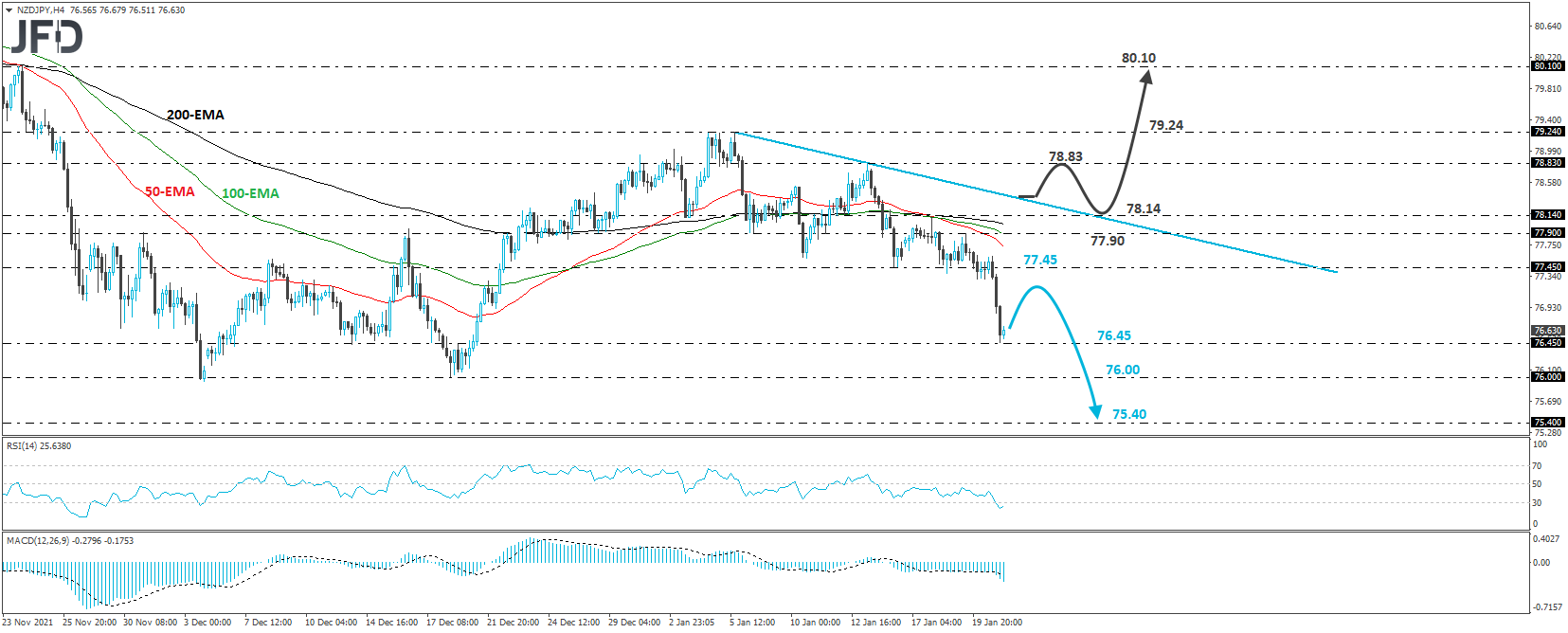
NZD/JPY tumbled as well yesterday, clearing the 77.45 support (now turned into resistance), marked by the lows of January 14th and 18th. That said, the fall was paused near the 76.45 marked today. Overall, the price structure is lower lows and lower highs since January 5th, with the rate trading currently trading well below a downside line taken from that high. With all those technical signs in mind, we will hold a bearish stance for now.
A clear dip below the 76.45 barrier, could encourage fresh declines towards the low of December 20th, at 76.00, the break of which could carry more bearish implications, allowing extensions towards the 75.40 territory, around the low of July 20th.
We will start examining the bullish case again, upon a break above the 78.14level , and the downside line taken from the high of January 5th. This could initially target the 78.83 level, marked by the high of January 13th, the break of which could allow a test at the peak of January 5th, at 79.24. If the bulls are not willing to stop there either, we could see them climbing towards the 80.10 zone, marked by the high of November 24th.
As for Today’s Events
During the early European session, we already got the UK retail sales for December, with both the headline and core rates disappointing largely, as they dropped to -3.7% and -3.6% respectively. This resulted in a small slide in the pound, but bearing in mind the acceleration in inflation on Wednesday, we don’t believe that it could force participants to remove their bets over a rate hike by the BoE at its upcoming gathering.
The Canadian data are for November. The headline rate is forecast to have declined, but the core one to have held steady. Again, we don’t believe these numbers could prove game changers for the BoC. After all, they are for November, and we already have the CPIs for December in hand, which, similarly to the UK ones, accelerated as well.
Disclaimer:
The content we produce does not constitute investment advice or investment recommendation (should not be considered as such) and does not in any way constitute an invitation to acquire any financial instrument or product. The Group of Companies of JFD, its affiliates, agents, directors, officers or employees are not liable for any damages that may be caused by individual comments or statements by JFD analysts and assumes no liability with respect to the completeness and correctness of the content presented. The investor is solely responsible for the risk of his investment decisions. Accordingly, you should seek, if you consider appropriate, relevant independent professional advice on the investment considered. The analyses and comments presented do not include any consideration of your personal investment objectives, financial circumstances or needs. The content has not been prepared in accordance with the legal requirements for financial analyses and must therefore be viewed by the reader as marketing information. JFD prohibits the duplication or publication without explicit approval.
CFDs are complex instruments and come with a high risk of losing money rapidly due to leverage. 68.02% of retail investor accounts lose money when trading CFDs with the Company. You should consider whether you understand how CFDs work and whether you can afford to take the high risk of losing your money. Please read the full Risk Disclosure.
Copyright 2022 JFD Group Ltd.