


Global equities fell yesterday and during the Asian session today as covid cases in the US, Russia and France hit new daily records, and after White House economic adviser Larry Kudlow said that negotiations over a coronavirus-aid bill have slowed. As for tonight, Aussie traders are likely to pay extra attention to Australia’s CPIs for Q3, with the probability for a rate cut by the RBA next week standing at elevated levels.
Equities Slide on Rising Covid Infections, US Stimulus Concerns
The US dollar traded lower against most of the other G10 currencies on Monday and during the Asian morning Tuesday. It gained only against CHF and CAD, while it was found virtually unchanged against EUR. The greenback underperformed the most versus NOK, SEK, and AUD.
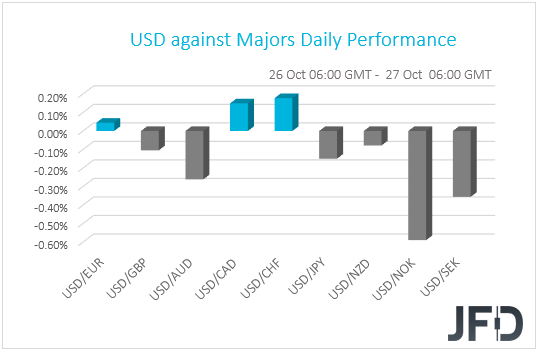
The relative weakness of the dollar and the franc, combined with the strengthening of the Aussie, suggests that markets traded in a risk-on manner. That said, the strengthening of the yen and the weakening of the Loonie point otherwise. Thus, in order to get a clearer picture with regards to the broader market sentiment, we prefer to turn our gaze to the equity world. There, major EU and US indices were a sea of red, with the negative morale rolling somewhat into the Asian session today. Although China’s Shanghai Composite is up 0.10%, and Japan’s Nikkei slid only 0.04%, Hong Kong’s Hang Seng and South Korea’s KOSPI fell 0.66% and 0.56% respectively.
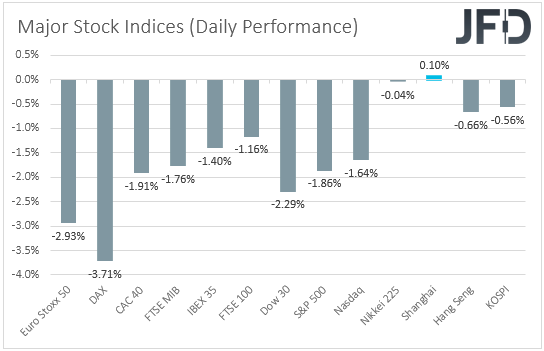
The German DAX was the biggest loser (-3.71%), closing at its lowest in nearly four months after Europe’s most valuable tech firm, SAP, slumped almost 22% after abandoning profitability targets and warning that its business may take longer than expected to recover from the damages of the coronavirus pandemic. Wall Street indices fell on average 1.93% as the US, Russia and France set new daily records of covid infections, with the number of hospitalized Americans jumping to a two-month high. Adding to the woes, White House economic adviser Larry Kudlow said that negotiations over a coronavirus-aid bill have slowed, although House Speaker Nancy Pelosi remained optimistic that a breakthrough is still possible before next week’s election.
With just a week before the US election, investors find it very hard to believe that any accord on further fiscal stimulus could be reached beforehand. This, combined with the fast spreading of the coronavirus, keeps sentiment subdued. As for our view, we believe that market participants will maintain a cautious stance ahead of the election, as the outcome may prove determinant with regards to the market’s forthcoming direction. According to opinion polls, Biden is leading Trump by over 10 percentage points, but the contest is much tighter in battleground states that could decide the outcome.
In our view, given that Biden has called for corporate tax increases, his election could prove somewhat negative for US equities, but this may not be true for stocks in the rest of the world, as he may adopt a softer stance on international trade than Trump. In the FX world, a Biden victory may result in a slide in the US dollar, as Biden’s fiscal agenda is looser than Trump’s. The yen and other safe havens could also slide on expectations of a better handling of international trade relations, while the commodity-linked Aussie and Kiwi could strengthen.
FTSE 100 – Technical Outlook
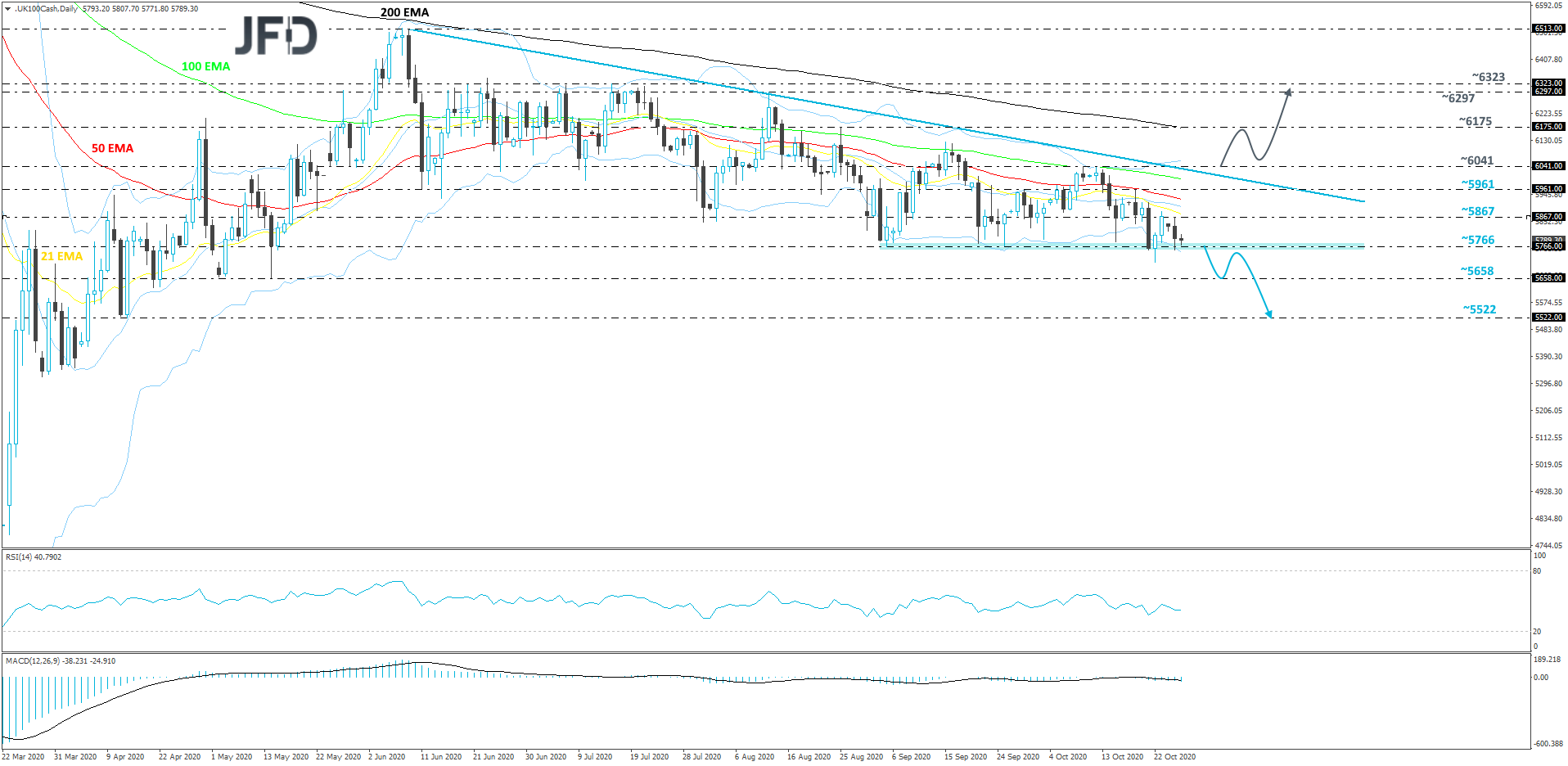
Despite still trading below a medium-term downside resistance line drawn from the high of June 9th, the FTSE 100 index continues to balance slightly above the 5766 hurdle, which has been acting as a good support area from around the beginning of September. Although the medium-term trend is to the downside, we would prefer to wait for a strong break below that support hurdle first, before examining further declines.
A strong drop below the 5766 hurdle may send the index to the 5658 area, marked near the lowest point of May, which could temporarily provide a hold-up. If so, the price might rebound back up a bit. That said, if it struggles to get back above the previously-discussed 5766 zone, that may lead to another slide. If this time the bears are able to overcome 5658 territory, the next potential target could be at 5522, marked by the lows of April 15th and 16th.
On the other hand, if the price gets a boost, breaks the aforementioned downside line and then climbs above the 6041 barrier, marked by the highs of October 9th and 12th, that would confirm a forthcoming higher high, possibly clearing the path to the 6175 hurdle. That hurdle marks the high of August 25th, which also coincides with 200-day EMA. The index might stall there temporarily, however, a further uprise could bring FTSE 100 to the 6297 and 6323 levels, marked by the highest points of August and July respectively.
AUD-Traders Await Australia’s CPIs for Q3
The Aussie was among the main gainers against the US dollar, with its traders awaiting Australia’s CPIs for Q3, due out tonight, during the Asian session Wednesday. Expectations are for the headline CPI rate to have rebounded to +0.7% yoy from -0.3%, and for the trimmed mean one to have ticked down to +1.1% yoy from +1.2%. The weighted mean CPI rate is forecast to have remained unchanged at +1.3% yoy.
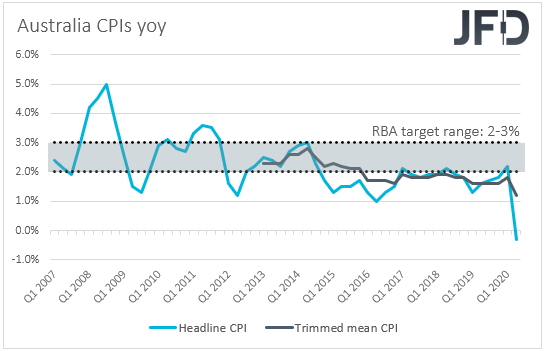
At its latest gathering, the RBA kept its monetary policy settings unchanged, disappointing those looking for further easing after Deputy Governor Guy Debelle flagged the prospect. Having said that though, a couple of weeks ago RBA Governor Philip Lowe said that more stimulus is possible, with the options including bond buying and a small rate cut. On top of that, the minutes of the latest RBA gathering revealed that officials discussed cutting rates and buying longer-dated debt, which suggests that other members, besides Lowe and Debelle, share the same view. Thus, even if the CPIs improve somewhat, the chances for further action at the next gathering are likely to remain high. According to the ASX 30-day interbank cash rate futures yield curve, there is a 76% probability for interest rates to be cut to zero. Market chatter suggests that rates could be cut to 0.10%, a move that is more than fully priced in.
AUD/USD – Technical Outlook
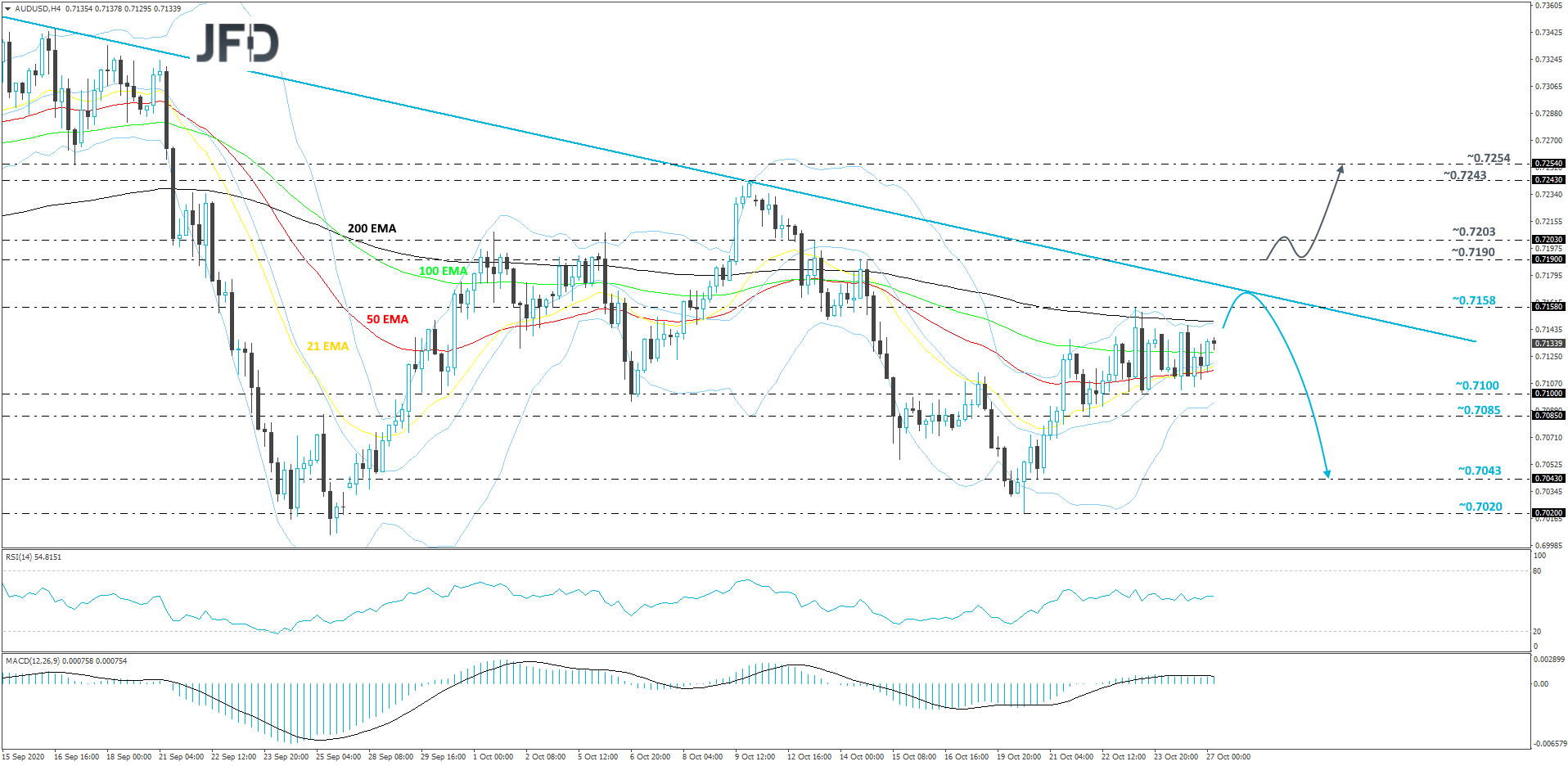
Overall, AUD/USD continues to trade below a short-term downside resistance line drawn from the high of September 1st. Although the pair is seen moving higher from around mid-October, as long as that downside line stays intact, this move higher might be seen as a temporary correction before another leg of selling. We will take a cautiously-bearish approach for now.
A small push north could bring the rate to the 0.7158 hurdle, marked by the high of last week, or to the aforementioned downside line. If that line does provide a good hold-up, this may result in AUD/USD drifting south, possibly even back to the 0.7100 zone, marked near the low of October 23rd. That said, if the slide doesn’t stop there, the next possible support area might be at 0.7085, or at 0.7043, which is an intraday swing low of October 20th.
On the other hand, if the previously-discussed downside line breaks and the rate rises above the 0.7190 barrier, marked by the high of October 14th, that may increase the pair’s chances of moving further north. AUD/USD might then drift to the 0.7203 hurdle, or to the 0.7243 area, marked by the current highest point of October. Slightly above it lies another potential resistance level, which could get tested and that’s at 0.7254, marked by the inside swing low of September 17th.
As for Today’s Events
Tuesday’s calendar is light. We only get the US durable goods orders for September, and the API (American Petroleum Institute) report on crude oil inventories for last week. With regards to durable goods, headline orders are expected to have increased at the same pace as in August, which is +0.5% mom, while the core rate is anticipated to have declined to +0.4% mom from +0.6%. As far as the API report is concerned, as it is always the case, no forecast is available.
The content we produce does not constitute investment advice or investment recommendation (should not be considered as such) and does not in any way constitute an invitation to acquire any financial instrument or product. The Group of Companies of JFD, its affiliates, agents, directors, officers or employees are not liable for any damages that may be caused by individual comments or statements by JFD analysts and assumes no liability with respect to the completeness and correctness of the content presented. The investor is solely responsible for the risk of his investment decisions. Accordingly, you should seek, if you consider appropriate, relevant independent professional advice on the investment considered. The analyses and comments presented do not include any consideration of your personal investment objectives, financial circumstances or needs. The content has not been prepared in accordance with the legal requirements for financial analyses and must therefore be viewed by the reader as marketing information. JFD prohibits the duplication or publication without explicit approval.
CFDs are complex instruments and come with a high risk of losing money rapidly due to leverage. 84.25% of retail investor accounts lose money when trading CFDs with the Company. You should consider whether you understand how CFDs work and whether you can afford to take the high risk of losing your money. Please read the full Risk Disclosure.
Copyright 2020 JFD Group Ltd.