


We have a relatively busy week ahead of us, with the US elections on Tuesday taking the center stage. According to opinion polls, Joe Biden is leading incumbent President Trump by nearly 10 percentage points, but the contest is much tighter in battleground states that could decide the outcome. We also have three major central banks deciding on interest rates and those are the RBA, the BoE and the FOMC.
Monday is a relatively light day. We only get the final manufacturing PMIs for October, from the Eurozone, the UK and the US, as well as the US ISM manufacturing index for the month. As usual, the final Markit PMIs are forecast to confirm their preliminary estimates, while the ISM index is expected to have increased to 55.8 from 55.4.
On Tuesday, we have the 59th US presidential election, with around 92 million people already casting their ballot. According to opinion polls, Joe Biden is leading incumbent President Trump by nearly 10 percentage points, but the contest is much tighter in battleground states that could decide the outcome.
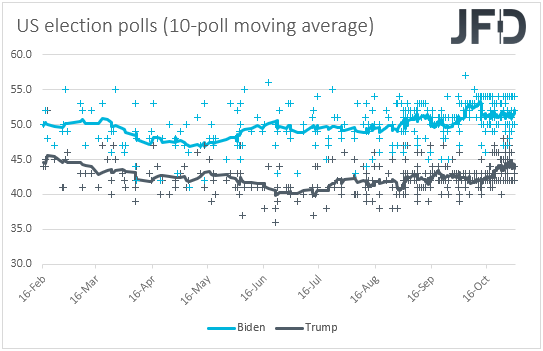
In our view, given that Biden has called for corporate tax increases, his election could prove somewhat negative for US equities, but this may not be true for stocks in the rest of the world, as he may adopt a softer stance on international trade than Trump. In the FX world, a Biden victory may result in a slide in the US dollar, as Biden’s fiscal agenda is looser than Trump’s. The yen and other safe havens could also slide on expectations of a better handling of international trade relations, while the commodity-linked Aussie and Kiwi could strengthen. Now in case we get an extended period of uncertainty, due to either delays in announcing a winner, or even a contested election (Trump said that he may not accept a defeat as mail-in balloting could lead to voter fraud), risk assets around the globe may suffer as investors seek shelter in safe havens until we have a clear outcome.
Having said all that, the market reaction may also depend on which party will gain majority in US Congress. Whoever gets elected, a failure of his party to take full control of the Congress may result in a more modest market reaction, as he may not be able to push through with his agenda. For example, if Biden is elected, but fails to flip the Senate, stock markets may not slide that much, on expectations that Republicans may veto his decision of increasing corporate taxes. Republicans may also oppose his spending agenda, which means a softer slide in the dollar than otherwise.
Earlier in the day, during the Asian morning, we have an RBA monetary policy decision. At its previous meeting, this Bank kept its monetary policy settings unchanged, disappointing those looking for further easing after Deputy Governor Guy Debelle flagged the prospect. Having said that though, a few weeks ago RBA Governor Philip Lowe said that more stimulus is possible, with the options including bond buying and a small rate cut. On top of that, the minutes of the latest RBA gathering revealed that officials discussed cutting rates and buying longer-dated debt, which suggests that other members, besides Lowe and Debelle, share the same view.
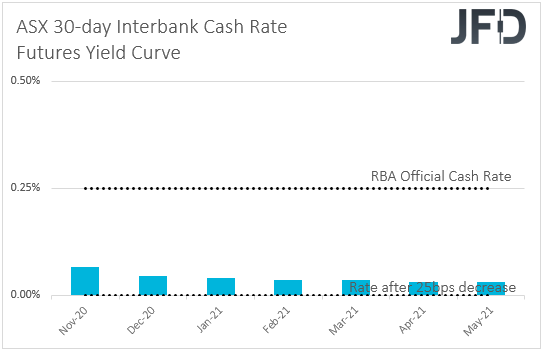
According to the ASX 30-day interbank cash rate futures yield curve, there is a 74% probability for interest rates to be cut to zero. Market chatter suggests that rates could be cut to 0.10%, a move that is more than fully priced in. Thus, a rate cut by itself is unlikely to prove a major market mover. We believe that investors will focus on whether officials remain willing to do more in order to support their economy. If so, the Aussie is likely to come under selling interest. The opposite may be true if policymakers signal that this was a one-and-done move.
On Wednesday, Asian trading, New Zealand’s employment report and Australia’s retail sales, both for Q3, are coming out. New Zealand’s unemployment rate is forecast to have risen to 5.4% from 4.0%, while the net change in employment is expected to show that the economy has lost 0.8% jobs after losing 0.4% in Q2. The labor cost index is expected to have slowed to +1.5% yoy from +1.8%. Australia’s retail sales are expected to have rebounded 6.0% qoq after falling 3.4%.
Later in the day, we have the final services and composite Markit PMIs from the Eurozone, the UK and the US, but as it is the case most of the times, they are expected to confirm their initial prints. The US ISM non-manufacturing index is also due to be released and the forecast points to a small decline, to 57.5 from 57.8.
On Thursday, we have two more central banks deciding on monetary policy and those are the BoE and the FOMC.
Getting the ball rolling with the BoE, at their latest gathering, policymakers of this Bank noted that they are exploring how a negative bank rate could be implemented effectively, something that increased speculation over the adoption of sub-zero rates at one of the Bank’s upcoming gatherings. That said, Deputy Governor Dave Ramsden recently said that he and his colleagues are not about to use negative interest rates immediately, which combined with the relative improvement in the nation’s CPIs may allow BoE officials to hold their hands off the cut button at this gathering. There are however expectations that they will increase their QE program by GBP 100bn.
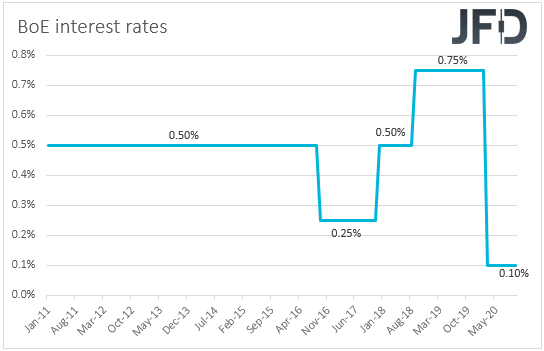
As for the pound, given that such a move is already expected, we don’t believe that it would prove determinant with regards to the currency’s forthcoming direction. We believe that the pound is likely to stay mostly linked to developments surrounding the Brexit landscape. Negotiations over a post-Brexit trade accord between the UK and the EU continued last week, with EU chief negotiator Michel Barnier saying that the two sides are working hard to reach consensus. With all that in mind, anything suggesting that a deal could be found in the next few weeks may prove supportive for the pound, while signs that the differences-gap is not narrowing may result in weakness in the currency.
Now passing the ball to the FOMC, at its most recent meeting, the Committee kept its policy unchanged, but changed its inflation language noting that they “will aim to achieve inflation moderately above 2% for some time so that inflation averages 2% over time”. With regards to the new dot plot, it showed that interest rates are likely to stay at present levels at least through 2023. That said, looking at the details, we see that one member was in favor of a hike in 2022, and four saw rates higher in 2023. Combined with the inflation forecast of 2023, which is at 2%, this shows that some members may not be willing to tolerate inflation above target for long as pointed in the decision statement.
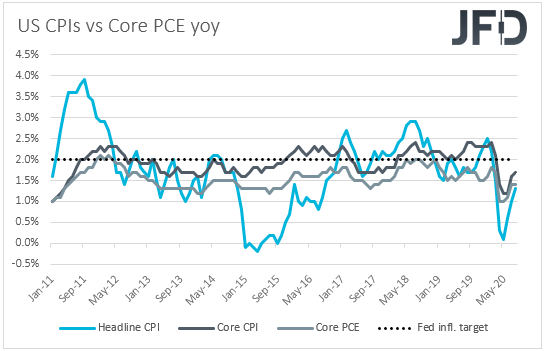
With that in mind, and also taking into account that the US economy continues to relatively improve, despite the spike in coronavirus infections, we believe that policymakers can afford staying sidelined at this gathering. Thus, investors may scan the statement for clues and hints as to how officials are likely to proceed in the months to come. If officials hint that there are high chances for further easing at the December gathering, the US dollar is likely to slid, while it could gain somewhat in the absence of such wording. In any case, we believe that its broader path will still be affected by the election outcome, and any post-FOMC reaction will just be a noise within the perhaps already decided trend.
Finally, on Friday, the main events are likely to be the US and Canadian employment reports for October.
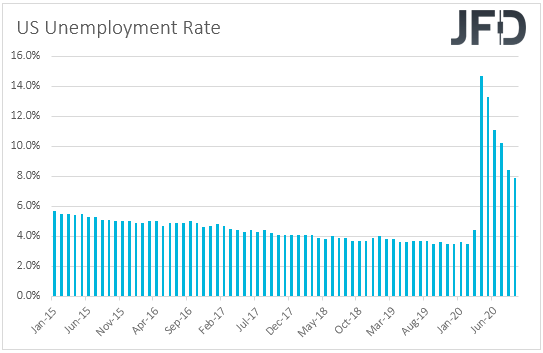
Kicking off with the US data, nonfarm payrolls are expected to have increased by 600k, less than September’s 661k, but still a very good number, consistent with further improvement in the labor market. The unemployment rate is forecast to have declined to 7.6% from 7.9%, while average hourly earnings are anticipated to have slowed somewhat, to +4.6% yoy from +4.7%. In our view, a decent report may increase the chances for Fed officials standing pat at the December meeting as well, as it would signal that the already-adopted stimulative measures are having the desired effect on the economy.
As for Canada’s report, the unemployment rate is expected to have held steady at 9.0%, while the net change in employment is forecast to reveal a 7.5k job loss, after the 378.2k gain in September.
Disclaimer:
The content we produce does not constitute investment advice or investment recommendation (should not be considered as such) and does not in any way constitute an invitation to acquire any financial instrument or product. The Group of Companies of JFD, its affiliates, agents, directors, officers or employees are not liable for any damages that may be caused by individual comments or statements by JFD analysts and assumes no liability with respect to the completeness and correctness of the content presented. The investor is solely responsible for the risk of his investment decisions. Accordingly, you should seek, if you consider appropriate, relevant independent professional advice on the investment considered. The analyses and comments presented do not include any consideration of your personal investment objectives, financial circumstances or needs. The content has not been prepared in accordance with the legal requirements for financial analyses and must therefore be viewed by the reader as marketing information. JFD prohibits the duplication or publication without explicit approval.
CFDs are complex instruments and come with a high risk of losing money rapidly due to leverage. 84.25% of retail investor accounts lose money when trading CFDs with the Company. You should consider whether you understand how CFDs work and whether you can afford to take the high risk of losing your money. Please read the full Risk Disclosure.
Copyright 2020 JFD Group Ltd.