


Following hints from several Fed officials that they could cut rates, as well as Friday’s disappointing NFPs, investors are now likely to turn attention to the US CPIs, as they try to figure out when the Fed may consider to start acting. The UK and Australian job reports will also be released. However, with regards to the UK, we expect investors to stay more focused on the political landscape and especially, on headlines pointing to who could be the nation’s new PM. Australia’s employment numbers are likely to attract more attention, as they could prove determinant with regards to the RBA’s future course of action. We also have an SNB meeting, but we don’t expect any change in monetary policy.
On Monday, markets in Australia will be closed in celebration of the Queen’s Birthday. Switzerland’s, Norway’s and Germany’s bourses will also stay closed due to the Whit Monday.
We get data from the UK, Canada and the US. Kicking off with the UK, industrial and manufacturing production data for April are due to be released, as well as the monthly GDP and the trade balance for the month. Both industrial and manufacturing productions are expected to have slid 0.7% and 1.0%, after rising 0.7% and 0.9% in March, something that would drive the yoy rates down to +1.0% and +2.2%, from +1.3% and +2.6% respectively. This is supported by the manufacturing PMI for the month, which slid to 53.1 from 55.1. No forecast is currently available for the monthly GDP, while the nation’s trade deficit is expected to have narrowed somewhat, to GBP 12.96bn from GBP 13.65bn.
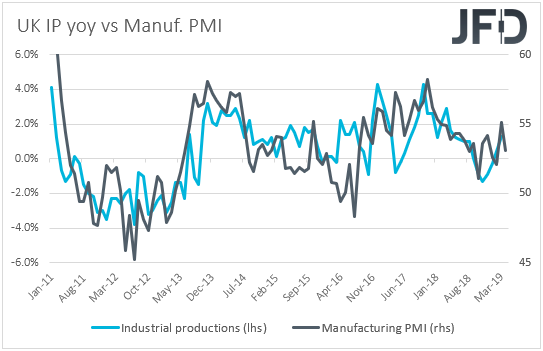
Given that we already got the PMIs for May, we believe that aforementioned April data are unlikely to prove major market movers. The uncertainty surrounding the UK’s future relationship with the EU appears to be leaving its marks on the economy with the modest expansion among services firms in May barely offsetting the weakness in the manufacturing and construction sectors. According to IHS Markit economist Chris Williamson, the PMIs suggest that the economy remained close to stagnation during the month.
We believe that GBP-traders will stay more focused on the political landscape. On Friday, Theresa May officially stepped down as leader of the Conservative Party, triggering a contest for her replacement. She will keep her position as Prime Minister until her successor is found, and thus market participants will keep their gaze locked on developments pointing to who that person might be. Up until now, the favorite is Boris Johnson, a hardline Brexiteer who wants Britain out of the UK by the end of October, with or without a deal.
Later in the day, the US JOLTs job openings for April are coming out, while from Canada, we get housing starts and building permits for May and April respectively. The US JOLTs are expected to have declined somewhat, while both Canada’s housing starts and building permits are expected to have slowed.
Monday was also the day that US was set to officially impose a 5% tariff rate on Mexican goods imported to the US. However, on Friday, US President Trump said that the US has reached a signed agreement over immigration with Mexico and thus, tariffs against Mexico are indefinitely suspended.
On Tuesday, during the Asian morning, we have Australia’s NAB business survey for May. Although this is not a major market mover, given the RBA’s emphasis on the labor market, we will take a close look to the Labor costs sub index.
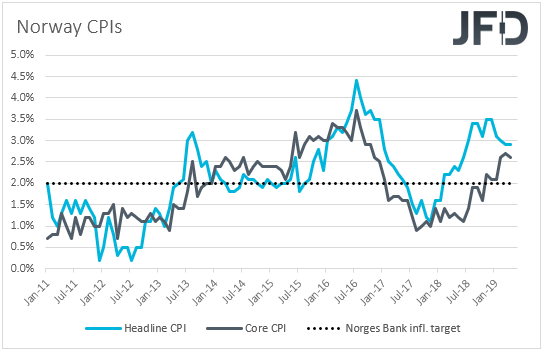
Later, during the European day, Norway’s inflation numbers for May are coming out and both the headline and core rates are expected to have held steady at +2.9% yoy and +2.6% yoy respectively. At its latest meeting, the Norges Bank maintained the view that its next hike would most likely come in “the course of the next half-year”, also noting that this could happen in June. With both rates well above the Bank’s objective of +2.0%, as well as above its own projections for the month, we doubt that policymakers will change their minds when they meet next week. We believe that a big disappointment is needed for officials to start worrying whether a June hike would be appropriate or not.
From the UK, we get the employment report for April. The unemployment rate is expected to have remained at its 45-year low of 3.8%, while average earnings including bonuses are expected to have slowed to +3.0% yoy from +3.2%. The excluding bonuses rate is anticipated to have declined as well, to +3.1% yoy from + 3.3%. According to the IHS Markit/KPMG & REC Report on Jobs for the month, the rate of starting salary inflation was the softest seen in two years, but temp wages rose at the strongest rate since January. Thus, it’s hard to say to which direction the risks surrounding the earnings forecasts are tilted.
In the US, the PPIs for May are due to be released, just a day ahead of the CPIs for the same month. Both the headline and core rates are expected to have declined to +2.0% yoy and +2.3% yoy, from +2.2% and +2.4% respectively. This could raise speculation that the CPIs, due out on Wednesday may follow suit.
On Wednesday, during the Asian morning, China’s CPI and PPI for May are due to be released. The CPI is anticipated to have accelerated to +2.7% yoy from +2.5%, but the PPI rate is forecast to have declined to +0.6% from +0.9%.
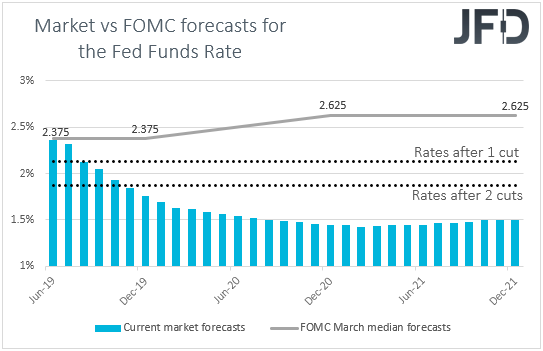
We get CPI data for May from the US as well. The headline rate is forecast to have ticked down to +1.9% yoy from +2.0%, while the core one is anticipated to have held steady at +2.1% yoy. That said, bearing in mind that both the headline and core PPI rates for the month are expected to have slid, we see the risks surrounding the core rate’s forecast as tilted to the downside. The latest escalation in trade tensions led several Fed officials to express willingness to reduce interest rates in order to avert a steep economic downturn. Thus, following Friday’s disappointing NFPs, slowing CPIs may prompt investors to add to their already elevated bets with regards to lower US rates by year end. According to the Fed funds futures, market participants are now fully pricing in a 25bps rate decrease for August, while the probability for something like that happening as early as in July is 66%. Another cut is more than factored in for November.
On Thursday, during the Asian morning, Australia’s employment report for May is due to be released. The unemployment rate is expected to have declined to 5.1% from 5.2%, but the net change in employment is anticipated to show that the economy gained 17.5k jobs, less than April’s 28.4k. When they last met, RBA policymakers decided to cut rates by 25bps, to +1.25% from +1.50%, and noted that they will continue monitoring developments in the labor market and adjust policy accordingly in order to support growth and the achievement of the inflation target over time.
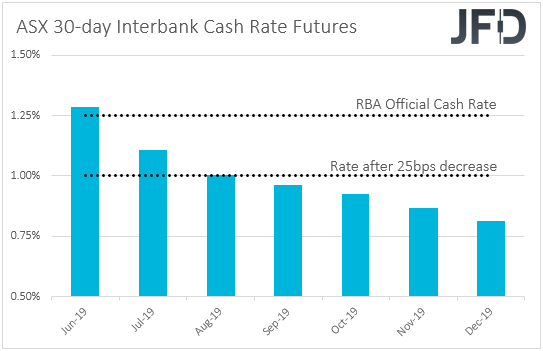
Thus, investors may pay extra attention to this data set as they try to figure out whether and when the RBA will likely hit the cut button again. According to the ASX 30-day interbank cash rate futures implied yield curve, another rate cut is nearly fully priced in for August. In our view, if the employment numbers come close to their forecasts, we doubt that this would change. We believe that for investors to push back that timing, a tick down in the unemployment rate should be accompanied by a stellar gain in jobs. On the other hand, a disappointment could have the opposite effect, bringing expectations over a cut forward to July.
Later, during the European day, the SNB decides on interest rates. At their latest gathering, Swiss policymakers kept interest rates unchanged at -0.75%, sticking to their guns that they will remain active in the foreign exchange market as necessary, and noting that the franc is still highly valued. They also revised further down their inflation projections. They expected the Swiss CPI rate to be at +1.5% yoy in Q4 2021, well below their 2% target, and this is conditional upon interest rates staying at current levels for the whole forecast horizon.
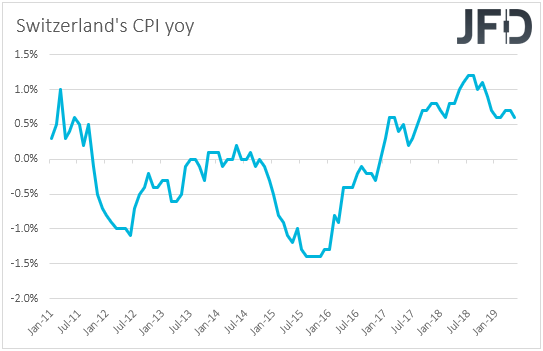
Latest data showed that the Swiss economy accelerated to +0.6% qoq in Q1 from +0.3% in the last three months of 2018, but the CPI slowed further, to +0.6% yoy from +0.7%. Thus, with inflation well below the Bank’s objective, and the Swiss franc strengthening notable lately due to the increased tensions between China and the US, we believe that officials will keep their stance unchanged. On May 10th, SNB Chairman Thomas Jordan said that the Bank needs to stick to its current policy framework of negative rates and foreign exchange interventions to protect the country’s economy, which adds more credence to our view.
With regards to the European data, we get Germany’s final CPI for May and Eurozone’s industrial production for April. As usual, the final German prints are expected to confirm their preliminary estimates, while Eurozone’s IP is anticipated to have declined for the third consecutive month, and at a faster pace than in March (-0.4% mom from -0.3%).
Finally, on Friday, Asian time, China’s fixed asset investment, industrial production and retail sales, all for May are scheduled to be released. Fixed asset investment is anticipated to have grown +6.1% yoy, the same pace as in April, while both IP and retail sales are expected to have accelerated, to +5.5% yoy and +8.2% yoy, from +5.4% and 7.2% respectively.
During the European morning, we have Sweden’s CPIs for May. The CPI rate is expected to have ticked down to +2.0% yoy from +2.1%, while the CPIF one is forecast to have remained unchanged at +2.0% yoy. That said, as we noted several times in the past, we prefer to pay more attention to the core CPIF metric, which excludes energy. At their latest gathering, Riksbank policymakers kept their key repo rate unchanged at -0.25%, but they decided to push back the timing of when they expect interest rates to rise further. While they have previously noted that the next rate increase will be “during the second half of the year”, this time, Swedish policymakers said that “The repo rate is expected to be raised again towards the end of the year or at the beginning of next year”.
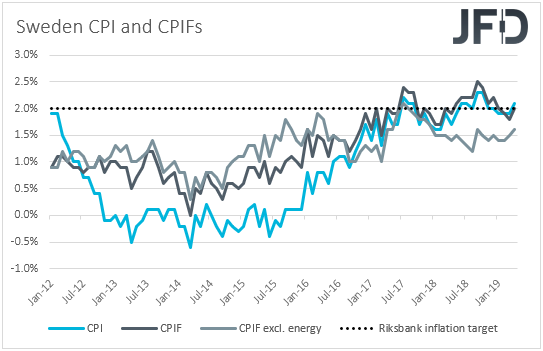
In April, the core CPIF rate ticked up to +1.6% yoy from +1.5%, while GDP data showed that the Swedish economy slowed less than expected in the first three months of 2019, keeping the door open for a hike by year end. However, the ECB’s decision to push back the timing of when it expects rates in Eurozone to start rising may have put a Riksbank hike this year into doubt, and a potential slowdown in Swedish inflation could start raising speculation that the Bank might consider the start of next year as a better option for acting. In any case, we prefer to wait for the upcoming Riksbank meeting in order to get clear signals of whether and when Swedish policymakers could bring interest rates up to zero.
Later in the day, US retail sales and industrial production for May are coming out. Headline sales are expected to have rebounded 0.6% mom after sliding 0.2%, while the core rate is anticipated to have risen to +0.4% mom from +0.1%. Industrial production is also forecast to have rebounded, +0.2% mom from -0.5%. The preliminary UoM consumer sentiment index for June is also due to be released, alongside the 1-year and 5-year UoM inflation expectations.
Disclaimer:
The content we produce does not constitute investment advice or investment recommendation (should not be considered as such) and does not in any way constitute an invitation to acquire any financial instrument or product. The Group of Companies of JFD, its affiliates, agents, directors, officers or employees are not liable for any damages that may be caused by individual comments or statements by JFD analysts and assumes no liability with respect to the completeness and correctness of the content presented. The investor is solely responsible for the risk of his investment decisions. Accordingly, you should seek, if you consider appropriate, relevant independent professional advice on the investment considered. The analyses and comments presented do not include any consideration of your personal investment objectives, financial circumstances or needs. The content has not been prepared in accordance with the legal requirements for financial analyses and must therefore be viewed by the reader as marketing information. JFD prohibits the duplication or publication without explicit approval.
70% of the retail investor accounts lose money when trading CFDs with this provider. You should consider whether you can afford to take the high risk of losing your money. Please read the full Risk Disclosure.
Copyright 2019 JFD Group Ltd