


We enter a very busy week today, with the Russia-Ukraine crisis staying on the front page of investors’ agendas. However, we also have two central banks deciding on monetary policy this week, the RBA and the BoC, as well as a testimony by Fed Chair Powell before Congress. On the data front, Canada and Australia release their GDP data for Q4, while Eurozone publishes its preliminary inflation numbers for February. Last but not least, we have the US employment report for February, which alongside Powell’s testimony could well shape market expectations over the Fed’s future course of action.
On Monday, we already got some economic releases, like Japan’s industrial production and retail sales, both for January, as well as Australia’s ANZ business confidence index for February and retail sales for January. Japan’s industrial production deteriorated 1.3% mom after shrinking 1.0% in December, but retail sales accelerated to +1.6% yoy from +1.2%. In Australia, the ANZ index fell further into the negative territory in February, while the nation’s retail sales rebounded 1.8% mom, after tumbling 4.4% in December.
As for the rest of the day, we don’t have any major market-moving indicator on the agenda, but that’s far from suggesting a quiet trading day. Investors seem more worried about geopolitics and Russia’s invasion in Ukraine, rather than the economic calendar. The attack began on Thursday, resulting in a sell-off in risky assets and a rally in safe havens. However, later in the same day, investors appeared willing to add back some risk to their portfolios after the US and other Western nations decided to redouble their efforts to crimp Russia’s ability to do business, with sanctions including freezing bank assets and cutting off state-owned enterprises. This may have sparked some hopes that the sanctions could force Russia to back down, without any other nation getting militarily involved.
However, remember that on Friday, we said that it was too early to assume something like that. Indeed, the situation escalated further over the weekend, with the West announcing more and stricter sanctions, including blocking some Russian banks from the SWIFT international payment system, while Russian President Putin responded by putting nuclear-armed forces on high alert. This resulted in markets opening this week in a risk-averse mode. Yes, Ukrainian and Russian officials eventually agreed to meet for talks on the Belarusian border with Ukraine, but unless we get concrete signs over a potential resolution, we are reluctant to call for a stronger rebound. As long as the situation continues to worsen, we will consider the path of least resistance for equities and other risk-linked assets to be to the downside.
On Tuesday, besides the conflict in Ukraine, traders of the risk-linked Aussie may pay attention to the RBA decision as well. At the prior meeting, officials decided to keep interest rates untouched at 0.10% and announced the end of their QE purchases, as was broadly expected. However, in the statement accompanying the decision, it was noted that, while inflation has picked up, it is too early to conclude that it is sustainably within that target band, and that they will not increase the cash rate until that happens.
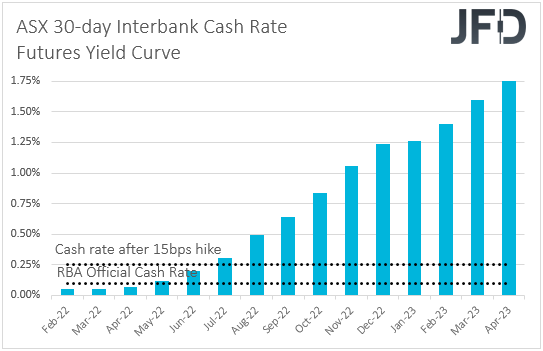
However, market participants remained convinced that the Bank will hike to 0.25% around June or July, while they see the OCR reaching 1.25% by the end of the year. Officials are widely expected to stand pat at this meeting as well, but it will be interesting to see whether they will sound a bit more hawkish due to the better-than-expected employment report and retail sales for January, which were released in the aftermath of the last gathering. This could support somewhat the Aussie, while the opposite may be true if we get a reiteration of the same cautious message. After all, we did not get any CPI data yet, and perhaps officials prefer to see where inflation is headed before they decide to change their language.
In any case, whatever the reaction to the RBA decision is, everything could change very soon, and this is because the Aussie is a risk-linked currency, and thus, any changes in the broader market sentiment due to the ongoing geopolitical tensions could well leave their marks on this currency.
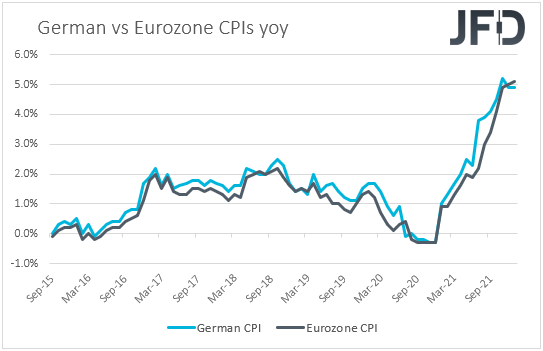
Later in the day, Germany’s preliminary inflation data for February are coming out, with both the CPI and HICP rates expected to have drifted further north. Specifically, the CPI rate is forecast to inch up to +5.1% yoy from +4.9%, while the HICP one to have risen to +5.4% yoy from +5.1%.
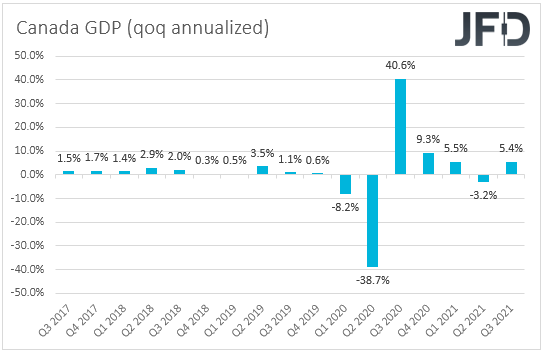
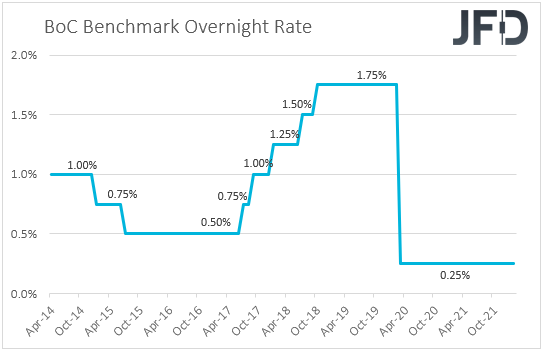
From Canada, we have the GDP numbers for Q4 and December. The annualized qoq rate is expected to have risen to +6.2% from +5.4%, but the monthly one for December to have slid to +0.1% from +0.6%. At its latest gathering, the BoC decided to keep interest rates untouched at 0.25%, at a time when the financial community was expecting a hike. In the statement accompanying the decision, it was noted that the Council expects rates to increase, and that the overall economic slack is now absorbed, which means that they are more likely to hit the hike button at this week’s gathering. Therefore, with that in mind and also taking into account the upside surprise in the CPI numbers for January, we doubt that a slowdown in economic activity for the month of December will be enough to prevent officials from pushing the hike button on Wednesday. After all, for the quarter as a whole, the economy is forecast to have improved.
Elsewhere, we have the final Markit manufacturing PMIs for February from the Eurozone, the UK, and the US, and as it is usually the case, they are expected to confirm their preliminary estimates. From the US, we also get the ISM manufacturing index for the month, which is forecast to have risen fractionally, to 58.0 from 57.6.
On Wednesday, the central bank torch will be passed to the BoC, and as we already noted, we see a strong chance for a rate hike to +0.50% from +0.25%. However, this is the market consensus as well, and thus, we don’t expect a quarter-point hike by itself to move much the Loonie. If indeed, the hike is delivered, CAD-traders may quickly turn their attention to the accompanying statement for clues and hints as to how fast officials are willing to proceed with subsequent rate hikes. If they appear willing to proceed with a relatively steep rate path in order to curb accelerating inflation, the Loonie is likely to gain.
Besides the BoC decision, traders of the Canadian dollar may also pay attention to the OPEC+ decision. Despite the ongoing conflict between Russia and Ukraine pushing oil prices above USD 100 per barrel, the cartel and its allies are not expected to accelerate their plan of gradually scaling back their supply cuts. This may allow oil prices to rebound and continue trending north, a factor that could also prove supportive for the Canadian dollar. Let’s not forget that Canada is the fifth largest oil producing nation in the whole world, while it holds the sixth place in terms of exports.
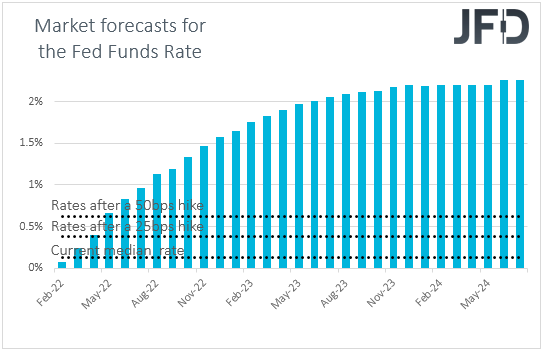
In the US, Fed Chair Jerome Powell will testify on monetary policy before the House Financial Services Committee on Wednesday, and again before the Senate Banking Committee on Thursday. At the latest FOMC gathering, Powell sounded more hawkish than expected, cementing expectations over a rate hike in March, and encouraging participants to price in around six quarter-point increases by the end of this year. Remember that the December “dot plot” pointed to only three. That said, some may have been scratching their heads as to whether the crisis in Eastern Europe will weigh against an aggressive attempt to curb inflation. In our view, that’s not the case. Actually, it might be the opposite. The crisis is pushing oil prices higher, which could result in further acceleration in inflation around the globe. Something like that could force policymakers to act more aggressively than previously thought. So, with that logic in mind, we expect Powell to maintain the view that a March hike is on the table, and that more are in the works for the months to come. This is likely to fuel further the dollar’s latest advance.
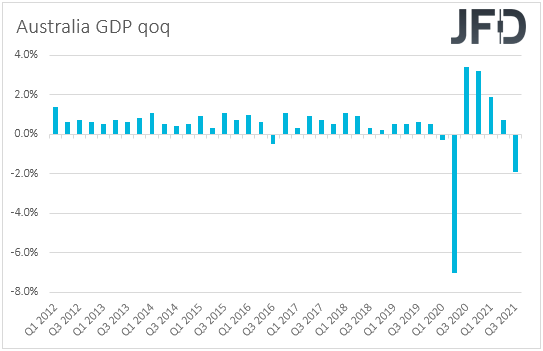
As for Wednesday’s economic indicators, during the Asian session, we have Australia’s GDP for Q4, which is expected to have shrunk at a steeper rate than in Q3, something that may drive the yoy rate down to +3.0% from +3.9%. Conditional upon the RBA sounding cautious again on Tuesday, this is likely to add some credence to officials’ view and may eventually prompt market participants to scale back their expectations with regards to future interest rate increases.
During the EU session, Eurozone’s preliminary CPIs for February are coming out, with the headline rate expected to have risen to +5.3% yoy from +5.1%, and the core one to jump to +2.7% yoy from +2.4%. Remember that at the press conference following the latest ECB decision, President Lagarde said that inflation remained elevated for longer than previously thought, and that the economy was hurt less than anticipated by the pandemic. She also added that the March and June meetings would be essential for evaluating their guidance, which means that they could, after all, decide to lift rates this year. Although she pushed against expectations over a summer rate increase in the aftermath of that gathering, accelerating inflation could encourage some participants to add back to such bets, which could prove supportive for the euro. However, we don’t expect any positive reaction in the common currency to last for long in case the Russia-Ukraine crisis continues. Further escalation could quickly bring it back under selling interest.
On Thursday, during the Asian session, China’s Caixin services PMI for February is coming out, but no forecast is available. We get more February PMIs later in the day, but those are the final Markit services and composite indices from the Eurozone, the UK, and the US, which are, once again, expected to confirm their preliminary estimates. Investors may pay more attention to the US’s ISM non-manufacturing index for February, which is expected to have ticked up to 61.0 from 59.9. As we already noted, we also have Fed Chair Powell’s testimony before the Senate Banking Committee.
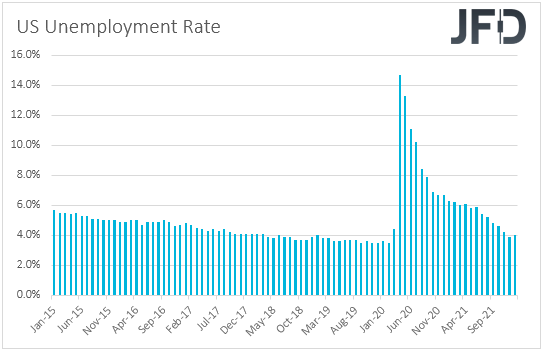
Finally, on Friday, the main item on the economic agenda is the US employment report for February. Nonfarm payrolls are forecast to have slowed somewhat, to 450k from 467k in January, but the unemployment rate is expected to have ticked down to 3.9% from 4.0%. Average hourly earnings are expected to have accelerated somewhat to +5.8% yoy form 5.7%, which adds to the case of further acceleration in inflation in the months to come. In our view, despite a small slowdown in NFPs, the slide in the unemployment rate and the acceleration in wages are likely to keep expectations over a March hike and multiple more thereafter, elevated.
Something like that is likely to keep the US dollar supported, while it may add pressure to equities, even if the crisis in Ukraine ends beforehand. Yes, we are very likely to experience a relief bounce in case we have a resolution, but expectations over aggressive tightening means higher borrowing costs for companies sooner, as well as lower present values, especially for high-growth firms, which are valued based on discounted expected cash flows for the months and years ahead. Therefore, we believe that for the near-term, the risks for equities are tilted to the downside.
As for the rest of Friday’s data, we get Eurozone’s retail sales for January and Canada’s Ivey PMI for February. Eurozone sales are expected to have rebounded 1.5% mom after tumbling 3.0%, while no forecast is available for Canada’s Ivey index.
The content we produce does not constitute investment advice or investment recommendation (should not be considered as such) and does not in any way constitute an invitation to acquire any financial instrument or product. The Group of Companies of JFD, its affiliates, agents, directors, officers or employees are not liable for any damages that may be caused by individual comments or statements by JFD analysts and assumes no liability with respect to the completeness and correctness of the content presented. The investor is solely responsible for the risk of his investment decisions. Accordingly, you should seek, if you consider appropriate, relevant independent professional advice on the investment considered. The analyses and comments presented do not include any consideration of your personal investment objectives, financial circumstances or needs. The content has not been prepared in accordance with the legal requirements for financial analyses and must therefore be viewed by the reader as marketing information. JFD prohibits the duplication or publication without explicit approval.
CFDs are complex instruments and come with a high risk of losing money rapidly due to leverage. 73.82% of retail investor accounts lose money when trading CFDs with the Company. You should consider whether you understand how CFDs work and whether you can afford to take the high risk of losing your money. Please read the full Risk Disclosure.
Copyright 2022 JFD Group Ltd.