

The Fed's Dilemma: What to Expect from the May FOMC Meeting
Between weak sentiment data and solid economic figures, interest rate cuts are unlikely until summer at the earliest.
While "hard" economic data (such as the labor market and consumer spending) remain robust, "soft" data (e.g., surveys of consumer and business sentiment) are declining significantly. Combined with the uncertainties surrounding Donald Trump's new punitive tariffs, the U.S. Federal Reserve (Fed) faces difficult decisions at its May meeting – it will likely leave the key interest rate unchanged for the time being.
Trump's Trade Policy Exacerbates Uncertainty
The economic environment has changed significantly since the last Fed meeting. At the beginning of April, former President Trump announced extensive punitive tariffs on key trading partners – a move that unsettled markets worldwide. While it is still unclear how much the tariffs will actually take, economists agree: Even moderate measures could dampen growth and further fuel inflation.
Unlike during the coronavirus pandemic, however, the Fed is unlikely to react quickly with interest rate cuts this time – inflation is currently still too high for that. There is also uncertainty, as many tariffs will not take effect for another 90 days and negotiations between the trading parties are still ongoing.
Soft data collapses – hard data holds up
Official statistics still show little direct impact of the new trade policy. Imports were unusually high in the first quarter – presumably because many companies brought forward their deliveries of goods. But while hard data such as GDP growth still appears stable, consumer and business confidence is declining significantly. The Fed is therefore likely to take a wait-and-see approach for the time being.
Labor market supports Fed strategy – for now
The US labor market has recently shown resilience. The latest jobs report exceeded expectations and will provide the Fed with arguments not to cut interest rates in May. But the central bank faces a difficult task: On the one hand, tariffs are pushing up prices – which argues for a tight monetary policy. On the other hand, slowing growth threatens a weaker labor market – which would actually argue for interest rate cuts.
"We are currently experiencing a kind of stagflation shock," says Don Rissmiller, chief economist at Strategas. "This makes it difficult for the Fed to achieve both goals – stable prices and maximum employment – simultaneously."
Interest rate reversal likely not until July at the earliest
The market currently expects a first interest rate cut in July with a probability of around 56%. For the June meeting, however, the probability has fallen to around 28% – just a few days ago it was at 60%. A total of three interest rate cuts are currently being priced in for 2025 (July, September, and October). Many analysts have pushed back their forecasts following the solid labor market report.
However, the sustainability of this development is questionable. "If the effects of the tariffs become more pronounced, the Fed may have to act more quickly," says Lindsay Rosner of Goldman Sachs Asset Management. Even if inflation remains above the 2% target, a weak labor market could force the Fed to act.
Hard facts count more than sentiment
The Fed is currently placing more emphasis on hard data – numbers that reflect actual economic developments – than on soft sentiment indicators. The latter are considered early warning signals but are less reliable. "The Fed wants solid evidence that the economy is weakening before it intervenes," says Rissmiller. If the situation doesn't deteriorate significantly until the third quarter, the first interest rate cut could not occur until the fall.
Analysts at Goldman Sachs also emphasize that the Fed is unlikely to act until weakness is evident in hard indicators such as the labor market.
Conclusion: The situation remains volatile
Despite the market's view that interest rate cuts are likely soon, uncertainties remain high. The economic effects of Trump's trade policy are not yet foreseeable. If inflation remains stubbornly high, interest rates could even remain unchanged until the end of the year. However, if the trade conflict escalates and a recession occurs, faster and deeper interest rate cuts would be conceivable.
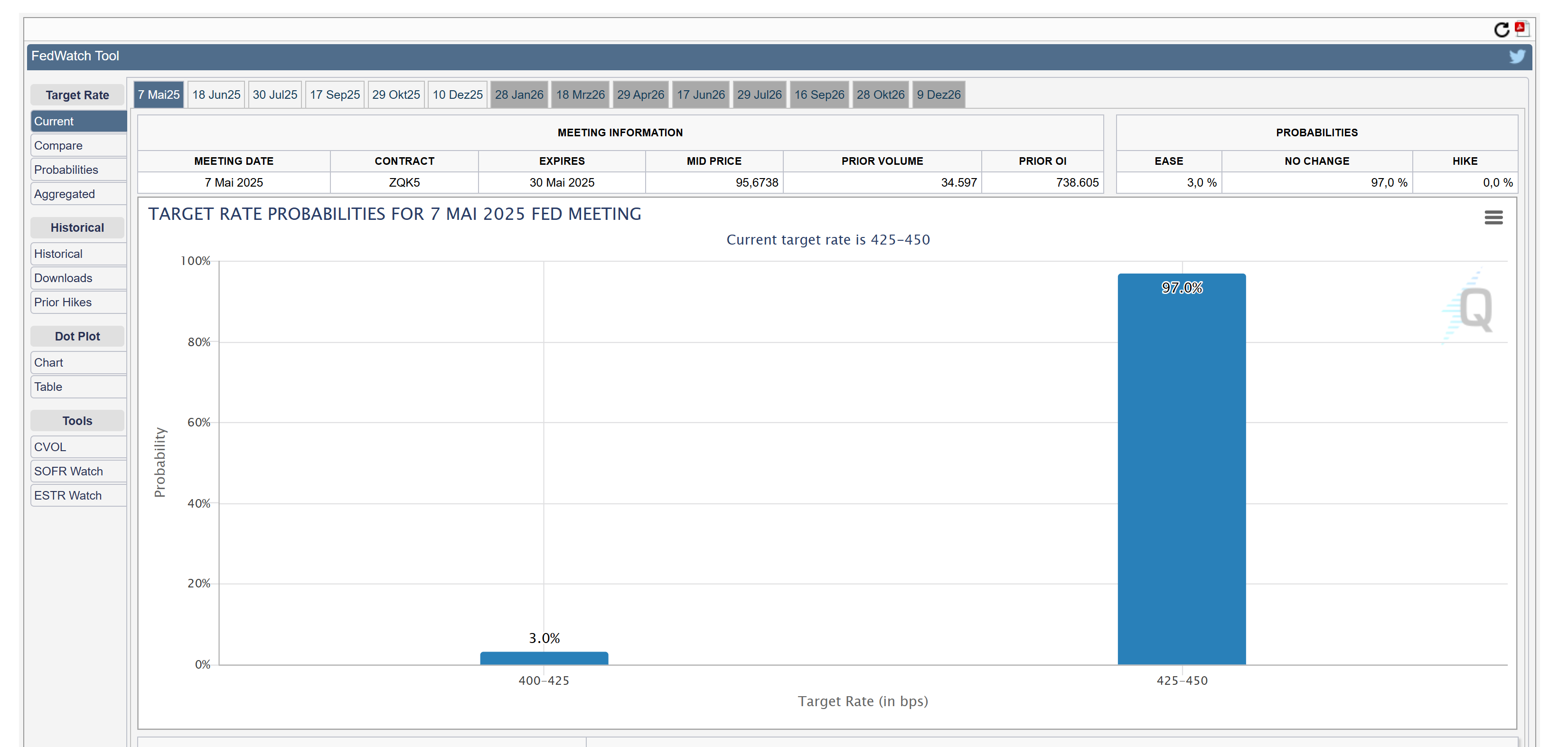
Source: www.cmegroup.com
Disclaimer:
The content we produce does not constitute investment advice or investment recommendation (should not be considered as such) and does not in any way constitute an invitation to acquire any financial instrument or product. The Group of Companies of JFD, its affiliates, agents, directors, officers or employees are not liable for any damages that may be caused by individual comments or statements by JFD analysts and assumes no liability with respect to the completeness and correctness of the content presented. The investor is solely responsible for the risk of his investment decisions. Accordingly, you should seek, if you consider appropriate, relevant independent professional advice on the investment considered. The analyses and comments presented do not include any consideration of your personal investment objectives, financial circumstances or needs. The content has not been prepared in accordance with the legal requirements for financial analyses and must therefore be viewed by the reader as marketing information. JFD prohibits the duplication or publication without explicit approval.
There are risks involved with trading of cash equities. Past performance is not indicative of future results. You should consider whether you can tolerate such losses before trading. Please read the full Risk Disclosure (https://www.jfdbrokers.com/en/legal/risk-disclosure).
Copyright 2024 JFD Group Ltd.