


With no central bank meetings on the agenda, this week appears to be lighter, at least as far as scheduled releases are concerned. With the Riksbank pushing back its hike timing at its latest policy gathering, SEK traders are likely to lock their gaze on Sweden’s inflation data. We get inflation numbers from Canada as well, and expectations are for both the headline and core rates to have increased somewhat. In Australia, the highlight is likely to be the employment report, as investors try to figure out whether, or not, the RBA will cut rates at its upcoming gathering.
Monday appears to be a light day in terms of economic data. The only noteworthy release on the agenda is Norway’s GDP for Q1 and it is already out. The headline qoq rate slid to -0.1% from an upwardly revised +0.6%, while the mainland rate declined to +0.3% qoq from +1.1%.
On Tuesday, during the Asian morning, we get Australia’s NAB Business survey for April. Although this is not a major market mover, given the RBA’s emphasis on employment and wage growth, we will pay attention to the Labour Costs sub-index for signs as to whether wage growth continues to pick up, in line with the Bank’s expectations.
During the European morning, we get inflation data for April from Sweden. Expectations are for both the CPI and CPIF to have ticked up to +2.0% yoy and 1.9% yoy from +1.9% and +1.8% respectively. That said, as we noted several times in the past, we prefer to pay more attention to the core CPIF metric, which excludes energy. At their latest gathering, Riksbank policymakers kept their key repo rate unchanged at -0.25%, but they decided to push back the timing of when they expect interest rates to rise further. While they have previously noted that the next rate increase will be “during the second half of the year”, this time, Swedish policymakers said that “The repo rate is expected to be raised again towards the end of the year or at the beginning of next year”.
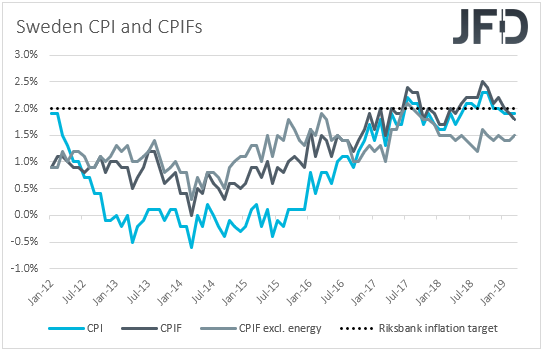
A potential slide in the core CPIF rate, which currently stands at +1.5%, may raise speculation that the Bank will dismiss the “end of the year” part, thereby joining the club of central banks that abandoned their hike-plans for 2019, like the ECB and the Fed. However, we prefer not to rush into conclusions based on this data set. The next Riksbank meeting is scheduled for July 2nd, and up until then we will have the May inflation data in hand in order to examine whether the world’s oldest central bank could alter its forward guidance again.
We get inflation numbers from Germany as well. That said, this data set will be the final estimates for April, which are expected to confirm their preliminary prints. The nation’s ZEW survey for May is also due to be released, while from Eurozone as a whole, we get industrial production for March. Kicking off with the ZEW survey, the current conditions index is expected to have rebounded to 7.5 from 5.5, after seven consecutive declines. The expectations one, after returning into positive territory in April, is expected to have risen somewhat further, to 5.1 from 3.1. Passing the ball to Eurozone’s industrial production for March, it is expected to have declined for the second consecutive month (-0.3% mom from -0.2%), which will drive the yoy rate down to -0.8% from -0.3%.
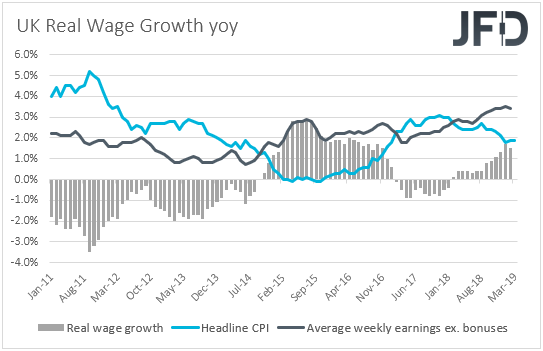
In the UK, the employment report for March is coming out. The unemployment rate is expected to have held steady at its 44-year low of 3.9%, while average weekly earnings, both including and excluding bonuses, are expected to have slowed somewhat, to +3.4% yoy and +3.3% yoy from +3.5% and 3.4% respectively. According to the IHS Markit/KPMG & REC Report on Jobs for the month, the latest increase in starting salaries was the slowest in almost two years, while temporary pay slowed to the lowest since March 2017, supporting the case for a slide in the earnings rates.
On Wednesday, during the Asian morning, Australia’s wage price index for Q1 is due to be released, just a day ahead of the nation’s employment report for April. No forecast is currently available, but bearing in mind that the Labor Costs sub-index of the NAB Business Survey rose 0.6% qoq in March, we see the case for the quarterly rate of the wage price index to be close to that number. Bearing in mind that the qoq rate for Q1 2018 – which will drop out of the yearly calculation – was at +0.5%, this may drive the yoy rate further up. In Q4 2018, the yoy rate of the index rose to 2.3% from 2.1%.
From China, we get industrial production, retail sales and fixed asset investment, all for April. The yoy rate of retail sales is expected to have ticked down to +8.6% from +8.7%, while industrial production us anticipated to see a more severe slowdown, to +6.5% yoy from +8.5%. Fixed asset investment is forecast to have accelerated somewhat, to +6.4% yoy from +6.3%. Following China’s better than expected GDP for Q1, this data set suggests that the economy may have entered Q2 on a softer footing. If this is the case, concerns with regards to the performance of the global economy may increase again, especially in the midst of all this uncertainty surrounding the US-China trade sequel. Although the door towards a deal is not closed yet, last week’s developments and the willingness of President Trump to tax all the remaining Chinese imports may keep investors on guard.
During the European day, the 2nd estimate of Eurozone’s GDP for Q1 is coming out. Expectations are for the release to confirm the 1st estimate and reveal that the Euro-area economy expanded 0.4% qoq from +0.2%. However, bearing in mind that industrial production is expected to have slid again in March, we see a chance for a downside revision. Coming on top of the disappointing Euro-area PMIs for April, something like that could increase somewhat speculation for additional stimulus measures by the ECB, beyond the new round of TLTROs, as well as for another delay in the timing of when interest rates could start rising.
Later in the day, the US retail sales and industrial production, both for April, are due to be released. Both headline and core sales are expected to have slowed to +0.2% mom and +0.7% mom, from +1.2%, while industrial production is expected to have stagnated after sliding 0.1% in March.
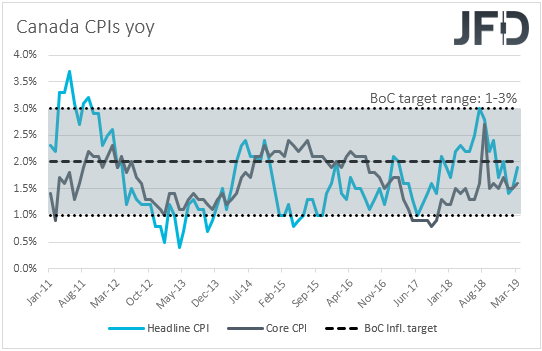
From Canada, we get the CPIs for April. Expectations are for the headline rate to have ticked up to +2.0% yoy from +1.9%, while the core one is anticipated to have risen to +1.8% yoy from +1.6%. Coming on top of the astonishing employment report for the month, which revealed record job gains, accelerating inflation could be encouraging news for BoC policymakers and may prompt them to adopt a more sanguine stance when they meet next, on May 29th. However, we believe that it is too early for them to start thinking about rate increases again. After all, they abandoned their hiking bias just at the previous meeting. We believe that they may prefer to wait for more evidence of improvement before they turn their eyes to the hike button.
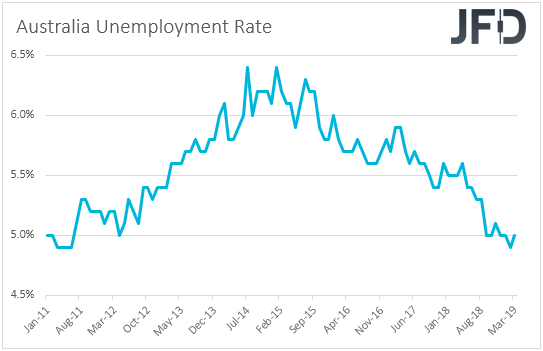
On Thursday, Asian time, Australia’s jobs data for April as scheduled to be released. The forecasts suggest that the unemployment rate held steady at 5.0% and that the employment changed slowed to 15.2k from 25.7k in March. At its latest meeting the RBA decided to keep interest rates unchanged at +1.50%, despite some speculation for a rate cut. According to the ASX 30-day interbank cash rate futures implied yield curve, investors now expect a cut in August. In our view, a slowdown in jobs growth by itself is unlikely to prompt investors to bring that timing forth, to the upcoming meeting in June, especially if Wednesday’s data reveal further pick up in wage growth. We would like to see job losses and/or slowing wages before we start examining whether officials could be tempted to hit the cut button when they meet next.
Later in the day, we get Eurozone’s trade balance for March, while from the US, we have building permits and housing starts for April. The Euro area trade surplus is expected to have increased to EUR +19.9bn from EUR +17.9bn, while both the US building permits and housing starts are expected to have increased after sliding in March.
Finally, on Friday, we only get Eurozone’s final CPIs for April and the preliminary UoM consumer sentiment index for May. As it is usually the case, Eurozone’s final inflation numbers are expected to be the same as the initial estimates, while the UoM index is forecast to have risen to 97.8 from 97.2.
Disclaimer:
The content we produce does not constitute investment advice or investment recommendation (should not be considered as such) and does not in any way constitute an invitation to acquire any financial instrument or product. The Group of Companies of JFD, its affiliates, agents, directors, officers or employees are not liable for any damages that may be caused by individual comments or statements by JFD analysts and assumes no liability with respect to the completeness and correctness of the content presented. The investor is solely responsible for the risk of his investment decisions. Accordingly, you should seek, if you consider appropriate, relevant independent professional advice on the investment considered. The analyses and comments presented do not include any consideration of your personal investment objectives, financial circumstances or needs. The content has not been prepared in accordance with the legal requirements for financial analyses and must therefore be viewed by the reader as marketing information. JFD prohibits the duplication or publication without explicit approval.
70% of the retail investor accounts lose money when trading CFDs with this provider. You should consider whether you can afford to take the high risk of losing your money. Please read the full Risk Disclosure.
Copyright 2019 JFD Group Ltd.