


Technical Analysis
1. S&P 500 WEEKLY OUTLOOK
REVIEW
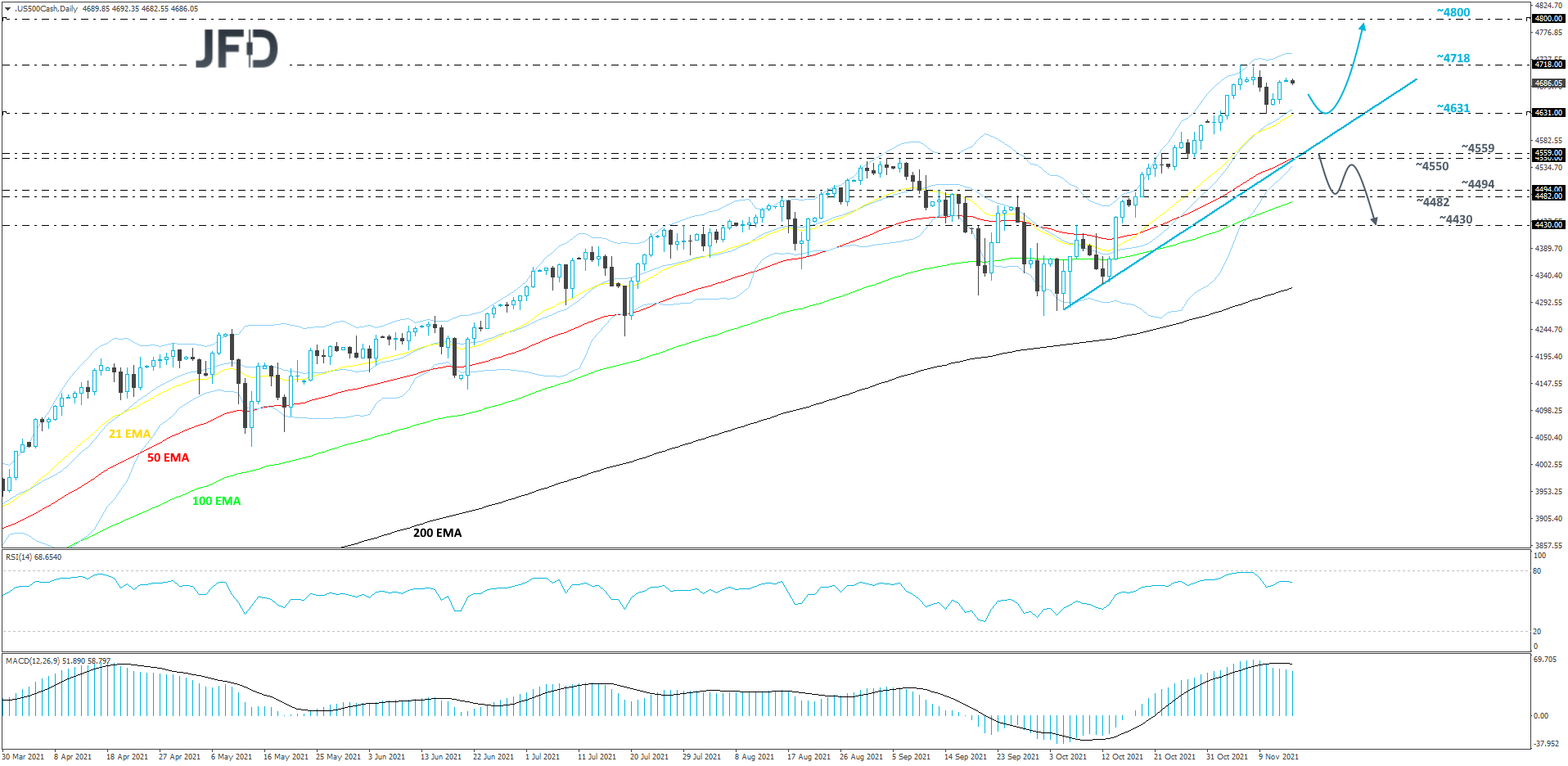
Last week, the S&P 500 failed to reach its current all-time high, at 4718, and instead corrected slightly lower around mid-week. By the end of it, the index managed to recover somewhat and ended the week in positive territory. At the same time, the price continues to trade above a short-term tentative upside support line taken from the low of October 5th. For now, we will continue aiming higher.
OUTLOOK (SCENARIO A / B)
The S&P 500 may push a bit higher and re-test the current all-time high, at 4718. The index might stall there for a bit, however, if the bulls remain confident, they could overcome that obstacle and move higher. That break would confirm a forthcoming higher high and the next target may be somewhere near the 4800 level.
Alternatively, a break of the aforementioned upside line and a price-drop below the 4550 hurdle, marked near the highest point of September and the low of October 27th, may change the direction of the short-term trend. The S&P 500 may drift to its next support area between the 4482 and 4494 levels, a break of which could set the stage for a test of the 4430 zone. That zone marks the inside swing high of October 7th.
2. DAX WEEKLY OUTLOOK
REVIEW
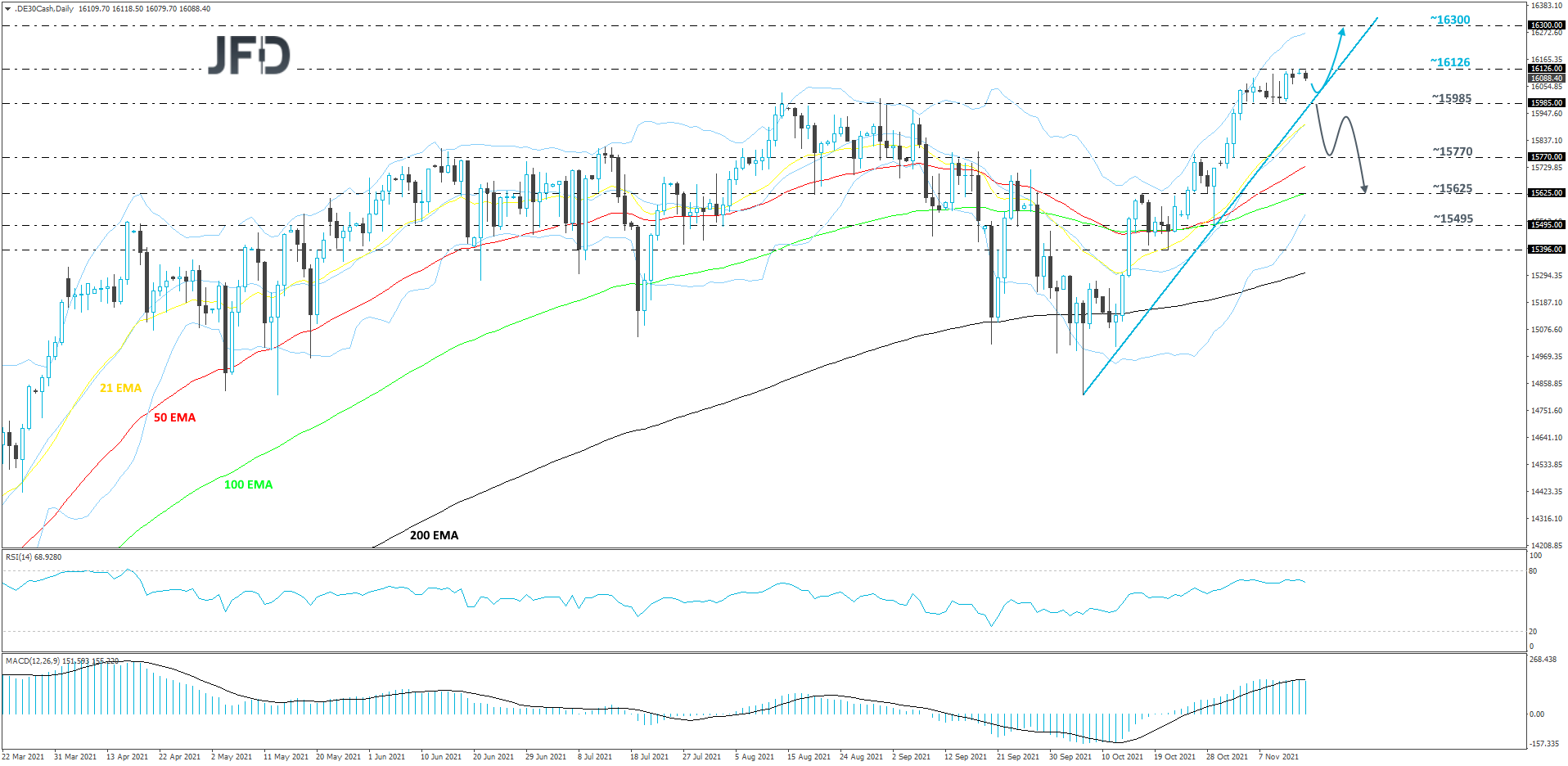
DAX continues to run above a short-term tentative upside support line taken from the low of October 6th. Despite the sideways activity last week, the German index managed to end the week slightly in positive territory. As long as DAX remains above that upside line, we will continue aiming higher.
OUTLOOK (SCENARIO A / B)
Even if the index corrects slightly lower, but continues to trade above the aforementioned upside line, the bulls could stay active and try to lift the price up again. They could send DAX to the high of last week, at 16126, which is also the current all-time high. If that area gets violated, this will place the German index into the uncharted territory, potentially clearing the way towards the 16300 level.
On the other hand, if the previously discussed upside line breaks and the price drops below the 15985 hurdle, which is the low of last week, that could signal a change in the direction of the short-term trend. The index could slide to the 15770 obstacle, or even to the 15625 zone, marked near the high of October 17th and the low of October 28th.
3. XAU/USD WEEKLY OUTLOOK
REVIEW
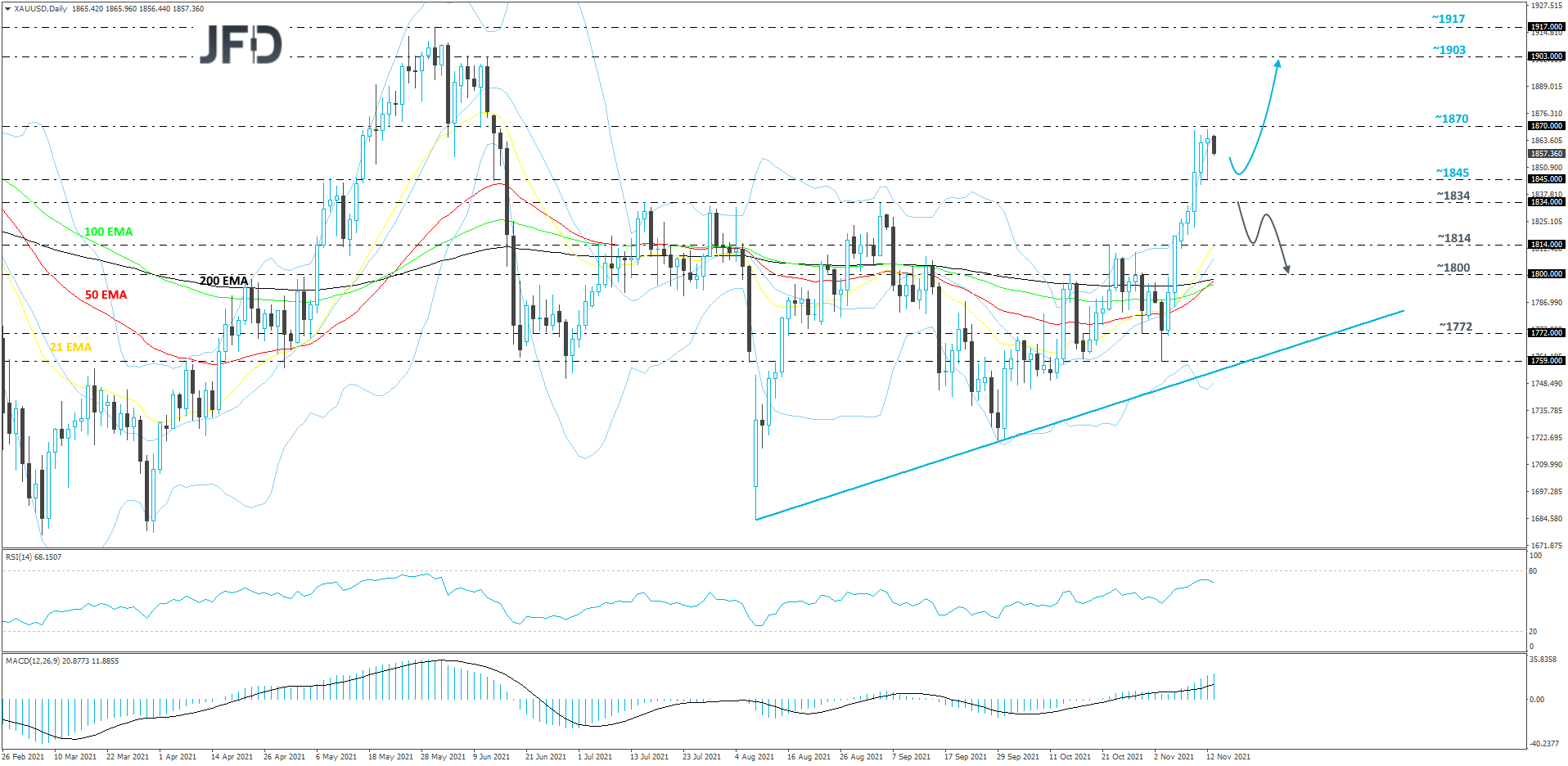
Overall, gold is trading well above a medium-term tentative upside support line taken from the low of August 9th. After a strong upmove last week, the commodity found resistance near the 1870 hurdle, which also marks the inside swing low of June 10th. That said, for now, we will remain positive overall.
OUTLOOK (SCENARIO A / B)
Given the strong move higher, which we saw last week, there might be some room for a small correction lower, before another possible leg of buying. If the price retraces a bit lower, but stays somewhere above the 1834 hurdle, marked near the highs of July and September, that could keep the bulls in the field for a while. They might push the yellow metal up again, aiming for the 1870 obstacle, a break of which may open the door for a move to the 1903 level, marked by the high of June 11th.
On the downside, a drop below the aforementioned 1834 zone, might lead to a larger correction lower. Gold could fall to the 1814 obstacle, which if fails to provide support and breaks, may clear the path to the psychological 1800 zone, marked near the inside swing highs of October 29th and November 4th.
4. LTC/USD WEEKLY OUTLOOK
REVIEW
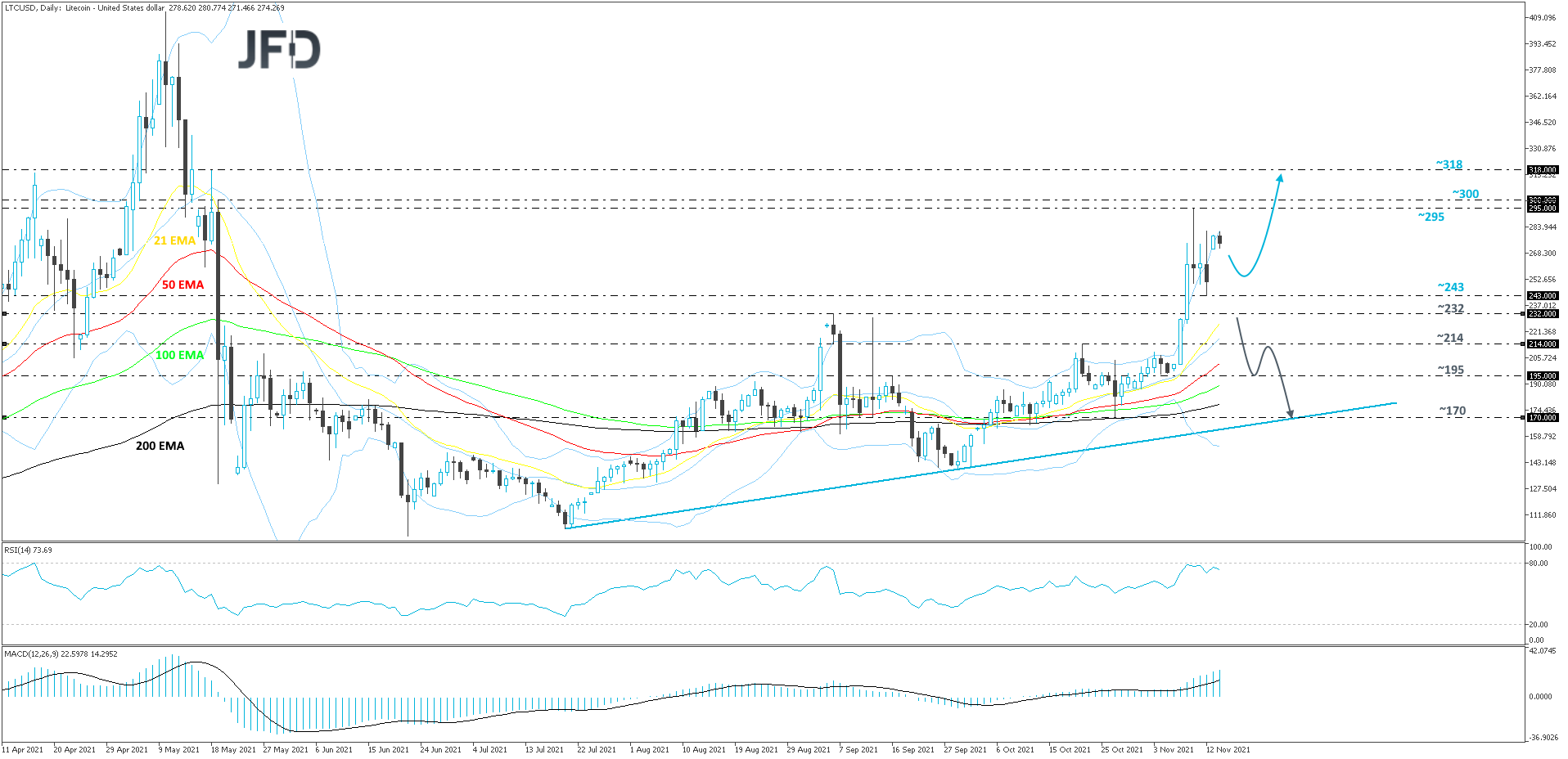
LTC/USD pushed higher last week, overcoming the 232 barrier, marked by the highest point of September. Despite correcting slightly lower, the rate remains above that 232 zone. At the same the crypto continues to trade above a medium-term tentative upside support line taken from the low of July 20th. If LTC/USD continues to trade above that highest point of September, we will stay positive, at least for now.
OUTLOOK (SCENARIO A / B)
A small decline could bring the crypto closer to the 243 area, marked by Friday’s low, which if holds, may attract the buyers back into the game, who could take advantage of the lower rate. If so, LTC/USD might drift back to the 260 obstacle, or even to the next possible resistance area between the 295 and 300 levels, marked by the high of last week and the high of May 19th. Slightly above it sits another potential resistance hurdle, at 318, which could get tested.
Alternatively, a drop below the 214 hurdle, marked near the highest point of October, could lead to a larger correction lower. LTC/USD might fall to the 195 obstacle, or even to the 170 level, marked by the low of October 27th.
5. GBP/JPY WEEKLY OUTLOOK
REVIEW
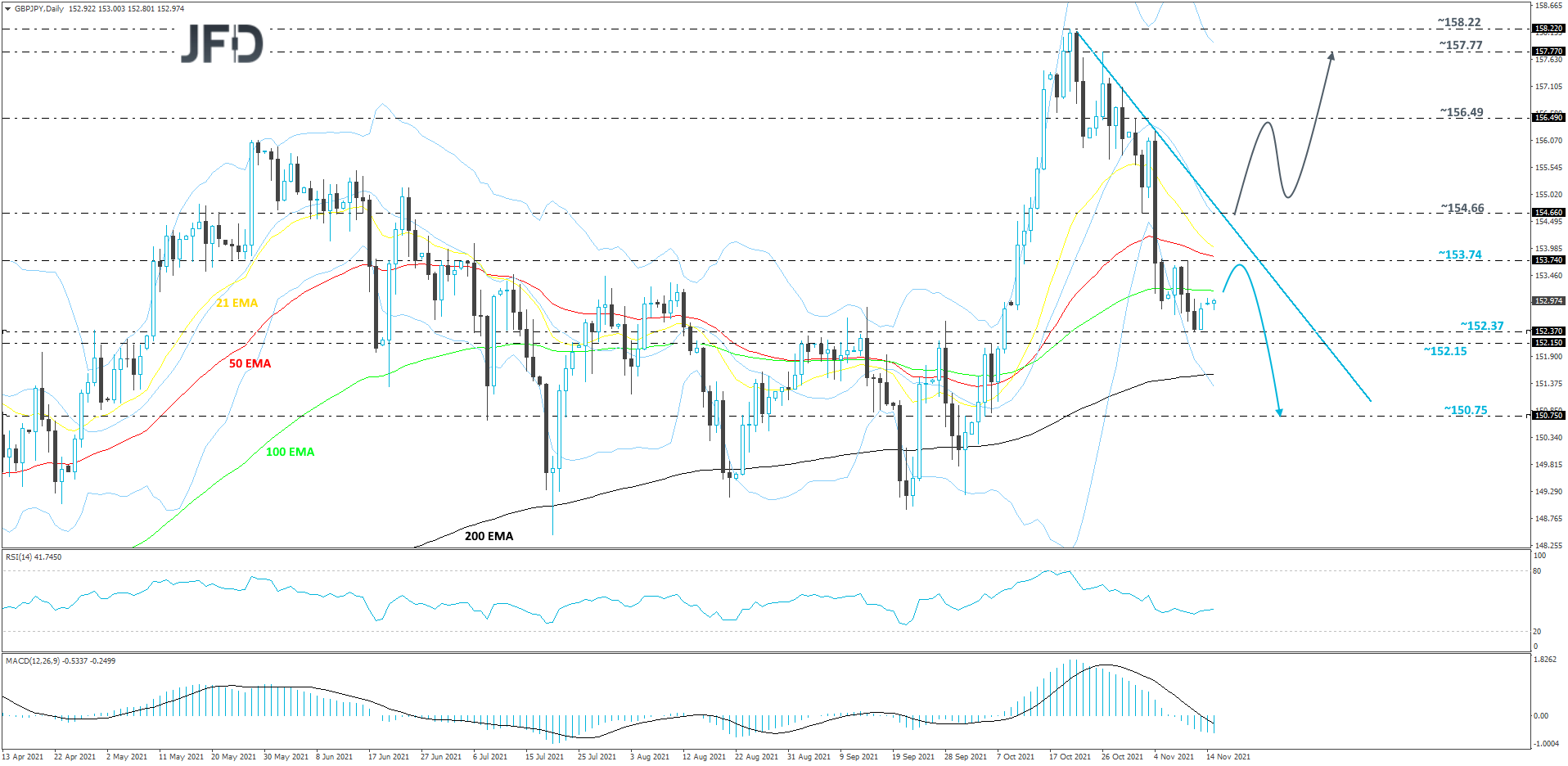
GBP/JPY continues to move lower, while trading below a short-term downside resistance line taken from the high of October 21st. Even if the pair corrects a bit higher, but stays below that downside line, we will stay bearish overall.
OUTLOOK (SCENARIO A / B)
A move higher might bring the rate closer to the 153.74 hurdle, marked by the high of last week, or to the aforementioned downside line. If that area provides strong resistance, the bears could step in again and drag the pair lower. GBP/JPY may fall to the zone between the 152.15 and 152.37 levels, which mark the high of October 6th and the low of last week. If that zone fails to provide support and breaks, the next potential target might be the 200-day EMA, or even the 150.75 zone, marked by the inside swing high of October 1st and the low of October 5th.
On the upside, a break of the previously mentioned downside line might attract more buyers into the game, especially if the rate climbs above the 154.66 hurdle, marked by the inside swing low of November 2nd. GBP/JPY could climb to the highest point of November, at 156.49, a break of which may open the door for a move to the 157.77 level. That level marks the high of October 26th.
6. USD/CAD WEEKLY OUTLOOK
REVIEW
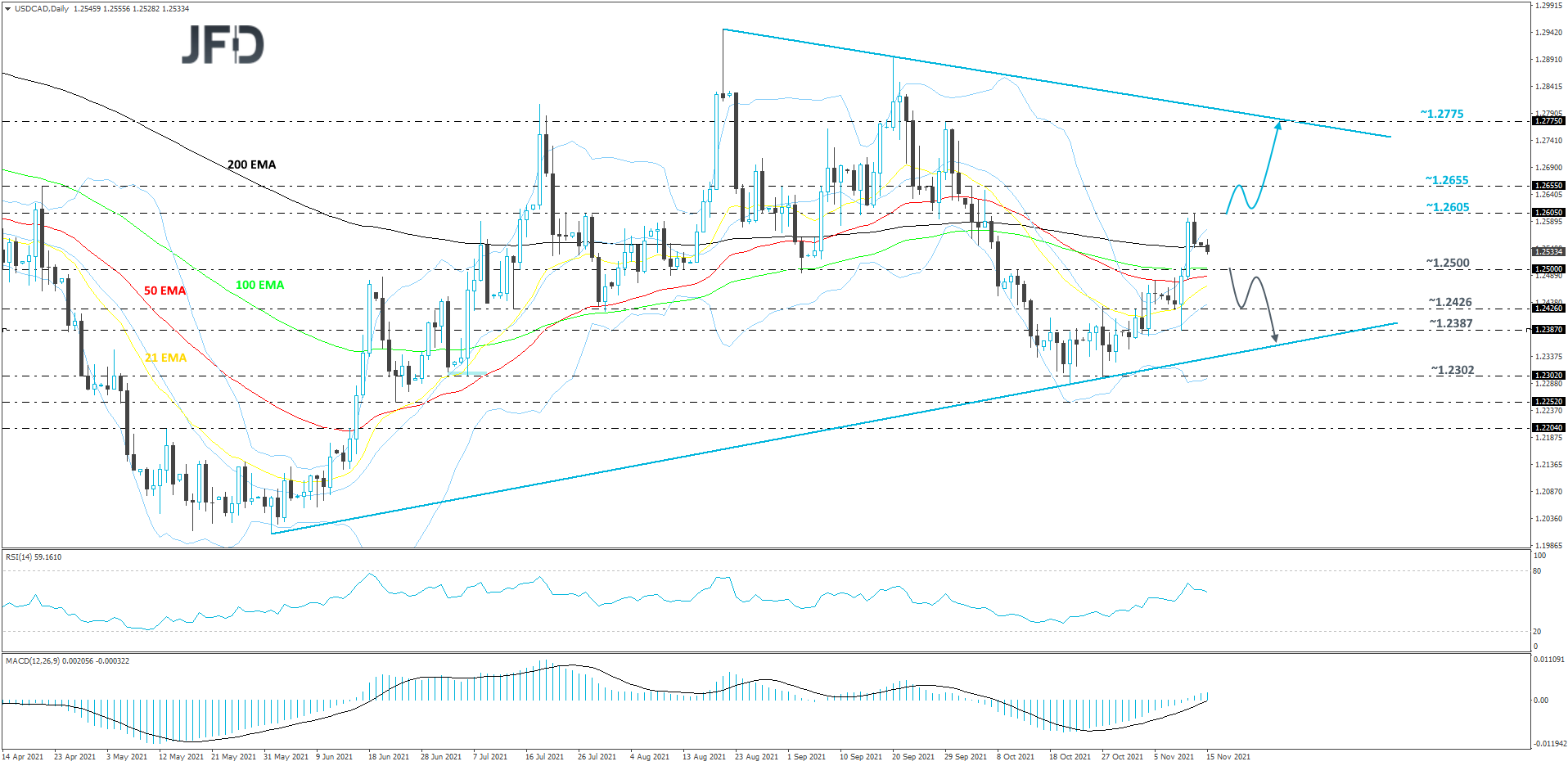
Overall, USD/CAD is still trading between two medium-term tentative lines, a downside one drawn from the high of August 20th and an upside one taken from the low of June 1st. Given that the pair rebounded from that upside line at the end of October, it may drift a bit higher. That said, as long as those lines stay intact, we will remain neutral.
OUTLOOK (SCENARIO A / B)
A push above last week’s high, at 1.2605, may allow USD/CAD to move further north, as more buyers could join in. The pair might travel to the 1.2655 obstacle, or even all the way to the 1.2775 level, marked by the high of September 29th. Around there the upmove might get halted, as the pair could also test the aforementioned downside line, which may provide temporary resistance.
On the other hand, a drop below the 1.2500 zone, marked near the highs of October 12th and November 10th, would place the rate back below the 200-day EMA. This move might temporarily spook the bulls from the field, forcing USD/CAD to move a bit lower. That’s when the pair might drift to the 1.2482 hurdle, or to the 1.2387 zone, marked by the low of last week. Slightly lower runs the previously discussed upside line, which could help support the pair from moving further south.
7. Home Depot Inc. WEEKLY OUTLOOK
REVIEW
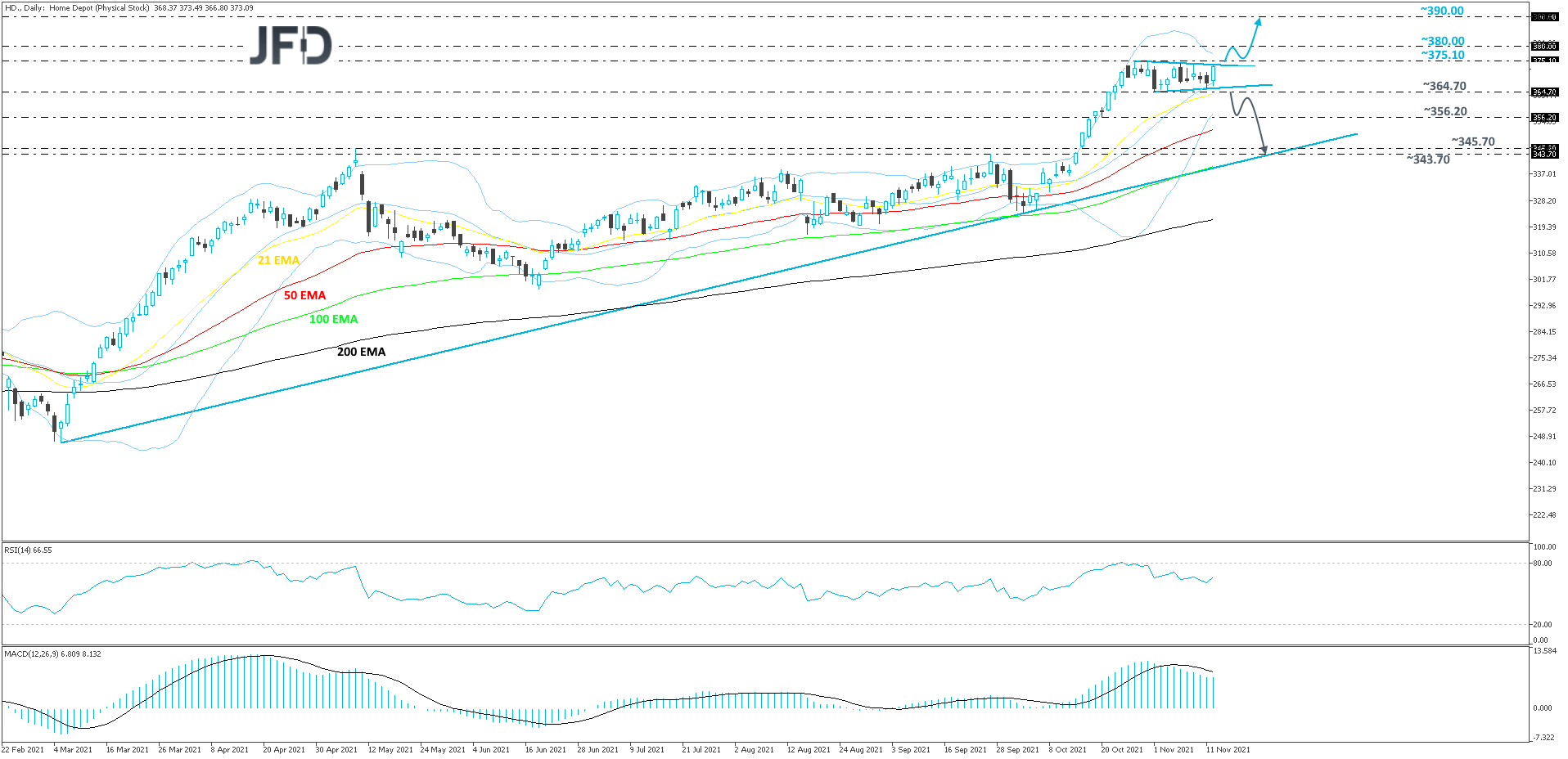
The technical picture of the Home Depot Inc. stock (NYSE: HD) on our daily chart shows that, overall, the share price is balancing well above a medium-term tentative upside support line drawn from the low of March 5th. However, from around the beginning of November, the stock seems to be forming a triangle, meaning that the price is getting squeezed. Given that the prevailing trend was to the upside, there is a decent chance the breakout might occur to the upside. However, until that happens, we will stand pat for now.
OUTLOOK (SCENARIO A / B)
A push through the upper side of the triangle and a break above the 375.10 barrier, which is the current all-time high, would confirm a forthcoming higher high and place the stock into the uncharted zone. We could then aim for the 380.00 territory, or even for the 390.00 level.
Alternatively, a break of the lower side of the aforementioned triangle and a drop below the current lowest point of November, at 364.70, may temporarily spook some buyers from the arena. This could lead to a larger correction lower, initially aiming for the 356.20 obstacle, a break of which may open the way to the next support area between the 343.70 and 345.70 levels. Those levels mark the highest point of September and the low of October 15th respectively.
FX Weekly Market Preview
Weekly Outlook: Nov 15 – Nov 19: US Retail Sales, UK and Canada CPIs Under the Spotlight
Following last week’s US CPI data, which showed that inflation in the US accelerated by more than anticipated, investors will be eager to find out whether this is the case in other major economies as well. Thus, they may pay extra attention to the UK and Canadian CPI data, where further acceleration could bring forth expectations with regards to rate hikes by the BoE and the BoC. Retail sales from those nations are also due to be released, but also from the US, with upbeat numbers possibly adding to the view that the Fed could start raising rates as soon as tapering is over.
On Monday, during the Asian morning, we got Japan’s preliminary GDP for Q3. The data showed that economic activity shrank 0.8% qoq after expanding 0.4% in Q2. The forecast was for a 0.2% contraction. This took the yoy rate down to -3.0% from +1.5%. At its latest gathering, the BoJ kept its monetary policy settings untouched and downgraded is growth and inflation projections, while today, Governor Kuroda said that they will maintain their “powerful” easing strategy and stand ready to rump up stimulus if needed, even as other central banks have begun to, or are preparing to start, withdrawing pandemic-related policies.

In our view, the GDP data add credence to Kuroda’s view, and leave the yen exposed to another round of selling, despite its latest recovery. With the BoJ keeping a lid on Japanese government bond yields and other central banks moving towards higher rates, the yield differentials between Japan and other major nations could weigh against the yen.
China’s fixed asset investment, industrial production and retail sales for October are also out. Fixed asset investment slowed to +6.1% yoy from +7.3%, while industrial production and retail sales surprisingly accelerated, instead of slowing down as their own forecasts suggested. Specifically, they accelerated to +3.5% yoy and +4.9% yoy from +3.1% and +4.4% respectively. The data may be a relief following the latest evidence of a slowing economy, but the deepening debt crisis in the property sector leaves no room for celebration. Despite not affecting the overall global market sentiment, this has left marks in the morale of Asian investors, and this is distinct by the fact that Asian equity indices continue to underperform their European and US peers.
Later in the day, we get the New York Empire State manufacturing index for November, which is expected to have increased to 21.60 from 19.80. This may be a first indication over which direction the official manufacturing index for the whole nation may take and could add credence to the view that the latest bottlenecks have not affected the US economy as much as initially thought.
On Tuesday, during the Asian session, the RBA releases the minutes from its latest meeting, where it maintained its core policies – rates and QE – unchanged, but decided to discontinue the 10bps April 2024 yield target, something that was obvious, after they failed to defend that level the week before. They also abandoned the forward guidance that interest rates are most likely to stay unchanged at least until 2024 and suggested that this could happen in 2023. At the press conference following the decision, Governor Lowe said that latest data and forecasts do not warrant an increase in the cash rate in 2022. However, according to the ASX 30-day interbank cash rate futures yield curve, the market still anticipates a 15bps hike in June next year and sees rates getting very close to 1% in December. Therefore, stronger hints that the RBA is not planning to touch the rate next year could hurt the Aussie again. As we noted after the meeting, with expectations around interest rate hikes staying elevated, there is ample room for more disappointment, and thereby, more downside potential for the Australian currency.

Later in the day, the UK employment report for September is expected to reveal that the unemployment rate has ticked down to 4.4% from 4.5% and that the employment change has added slightly less jobs in the three months to September than in the three months to August. Average hourly earnings, both including and excluding bonuses, are expected to have slowed decently, but although this could be a relief indication for future inflation, market participants will continue biting their nails in anticipation of the UK CPIs for October, due out on Wednesday.
From the Eurozone, we get the 2nd estimate of the GDP for Q3, which is expected to confirm its preliminary print of 2.2%, as well as the bloc’s employment change for the quarter, for which no forecast is available though.
Later in the day, all the market attention may turn to the US retail sales for October, as well as the industrial and manufacturing production rates for the month. Headline sales are forecast to have accelerated to +1.1% mom from +0.7%, while the core rate is expected to have held steady at +0.8% mom. Industrial and manufacturing productions are expected to have rebounded 0.7% mom and 0.8% mom, after sliding 1.3% and 0.7% respectively.

In our view, the forecasts point to decent data, which following last week’s acceleration in the US CPIs could increase bets over a hike by the Fed as soon as the tapering process is over. Remember that at the latest gathering, Fed Chair Powell said that they will stay “patient” on interest rates, but he did not close the door on the likelihood of an action just after tapering is over. According to the Fed funds futures, investors are already pricing in a 25bps hike to be delivered in July or August next year, and another round of strong US data could add more credence to their view. This is likely to allow more dollar buying, but in terms of how the equities will react, the answer is not straight forward. Will they slide on speculation that faster rate hikes will hurt profitability of firms, or will they rise on indications that the economy is performing better than previously thought? Although the former was the case in the past, we believe that now it is the latter, and thus, even if equities correct somewhat, we expect a rebound very soon. After all, market participants may have already digested the idea of higher rates soon.
On Wednesday, following the acceleration in the US CPIs last week, market participants may be sitting on the edge of their seats in anticipations of more inflation numbers. We do get data for October from the UK, the Eurozone, and Canada. However, Eurozone’s numbers will be the final ones, which are just expected to confirm their initial estimates.
In the UK, expectations are for the headline rate to jump to +3.9% yoy from +3.1%, while the core one is expected to rise to +3.1% yoy from +2.9%. At its latest meeting, the BoE decided not to hike, despite market participants assigning an 80% chance for such a move ahead of the meeting, and instead said that this could happen in “coming months”. Last Monday, the pound rebounded strongly, following remarks by BoE Governor Andrew Bailey, who said that they are on a path towards raising interest rates, which may have sparked expectations over a December move. However, on Thursday, the preliminary UK GDP for Q3 disappointed, slowing by more than expected. This may have forced market participants to push back their hike expectations, perhaps somewhere in the first months of next year. After all, February is also in the “coming months” spectrum. Having said all that though, a strong acceleration in consumer prices will add credence to Governor’s Baily remarks and may revive speculation for a December hike. This is likely to prove positive for the pound. The big question here is whether GBP-traders are still trusting Bailey, who ahead of the prior meeting has been adding to hopes over a hike, but instead was among those supporting standing pat.

Now, passing the ball to Canada, the headline rate is expected to have continued rising, to +4.6% yoy from +4.4%, while no forecast is available for the core one. With the BoC unexpectedly ending its QE program at its latest meeting, officials may be now looking for the appropriate time to increase interest rates. Around 10 days ago, the employment data revealed a slowdown in jobs growth, but also a slide in the unemployment rate. We don’t believe that this may have affected expectations around a hike early next year much, and further acceleration in inflation could strengthen the case, providing some support to the Canadian dollar. That said, we are reluctant to call for a long-lasting recovery and this is due to the latest slide in oil prices. Remember that Canada is a major oil producing and exporting nation, and thereby, the Loonie is correlated to prices of the black liquid.

On Thursday, there are no major events or indicators on the financial agenda.
Finally, on Friday, Asian time, Japan releases its National CPIs for October. No forecast is available for the headline rate, while the core one is anticipated to have held steady at +0.1% yoy, well below the BoJ’s objective of 2%. In our view, this is likely to add more credence to the BoJ’s stance of maintaining its policy extra loose.

Later in the day, we get retail sales data from the UK and Canada, for the months of October and September respectively. In the UK, both headline and core sales are expected to have rebounded after sliding in September, which could add to expectations over a December hike by the BoE if indeed inflation keeps accelerating on Wednesday. In Canada, headline sales are forecast to have fallen, but core sales are anticipated to have risen at the same pace as in August. Given that this is September data and that on Wednesday, we get October CPIs, we don’t expect any major market reaction.
Disclaimer:
The content we produce does not constitute investment advice or investment recommendation (should not be considered as such) and does not in any way constitute an invitation to acquire any financial instrument or product. The Group of Companies of JFD, its affiliates, agents, directors, officers or employees are not liable for any damages that may be caused by individual comments or statements by JFD analysts and assumes no liability with respect to the completeness and correctness of the content presented. The investor is solely responsible for the risk of his investment decisions. Accordingly, you should seek, if you consider appropriate, relevant independent professional advice on the investment considered. The analyses and comments presented do not include any consideration of your personal investment objectives, financial circumstances or needs. The content has not been prepared in accordance with the legal requirements for financial analyses and must therefore be viewed by the reader as marketing information. JFD prohibits the duplication or publication without explicit approval.
CFDs are complex instruments and come with a high risk of losing money rapidly due to leverage. 73.90% of retail investor accounts lose money when trading CFDs with the Company. You should consider whether you understand how CFDs work and whether you can afford to take the high risk of losing your money. Please read the full Risk Disclosure.
Copyright 2021 JFD Group Ltd.