


Equities gained yesterday and today in Asia, as peace talks between Russia and Ukraine in Turkey resulted in progress. The euro rallied as well, as a potential resolution could make more likely a rate hike by the ECB before year end. That said, the yen gained notably, and in our view, this may have been a short covering move following its latest steep fall.
Equities and EUR Rally on Progress in Russia-Ukraine Peace Talks
The US dollar traded lower against all but one of the other major currencies on Tuesday and during the Asian session Wednesday. It lost the most ground versus JPY, EUR, and NZD in that order, while it was found virtually unchanged against GBP.
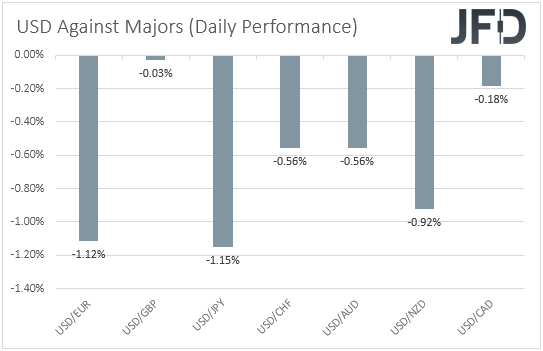
The strengthening of the Japanese yen usually points to risk-off trading, but the strengthening of the risk-linked Kiwi, and the weakening of the US dollar suggest otherwise. The strengthening of the euro is also an indication of improvement in the geopolitical saga, and indeed this was the case. Major EU and US indices were a sea of green yesterday, with the positive appetite rolling into the Asian session today. Among the indices under our radar, only Japan’s Nikkei lost ground and this may be because of the yen’s strength.
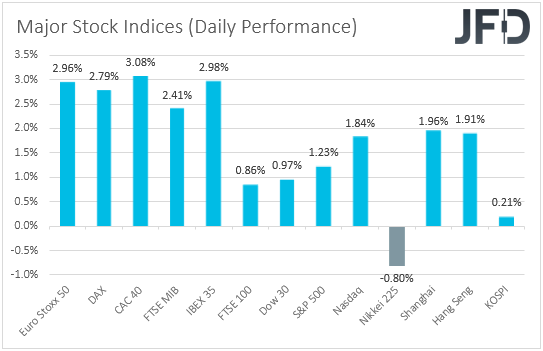
In our view, the main catalyst behind the rally in the euro and the broader market sentiment may have been the progress in peace talks between Russia and Ukraine in Turkey. In what it is described as the most tangible sign of progress until now, Russia promised to scale down military operations around Kyiv and norther Ukraine, while Ukraine expressed willingness to adopt a neutral status. This encouraged market participants to add to their risk exposures, and also to buy back a decent amount of euros, as a potential resolution could increase the likelihood for the ECB to lift rates to zero before the end of 2022, as officials will be able to focus mainly on bringing down accelerating inflation, rather than also having concerns on how economic growth will be affected by a prolonged geopolitical conflict.
But if there was so much to cheer yesterday, why did the yen rebound so strongly? Some say that it may have been due to market participants getting worried that further weakness may start pushing inflation up by raising import costs. However, with Japanese inflation well behind that of other major economies, we believe that this is not the case yet. Maybe some investors decided to cover some short positions in order to lock some profits. With the BoJ pledged to stay extra-loose, the divergence with other major central banks is likely to continue widening, which could continue adding pressure on the yen.
DAX – Technical Outlook
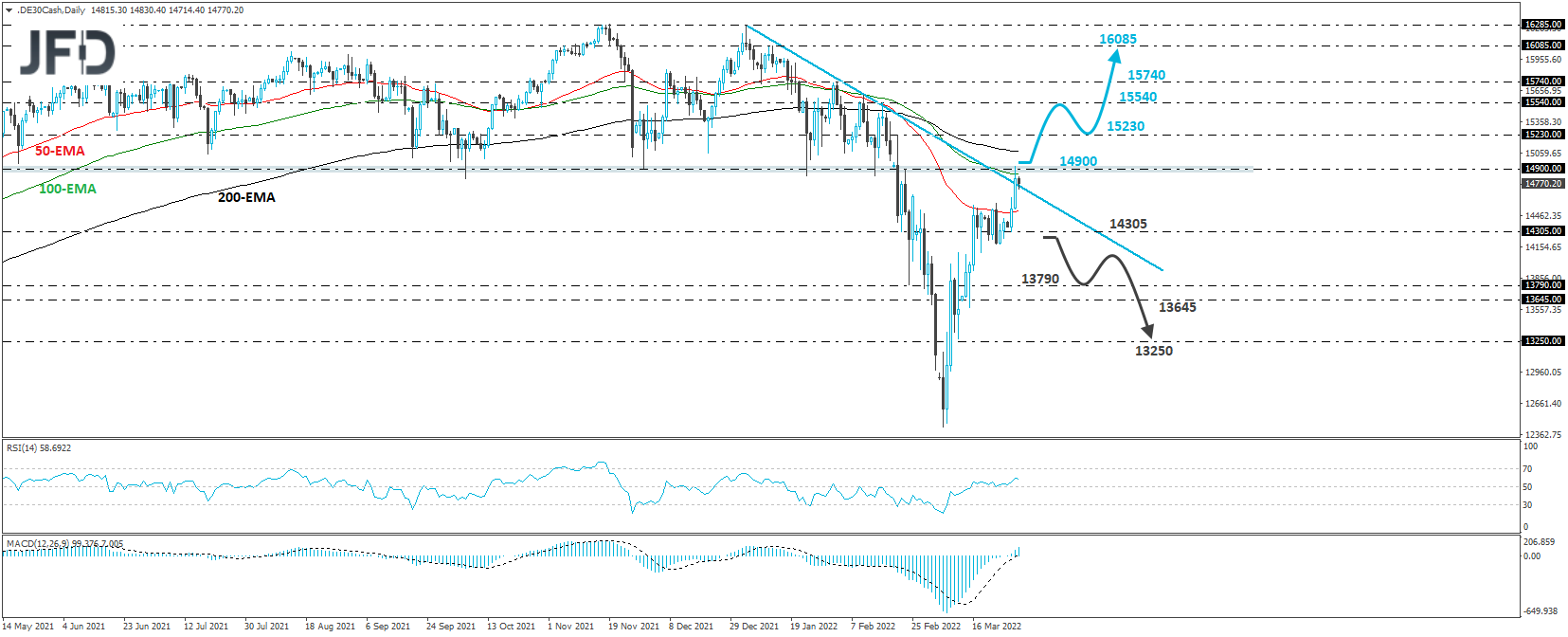
The German DAX cash index traded higher yesterday, breaking above the downside resistance line drawn from the high of January 5th. However, the index has yet to overcome the key territory of 14900, which acted as a strong support between May 5th, 2021, and February 14th. We prefer to wait for a break above that zone first before we get confident on more advances.
Such a break could initially target the high of February 21st, at 15230, the break of which could allow advances towards the high of February 16th, at 15540, or the peak of February 2nd, at 15740. If neither zone is able to throw the bulls out of the game, then we could see DAX being pushed towards the high of January 12th, at 16085.
On the downside, we would like to see a clear dip below 14305, before we start examining whether the outlook has turned back bearish. This could pave the way towards the 13790 zone, marked by the low of February 24th, or towards the 13645 territory, marked by the low of March 14th. A break below the latter one could carry more bearish implications, perhaps seeing scope for declines towards the low of March 11th, at 13250.
EUR/GBP – Technical Outlook
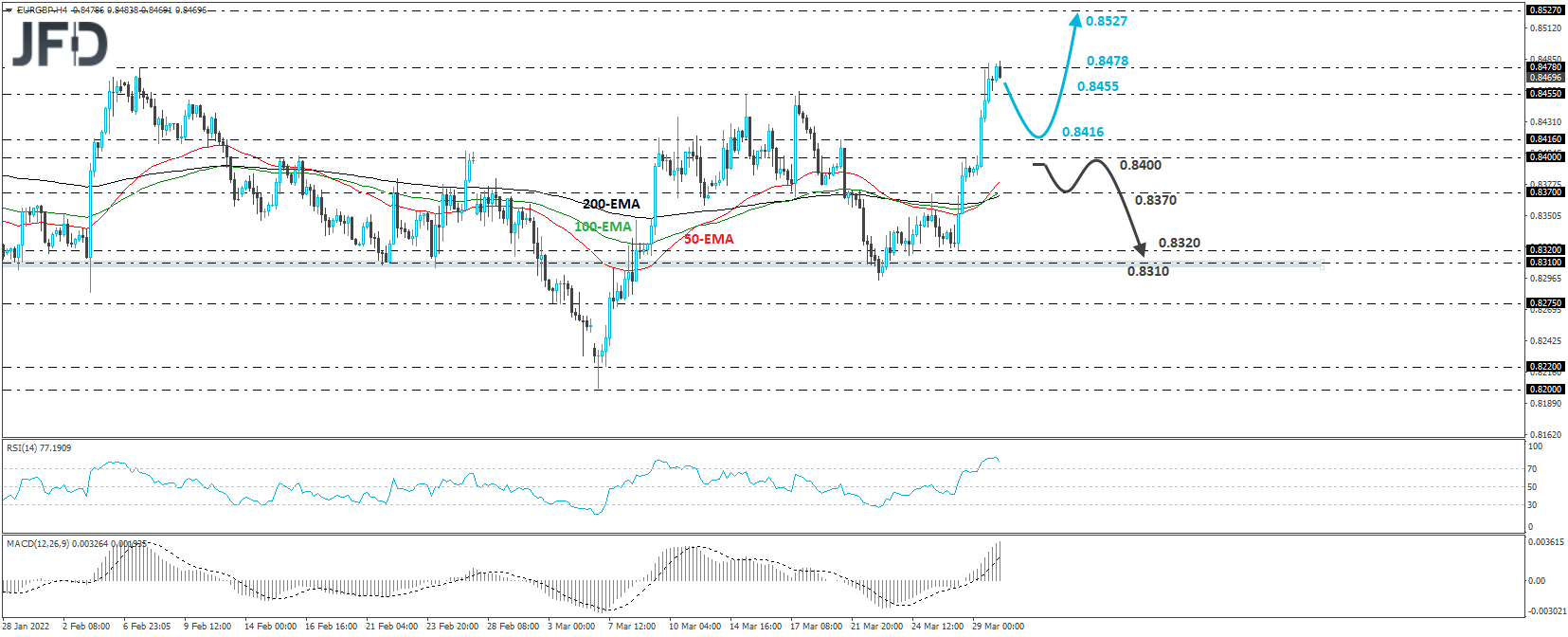
EUR/GBP rallied yesterday, breaking several resistance barriers in a row, including the 0.8455 key zone, marked by the highs of March 15th and 17th. However, the pair was stopped by the 0.8478 hurdle, which is marked as a resistance by the high of February 7th.
This could result in a setback, even back below 0.8455, but the bulls could take charge again from near the 0.8416 zone, marked by the high of March 21st, and push the action back up for another test at 0.8478. A break higher would confirm a forthcoming higher high and may see scope for extensions towards the 0.8527 area, which provided strong resistance between December 15th and 17th.
Now, if the setback continues below 0.8400, this could be a signal of a larger bearish correction, with the next stop perhaps being at 0.8370, marked by the inside swing high of March 25th. If the bears are not willing to stop there either, then we may see them diving towards the 0.8320 barrier, marked by the low of March 28th, or the important zone of 0.8310, which provided strong support in several occasions between January 20th and March 23th.
As for Today’s Events
Although not major market movers, the most important releases to monitor are Germany’s preliminary CPIs and the US ADP employment report, both for March. In Germany, both the CPI and HICP rates are expected to have continued climbing north. Specifically, they are expected to rise to +6.1% yoy and +6.4% yoy, from +5.1% and +5.5% respectively, which could mean that Eurozone’s rates, at least the headline one, due out on Friday, may follow suit.
As for the US’s ADP report, the forecast suggests that the private sector has gained 438k jobs in March after adding 475k in February. This could raise some speculation that the NFPs, due out on Friday, may also come in below their February print. Indeed, the forecast is for the NFPs to have slowed to 475k from 678k. Having said all that though, we need to remind you that the ADP number is not a reliable predictor of the NFPs, and thus, we will not form an official opinion about the Fed’s and the dollar’s future course based on the ADP result.
As for the rest of the data, from the US, besides the ADP report, we also get the final GDP for Q4, with the forecast pointing to a fractional upside revision, to +7.1% qoq SAAR from +7.0%.
Tomorrow, during the Asian session, Japan’s preliminary industrial production for February is expected to reveal a rebound to +0.5% mom from -0.8%. The Chinese PMIs for March are also due to be released, but no forecast is currently available. That said, with several cities entering lockdowns due to accelerating spreading of the coronavirus, we see the risks as tilted to the downside. This could initially hurt currencies of countries which have close trade ties with China, the likes of Australia and New Zealand. However, with Chinese officials pledged to take all the necessary measures to support the economy, and also taking into account the latest recovery in the broader market sentiment, we will treat any such setbacks in the Aussie and the Kiwi as corrective moves before their next legs north.
The content we produce does not constitute investment advice or investment recommendation (should not be considered as such) and does not in any way constitute an invitation to acquire any financial instrument or product. The Group of Companies of JFD, its affiliates, agents, directors, officers or employees are not liable for any damages that may be caused by individual comments or statements by JFD analysts and assumes no liability with respect to the completeness and correctness of the content presented. The investor is solely responsible for the risk of his investment decisions. Accordingly, you should seek, if you consider appropriate, relevant independent professional advice on the investment considered. The analyses and comments presented do not include any consideration of your personal investment objectives, financial circumstances or needs. The content has not been prepared in accordance with the legal requirements for financial analyses and must therefore be viewed by the reader as marketing information. JFD prohibits the duplication or publication without explicit approval.
CFDs are complex instruments and come with a high risk of losing money rapidly due to leverage. 73.82% of retail investor accounts lose money when trading CFDs with the Company. You should consider whether you understand how CFDs work and whether you can afford to take the high risk of losing your money. Please read the full Risk Disclosure.
Copyright 2022 JFD Group Ltd.