


Wall Street rebounded yesterday, with the increase in appetite rolling into the Asian session today, as the US and other Western nations decided to step up attempts against Russia’s business ability, by imposing fresh and stricter sanctions. However, in our view, it is too early to assume that the sanctions will force Russia to back down, or that any other nation will not get involved.
Risk Linked Assets Rebound as West Hits Russia with New Sanctions
The US dollar continued trading higher against most of the other major currencies on Thursday and during the Asian morning Friday, with the main losers being JPY, GBP, and CHF. The only currencies against which the greenback did not eked out any gains, and instead was found virtually unchanged, are AUD and CAD.
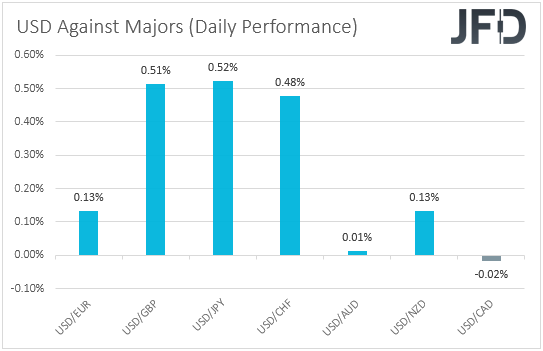
Although the dollar kept marching north, the fact that the main losers were the safe-havens yen and franc suggests that the financial world may have turned to a risk-on mode at some point. Indeed, although EU shares closed in negative territory due to Russia’s invasion in Ukraine intensifying investors flight to safety, Wall Street rebounded, with Nasdaq gaining the most. Appetite stayed relatively supported during the Asian session today as well.
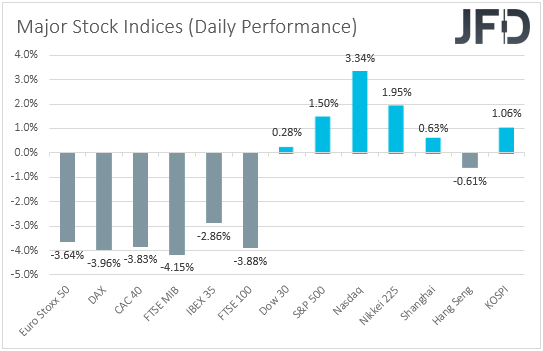
For another day, investors’ gaze stayed locked on developments surrounding the Russia-Ukraine conflict, and what may have prompted them to add back some risk to their portfolios may have been the decision of the US and other Western nations to redouble their efforts to crimp Russia’s ability to do business, with sanctions including freezing bank assets and cutting off state-owned enterprises.
Maybe, this sparked some hopes that the conflict could be resolved without any other nation getting involved. US President Biden himself has repeatedly noted these days that the US would not engage in war with Russia. Yes, NATO members agree that an attack against one of them is considered an attack against all of them, but Ukraine is not a NATO member yet, and thus those protections do not apply.
Having said all that though, it is too early to assume that the sanctions will force Russia to back down, or that any other nation will not get involved. Thus, we prefer to treat yesterday’s recovery in risk assets as a corrective rebound and we see decent chances for another leg south. Besides equities and other traditional risk-linked currencies, due to the geographical location of the conflict, we believe that the euro and the pound could suffer additional losses as well. At the same, safe havens, like the yen and franc, could come under renewed selling interest.
The only major risk-linked currency which could experience limited losses may be the Canadian dollar, and this is because the conflict is driving oil prices up due to fears of supply disruptions. Let’s not forget that Canada is the fifth largest oil producing nation in the whole world, while it holds the sixth place in terms of exports.
Now, in terms of monetary policy, some may, at first glance, think that the conflict could translate into less hawkish narrative by major central banks. However, we believe that it may be the opposite. Surging oil prices to levels last seen in July 2014 could mean higher inflation in the months to come, which may require an even more aggressive tightening. Thus, we stick to our guns that even if the geopolitical tensions ease sooner than expected, expectations over faster rate increases around the globe could keep a lid on any relief bounce. We believe that the path of least resistance will stay to the downside even when the Russia-Ukraine conflict ends.
Euro Stoxx 50 – Technical Outlook
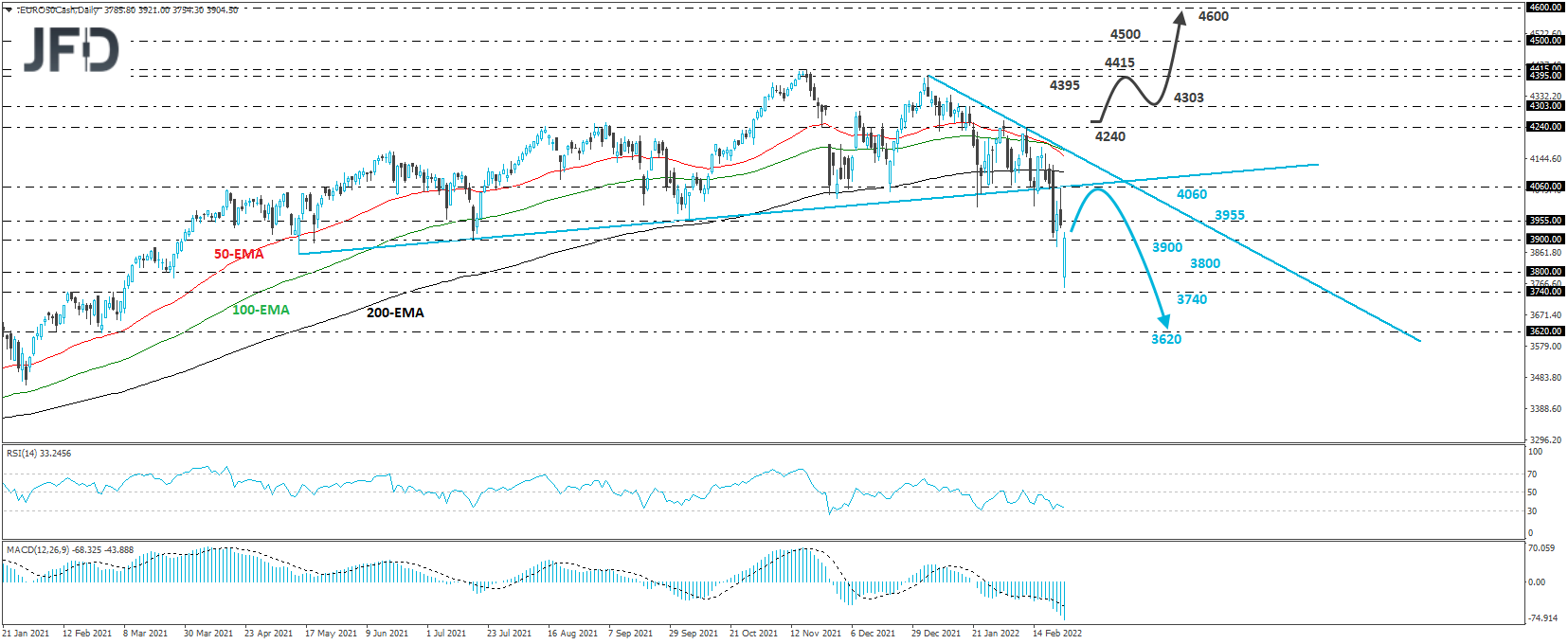
The Euro Stoxx 50 opened with a negative gap yesterday, but hit support slightly above the 3740 zone, marked by the inside swing high of March 3rd, and then, it rebounded. However, it is still trading below the upside support line drawn from the low of May 15th, and also below the downside line taken from the high of January 5th. Thus, we still see a negative near-term picture.
Even if the rebound continues for a while more, we expect the bears to take charge again from somewhere below the 4060 barrier, marked by Wednesday’s peak. This could result in another tumble near the 3740 zone, the break of which would confirm a forthcoming lower low and may extend the latest short-term downtrend to the low of February 26th, at 3620.
On the upside, we would like to see a clear rebound back above the 4240 zone, marked by the high of February 10th, before we assume that the bulls are back in full control. This could confirm the break back above both the aforementioned diagonal lines and main initially target the peak of January 20th, at 4303. Another break, above that level, could aim for the peak of November 18th at 4415. If participants are not willing to stop there, by breaking higher, they will enter territories last tested in December 2017. The next territories to consider as resistance may be the 4500 and 4600 areas.
EUR/JPY – Technical Outlook
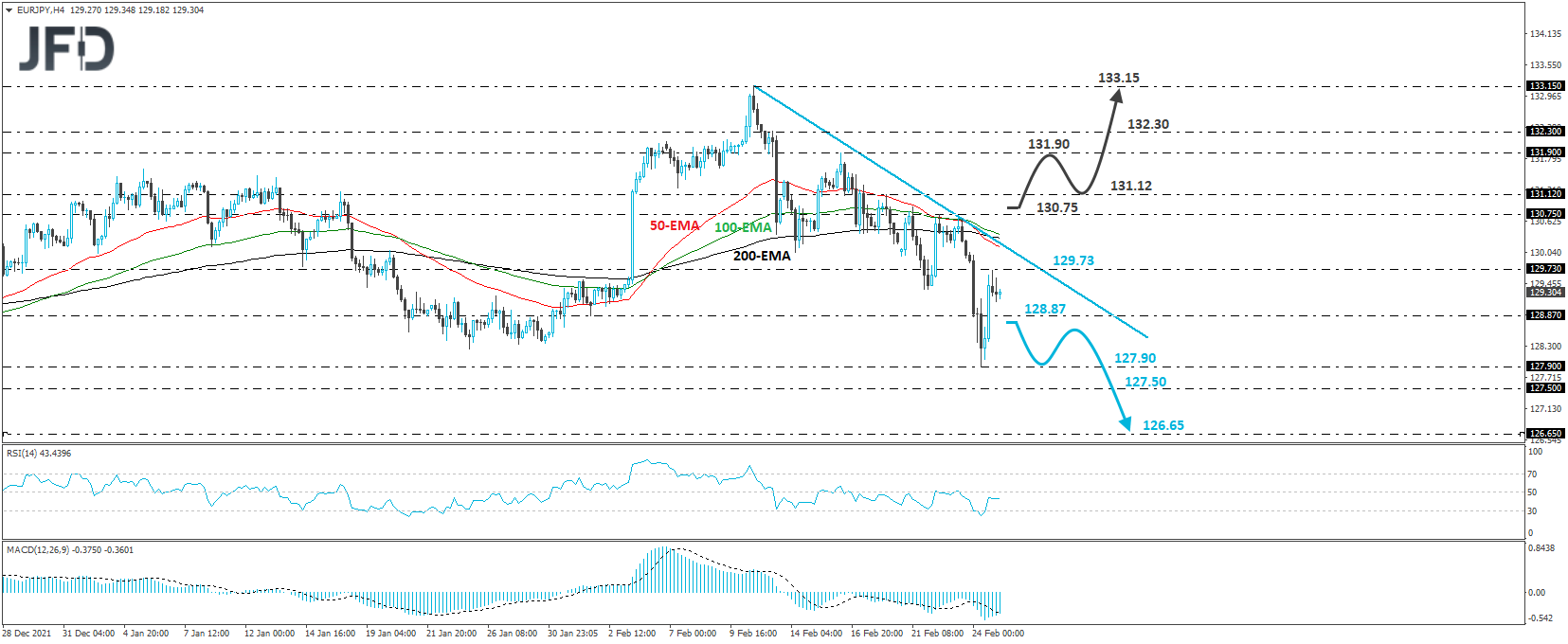
EUR/JPY rebounded as well, after hitting support at 127.90. That said, the recovery was stopped by the 129.93 level, still below the downside resistance line drawn from the peak of February 10th. As long as the rate continues to print lower highs and lower lows below that line, we will stay negative with regards to the short-term picture of this pair.
A clear break below 128.87 may confirm that the current rebound is over and that the bears are back in full control. We could then see another round of selling towards the 127.90 barrier, the break of which could aim for the 127.50 level, marked by the low of December 12th. If that barrier is not able to hold either, then we could experience larger declines, perhaps towards the 126.65 zone, marked by the low of February 10th, 2021.
On the upside, we would like to see a clear break above 130.75 before we start examining the case of a bullish reversal. This rate would not only be well above the pre-discussed downside line, but it will also confirm a forthcoming higher high. The next resistance may be the peak of February 18th, at 131.12, the break of which could pave the way towards the high of February 16th, at 131.90, or the high of February 11th, at 132.30. Another break, above 132.30, could see scope for extensions towards the 133.15 zone, marked by the high of February 10th.
As for Today’s Events
For another day, we believe that market attention will stay locked on developments surrounding the Russia-Ukraine conflict. However, there are some data on today’s agenda we need to mention and those are the US durable goods orders for January, the personal income and spending, and well as the core PCE index for the same month.
We also have two ECB officials speaking today and those are President Christine Lagarde and Supervisory Board member Elizabeth McCaul.
Disclaimer:
The content we produce does not constitute investment advice or investment recommendation (should not be considered as such) and does not in any way constitute an invitation to acquire any financial instrument or product. The Group of Companies of JFD, its affiliates, agents, directors, officers or employees are not liable for any damages that may be caused by individual comments or statements by JFD analysts and assumes no liability with respect to the completeness and correctness of the content presented. The investor is solely responsible for the risk of his investment decisions. Accordingly, you should seek, if you consider appropriate, relevant independent professional advice on the investment considered. The analyses and comments presented do not include any consideration of your personal investment objectives, financial circumstances or needs. The content has not been prepared in accordance with the legal requirements for financial analyses and must therefore be viewed by the reader as marketing information. JFD prohibits the duplication or publication without explicit approval.
CFDs are complex instruments and come with a high risk of losing money rapidly due to leverage. 73.82% of retail investor accounts lose money when trading CFDs with the Company. You should consider whether you understand how CFDs work and whether you can afford to take the high risk of losing your money. Please read the full Risk Disclosure.
Copyright 2022 JFD Group Ltd.