


Equities continued to slide yesterday and today in Asia, with last week’s concerns rolling over into this week. On top of that, the outage of Facebook and its family apps, as well as the OPEC+ decision not to increase oil production may have hurt investors’ morale even further. Today, the RBA stood pat, but tonight, the RBNZ is widely expected to raise interest rates by 25bps.
Equities Continue to Drift South, RBNZ Set to Hike Interest Rates
The US dollar traded mixed against the other major currencies on Monday and during the Asian session Tuesday. It underperformed versus CHF and GBP in that order, while it gained only versus JPY. The greenback traded virtually unchanged, within a ±0.05% range, against EUR, AUD, NZD, and CAD.
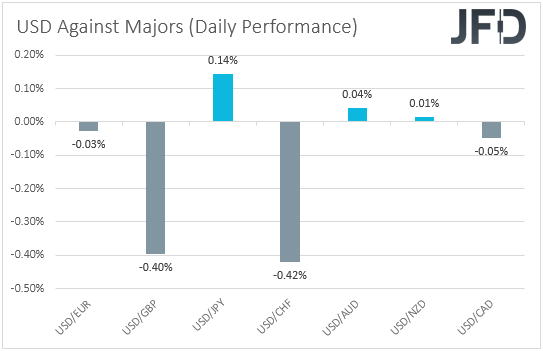
The strengthening of the Swiss franc suggests a risk-off trading activity, but the gains in the British pound and the weakening of the Japanese yen point otherwise. Therefore, in order to clear things up with regards to investors’ overall appetite, we prefer to turn our gaze to the equity world. There, we see that major EU and US indices were a sea of red, with the pessimism rolling into the Asian session today. As we noted yesterday, Chinese markets will stay closed until Thursday.
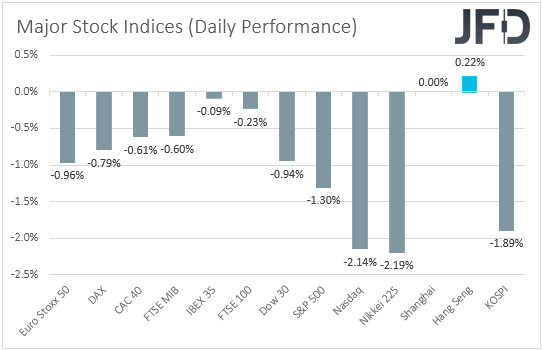
In our view, this is a continuation of last week’s selling, as the fundamental background remains the same. We believe that market participants remain concerned over persistently high inflation, the deadlock in the US Congress over the debt ceiling, and fears of Evergrande defaulting after it missed a second offshore bond payment last Thursday. What may have added some extra pressure during the US session is the fact that Facebook and its family of apps, Instagram and WhatsApp, were all down for hours yesterday. The stock of the social-media giant tumbled nearly 5%, dragging Nasdaq 2.14% down.
Besides the further deterioration in investors’ morale, another important theme yesterday was the outcome of the OPEC+ decision on oil output. In the midst of market chatter that some members were in favor of increasing production due to global supply shortages, the group decided to stick to the current plan of 400k bpd, perhaps as they continued to forecast excess supply early in 2022. This resulted in a spike in oil prices, with WTI now testing territories last seen in 2014. Usually, commodity and equity prices move in tandem. For example, during periods of very low inflation, higher commodity prices mean inflation may be making a comeback, which could eventually support an economy. However, this time around, the picture is totally different. With inflation in most places around the globe at extremely high levels, rising oil prices generate fears that this could persist for longer than previously thought, which, in turn, may force central banks to proceed with faster tightening. Expectations of faster tightening translate into expectations of faster rate hikes, which means more expensive borrowing for companies and lower present values, at least for growth firms which are valued based on estimated future cash flows. Thus, all this is negative for the stock market.
As for today, in Asia, we had an RBA monetary policy decision, with the Bank matching market expectations by keeping all its policy settings untouched. Officials said that they will continue to purchase government securities at the current pace until at least mid-February and maintained the view that interest rates are unlikely to rise before 2024. Yesterday, we said that we will look in the statement for any fresh concerns over the nation’s economic recovery, especially with daily covid infections staying near records and the Chinese economy slowing down, but we didn’t find any. On the contrary, officials appeared relatively optimistic, saying that the setback to the economic expansion is expected to be only temporary and that, as vaccination rates increase further and restrictions are eased, the economy is expected to bounce back.
Tonight, during the Asian session Wednesday, the central bank torch will be passed to the RBNZ. When they last met, officials of this Bank delayed raising interest rates, at a time when the financial community was more than certain over a hike. Policymakers changed their minds after the nation entered a lockdown due to new coronavirus cases, however, they signaled that they still expect to push the hike button before year end.
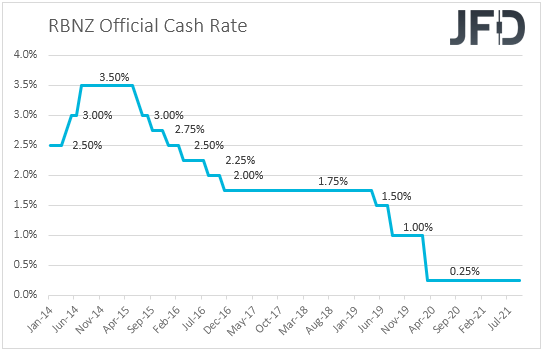
Market participants are betting that such a move could indeed take place at this gathering, but they only anticipate a 25bps rate increase. Any expectations over a double hike may have diminished recently as covid infections have spiked again, suggesting that a full economic reopening is still away. Therefore, with a quarter-point hike fully priced in, we don’t expect any Kiwi reaction on that. We believe that any move is likely to be triggered by the language in the accompanying statement. Anything suggesting a more cautious hike path could push the Kiwi lower. For the currency to strengthen, we need to see optimistic remarks pointing to faster hikes, a case we see as unlikely for now. Therefore, with all that in mind, we would consider the risks surrounding the Kiwi’s reaction to the meeting as tilted to the downside.
Nasdaq 100 – Technical Outlook
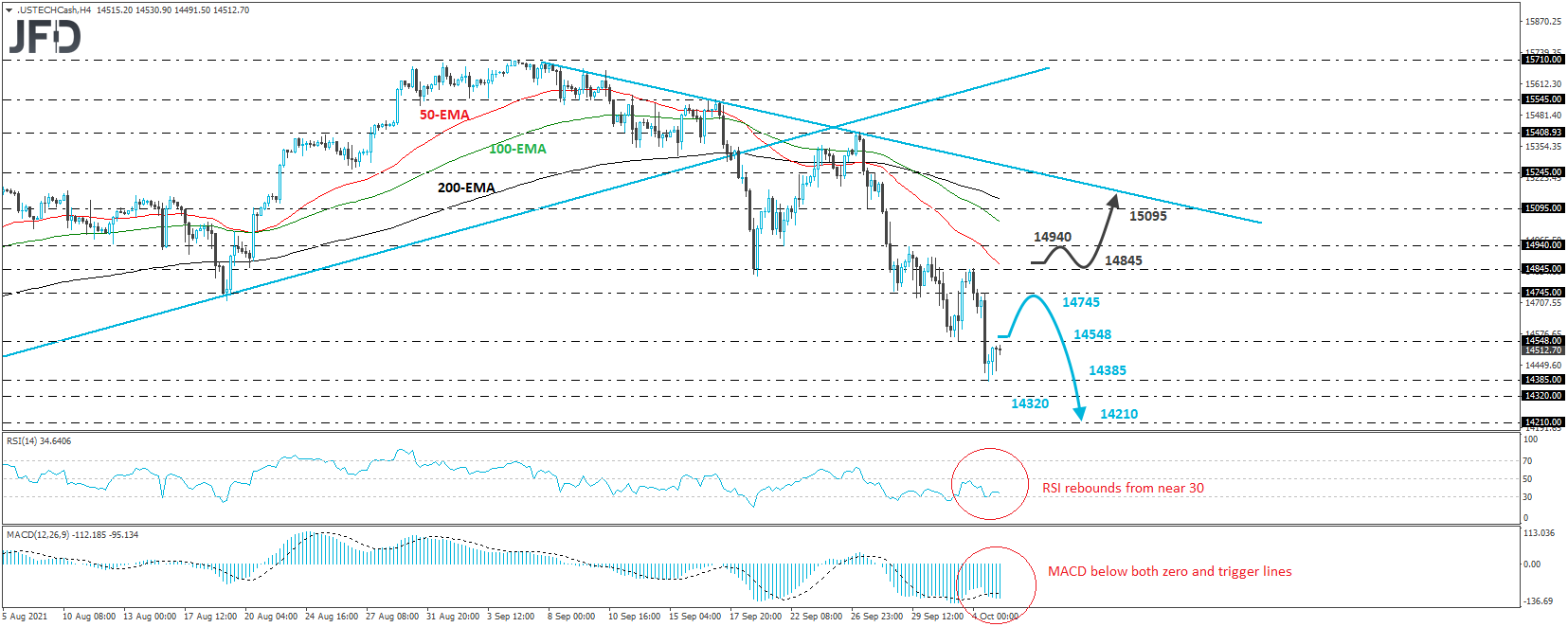
The Nasdaq 100 cash index fell sharply yesterday, breaking below Friday’s low of 14548, thereby confirming a forthcoming lower low. Then, then index hit support at 14385 and rebounded somewhat. Even if the rebound continues for a while more, the price structure on the 4-hour chart remains of lower highs and lower lows and thus, we will consider the short-term picture to still be negative.
As we already noted, the current rebound may continue for a while more, even above the Friday’s low of 14548, but the bears may take charge again from near the 14745 or 14845 resistances. If so, we may see another test at 14385 soon, the break of which could aim for the low of June 25th, at 14320. Another break, below 14320, could extend the slide towards the inside swing high of June 18th, at 14210.
We will start examining a larger correction to the upside, only if we see a break back above 14845. This may allow the bulls to take charge temporarily, and perhaps initially target the peak of September 29th, at 14940. If that barrier doesn’t hold, then we may experience extensions towards the inside swing low of September 27th, at 15095, or even the downside resistance line taken from the high of September 7th.
NZD/CAD – Technical Outlook
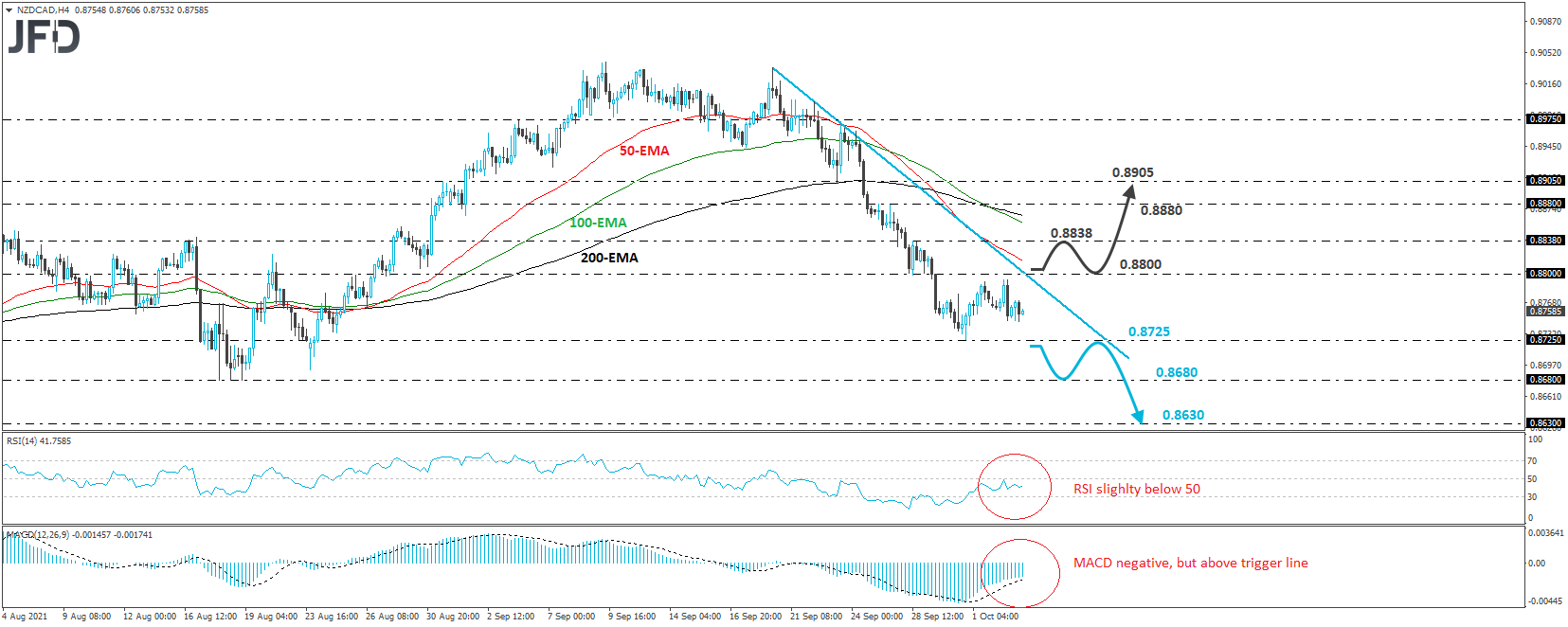
NZD/CAD traded slightly lower yesterday, after it hit resistance slightly below the 0.8800 zone, marked by the inside swing low of September 28th. Overall, the pair remains below the downside resistance line drawn from the high of September 20th, and thus, we will consider the short-term outlook to be cautiously bearish.
That said, in order to get confident on a trend continuation, we would like to see a clear dip below 0.8725, marked by the low of September 30th. This will confirm a forthcoming lower low and may target the 0.8680 zone, which provided support on August 18th and 19th, the break of which could pave the way towards the 0.8630 area, defined as a support by the lows of June 30th and July 2nd.
On the upside, we would like to see a rebound above 0.8800 before we abandon the bearish case. This may confirm the break above the aforementioned downside line and may allow the bulls to target the 0.8838 barrier. If they don’t stop there, we could experience extensions towards the 0.8880 hurdle, marked by the high of September 27th, or the 0.8905 territory, marked by the inside swing low of September 23rd.
As for the Rest of Today’s Events
Throughout the day, we will get the final composite and services PMIs from the Eurozone, the UK, and the US, but as it is always the case, they are expected to confirm their preliminary estimates. The ISM non-manufacturing index for the month is also due to be released and it is forecast to have declined to 60.0 from 61.7. From Canada, we have the nation’s trade balance for August.
With regards to the energy market, we have the API (American Petroleum Institute) report on crude oil inventories for last week, but as it is always the case, no forecast is available.
As for the speakers, we will get to hear from ECB President Christine Lagarde and Fed Vice Chair for Supervision Randal Quarles.
Disclaimer:
The content we produce does not constitute investment advice or investment recommendation (should not be considered as such) and does not in any way constitute an invitation to acquire any financial instrument or product. The Group of Companies of JFD, its affiliates, agents, directors, officers or employees are not liable for any damages that may be caused by individual comments or statements by JFD analysts and assumes no liability with respect to the completeness and correctness of the content presented. The investor is solely responsible for the risk of his investment decisions. Accordingly, you should seek, if you consider appropriate, relevant independent professional advice on the investment considered. The analyses and comments presented do not include any consideration of your personal investment objectives, financial circumstances or needs. The content has not been prepared in accordance with the legal requirements for financial analyses and must therefore be viewed by the reader as marketing information. JFD prohibits the duplication or publication without explicit approval.
CFDs are complex instruments and come with a high risk of losing money rapidly due to leverage. 73.90% of retail investor accounts lose money when trading CFDs with the Company. You should consider whether you understand how CFDs work and whether you can afford to take the high risk of losing your money. Please read the full Risk Disclosure.
Copyright 2021 JFD Group Ltd.