


The Kiwi was the main loser among the G10 currencies, coming under decent selling pressure after the RBNZ decided to expand its Large-Scale Asset Purchase program, adding that more action may be possible if needed, including negative interest rates. As for tonight, during the Asian morning Thursday, Australia’s employment report for July is due to be released. Even if the Aussie slides further on a potential soft report, we believe that its broader direction is likely to stay linked to developments surrounding the broader market sentiment.
Equities Slide as Risk Appetite Softens
The US dollar traded higher against all the other G10 currencies on Tuesday and during the Asian morning Wednesday. It gained the most versus NZD, AUD, and JPY in that order while it eked out the least gains against CAD.
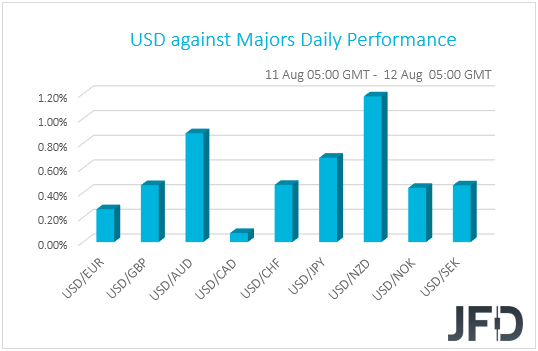
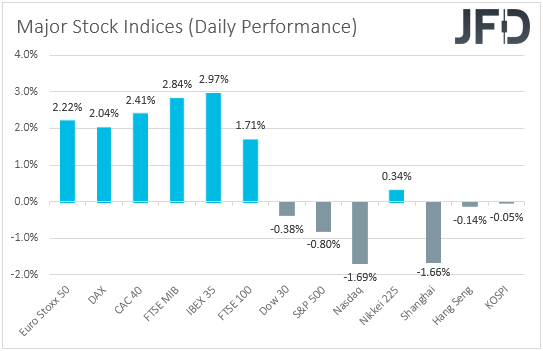
The strengthening of the US dollar, combined with the weakening of the risk-linked Aussie and Kiwi, suggests that trading turned risk off at some point yesterday. That said, bearing in mind that the safe-haven yen was among the main losers as well, we will turn our gaze to the equity world in order to get a clearer picture with regards to the broader investor morale.
There, major EU indices were a sea of green, boosted by the better-than-expected ZEW economic sentiment index for August, as well as by remarks from Russian President Vladimir Putin, who claimed that his nation has become the first country in the world to grant regulatory approval to a coronavirus vaccine. That said, sentiment took a 180-degree spin during the US session, with Wall Street’s main indices falling on average 0.96%. The reversal may have come as the deadlock between the White House and Congress over a coronavirus-aid package continued for a fourth day. With Trump’s orders seen not as helpful as a potential congressional deal, equities and risk linked assets may continue correcting lower for a while more, but anything pointing to approaching common ground in the days ahead could be a viable reason for investors to re-increase their risk exposures. The risk aversion rolled over into the Asian session today as well. Although Japan’s Nikkei gained 0.34%, China’s Shanghai Composite and Hong Kong’s Hang Seng are currently down 1.66% and 0.14% respectively.
RBNZ Expands Bond-buying
Back to the currencies, apart from the switch in the broader market sentiment, the Kiwi was also beaten by the overnight monetary policy decision of the RBNZ. The Bank decided to keep its Official Cash Rate (OCR) unchanged at 0.25%, but expanded its Large-Scale Asset Purchase (LSAP) program up to NZD 100bn from NZD 60bn, adding that a package of additional monetary instruments must remain in active preparation, including a negative OCR and purchases of foreign assets. Although they acknowledged that New Zealand had contained the spread of the coronavirus locally, they noted that the global economic disruption caused by the pandemic is persisting, and that’s why there remains a downside risk to their baseline economic scenario.
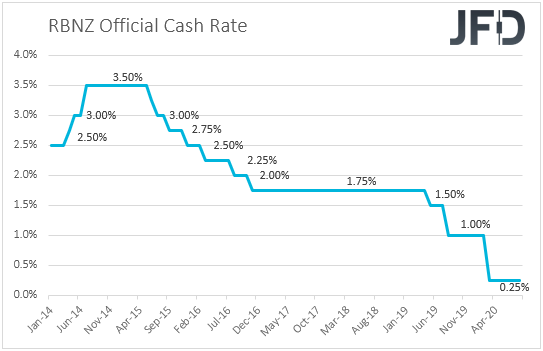
The Kiwi slid around 40 pips against the greenback at the time of the announcement, while the clear prospect of negative interest rates may keep it under selling interest for a while more. However, the broader direction of the risk-linked currency is likely to stay dependent on developments surrounding the broader market sentiment. Even if we see some further declines in the short run, a potential agreement between the White House and Congress in the US over a coronavirus-aid bill may be a decent reason for another reversal to the upside.
NZD/USD – Technical Outlook
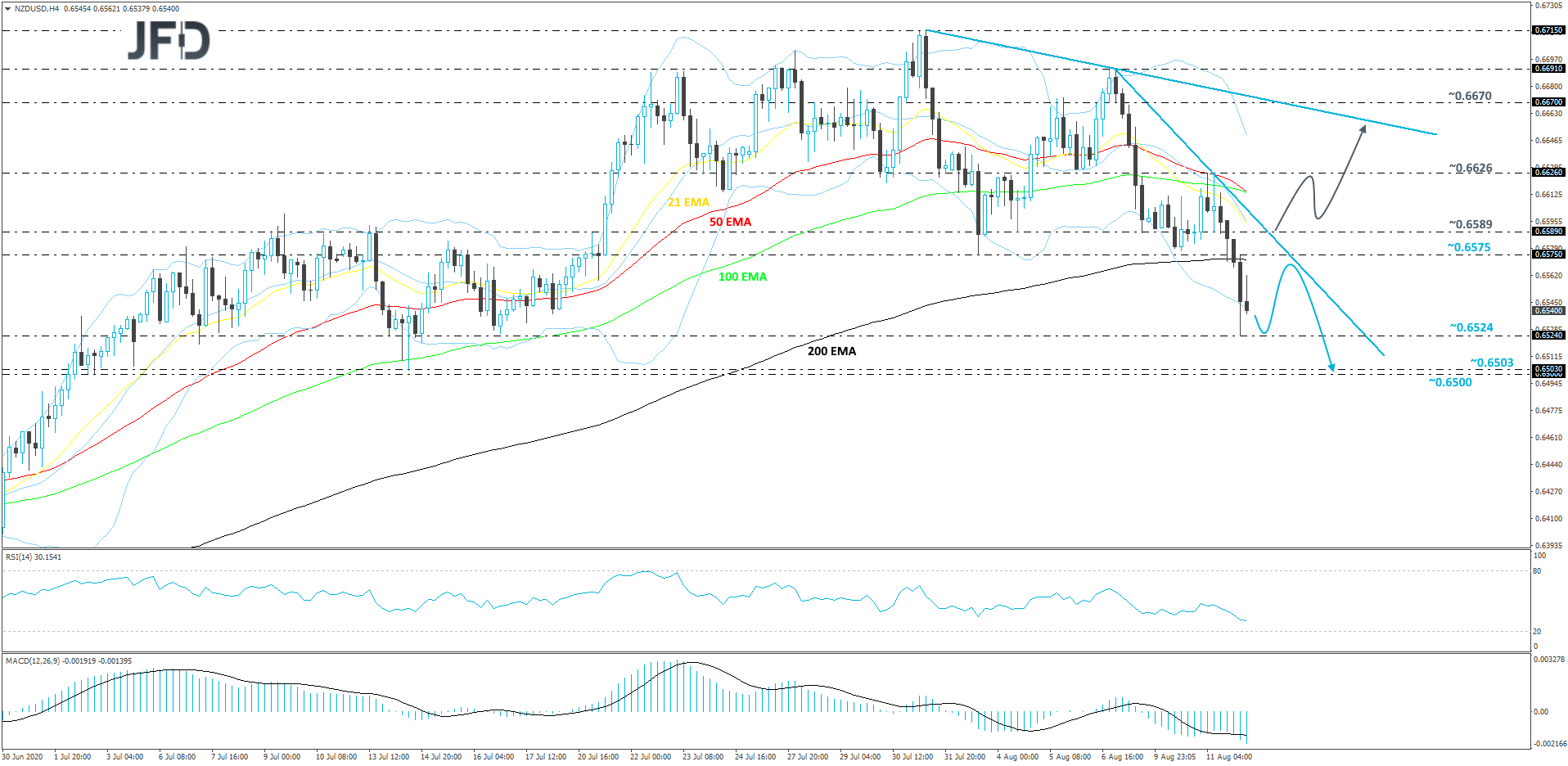
After hitting the 0.6715 barrier on the last day of July, NZD/USD started moving lower. Yesterday, the pair broke one of its key support areas, at 0.6575, this way confirming a lower low, which may invite more sellers into the game. At the same time, the rate is trading below a steep short-term tentative downside line taken from the high of August 8th. If the pair struggles to break that downside line, the near-term outlook could remain bearish for a while.
If NZD/USD continues to trade above the 0.6524 hurdle, which is the current lowest point of today, the rate could go for a slight correction back to the upside. That said, if the bulls find it hard to break the aforementioned downside line, this may result in another round of selling, as the bears might take the steering wheel back under their control. Another drop to the 0.6524 obstacle could force it to surrender this time and a break would confirm a new lower low, possibly opening the way for further declines. That’s when we will examine the area near the psychological 0.6500 level, marked by an intraday swing low of July 2nd and near the low of July 14th.
Alternatively, if the previously-discussed downside line breaks and the rate moves above the 0.6589 hurdle, marked by the lows of August 4th and 7th, and also by an intraday swing low of yesterday, that may attract a few extra buyers into the game. NZD/USD might then drift to yesterday’s high, at 0.6626, a break of which could clear the way towards another short-term tentative downside resistance line taken from the high of July 31st. If the pair gets held near that line, this whole move higher could be considered as a corrective one.
AUD-Traders Lock Gaze on Jobs Data
As for tonight, during the Asian morning Thursday, Australia’s employment report for July is coming out. The unemployment rate is forecast to have risen to 7.8% from 7.4%, while the net change in employment is anticipated to show that the economy has added 40.0k jobs after gaining 210.8k in June.
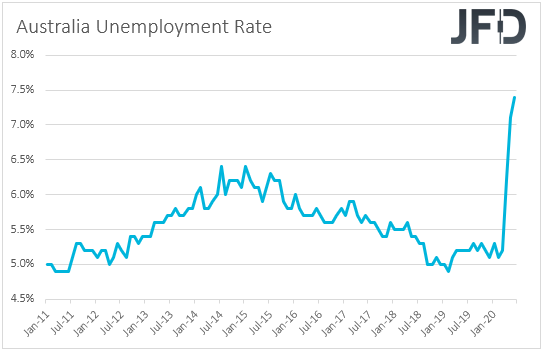
At last week’s gathering, the RBA kept its targets for the cash rate and the yield on 3-year government bonds unchanged at 0.25%, noting that the Bank’s mid-March package of support is working as expected. What’s more, officials noted that even though the worst of this contraction has now passed, the outlook remains highly uncertain and that the recovery will be dependent on the containment of the virus. With the Bank also noting that in its baseline scenario, the unemployment rate is likely to rise to around 10% later this year, we don’t expect a rise to 7.8% to come as a surprise to policymakers. Thus, we don’t expect this report to prove a game changer with regards to the RBA’s plans.
Similarly with the Kiwi, even if the Aussie slides somewhat on a weak report, the main driver for this currency is also likely to be developments surrounding the broader investor morale. Any positive headlines over a potential accord in the US over a new fiscal package may invite buyers of this risk-linked currency back into the action.
AUD/CAD – Technical Outlook
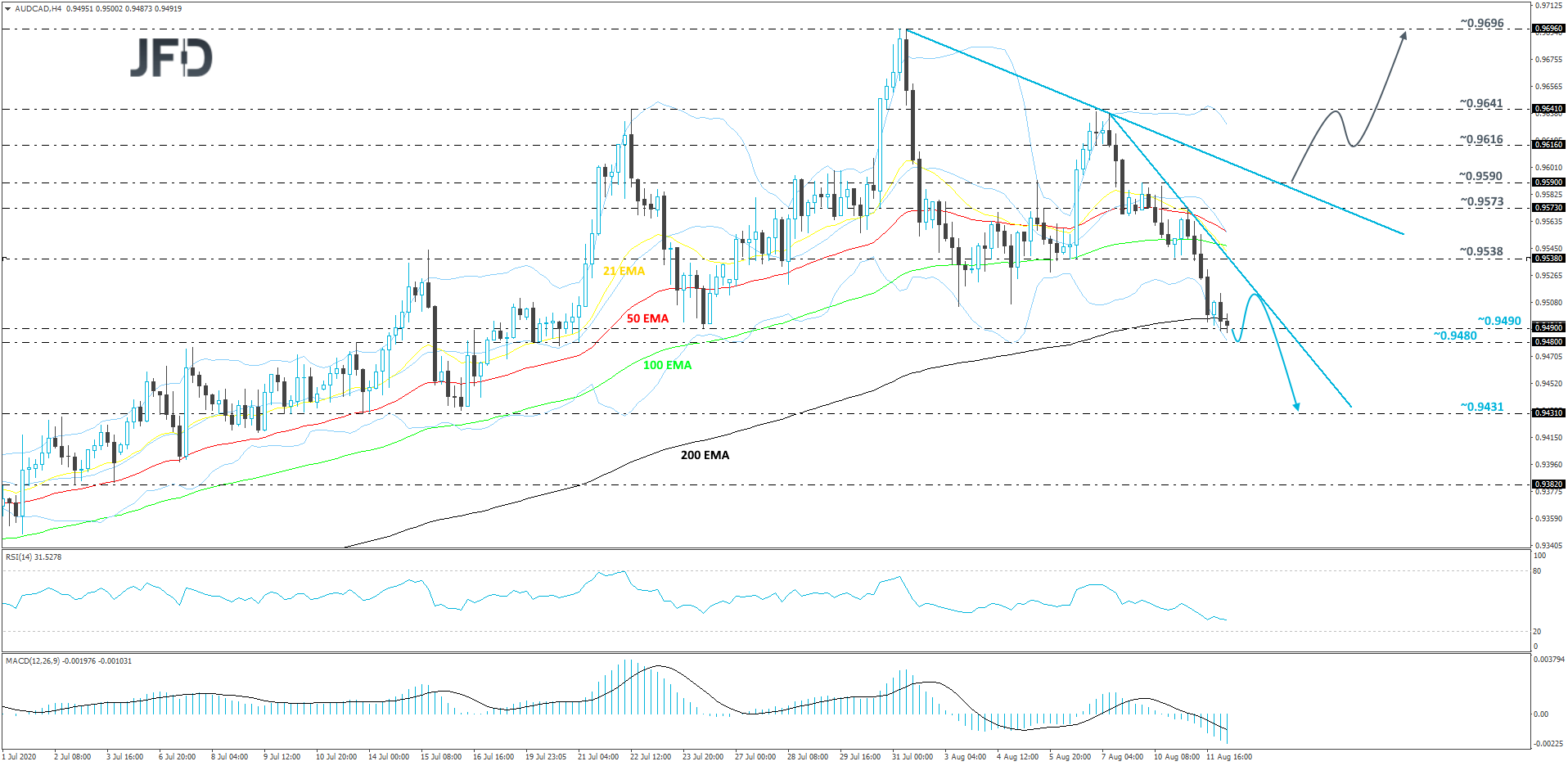
AUD/CAD continues to drift lower and at the time of writing, it is trading slightly below the 200 EMA on our 4-hour chart. In addition to that, the rate is also running below a short-term tentative downside resistance line taken from the high of August 7th. At some point in the very near future, there is chance we may see a correction higher, however, if the pair stays below that downside line, we will remain bearish.
If AUD/CAD moves a bit lower, but finds good support near the 0.9480 hurdle, marked by the high of July 13th and the low of July 21st, that could make the bulls a bit more confident in themselves, allowing them to raise the rate to the aforementioned downside line. But all that confidence might fade away if the pair struggles to overcome that downside line, as the bears could quickly jump back into the action and drive AUD/CAD back to the 0.9480 obstacle. If this time that obstacle cannot withstand the bearish pressure and breaks, such a move would confirm a forthcoming lower low and may open the way to the 0.9431 area, marked near the lows of July 10th, 13th and 16th.
In order to shift our attention to some higher areas, not only that we would like to see a break of the above-discussed downside line, but also a break of another short-term tentative downside resistance line taken from the high of July 31st. In addition to that, a push above the 0.9590 barrier, which is the high of August 10th, may strengthen the bullish case and send the rate to the 0.9616 obstacle, or even the 0.9641 zone, marked near the peaks of July 22nd and August 7th. Initially, AUD/CAD might stall there temporarily, but if the bulls are still in control, a break of that zone could set the stage for a push to the 0.9696 level, marked by the current highest point of this year.
As for the Rest of Today’s Events
Ahead of the EU open, we already got the 1st estimate of the UK GDP for Q2, as well as the nation’s industrial and manufacturing production rates for June. Economic activity in the UK tumbled 20.4%, which is marginally better than the -20.9% forecast, something that took the yoy rate down to -21.7% from -1.7%. Both the IP and MP rates increased to 9.3% and 11.0% from +6.2% and +8.3% respectively.
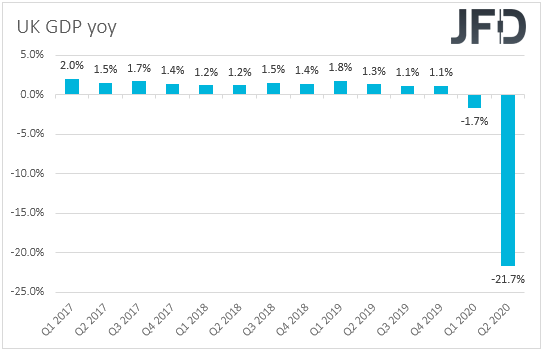
At last week’s gathering, the BoE kept its policy unchanged and although it highlighted that the economic outlook remains uncertain, it upgraded its GDP forecast for this year, but with the condition that the direct impact of the pandemic on the economy will dissipate gradually over the forecast period. In the quarterly Monetary Policy Report, officials discussed the effectiveness of negative interest rates and noted that they will continue to monitor their appropriateness. That said, we don’t expect the contraction in GDP to increase speculation that the Bank could adopt negative rates soon. After all, officials kept policy unchanged last week, after noting that economic activity is likely to fall more than 20% in Q2. We prefer to pay more attention to data regarding Q3 before we start examining whether officials will consider negative rates at some point in the foreseeable future.
From Sweden, we have the CPIs for July. Both the CPI and CPIF rates are expected to have declined to +0.5% yoy and +0.4% yoy respectively, after both sitting at 0.7% yoy in June. That said, as it is always the case, we prefer to pay more attention to the core CPIF metric, which excludes the volatile items of energy. That rate stood at 1.3% in June.
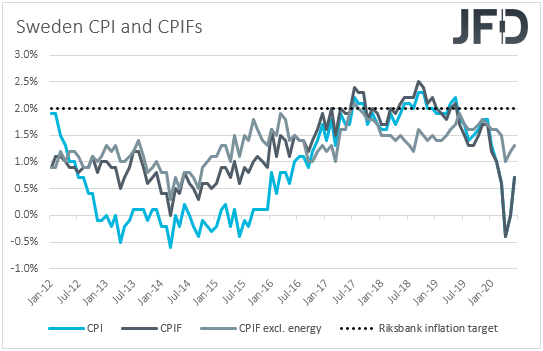
At its latest gathering, the Riksbank decided to extend its framework for its asset purchases from SEK 300bn to SEK 500bn, up to the end of June 2021, while it announced that in September, it will start purchasing corporate bonds. The Board also decided to cut interest rates and extend maturities on lending to banks, despite keeping the repo rate unchanged at 0%. We believe that a potential slowdown in core inflation is unlikely to prompt additional action at the Bank’s upcoming gathering, but it may keep officials willing to do so if the situation continues to worsen.
From the Eurozone, we get industrial production data for June. Expectations are for a small slowdown, to +10.0% mom from +12.4%. However, this would still be a decent monthly rate as it would drive the yoy rate up to -11.6% from -20.9%.
Later in the day, the US CPIs for July are coming out. The headline rate is anticipated to have increased to +0.8% yoy from +0.6%, while the core one is expected to have held steady at +1.2%. Although this could lessen somewhat the probability for the Fed to expand its stimulative efforts, all the attention in the US is likely to stay on whether the Congress can eventually reach consensus on a coronavirus-aid package.
Disclaimer:
The content we produce does not constitute investment advice or investment recommendation (should not be considered as such) and does not in any way constitute an invitation to acquire any financial instrument or product. The Group of Companies of JFD, its affiliates, agents, directors, officers or employees are not liable for any damages that may be caused by individual comments or statements by JFD analysts and assumes no liability with respect to the completeness and correctness of the content presented. The investor is solely responsible for the risk of his investment decisions. Accordingly, you should seek, if you consider appropriate, relevant independent professional advice on the investment considered. The analyses and comments presented do not include any consideration of your personal investment objectives, financial circumstances or needs. The content has not been prepared in accordance with the legal requirements for financial analyses and must therefore be viewed by the reader as marketing information. JFD prohibits the duplication or publication without explicit approval.
CFDs are complex instruments and come with a high risk of losing money rapidly due to leverage. 84.25% of retail investor accounts lose money when trading CFDs with the Company. You should consider whether you understand how CFDs work and whether you can afford to take the high risk of losing your money. Please read the full Risk Disclosure.
Copyright 2020 JFD Group Ltd.