


We have a relatively busy week ahead of us, with three central banks deciding on monetary policy: The RBA, the BoE, and the ECB. Only the BoE is expected to act and lift interest rates, but this doesn’t mean that the others will pass unnoticed. On the contrary, participants may be eager to find out opinions and views with regards to their future course of action. On Friday, we have the US employment report, which could add credence to the view of a March hike by the Fed and multiple more for the rest of the year.
On Monday, during the Asian trading, we already got Japan’s preliminary industrial production for January and the retail sales for December. IP slid 1.0% mom, after rising 7.0% in December, while retail sales slowed to +1.4% yoy from +1.9%. Chinese markets were closed and will stay closed for the whole week, in celebration of the Lunar New Year.
Later in the day, we have Eurozone’s preliminary GDP for Q4 and Germany’s preliminary inflation data for January. Eurozone’s GDP is expected to have slowed to +0.3% qoq form +2.2%, but this would take the yoy rate up to +4.7% from 3.9%. Both Germany’s CPI and HICP rates are expected to have declined, to +4.3% yoy and +4.7% yoy, from +5.3% and +5.7% respectively.
On Tuesday, during the Asian session, the RBA decides on interest rates, but no action is expected. At their latest gathering, officials noted that rates could start rising in 2023, meaning that they will stay untouched this year. However, market participants have a different opinion. According to the ASX 30-day interbank cash rate futures yield curve, they expect the first rate hike to be delivered in May, while they see the OCR exceeding 1.0% by year end. In other words, they anticipate slightly more than 4 increases this year.
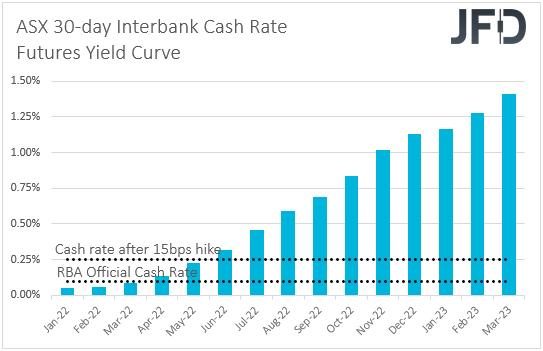
Yes, Australian data have been supporting the idea that the lift-offs could start this year, with the unemployment rate sliding decently in December, and inflation for the last three months of 2021 accelerating by more than expected. However, even if the RBA sounds more optimistic than previously, and perhaps opens the door for higher rates in 2022, we see the notion of hinting 4 hikes by December as very unlikely. Therefore, with all that in mind, we see ample room for disappointment, something that could add extra pressure to the already wounded Aussie.
As for the data, ahead of the RBA decision, Australia releases its retail sales for December, and Japan its employment report for the same month. Later in the day, we get the final manufacturing PMIs for January from the Eurozone, the UK, and the US, but as it is usually the case, they are expected to confirm their preliminary estimates. The US ISM manufacturing index for the month is also coming out and expectations are for a slide to 57.5 from 58.7. In Canada, the monthly GDP for November is expected to reveal a slowdown to+0.4% mom from +0.8%.
On Wednesday, in the early Asian morning, New Zealand’s unemployment rate for Q4 is expected to have stayed unchanged, with the employment change expected to have slowed to +0.3% qoq from +2.0%. That said, the Labor Costs Index is expected to have accelerated to +2.9% yoy from +2.5%, keeping the door open for more rate hikes by the RBNZ.
In the Eurozone, both headline and core inflation are expected to have slowed notably, adding to chances that the ECB will sound dovish on Thursday, while in the US, the ADP report is expected to show that the private sector added 208k jobs in January from 807k in December.
On Thursday, the central bank torch will be passed to the BoE and the ECB. First, we have the BoE, which, at its latest gathering, decided to push the hike button for the first time since the outbreak of the coronavirus, lifting interest rates to 0.25% from 0.10%, and adding that more modest tightening is underway. Recent UK data have been relatively supportive, with the unemployment rate declining further in November, the CPIs accelerating more than anticipated in December, and the preliminary PMIs revealing further economic expansion during the month of January, despite at a slower pace than in December.
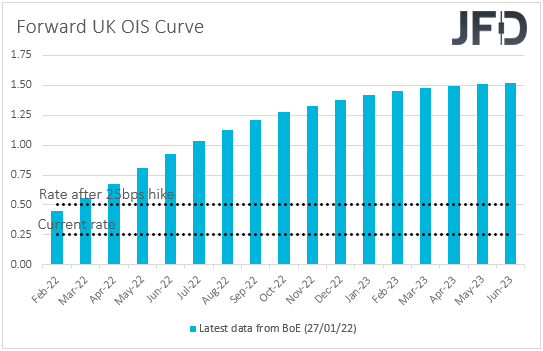
Thus, we do see the case for a quarter-point increase at this gathering, and, actually, this is not only our own view, but the market consensus as well. According to the UK OIS (Overnight Index Swaps) forward yield curve, investors are fully pricing in such an action, while they see the case for nearly four more hikes by the end of the year. Thus, a 25bps hike by itself is unlikely to prove a major market mover. Market attention is likely to fall to clues and hints on how fast policymakers are planning to proceed with upcoming lift-offs. What’s more, remember that 0.5% is the level the Bank placed as a threshold for beginning to shrink its balance sheet. Therefore, we will look for references on that front as well, as well as on the updated economic projections. Let’s not forget that this will be a Super Thursday for the BoE. Anything suggesting an aggressive rate path, and a balance-sheet reduction as early as this week, could support the British pound, which due to monetary policy divergencies could keep outperforming currencies like the Aussie and the euro.
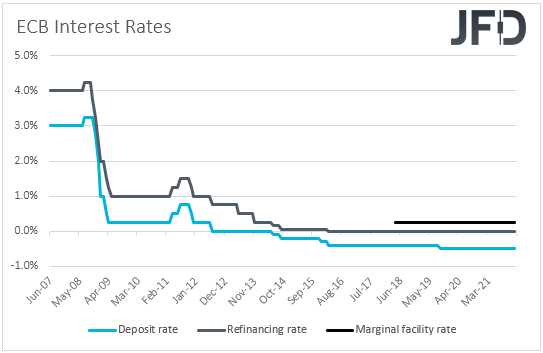
Speaking about the euro, soon after the BoE decision, we have the ECB deciding on monetary policy, but no action is expected from this Bank. Despite market participants pricing in a small rate increase by the end of this year, the Governing Council has been holding the view that something like that is unlikely. ECB President Christine Lagarde expressed that view several times in the past, while a couple of weeks ago, she said that inflation in the Eurozone will decrease gradually over the course of the year and that the ECB did not need to act as boldly as the Fed, due to a different economic situation. Therefore, with the GDP and the CPIs expected to reveal a slowdown for Q4 and January respectively, we believe that Lagarde and her colleagues will repeat the view that interest rates are unlikely to be lifted this year, something that could come as a disappointment to those expecting a small lift-off, and thus, the euro may come under more selling interest. Actually, this could be the case even before the ECB meeting, if the aforementioned economic data disappoint by a large margin.
As for Thursday’s data, we have the final Markit services and composite PMIs for January from the Eurozone, the UK, and the US, as well as the ISM non-manufacturing index for the month. As it is usually the case, the final Markit prints are expected to confirm their initial forecasts, while the ISM index is anticipated to have declined somewhat, to 59.3 from 62.3.
Finally, on Friday, the main item on the agenda may be the US employment report for January. Nonfarm payrolls are expected to have slowed to 155k from 199k, while the unemployment rate is forecast to have stayed unchanged at 3.9%. Average hourly earnings are expected to have slowed to +0.5% mom from +0.6% mom, but barring any major deviations to the prior monthly prints, this would take the yoy rate up to +5.2% from 4.7%, which could add to expectations of further acceleration in US inflation for the months to come.
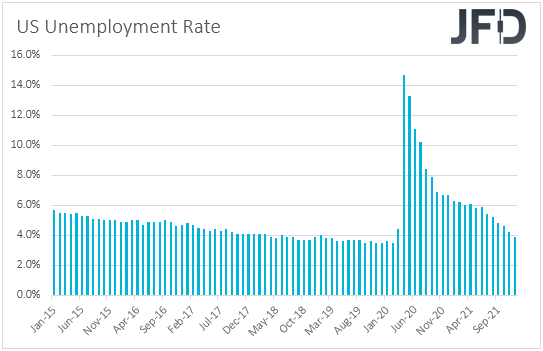
In our view, the forecasts point to another decent report, despite a potential slowdown in the NFPs, which could add credence to the Fed’s view of a March rate hike, and some more during the rest of the year. Remember, that the December “dot plot” pointed to three quarter-point liftoffs for 2022, but according to the Fed funds futures, investors are convinced that the Committee will proceed with nearly five. Thus, if the forecasts are met, or even better exceeded, market participants may become more confident with regards to their view and could buy more US dollars.
At the same time with the US employment report, we get jobs data for January from Canada as well. The unemployment rate is forecast to have risen to 6.2% from 5.9%, while the employment change is anticipated to show that the Canadian economy has lost 125k jobs after adding 54.7k in December. A weak report could hurt the Canadian dollar, but not much in our view, as last week, the BoC provided strong signals with regards to a rate hike in March, and we don’t believe that these numbers could change that.
The content we produce does not constitute investment advice or investment recommendation (should not be considered as such) and does not in any way constitute an invitation to acquire any financial instrument or product. The Group of Companies of JFD, its affiliates, agents, directors, officers or employees are not liable for any damages that may be caused by individual comments or statements by JFD analysts and assumes no liability with respect to the completeness and correctness of the content presented. The investor is solely responsible for the risk of his investment decisions. Accordingly, you should seek, if you consider appropriate, relevant independent professional advice on the investment considered. The analyses and comments presented do not include any consideration of your personal investment objectives, financial circumstances or needs. The content has not been prepared in accordance with the legal requirements for financial analyses and must therefore be viewed by the reader as marketing information. JFD prohibits the duplication or publication without explicit approval.
CFDs are complex instruments and come with a high risk of losing money rapidly due to leverage. 68.02% of retail investor accounts lose money when trading CFDs with the Company. You should consider whether you understand how CFDs work and whether you can afford to take the high risk of losing your money. Please read the full Risk Disclosure.
Copyright 2022 JFD Group Ltd.