


Following the Fed, the BoJ and the BoE monetary policy decisions last week, the central bank torch will be passed to the RBA and the RBNZ. With regards to the RBA, although the Bank has kept the door for further easing at its latest gathering, we don’t expect a cut to be delivered this time. However, we do expect a cut from the RBNZ, which in June signaled that more easing may be underway, with the forward guidance appearing twice in the statement. As for the economic releases, we get preliminary GDP data for Q2 from Japan and the UK, as well as Canada’s employment report for July.
Monday is a PMI day. During the European morning, we get the final services and composite PMIs for July from the Eurozone member-states from which we got the manufacturing prints last Thursday. At it is always the case, expectations are for the final prints to confirm their preliminary estimates. The UK services PMI is also due to be released and is anticipated to have risen slightly, to 50.4 from 50.2. In the US, the final Markit services and composite PMIs are also forecast to match their initial estimates, while the ISM non-manufacturing index is expected to have risen to 55.5 from 55.1.
On Tuesday, during the Asian morning, the RBA decides on monetary policy. At its prior meeting, the Bank decided to cut rates to a new record low of +1.00%, with officials noting that they will continue to monitor developments in the labor market closely and adjust policy “if needed” to support sustainable growth and the achievement of the inflation target. In June, the guidance was the same but without the “if needed” part. So, in our view, its addition meant that, although the door for further action was not closed, the RBA was not in a rush to cut again.
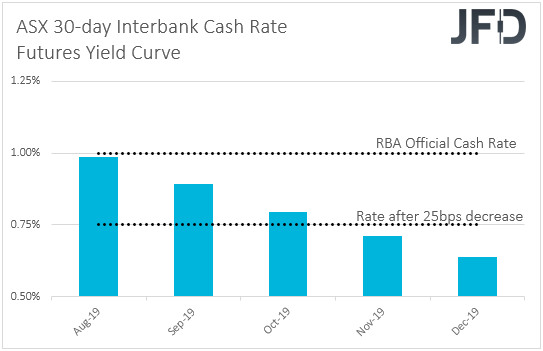
Since then, employment data showed the unemployment rate remained at 5.2% in June, above the 4.5% mark, which the RBA believes would start generating inflationary pressures, while the net change in employment slid to 0.5k from 42.3k in May. What’s more, although the headline inflation rate for July rose more than expected, it remained below the RBA’s latest forecast. The trimmed mean rate stood a tick above its respective projection. In our view, the data suggest that the Bank may indeed not be in a rush to cut again at this gathering, but they support further action in the months to come. That view appears to be shared among market participants as well. According to the ASX 30-day interbank cash rate futures implied yield curve, they are almost fully pricing in the next quarter-point cut to come in October.
As for Tuesday’s data, during the Asian morning, New Zealand’s employment report for Q2 is coming out. The unemployment rate is forecast to have ticked up to 4.3% from 4.2%, while the employment change is anticipated to have shown a 0.3% qoq job gain after a 0.2% loss in Q1. The Labor Cost Index is expected to have accelerated to +0.7% from +0.3%, which will drive the yoy rate a tick higher, to +2.1% from 2.0%. Overall, the forecasts point to a decent report, but we doubt that it could materially alter market expectations with regards to the RBNZ just a day before the Bank announces its monetary policy decision.
Later in the day, Germany’s factory orders are expected to have rebounded 0.5% in June, after sliding 2.2% in May, while the US JOLTs Job Openings for the same month are expected to have slid somewhat, to 7.27mn from 7.32mn in May.
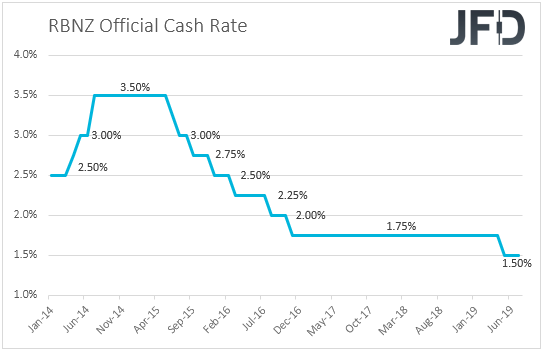
On Wednesday, it’s the turn of the RBNZ to decide on interest rates. Last time they met, officials of this Bank decided to keep rates steady, after cutting them to 1.50% in May, and signaled that more easing may be underway, with the forward guidance appearing twice in the statement. Since then, market participants have ramped up their expectations with regards to a policy move as early as at this meeting, with the probability for a 25bps reduction standing at 100% according to New Zealand’s OIS (Overnight Index Swaps). Bearing in mind that a 25bps cut is a “done deal” in the eyes of investors, if indeed this is what the Bank decides to do, attention will quickly turn to the accompanying statement, the updated economic projections, as well as the press conference by Governor Adrian Orr. Market participants will be eager to find out whether more cuts are underway, and if so, when is the next one likely to be delivered.
As for Wednesday’s data, the only one worth mentioning is Canada’s Ivey PMI for July, which is expected to have risen to 52.7 from 52.4.
On Thursday, Asian time, China’s trade balance for July is coming out and the forecast suggests that the nation’s surplus has declined to USD 44.20bn from USD 50.98bn. Both exports and imports are expected to have slid at a faster pace than in June. Specifically, exports are anticipated to have slid 2.2% yoy after declining 1.3%, while imports are expected to have fallen 7.6% after tumbling 7.3% the previous month.
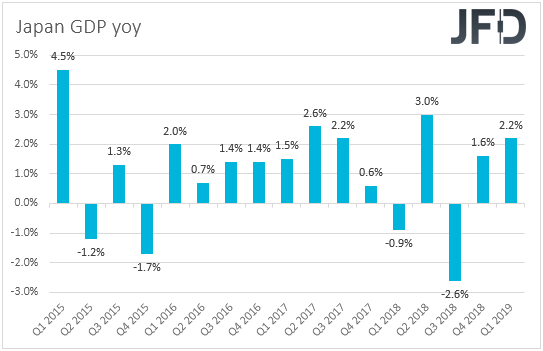
Finally, on Friday, during the Asian morning, Japan’s preliminary GDP for Q2 is due to be released. Expectations are for the qoq rate to have declined to +0.1% from +0.6%, which will drive the yoy rate down to +0.4% from +2.2%. At last week’s meeting, BoJ policymakers kept their policy and guidance unchanged, but noted that they will not “hesitate to take additional easing measures if there is a greater possibility that the momentum towards achieving the price stability target will be lost”. With all inflation metrics well below that objective, a notable slowdown in economic activity may increase the need for fresh stimulus by the BoJ. From China, we get the CPI and PPI rates for July, and both of them are expected to have remained unchanged at 2.7% and 0.0% respectively.
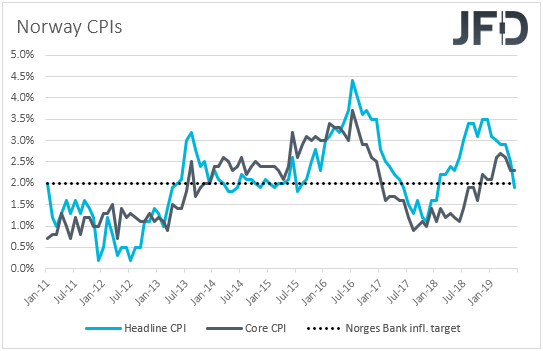
During the European morning, Norway’s CPIs for July are scheduled to be released, with both the headline and core rates expected to have ticked down to +1.8% yoy and +2.2% yoy, from +1.9% and +2.3% respectively. The headline rate would be in line with the Norges Bank’s projection for the month, but the core rate would be slightly below its respective projection, which is at +2.4% yoy. That said, it would still be above the Bank’s inflation aim of 2.0%, something that may allow Norwegian policymakers to maintain the view with regards to further rate increased later this year.
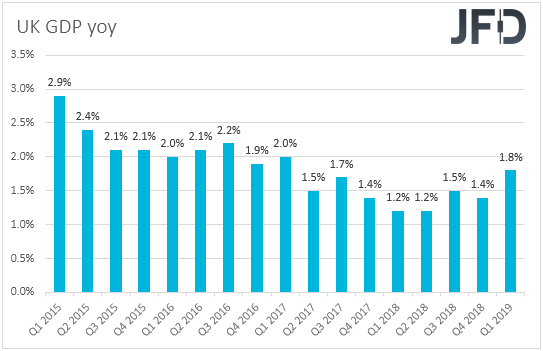
From the UK, the 1st estimate of GDP for Q2 is coming out. Expectations are for the UK economy to have stagnated after growing 0.5% qoq in Q1, which would drive the yoy rate down to +1.4% from +1.8%. Industrial and manufacturing production for June are also due to be released, alongside the trade balance for the month. IP is forecast to have declined 0.2% mom after rising 1.4% in May, while MP is expected to have slid 0.1% mom after rising 1.4% as well. With regards to the nation’s trade balance, expectations are for the deficit to have widened to GBP 11.86bn from GBP 11.52bn. A soft batch of data will add more credence to the view that Brexit uncertainty is leaving marks on the UK economy, but we don’t expect a major market reaction. Following the disappointing PMIs for June, investors have been prepared for a soft reading in economic growth, while the BoE itself already noted last week that it estimates a flat print. Although we remain bearish on the pound, we believe that a negative GDP rate is needed to trigger an instant and notable slide.
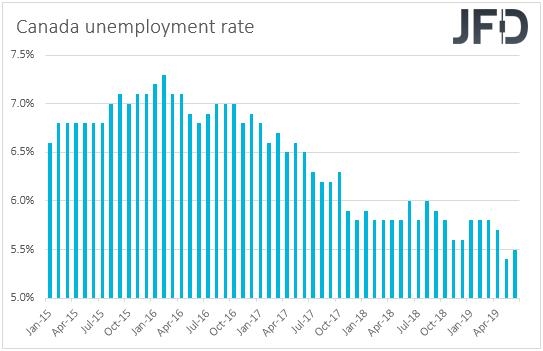
Later in the day, we get Canada’s employment report for July. The unemployment rate is expected to have held steady at 5.5%, while the net change in employment is forecast to show that the economy added 12.5k jobs after losing 2.2k in June. At their latest meeting, BoC policymakers kept interest rates unchanged and noted that the degree of accommodation provided by the current rate remains appropriate, staying among the very few major central banks that have not turned their eyes to the cut button yet, although they appeared concerned with regards to the US-China trade conflict.
Since then, inflation for June slowed in both headline and core terms, but both rates stood at 2.0%, which is the midpoint of the BoC’s target range. What’s more, GDP for May slowed less than expected. So, combined with the aforementioned data, a decent employment report may allow BoC officials to stay distant from the cut button, even if Trump’s latest threat towards China keeps them concerned on the global trade front.
Disclaimer:
The content we produce does not constitute investment advice or investment recommendation (should not be considered as such) and does not in any way constitute an invitation to acquire any financial instrument or product. The Group of Companies of JFD, its affiliates, agents, directors, officers or employees are not liable for any damages that may be caused by individual comments or statements by JFD analysts and assumes no liability with respect to the completeness and correctness of the content presented. The investor is solely responsible for the risk of his investment decisions. Accordingly, you should seek, if you consider appropriate, relevant independent professional advice on the investment considered. The analyses and comments presented do not include any consideration of your personal investment objectives, financial circumstances or needs. The content has not been prepared in accordance with the legal requirements for financial analyses and must therefore be viewed by the reader as marketing information. JFD prohibits the duplication or publication without explicit approval.
75% of the retail investor accounts lose money when trading CFDs with this provider. You should consider whether you can afford to take the high risk of losing your money. Please read the full Risk Disclosure.
Copyright 2019 JFD Group Ltd