


We have two major central banks deciding on monetary policy this week, and those are the RBA and the BoC. We expect the RBA to maintain its cautious stance and push back against interest rate hike expectations for next year. On the other hand, we believe that the BoC will maintain an upbeat view and perhaps allow bets over a rate hike in coming months, to stay elevated. In the US, we have the CPIs for November, where further acceleration could add credence to Fed Chair Powell’s view that QE tapering should end sooner than previously estimated.
Monday appears to be a relatively light day, with the only release worth mentioning being the UK construction PMI for November, which is expected to have declined to 52.0 from 54.6.
On Tuesday, during the Asian session, the RBA decides on monetary policy. At their latest gathering, officials of this Bank maintained their core policies – rates and QE – unchanged but decided to discontinue the 10bps April 2024 yield target. They also abandoned the forward guidance that interest rates are most likely to stay unchanged at least until 2024 and suggested that this could happen in 2023.
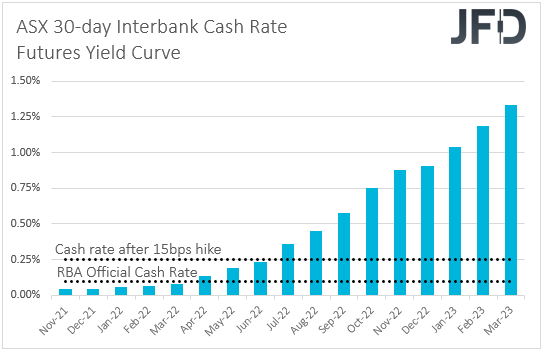
Since then, market participants remained convinced that policymakers could change their mind and perhaps deliver as many as three hike during the course of the next year, despite Governor Lowe making it clear that data and forecasts did not warrant an increase in 2022. Data after the meeting showed that the unemployment rate jumped to 5.2% in October from 4.6%, with the economy seeing another month of lost jobs, while economic activity, although at a slower-than-expected pace, contracted in Q3. All this, combined with a slowing headline inflation in Q3, and underlying metrics near the lower end of the RBA’s 2-3% target range, suggests that officials are unlikely to appear more hawkish this time around. Having also in mind the slowdown in China, we would expect them to reiterate the view that no hikes are on the schedule for next year, something that could eventually convince some market participants that this may indeed be the case. Therefore, expectations on that front could get pushed back, which could result in further selling in the already wounded Aussie. The risk-linked currency has been mostly driven by developments surrounding the broader market sentiment, and as long as investors remain concerned over the new coronavirus variant and what economic implications new restrictive measures around the globe could have, we see the case for the latest downtrend to continue for a while longer. A cautious RBA could just add extra fuel.
On Wednesday, the central bank torch will be passed to the BoC. At its latest meeting, this Bank unexpectedly ended its QE program, maintaining an optimistic stance. Data since then showed that Canada’s labor market continued to improve in October and performed even better in November, with the economy adding much more jobs that the forecast suggested, and the unemployment rate sliding to 6.0% from 6.7%. Both the headline and core CPIs for October accelerated further above the upper end of the BoC’s target range of 1-3%, while GDP data revealed that the economy rebounded by much more than anticipated in Q3.
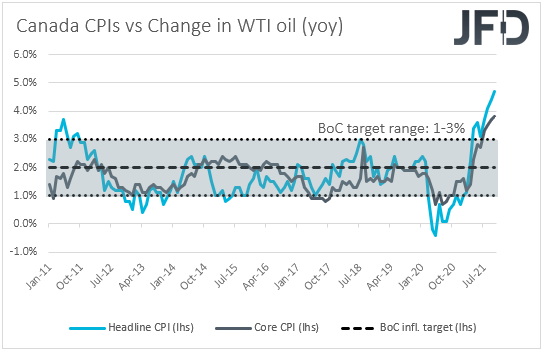
All this data suggests that BoC could maintain an upbeat stance, allowing expectations that a hike could be looming in upcoming months, to stay elevated. However, it remains to be seen whether the new coronavirus variant would affect policymakers’ stance. We believe that it is too early for them to switch to a more cautious stance. They may prefer to wait for upcoming economic data before they arrive to safer conclusions about the impact of the coronavirus and its new mutation. For now, we expect them to stay optimistic, something that could support the Loonie at the time of the release. That said, with the broader sentiment staying subdued lately, and oil prices turning down, this risk-linked currency could stay in downtrend mode as well. For now, we will treat any BoC-related rebound as a corrective bounce.
On Thursday, the only noteworthy data set, besides the US initial jobless claims, which we get every week, is China’s CPI and PPI for November. The CPI rate is expected to have risen to +2.5% yoy from +1.5%, while the PPI one is forecast to have slid to +12.6% yoy from +13.5%.
Finally, on Friday, during the early European session, the UK releases its monthly GDP for October, alongside the industrial and manufacturing production rates for the month. There is no forecast for the monthly GDP rate, but the yoy rate is anticipated to have jumped to +22.2% from +6.6%. Industrial production is anticipated to have rebounded +0.2% mom after sliding 0.4%, while the manufacturing production rate is forecast to have held steady at +0.1% mom.
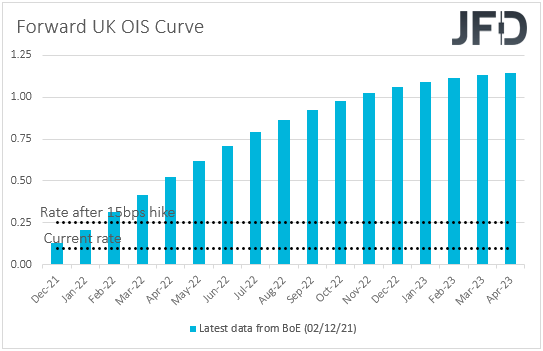
Lately, due to fresh coronavirus-related worries, bets around a December hike by the BoE have declined, with most market participants now believing that officials may prefer to wait and act after the turn of the year. This, combined with the pound’s strengthening correlation with risk sentiment, have brought the currency under selling interest. So, with that in mind, it remains to be seen whether upbeat data on Friday will be enough to revive some speculation over a December hike, and perhaps provide some support to the pound.
Later in the day, the spotlight is likely to turn to the US CPIs for November. The headline CPI is forecast to have accelerated further, to +6.7% yoy from +6.2%, while the core rate is expected to have increased to +4.9% yoy from +4.6%.
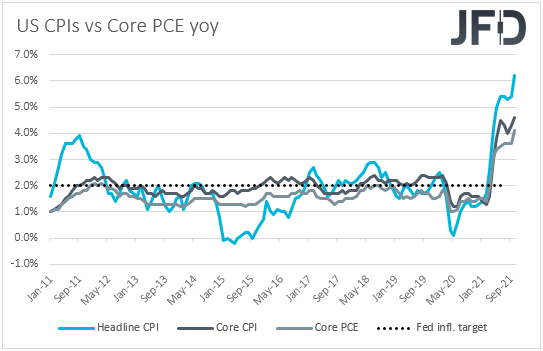
Last week, Fed Chair Jerome Powell appeared hawkish before the US Congress, surprising those expecting him to adopt a more cautious stance due to the new coronavirus variant and the restrictive measures adopted around the globe. In contrast, the Fed Chief said that the “transitory” wording with regards to inflation may have to be dropped out of the Fed’s monetary policy statement, and that QE tapering should end sooner than previously estimated. Despite nonfarm payrolls missing expectations on Friday, the unemployment rate declined even more, to 4.2% from 4.6%, and combined with further acceleration in the CPIs, it could add more credence to Powell’s view. Faster tapering could also mean faster rate hikes as well, and thereby a stronger dollar.
However, how the equity market will react is not crystal clear. On the one hand, more investors may reduce their risk on expectations that higher rates sooner could hurt companies’ profitability, while on the other hand, investors could buy more stocks as a strong report could underscore the strong performance of the US economy. Even if the second proves to be true, as investors may have digested somewhat the idea of higher rates sooner, we will still not call for a long-lasting recovery. We will treat this as a corrective bounce. We stick to our guns that the uncertainty surrounding the Omicron variant could keep market participants reluctant to add risk to their portfolios for a while more, perhaps until the WHO gives official and justified answers with regards to the new coronavirus variant.
Disclaimer:
The content we produce does not constitute investment advice or investment recommendation (should not be considered as such) and does not in any way constitute an invitation to acquire any financial instrument or product. The Group of Companies of JFD, its affiliates, agents, directors, officers or employees are not liable for any damages that may be caused by individual comments or statements by JFD analysts and assumes no liability with respect to the completeness and correctness of the content presented. The investor is solely responsible for the risk of his investment decisions. Accordingly, you should seek, if you consider appropriate, relevant independent professional advice on the investment considered. The analyses and comments presented do not include any consideration of your personal investment objectives, financial circumstances or needs. The content has not been prepared in accordance with the legal requirements for financial analyses and must therefore be viewed by the reader as marketing information. JFD prohibits the duplication or publication without explicit approval.
CFDs are complex instruments and come with a high risk of losing money rapidly due to leverage. 68.02% of retail investor accounts lose money when trading CFDs with the Company. You should consider whether you understand how CFDs work and whether you can afford to take the high risk of losing your money. Please read the full Risk Disclosure.
Copyright 2021 JFD Group Ltd.