


Yesterday, Fed Chief Jerome Powell maintained his dovish stance, helping equities to rebound during the US session. However, this did not last for long, as this may have been largely anticipated. Inflation fears returned, and yields rebounded during the Asian session today. Overnight, the RBNZ stood pat, projecting that interest rates may turn higher in December, something that helped the Kiwi to trade higher.
Inflation Fears Persist Despite Powell’s Dovish Stance
The US dollar traded higher against the majority of the other G10 currencies on Tuesday and during the Asian session Wednesday. It gained the most versus CHF, JPY, SEK, and EUR, while it underperformed only versus NZD and GBP. The greenback was found virtually unchanged against CAD.
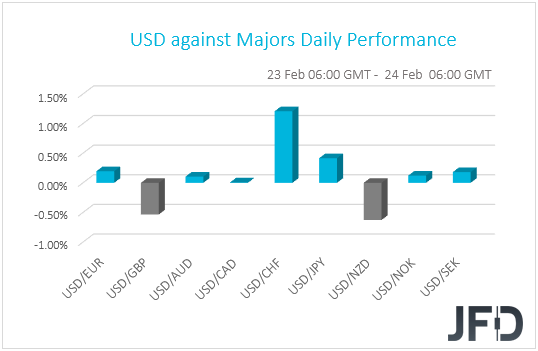
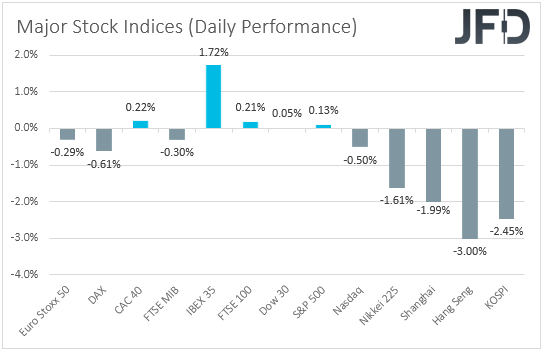
The weakening of the safe-havens franc and yen, combined with the strengthening of the risk-linked Kiwi, suggests that markets traded in a risk-on fashion yesterday and today in Asia. However, shifting our attention to the equity world, we see that this was not the case. Major EU indices closed mixed, with Spain’s IBEX 35 being the main gainer and Germany’s DAX the main loser. In the US, both the DJIA and the S&P 500 ended their trading fractionally higher, but Nasdaq slid 0.50%. Today in Asia, market sentiment deteriorated further.
Yesterday, the main event on the agenda was Fed Chair Powell’s testimony before the Senate Banking Committee. The Fed Chief reiterated his stance that the economy is a long way from the employment and inflation goals, and that even if the labor market strengthens, the Committee will not tighten monetary policy solely in response to that. With regards to scaling back QE purchases, he noted that they will clearly communicate “well in advance” any change, but they haven’t seen the desired progress yet. Basically, he maintained his dovish rhetoric, which may have been the reason behind the recovery in equities during the US session. That said, as we noted yesterday, this was the base-case scenario. In other words, it may have been largely anticipated and thus, the rebound did not last for long. Inflation fears returned, and yields rebounded during the Asian session today.
S&P 500 – Technical Outlook
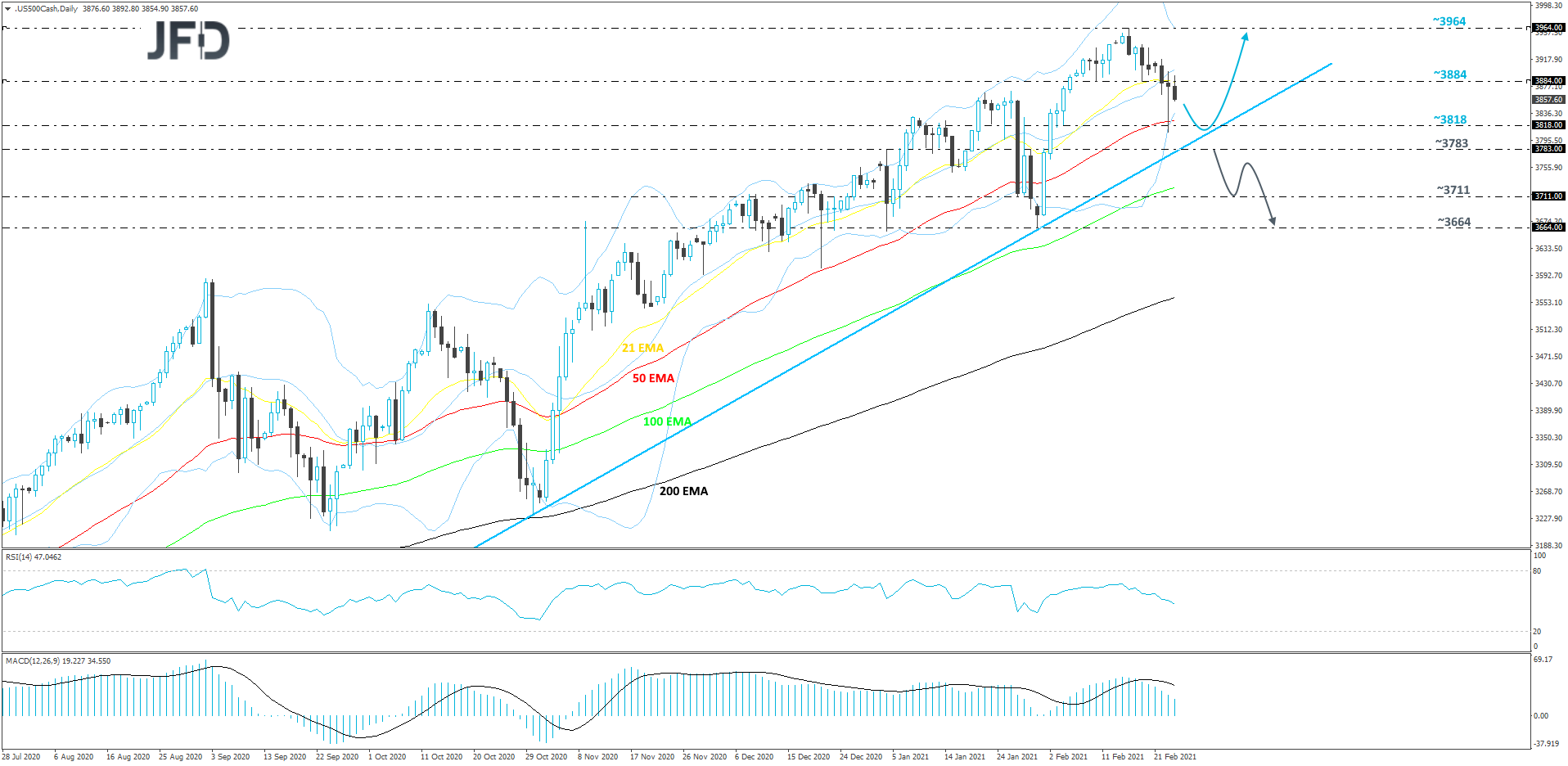
After hitting the all-time high, at 3964, the S&P 500 index is now seen to be in a correction mode, as it makes its way towards the medium-term upside support line drawn from the low of March 23rd. If that upside line can stay intact, the bulls might join the game again. For now, we will take a somewhat bullish approach.
A push further south, could bring the index to the 3818 hurdle, marked near the lows of January 22nd and February 4th, or to the aforementioned upside line. As mentioned above, if that upside line continues to provide good support, the buyers may join in and drive the S&P 500 back to the 3884 zone, marked near the lows of February 10th and 18th. If that zone is not able to withstand the uprise, the next possible target might be at 3964, which is the current all-time high.
Alternatively, if the S&P 500 breaks the aforementioned upside line and then also falls below the 3783 area, marked by the lows of January 11th and 13th, and also by the highs of January 29th and February 1st, that may invite a few more sellers into the arena. The index could then slide to the 3711 obstacle, a break of which might set the stage for a test of the 3664 level, marked by the low of January 31st.
RBNZ Stands Pat, Sees Rates Turning Higher in December
Overnight, apart from the rising-yields theme, we also had an RBNZ monetary policy decision. The Bank decided to keep its official cash rate and its Large-Scale Asset Purchase program unchanged, noting that they agreed to stay prepared to provide additional support if necessary, with the options including a lower OCR. The Kiwi slid initially, perhaps as the statement may have revived speculation over negative interest rates by this Bank, but it was quick to rebound, recover the losses, and trade even higher, perhaps as investors started scanning the quarterly Monetary Policy Report, in which the economic forecasts showed the OCR turning higher from December.
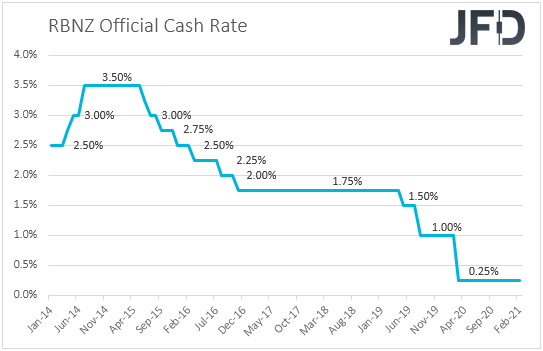
In our view, the probability for this Bank to adopt negative interest rates remains slim, though it is not zero. After all, at the press conference, Governor Adrian Orr said that negative rates remain an available option. That said, for now, due to the Bank’s own projections, we see the case for the Kiwi to stay supported. We also believe that with monetary policy around the globe set to stay accommodative in the months to come, risk sentiment may improve at some point soon, which could support risk-linked currencies like the Kiwi, especially against safe havens, like the yen. We see the case for equities to rebound as well. We will treat the current setback due to inflation fears as a corrective phase.
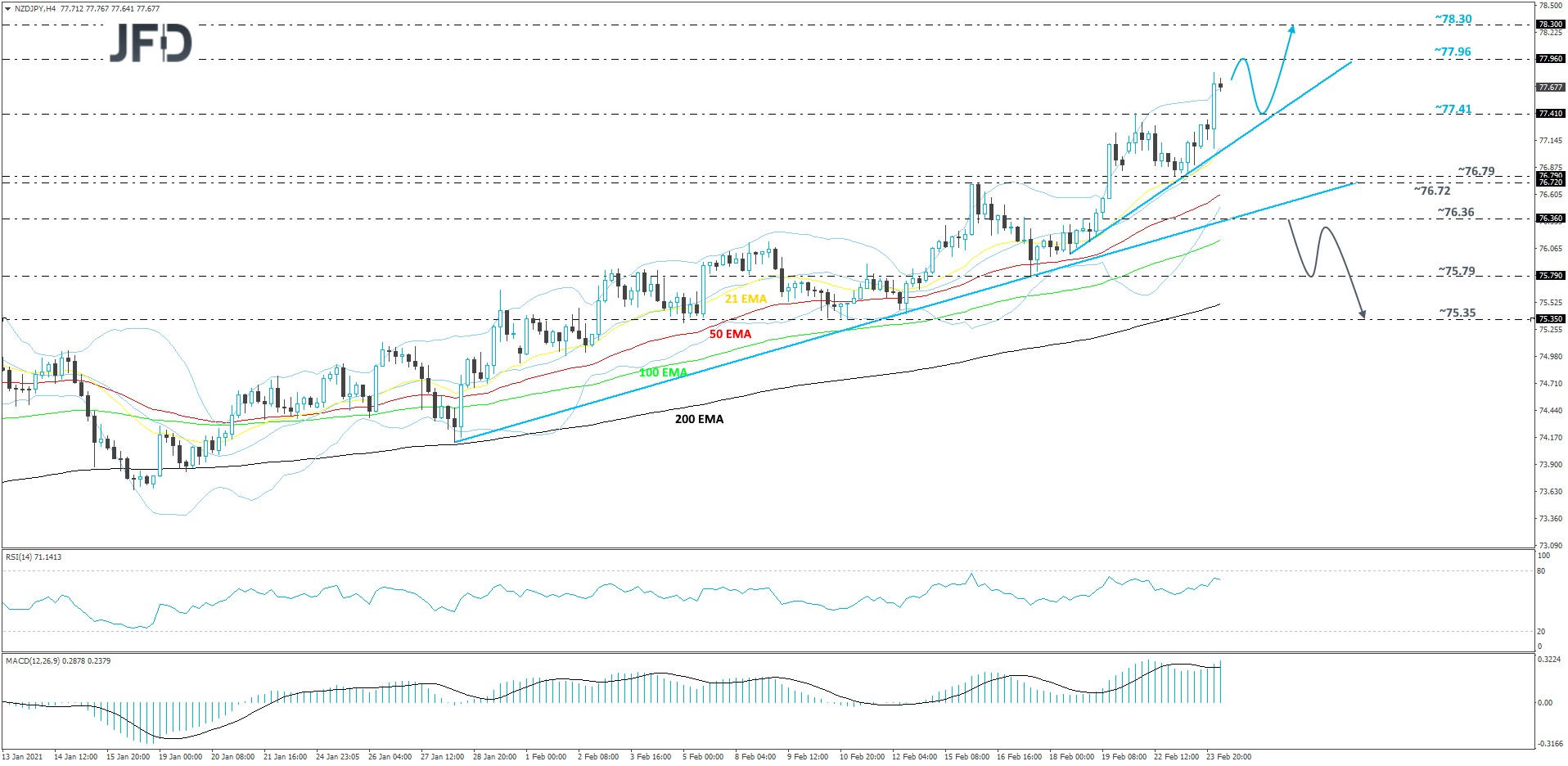
NZD/JPY – Technical Outlook
NZD/JPY continues to run higher, while balancing above a couple of short-term upside lines. The slightly steeper one is drawn from the low of February 18th and as long as the rate stays above that line, we will stay a bit more confident with larger advances in the near term. Hence our positive approach for now.
If the pair pushes a bit more to the upside, it may find resistance near the 77.96 hurdle, marked by the high of December 14th, 2018. The rate might stall there for a bit, or even correct back down. However, if NZD/JPY fails to break that line, the buyers could take advantage of the lower rate and lift it up again. If this time the pair is able to overcome the 77.96 obstacle, the next potential target might be at 78.30, marked by the high of December 12th, 2018.
In order to shift our attention to some lower areas, a break of the other upside line, which is drawn from the low of January 28th, would be required. In addition to that, a rate-drop below the 76.36 hurdle, marked by the high of February 19th, could increase the pair’s chances of drifting further south. We will then ai for the low of February 17th, at 75.79, a break of which might set the stage for a push towards the 75.35 level, marked by the low of February 11th.
As for the Rest of Today’s Events
During the European session, we get Germany’s final GDP for Q4, which is forecast to confirm its preliminary estimate of +0.1% qoq. In the US, new home sales for January are expected to have accelerated to +2.1% mom from +1.6%, while the EIA (Energy Information Administration) is expected to show that crude oil inventories fell 5.190mn barrels last week, after falling 7.258mn the week before. That said, bearing in mind that the API (American Petroleum Institute) reported a 1.026mn barrels gain, we would consider the risks of the EIA forecast as tilted to the upside.
As for the speakers, Fed Chair Powell will present his testimony before the House Financial Services Committee, but we don’t expect him to say something new. We expect him to stick to his dovish stance. Apart from him, we will also get to hear from Fed Vice Chair Richard Clarida and BoE Chief Economist Andy Haldane.
Disclaimer:
The content we produce does not constitute investment advice or investment recommendation (should not be considered as such) and does not in any way constitute an invitation to acquire any financial instrument or product. The Group of Companies of JFD, its affiliates, agents, directors, officers or employees are not liable for any damages that may be caused by individual comments or statements by JFD analysts and assumes no liability with respect to the completeness and correctness of the content presented. The investor is solely responsible for the risk of his investment decisions. Accordingly, you should seek, if you consider appropriate, relevant independent professional advice on the investment considered. The analyses and comments presented do not include any consideration of your personal investment objectives, financial circumstances or needs. The content has not been prepared in accordance with the legal requirements for financial analyses and must therefore be viewed by the reader as marketing information. JFD prohibits the duplication or publication without explicit approval.
CFDs are complex instruments and come with a high risk of losing money rapidly due to leverage. 79.07% of retail investor accounts lose money when trading CFDs with the Company. You should consider whether you understand how CFDs work and whether you can afford to take the high risk of losing your money. Please read the full Risk Disclosure.
Copyright 2021 JFD Group Ltd.