


The US dollar continued to slide against most of its major peers, while equities edged north yesterday and today in Asia, as Fed Chair Powell said that they will not raise interest rates pre-emptively solely due to fears of high inflation. Today, we will get to hear from a couple of more Fed officials, who could make their opinion on monetary policy public.
USD Stays in Retreat Mode, Nasdaq Hits Fresh Record High
The US dollar continued sliding against most of the other major currencies. The only currencies against which the dollar did not underperformed were JPY and CHF. It eked out some gains against JPY, while it was found virtually unchanged versus CHF. The greenback lost the most ground versus CAD, NZD, and AUD.
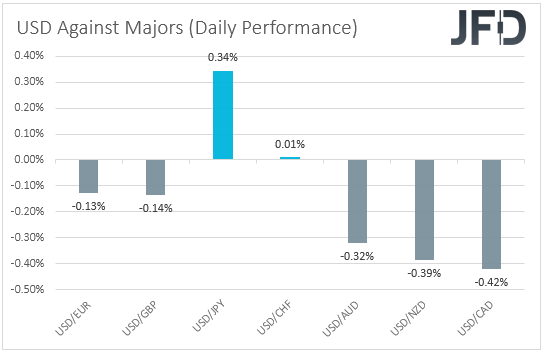
Once again, the weakening of the US dollar and the Japanese yen, combined with the strengthening of the risk-linked Loonie, Kiwi and Aussie, suggests that markets continued trading in a risk-on fashion. Indeed, looking at the performance in the equity world, we see that most major EU indices closed in the green, with the positive appetite rolling into the US session, where Nasdaq hit a fresh record high. Investors’ morale stayed upbeat during the Asian session today as well.
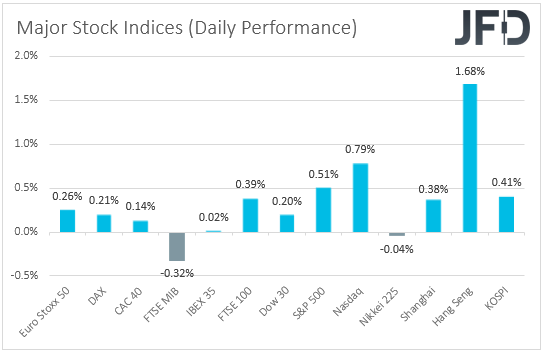
European shares traded slightly higher ahead of Fed Chair Powell’s testimony, as investors may have continued to increase their risk exposure based on comments by ECB President Lagarde, who said on Monday that she and her colleagues will maintain an accommodative stance, as well as following remarks by New York Fed President John Williams, who said that data and conditions have not progressed enough for the FOMC to shift its monetary policy stance. Investors continued to increase their risk-exposure during the US session as well, especially after Fed Chair Powell said “We will not raise interest rates pre-emptively because we fear the possible onset of inflation”, putting at rest concerns that interest rates could start rising as early as next year. New York’s Williams spoke again yesterday, adding that a discussion about raising interest rates is still “way off in the future.”
Investors have already allowed equities to correct lower following the hawkish outcome of the Fed meeting last week, and thus, now, with every evidence pointing that interest rates are not likely to start rising anytime soon, they seem exited to add to their risk exposure. However, this could have diminishing effects, as slowly slowly, participants are likely to start digesting the idea of rate hikes not coming soon, which could result in negative surprises if Fed officials start slowly shifting in the hawkish direction again. For now, we prefer to hold a cautious stance, despite some indices hitting fresh records, and wait for more officials to make their views and opinions public. In that respect, today, we will get to hear from Boston Fed President Eric Rosengren and Atlanta Fed President Raphael Bostic.
Nasdaq 100 – Technical Outlook
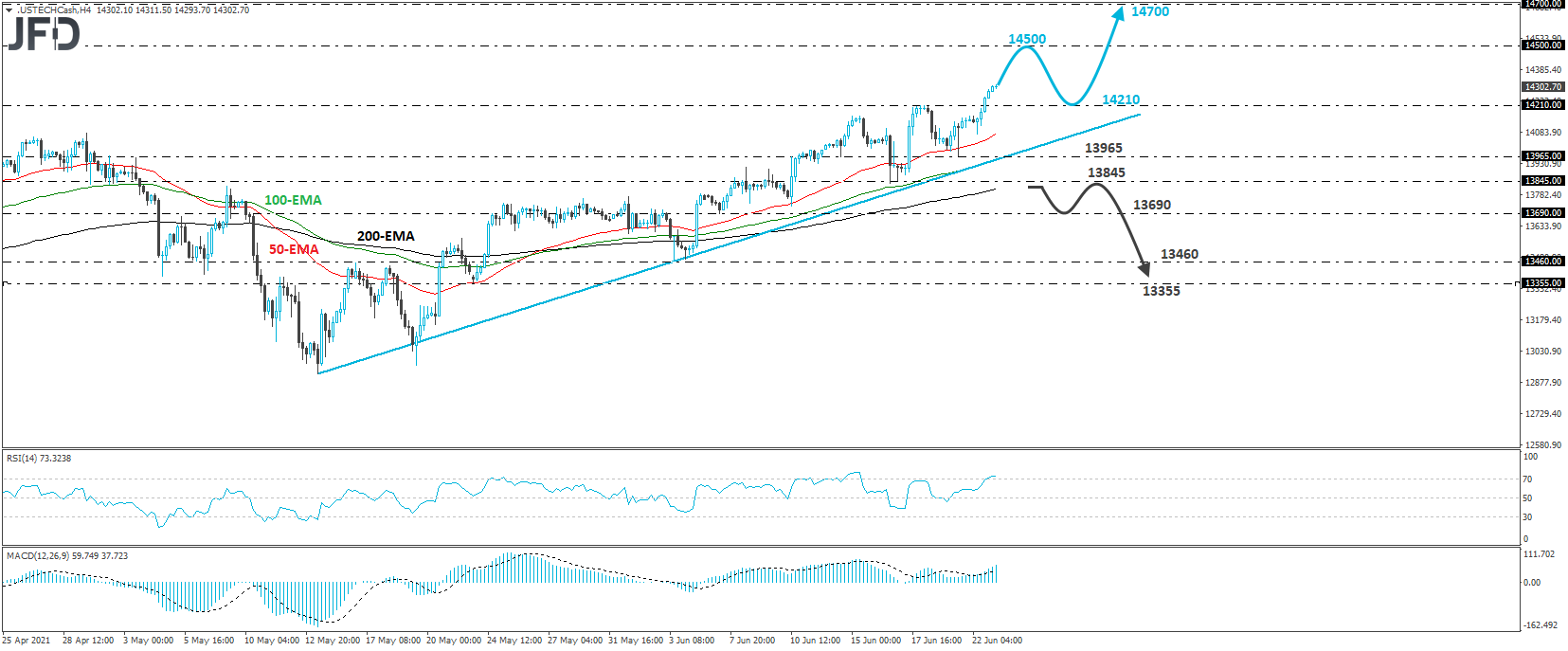
The Nasdaq 100 cash index edged north yesterday, breaking above its previous record high of 14210, and thereby, entering uncharted territories. Overall, the index continues to print higher highs and higher lows above the upside support line drawn from the low of May 13th, and thus, the technical outlook remains positive.
We believe that the break above 14210 may have opened the way towards the psychological zone of 14500, where the index may receive a hold up. Investors could take some profits after testing that zone, thereby allowing a downside correction, but as long as the index stays above the prementioned upside line, we would see decent chances for another leg north. If another positive leg results in a break above 14500, then we could see some extensions towards 14700.
In order to abandon the bullish case, at least in the short run, we would like to see a strong dip below 13845. This would not only take the price below the upside line, but would also confirm a forthcoming lower low on the daily chart. The bears may then get encouraged to push the action towards the low of June 7th, at 13690, the break of which could carry larger bearish implications, perhaps setting the stage for extensions towards the low of June 3rd, at 13460, or the low of May 23rd, at 13355.
NZD/USD – Technical Outlook
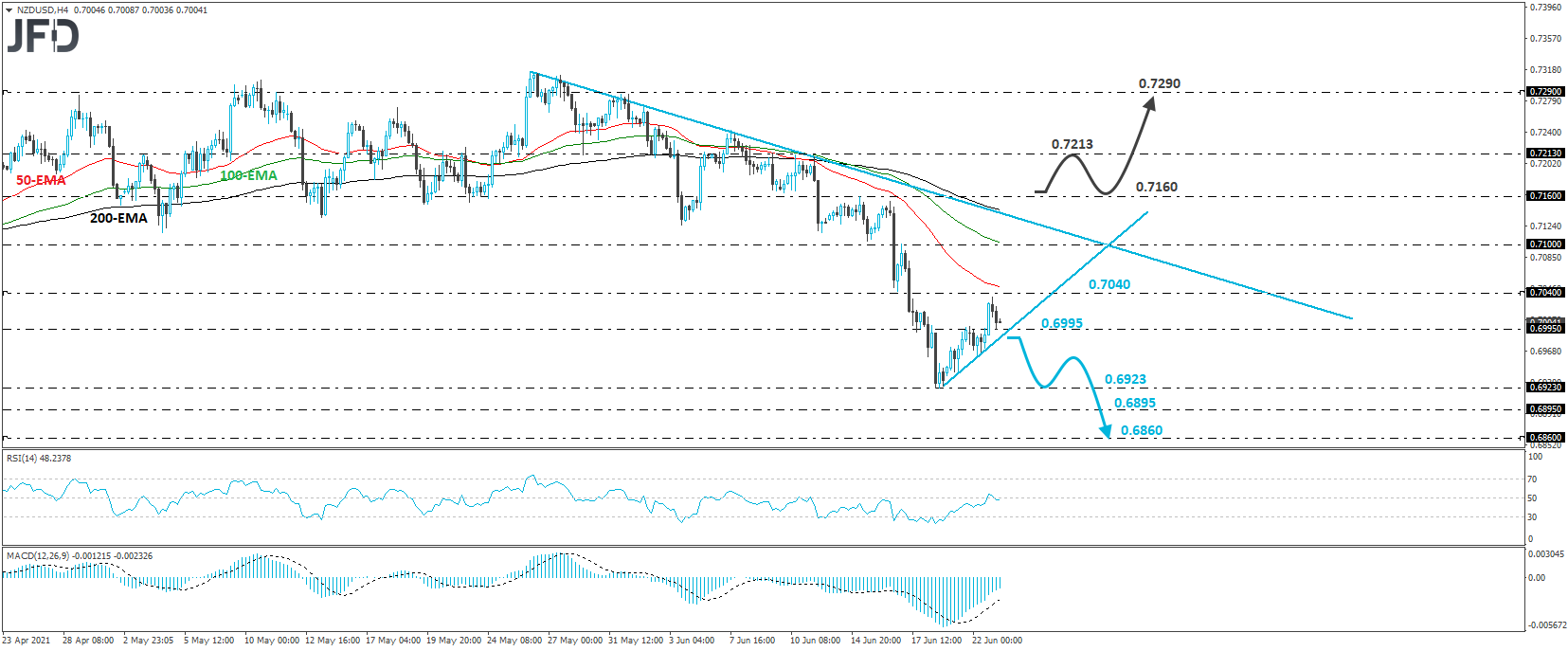
NZD/USD recovered a bit more yesterday, but the recovery stayed limited slightly below the 0.7040 barrier. Overall, the pair continues to trade well below the downside resistance line drawn from the high of May 26th, but also above a short-term upside one, taken from the low of June 18th. For now, we will take a neutral stance and wait for a dip below the short-term upside line before we start examining a trend continuation case.
If this happens, and the rate also falls below 0.6995, we may see declines towards the low of June 18th, at 0.6923. A break lower would confirm a forthcoming lower low on the daily chart and could initially target the 0.6895 zone, defined as a support by the low of November 23rd. If that barrier doesn’t hold, the next stop could be at 0.6860, marked by the low of November 16th.
On the upside, we would like to see a strong break above 0.7160 before we start examining whether the bulls have gained full control. This would also signal the break above the downside line drawn from the high of May 26th, and may initially pave the way towards the 0.7213 zone, marked by the high of June 10th. Another break, above 0.7213, could see scope for extensions towards the 0.7290 territory, near the high of June 1st.
As for Today’s Events
Today, we get the preliminary PMIs for June from the Eurozone, the UK and the US. With regards to the Euro area, the manufacturing index is expected to have declined slightly, to 62.2 from 63.1, but the services one is anticipated to have risen to 57.5 from 55.2. This is likely to take the composite index up to 58.8 from 57.1, confirming that the bloc continues to recover from the pandemic-related economic damages at a decent pace. However, we don’t expect the euro to gain much on potentially strong numbers, as the ECB has made it clear that they are not thinking about scaling back their monetary policy support any time soon. No forecast is available for the UK prints, while in the US, both the manufacturing and services indices are expected to have declined somewhat, but to have stayed at elevated levels.
As for the rest of the releases, we have Canada’s retail sales for April, which are expected to have declined around 5.0% mom in both headline and core terms, as well as the US new home sales for May, which are anticipated to have increased somewhat.
With regards to the energy market, the EIA (Energy Information Administration) report on crude oil inventories for last week is coming out, and the forecast points to a 3.942mn barrels decline following a 7.355mn barrels fall the week before. However, bearing in mind that, yesterday, the API report revealed a 7.199mn barrels inventory decrease, we would consider the risks surrounding the EIA forecast as tilted to the downside, something that may help oil prices trade higher.
As for the speakers, besides Boston Fed President Eric Rosengren and Atlanta Fed President Raphael Bostic, we will get to hear once again from ECB President Christine Lagarde.
Disclaimer:
The content we produce does not constitute investment advice or investment recommendation (should not be considered as such) and does not in any way constitute an invitation to acquire any financial instrument or product. The Group of Companies of JFD, its affiliates, agents, directors, officers or employees are not liable for any damages that may be caused by individual comments or statements by JFD analysts and assumes no liability with respect to the completeness and correctness of the content presented. The investor is solely responsible for the risk of his investment decisions. Accordingly, you should seek, if you consider appropriate, relevant independent professional advice on the investment considered. The analyses and comments presented do not include any consideration of your personal investment objectives, financial circumstances or needs. The content has not been prepared in accordance with the legal requirements for financial analyses and must therefore be viewed by the reader as marketing information. JFD prohibits the duplication or publication without explicit approval.
CFDs are complex instruments and come with a high risk of losing money rapidly due to leverage. 75.05% of retail investor accounts lose money when trading CFDs with the Company. You should consider whether you understand how CFDs work and whether you can afford to take the high risk of losing your money. Please read the full Risk Disclosure.
Copyright 2021 JFD Group Ltd.