


Yesterday disagreements followed, as the OPEC+ meeting was once again postponed, without any new date set. During the early hours of the Asian morning, the main event surrounded the RBA’s interest rate decision and the release of its statement. Other economic data is set to follow.
OPEC+ Postpones Meeting Again
Yesterday disagreements followed, as the OPEC+ meeting was once again postponed, without any new date set. On Friday, the energy alliance voted on a proposal to increase production by approximately 2mln barrels per day in the period between August and the end of 2021. But this is not something that UAE was in favour of, so that’s why they blocked the proposal. This means that production will remain at current levels, which could suggest higher oil prices in the near term, as global demand continues to rise.
RBA Decision
During the early hours of the Asian morning, the main event surrounded the RBA’s interest rate decision and the release of its statement. At its June meeting, this Bank decided to keep its policy settings untouched and reiterated that at the July meeting, it will consider further bond purchases. In the minutes of that meeting, it was revealed that officials’ decision will depend upon the Board’s goals for employment and inflation, as well as the likely effect of different options on the overall financial conditions. This morning, the RBA announced that:
- · retain the April 2024 bond as the bond for the yield target and retain the target of 10 basis points,
- · continue purchasing government bonds after the completion of the current bond purchase program in early September. These purchases will be at the rate of $4 billion a week until at least mid-November,
- · maintain the cash rate target at 10 basis points and the interest rate on Exchange Settlement balances of zero per cent.
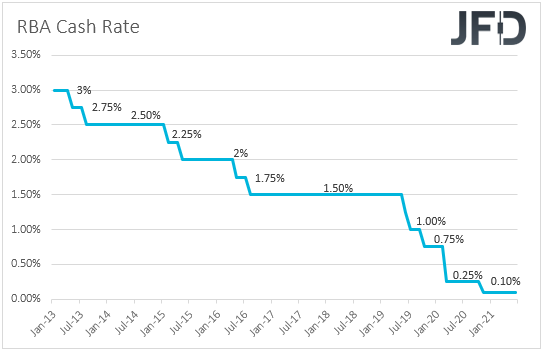
The Bank also stated that Australian economy is recovering much faster than it was initially expected. Households are showing financial stability, due to improvements in the labour market. However, one thing that remains unknown is how big would be the negative shock from the future effect of new virus outbreaks and lockdowns, which could follow after.
AUD/CHF – Technical Outlook
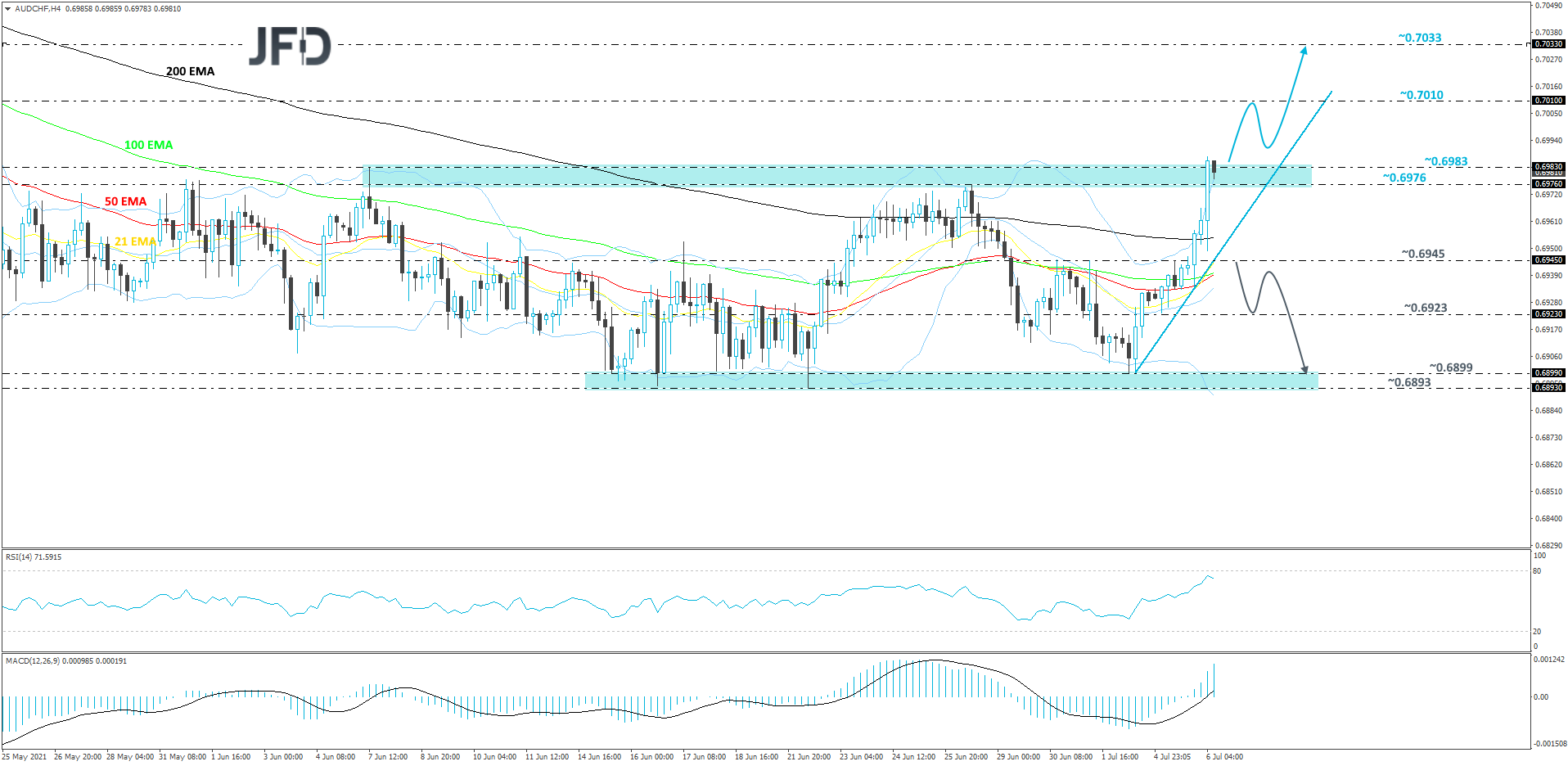
This morning, AUD/CHF managed to violate the upper side of the short-term range, where it has been trading from around the beginning of June. At the same time, the pair trades above a short-term tentative upside line, which is drawn from the low of July 2nd. If the rate continues to trade above that upside line and stays above the upper side of the above-mentioned range, which is roughly between the 0.6976 and 0.6983 levels, we will take a positive approach, at least for now.
I further push above the upper side of that range could bring the pair to the 0.7010 hurdle, marked by the high of May 20th, where a slight hold-up may happen. However, if the buyers are still feeling comfortable, they might send AUD/CHF even higher, possibly targeting the 0.7033 level, which is the high of May 18th.
On the other hand, if the previously discussed upside line breaks and the rate falls below the 0.6945 zone, marked near the highs of June 30th and July 1st, that could temporarily spook the bulls from the field, as such a move might lead to a larger decline within that range. AUD/CHF may travel to the 0.6923 obstacle, a break of which could set the stage for a test of the lower bound the range. That area is between the 0.6893 and 0.6899 levels, marked by the lowest point of June and the current lowest point of July.
Other Economic Data
Apart from the RBA, during the European morning, we will receive the UK’s construction PMI number for June, which is expected to show up at 63.8, against the previous 64.2. Germany will release their ZEW economic sentiment figure for July. The initial forecast is for a decline from 79.8 to 75.2.
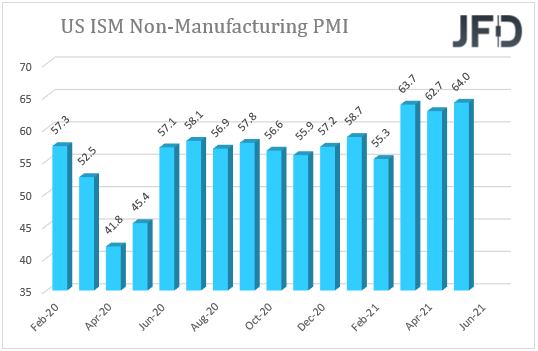
Later on in the day, the US will be coming back from a long weekend, as the US markets were closed yesterday due to their Independence Day. Before the US opening bell, we will receive the US services PMI number for June. Currently, there is no forecast available for that indicator. Also, there will be one economic data set, which will be carefully monitored, and that’s the ISM non-manufacturing PMI reading, also for June. The number is believed to have declined somewhat, going from 64.0 to 63.5. That said, even if the actual figure shows up as forecasted, the reading would continue to be in expansionary territory, meaning that the non-manufacturing sector of the economy is doing well, overall. If the reading is below forecast, this might have a slightly negative effect on the US dollar, but a positive effect on the US equities, as it may keep the Fed away for a while from changing its current policy of supporting the economy.
USD/CAD – Technical Outlook
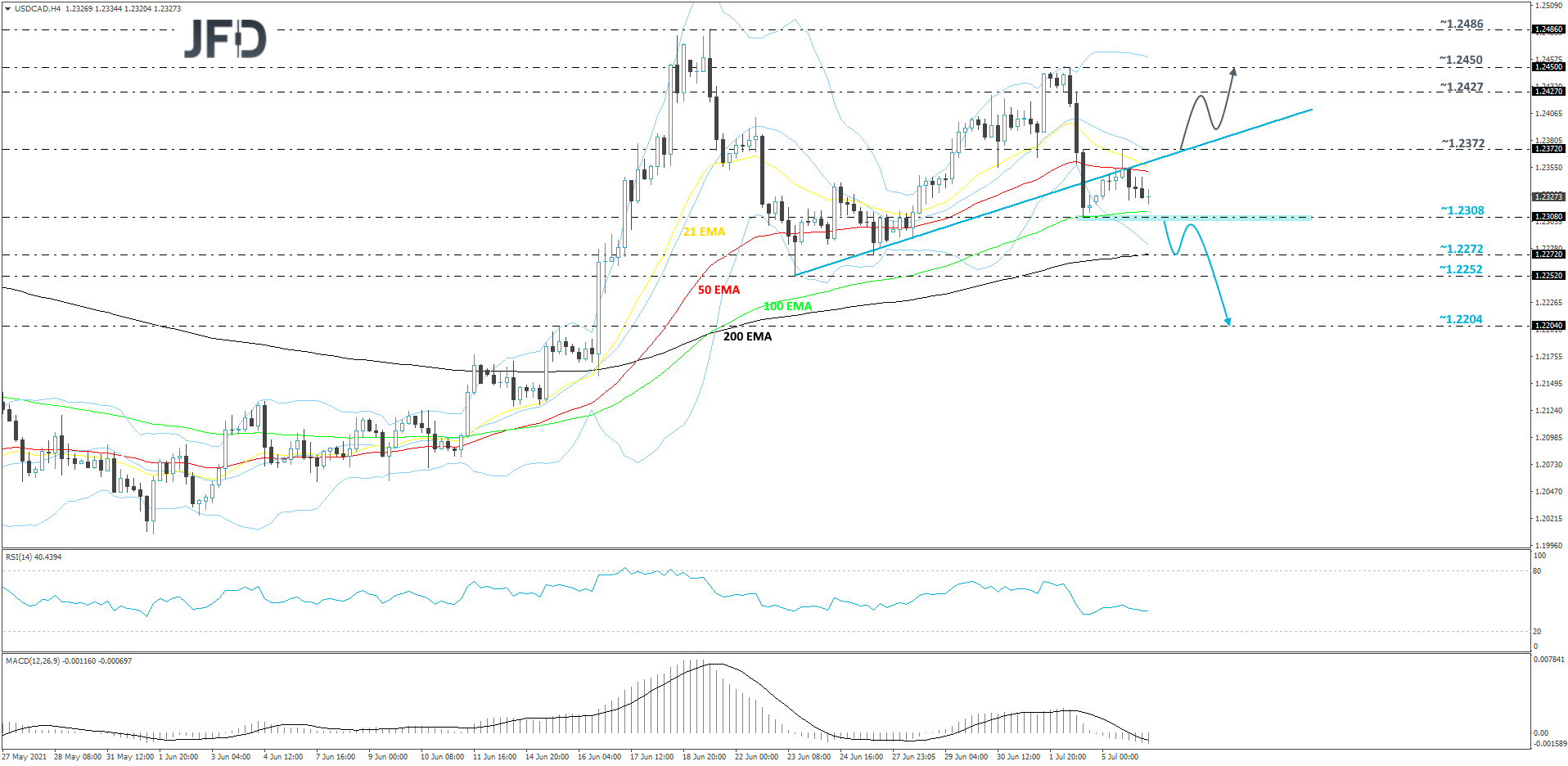
After breaking below the short-term upside support line taken from the low of June 23rd, USD/CAD rushed lower, but found support near the 1.2308 hurdle, marked by the low of July 2nd. If the pair continues to trade below that upside line, there is a good chance we could see further declines. That said, we would still prefer to wait for a strong push below the 1.2308 zone first, in order to get comfortable with further declines.
If, eventually, the rate makes a deeper dive below that 1.2308 hurdle, this may invite more sellers into the game, possibly opening the door to lower areas. USD/CAD might drift to the 1.2272 zone, marked by the low of June 25th, where a temporary hold-up could occur. The pair may also test the 200 EMA on our 4-hour chart, however, if those obstacles fail to provide support and break, this could open the way for further declines. That’s when we will aim for the 1.2252 obstacle, or even for the 1.2204 level, marked by the high of June 15th.
Alternatively, to consider a move higher, we would wait for the rate to climb back above the aforementioned upside line and then above the 1.2372 barrier, marked by yesterday’s high. This way, USD/CAD could get pushed to the 1.2427 hurdle, or even to the 1.2450 level, marked by the current highest point of July.
As for the rest of today’s events
US will also produce its Markit composite PMI figure for June, which is also expected to have declined a bit, from the previous 68.7 to 63.9.
Disclaimer:
The content we produce does not constitute investment advice or investment recommendation (should not be considered as such) and does not in any way constitute an invitation to acquire any financial instrument or product. The Group of Companies of JFD, its affiliates, agents, directors, officers or employees are not liable for any damages that may be caused by individual comments or statements by JFD analysts and assumes no liability with respect to the completeness and correctness of the content presented. The investor is solely responsible for the risk of his investment decisions. Accordingly, you should seek, if you consider appropriate, relevant independent professional advice on the investment considered. The analyses and comments presented do not include any consideration of your personal investment objectives, financial circumstances or needs. The content has not been prepared in accordance with the legal requirements for financial analyses and must therefore be viewed by the reader as marketing information. JFD prohibits the duplication or publication without explicit approval.
CFDs are complex instruments and come with a high risk of losing money rapidly due to leverage. 75.05% of retail investor accounts lose money when trading CFDs with the Company. You should consider whether you understand how CFDs work and whether you can afford to take the high risk of losing your money. Please read the full Risk Disclosure.
Copyright 2021 JFD Group Ltd.