

Nike inc. (NYSE: NKE) has been seen as a good growth stock for quite a while now. It is loved by many investors and was always seen as somewhat of a safer stock to own. When the pandemic started in March 2020, many investors and believers in the company, picked up Nike’s stock at around 70 dollars per share. This proved to be a success, as the share price reached its all-time high, at 179.10, back in November 2021. Since then, investors started slowly liquidating their positions. This might be caused by the fact that the company’s market share growth had stopped and flattened somewhat, due to other new sport names showing up on the “street” and some other existing ones picking up the pace. Also, million-dollar contracts with celebrities to promote the brand are not paying off that much, as consumers are starting to care less about it and nowadays, they can find good quality sports goods with other, less-expensive brands. That said, this doesn’t mean that the company might become less attractive for the investor, instead, this may lead to the share price adjusting accordingly, in relation to the company size and its real value.
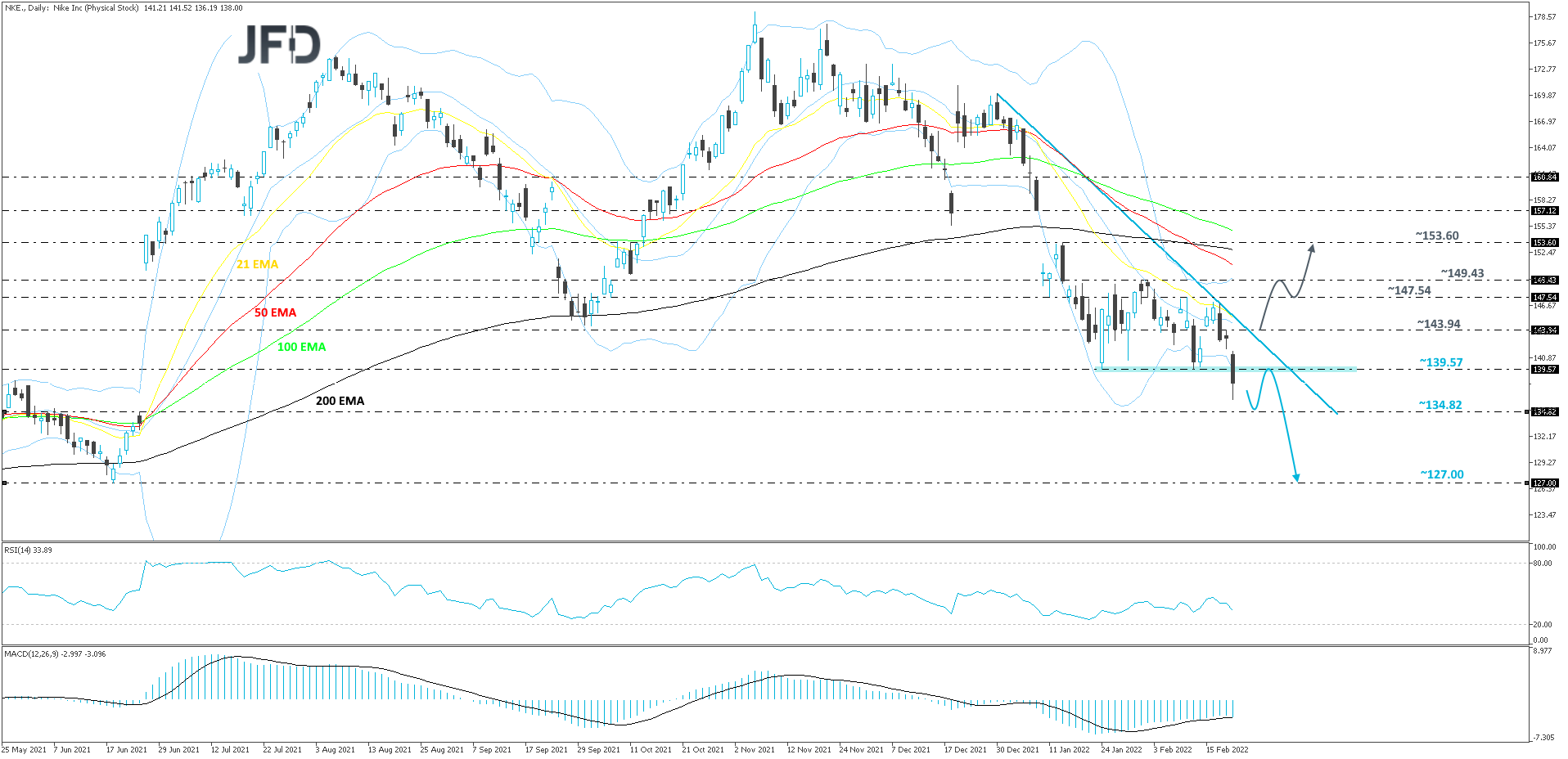
After peaking in November 2021, NKE drifted lower and is now trading below a short-term tentative downside resistance line drawn from the high of December 30th. Yesterday, the share price fell below one of its key support areas, at 139.57, marked near the lowest point of January and by the low of February 11th. As long as the stock remains below that hurdle, we will aim for lower areas.
A further push south may bring the share price to its next possible support zone, at 134.82, marked by the high of June 24th. NKE may stall there, or even correct back up a bit. That said, if the stock stays somewhere below the 139.57 hurdle, or the aforementioned downside line, another slide could be possible. If this time the stock breaks the 134.82 obstacle, the next potential target might be at 127.00, which is the lowest point of June 2021.
The RSI and the MACD are pointing slightly lower. Additionally, the RSI remains below 50 and the MACD continues to run below zero, despite sitting fractionally above the signal line. Overall, the two oscillators support the above-mentioned scenario.
Alternatively, a break of the previously discussed downside line and a push above the 143.94 hurdle, marked by the high of February 18th, could interest more buyers to join in. NKE may then drift to the 147.54 obstacle, or to the 149.43 level, which is the highest point of February. If the buying doesn’t stop there, the next potential target might be at 153.60, which is the high of January 13th.
Disclaimer:
The content we produce does not constitute investment advice or investment recommendation (should not be considered as such) and does not in any way constitute an invitation to acquire any financial instrument or product. The Group of Companies of JFD, its affiliates, agents, directors, officers or employees are not liable for any damages that may be caused by individual comments or statements by JFD analysts and assumes no liability with respect to the completeness and correctness of the content presented. The investor is solely responsible for the risk of his investment decisions. Accordingly, you should seek, if you consider appropriate, relevant independent professional advice on the investment considered. The analyses and comments presented do not include any consideration of your personal investment objectives, financial circumstances or needs. The content has not been prepared in accordance with the legal requirements for financial analyses and must therefore be viewed by the reader as marketing information. JFD prohibits the duplication or publication without explicit approval.
There are risks involved with trading of cash equities. Past performance is not indicative of future results. You should consider whether you can tolerate such losses before trading. Please read the full Risk Disclosure.
Copyright 2022 JFD Group Ltd.