


The US dollar and other safe havens rallied, while risky assets, as well as the Russian ruble, fell off the cliff as Russia invaded in Ukraine, firing missiles at several cities, and landing troops on its south coast. Marketwise, unless we do get trustworthy headlines pointing to a potential resolution, we believe that market participants may continue trading in a risk-averse mode.
Equities Tumble, Safe-havens Surge as Russia Invades Ukraine
The US dollar traded higher against all but two of the other major currencies on Wednesday and during the Asian session Thursday. It lost ground only versus JPY and CHF, while it gained the most versus EUR, GBP, and NZD in that order.
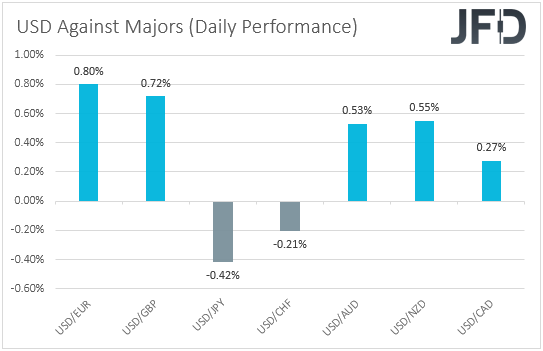
The strengthening of the US dollar and the other safe havens, yen and franc, suggests that markets may have turned back to risk off, while the fact that the euro and the pound were the main losers tells us that the catalyst may have been once again headlines surrounding the Russia-Ukraine conflict. After all, the Russian ruble tumbled overnight, while gold surged to territories last tested in January last year.
Shifting attention to the equity world, we see that major EU indices closed in negative territory, while later in the US, Wall Street tumbled even more, and in fact, this was due to geopolitical developments. Ukraine declared a state of emergency, and the US State Department said that a Russian invasion remains potentially imminent as they haven’t seen any indication of Russians backing away. Indeed, Russia fired missiles at several Ukrainian cities overnight, and landed troops on its south coast, with Russian President Vladimir Putin speaking about a “special military operation”.
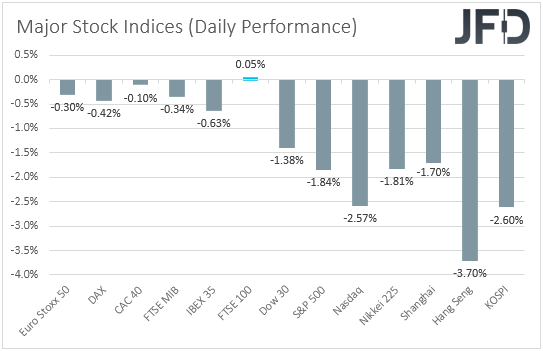
Now, marketwise, further escalation could result in more risk-off days, and further retreat in equities. Usually, such events don’t have a long-lasting effect in the financial world, but even if the situation is resolved sooner than anticipated, we don’t expect a prolonged recovery. Investors may turn their gaze back to monetary policy, and although the chances for a double hike at the next Fed gathering eased somewhat, the Fed funds futures still point to six quarter-point increases by the end of this year. Besides the Fed, there is talk over a 50bps hike by the BoE at its upcoming gathering, while the yesterday, the RBNZ steepened its rate path. The BoC is also expected to lift rates, while the ECB, which is among the more dovish Banks, has opened the door to a rate hike this year at its latest meeting, something that was dismissed in the past.
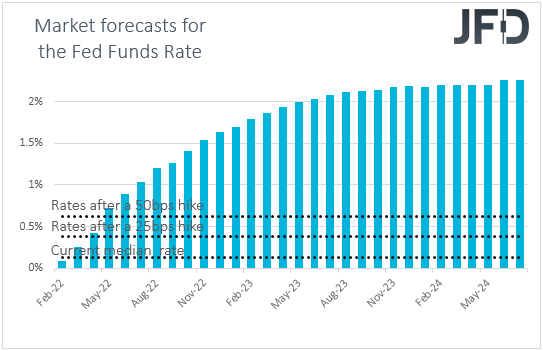
So, having in mind that interest rates are expected to continue rising globally, at least in the major economies, we believe that market participants may be somewhat discouraged to substantially increase their risk exposures. After all, as we have repeatedly noted, higher interest rates mean higher borrowing costs for companies, as well as lower present values, especially for high-growth firms, which are valued by discounting expected cash flows for the months and years ahead.
DJIA - Technical Outlook
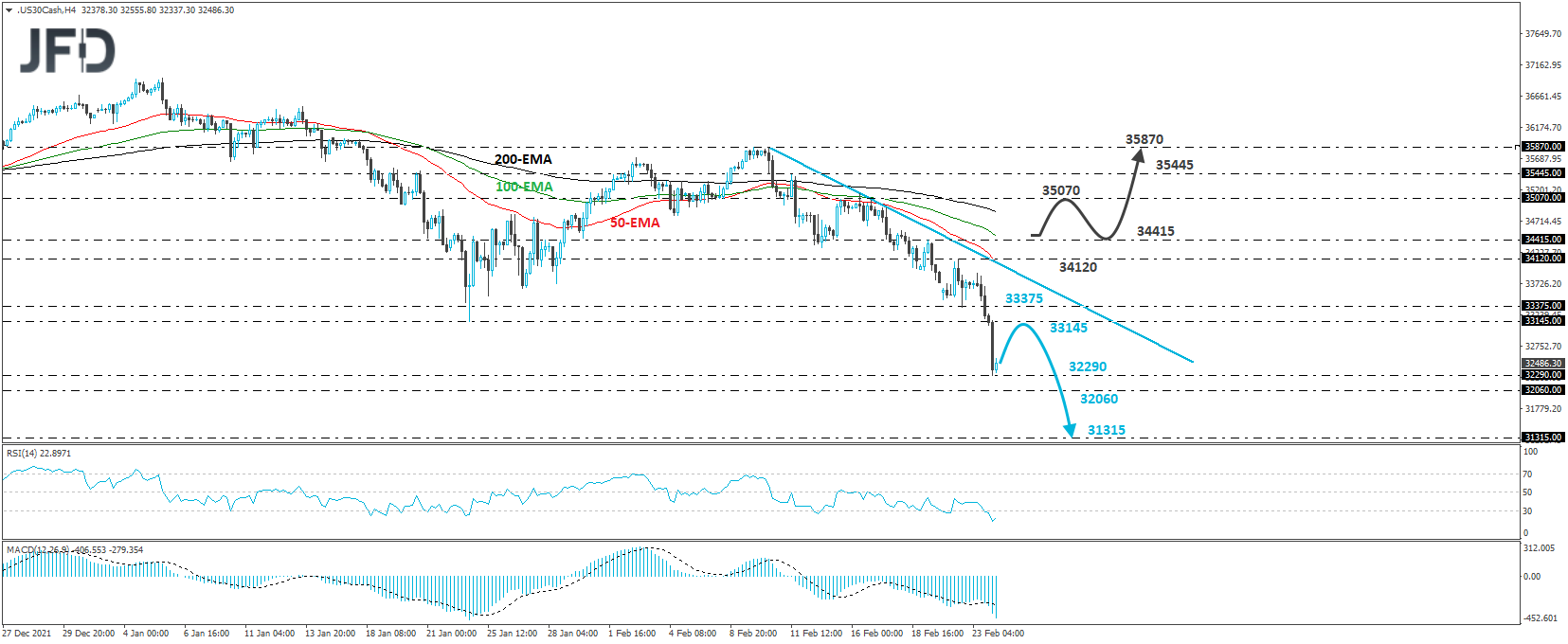
The Dow Jones Industrial Average cash index traded sharply lower yesterday, breaking below the low of January 24th, at 33145. That way, the index has distanced further itself from the downside line drawn from the high of February 10th, which, in our view, suggests that the short-term outlook is overly negative.
The tumble was paused near the 32290 zone, and even if we see a small rebound from there, as long as the index remains below the aforementioned downside line, we would see decent chances for another round of selling, and another test near the 32290 territory. Slightly lower lies the 32060 barrier, marked by the low of March 25th, 2021, the break of which could carry more bearish extensions, perhaps towards the 31315 territory, marked by the low of March 8th, 2021.
In order to start examining whether the outlook has turned somewhat positive, we would like to see a clear and strong rebound back above 34415, marked by the high of February 21st. This could confirm the break above the downside line drawn from the high February 10th, and may see scope for advances towards the 35070 zone, which provided resistance on February 15th and 16th. If participants are not willing to stop there, we may see them aiming for the peak of February 11th, the break of which could extend the advance towards the high of February 10th, at 35870.
Gold – Technical Outlook
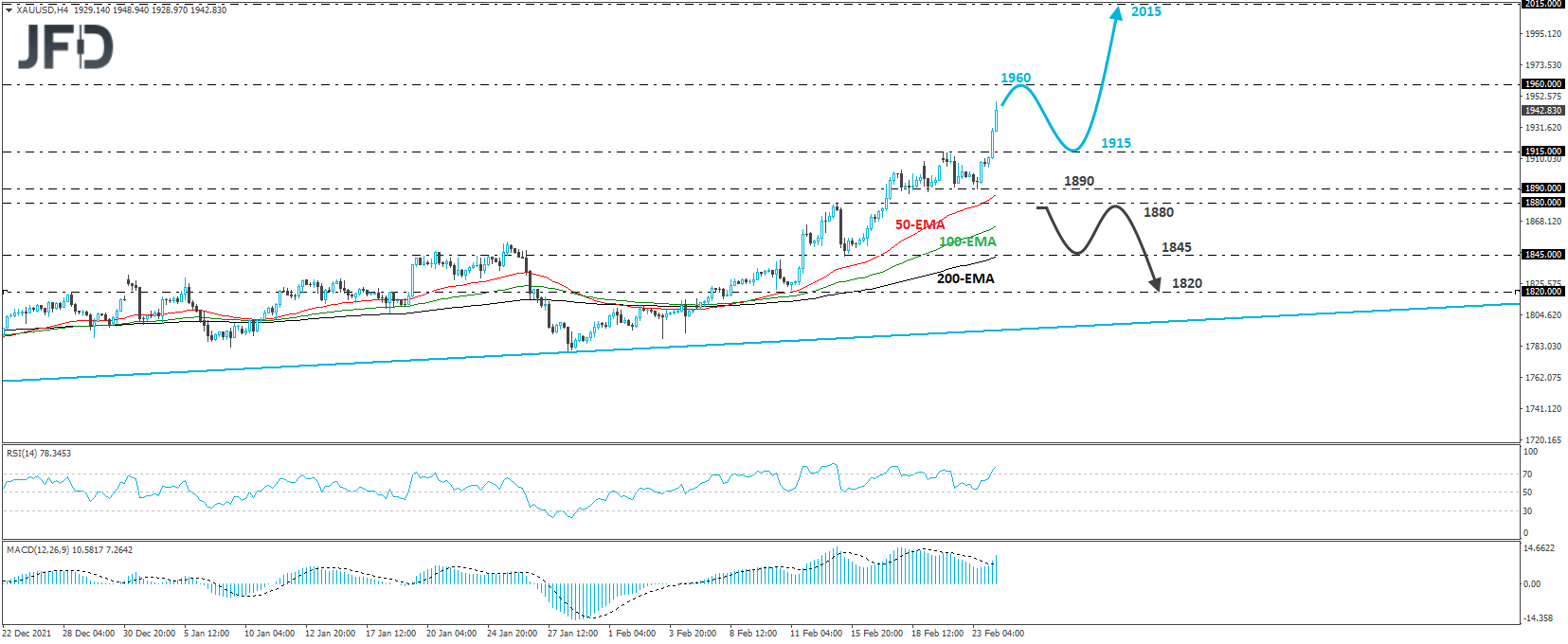
XAU/USD skyrocketed overnight, breaking above the key resistance zone of 1915, marked by the peak of June 1st. With the precious metal being in a strong rally mode since January 28th, when it hit the upside support line drawn from the low of August 9th, we will consider the near-term picture to be positive.
At the time of writing, the metal looks to be heading towards the 1960 zone, which provided resistance on November 9th, 2020, and January 6th, 2021. We believe that the bulls may decide to take a break after testing that key zone, however, as long as any potential retreat stays limited above 1890, we could expect another round of buying and perhaps a break above 1960. Such a break could see scope for extensions towards the 2015 territory, defined as s resistance by the peak of August 18th.
On the downside, a dip below 1880, marked by the inside swing high of February 15th, could signal a larger correction lower, with the next potential stop perhaps being the low that same day, at 1845. If that level doesn’t hold, then we could see declines towards the low of February 11th, at 1820, or the aforementioned upside line.
As for Today’s Events
Although market participants are likely to keep their gaze locked on developments surrounding geopolitics, there are also some indicators on today’s agenda worth mentioning and those are the second estimate of the US GDP for Q4, as well as the US new home sales for January. The US GDP is expected to be revised fractionally up, to +7.0% qoq SAAR from +6.9%, while new home sales are forecast to have slowed slightly.
Tonight, during the Asian session Friday, we have New Zealand’s retail sales for Q4, but no forecast is currently available.
As for the speakers, we have five on today’s agenda and those are: BoE Governor Andrew Bailey, ECB members McCaul and Schnabel, as well as Atlanta and Cleveland Fed Presidents Raphael Bostic and Loretta Mester.
Disclaimer:
The content we produce does not constitute investment advice or investment recommendation (should not be considered as such) and does not in any way constitute an invitation to acquire any financial instrument or product. The Group of Companies of JFD, its affiliates, agents, directors, officers or employees are not liable for any damages that may be caused by individual comments or statements by JFD analysts and assumes no liability with respect to the completeness and correctness of the content presented. The investor is solely responsible for the risk of his investment decisions. Accordingly, you should seek, if you consider appropriate, relevant independent professional advice on the investment considered. The analyses and comments presented do not include any consideration of your personal investment objectives, financial circumstances or needs. The content has not been prepared in accordance with the legal requirements for financial analyses and must therefore be viewed by the reader as marketing information. JFD prohibits the duplication or publication without explicit approval.
CFDs are complex instruments and come with a high risk of losing money rapidly due to leverage. 73.82% of retail investor accounts lose money when trading CFDs with the Company. You should consider whether you understand how CFDs work and whether you can afford to take the high risk of losing your money. Please read the full Risk Disclosure.
Copyright 2022 JFD Group Ltd.