


Risk sentiment continued to deteriorate due to the heightened tensions between the US and China. Yesterday, a report said that a completion of a “phase one” trade deal between the world’s two largest economies could slide into next year, disappointing market participants even more. As for today, we get the minutes from the latest ECB gathering, but given that the meeting was uneventful, we don’t expect the minutes to prove a major market mover either.
US-China Interim Deal to Slide into Next Year
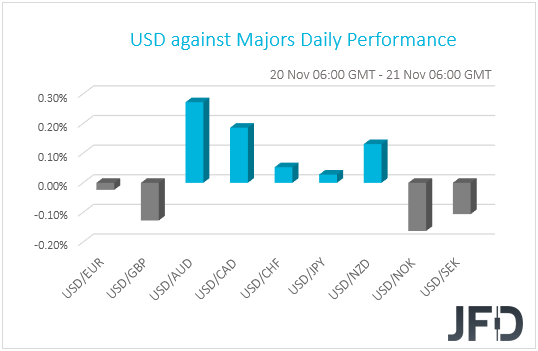
Once again, the dollar traded mixed against the other G10 currencies on Wednesday and during the Asian morning Thursday. It gained against AUD, CAD, NZD and slightly against CHF, while it underperformed versus NOK, GBP and SEK. It was found virtually unchanged against EUR and JPY.
Yesterday, we got the minutes from the latest FOMC meeting, where the Committee decided to cut rates by 25bps as was widely anticipated but signaled that it is planning to stay sidelined until things fall out of orbit. In the minutes it was revealed that most participants judged that the current stance of policy is now appropriate, barring a “material” reassessment of the outlook. Many said that the cut was appropriate in light of persistent weakness in global growth and elevated uncertainty regarding trade developments, while some were against the reduction, viewing the economic outlook as still favorable.
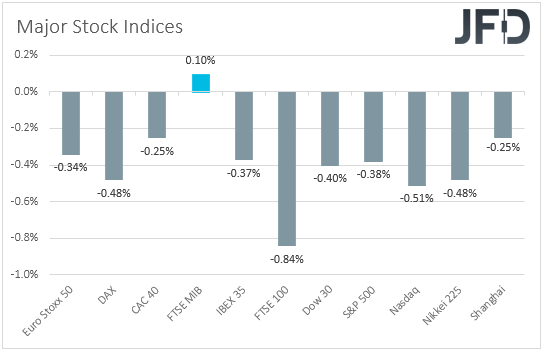
The minutes did not include any surprisingly new information and thus, the market barely reacted on their release. Instead, investors kept their gaze locked on the US-China sequel. Ahead of the US session and the minutes, most EU indices traded in the red due to the heightened tensions between the two nations after the US senate passed a bill in support of Hong Kong protests. Later in the day the House of Representatives also approved the bill, while headlines suggested that President Trump is expected to sign it, thereby giving it a legislative form. On top of that, a report said that a completion of a “phase one” trade deal between the world’s two largest economies could slide into next year, citing trade experts and people close to the White House. According to the report, China pushes for more tariff rollbacks, while US President Trump and Trade Rep. Robert Lighthizer hold the view that doing so for a deal that does not address intellectual property differences will not be good for their nation. “I don’t think they’re stepping up to the level that I want”, the US President said yesterday, referring to China. US indices slid as well, with the negative investor morale rolling into the Asian session today. Japan’s Nikkei 225 and China’s Shanghai Composite index lost 0.48% and 0.25% respectively.
On Tuesday, we noted that given the up-until-then rally in equities, there was a notable risk of a decent correction in case negative headlines were to start hitting the wires, and this is what is happening now. A preliminary accord was expected to be signed this month, and thus, the report suggesting that this could be pushed into next year came as a disappointment to market participants. We believe that there is room for a deeper correction if tensions continue to flare up, something that could benefit safe havens, like the yen and the Swiss franc. Risk-linked currencies, like the Aussie and the Kiwi, could come under stronger pressure. Now, in case the conflict eases and optimism returns, risk appetite could also be revived. However, we would still stay reluctant to trust a long-lasting uptrend, as history showed that things could easily fall apart at any time. We prefer to take the safe side and wait for handshakes and signatures before we start examining whether the worst is behind us.
The Loonie ignored Canada’s CPIs, which came in line with market expectations, as well as the rally in oil prices, which was triggered by the EIA reporting a less-than-expected crude inventory build. Given that on Tuesday, the API reported a 5.954mn barrels increase, oil-traders may have been positioned for a bigger-than-anticipated EIA number as well. Instead, the EIA print came at 1.379mn, while the forecast was at 1.543mn. What may have kept the Canadian currency pressured may have been the pessimistic headlines surrounding the US-China trade saga.
S&P 500 – Technical Outlook
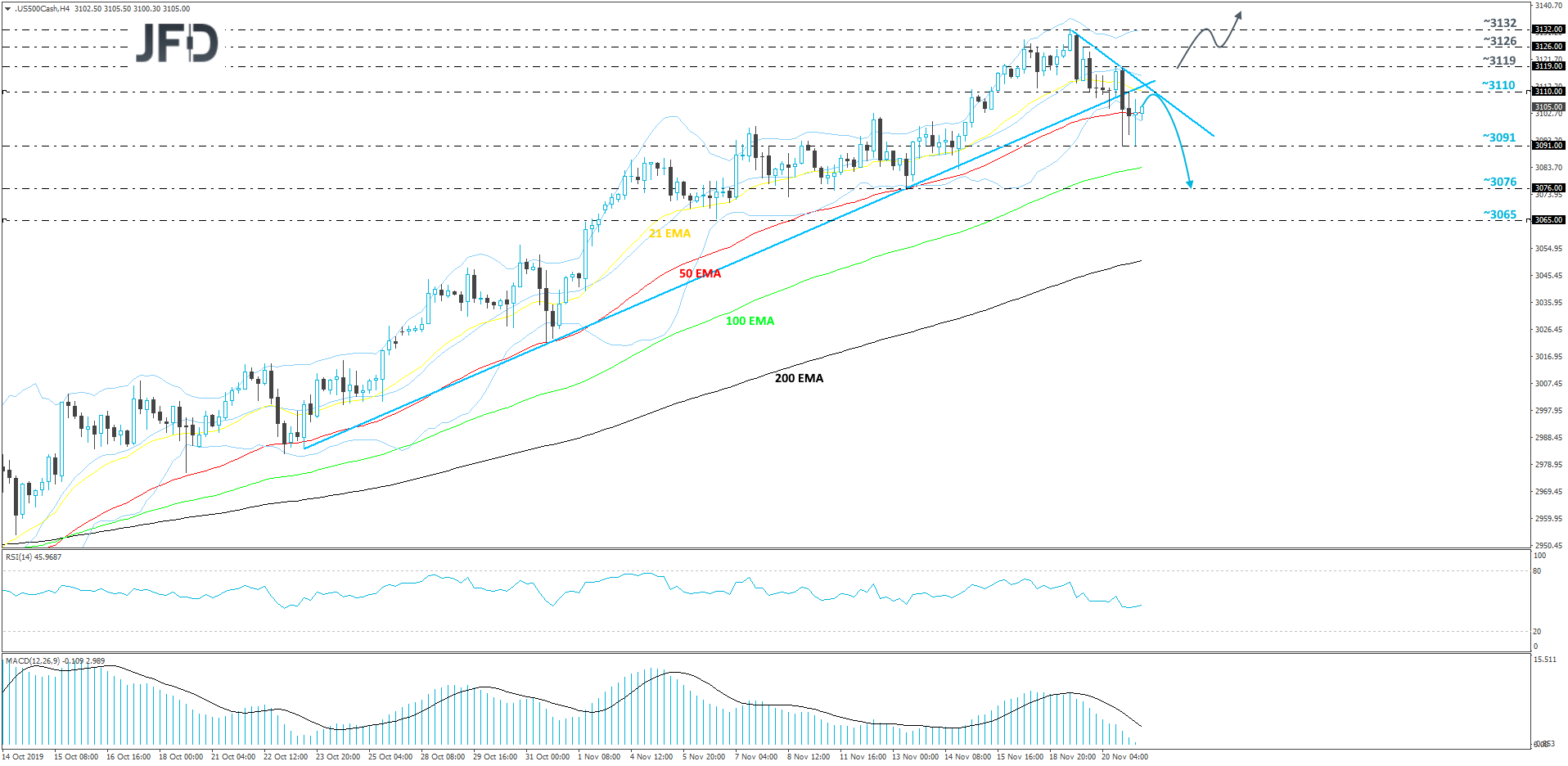
Yesterday, was the second day in a row when the S&P 500 closed in the red. This led the index to a break below its short-term upside support line taken from the low of October 23rd. At the same time, the price is now balancing below another line, this time a short-term tentative downside one, which is drawn from the high of November 19th. Given the current twist to the risk-off environment, the index may continue correcting lower, especially if it continues to trade below that downside line. But the risk-off atmosphere could be temporary, as we are still within an uptrend on a broader picture.
If the price moves back up a bit, but fails to break above the aforementioned downside line, this may result in another round of selling, possibly bringing the index to the current lows of this week, at 3091. If this area fails to hold the S&P 500 from moving further down, a break of that 3091 hurdle would confirm a forthcoming lower low on the 4-hour chart and we may see the price sliding to the 3076 level, marked by the low of November 13th.
Alternatively, if the previously-mentioned downside line breaks and the index moves above the 3116 barrier, which is near yesterday’s high, this may attract more buyers into the game and the price could rise to the 3126 obstacle, or even back to the all-time high, at around 3132. The S&P 500 might stall around or even retrace back down a bit. That said, if there is still enough buying interest floating around, this could push the price to the upside again, which might force the 3132 barrier to break and the index would enter a new uncharted territory.
AUD/CHF – Technical Outlook
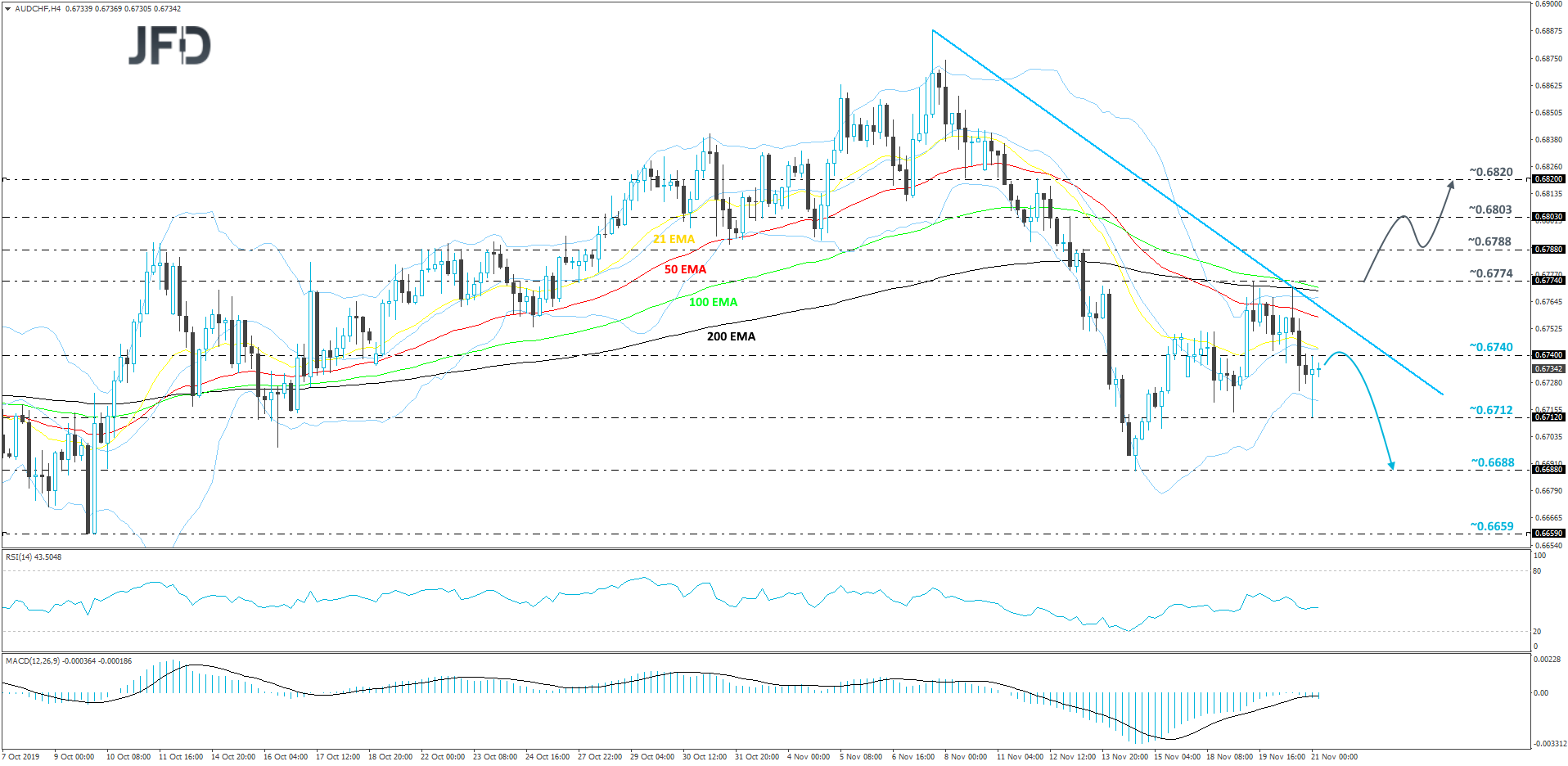
From around the beginning of this month, AUD/CHF started moving slightly lower, and is now trading below a newly-established short-term tentative downside resistance line taken from the high of November 7th and also below its 200 EMA on the 4-hour chart. For now, as long as the rate stays below both of these, there is more likelihood that the pair could end up moving down again, hence why we will stay cautiously-bearish, at least for now.
If the rate pushes a bit higher, but struggles to break the aforementioned downside line, this could invite the bears back into the field. Such activity might bring the pair to the 0.6712 obstacle, a break of which could set the stage for revisiting the 0.6688 level, marked by the current lowest point of November.
In order to examine the upside, at least in the short run, we would need to see a break of the previously-discussed downside line and a push above the 0.6774 barrier, marked by the high of November 19th. This is when we could start targeting the 0.6788 obstacle, a break of which may lift the rate to the 0.6803 zone, which is near the high of November 13th. Initially, the pair might stall around there, or even correct slightly lower, but if it continues to trade above the 0.6774 area, this could invite the bulls back into the action. Another strong rise could bypass all of the above-mentioned barriers and send AUD/CHF to the 0.6820 level, marked near the high of November 12th.
As for Today’s Events
During the European morning, we get the minutes from the October ECB meeting. At that meeting, which was the last for Draghi at the Bank’s helm, officials decided to keep their policy and guidance unchanged, reiterating that interest rates are expected to remain at their present or lower levels until the inflation outlook robustly converges to their aim. The meeting was uneventful and thus, we don’t expect the minutes to result any fireworks either. We prefer to wait for the upcoming meeting, the first headed by Christine Lagarde, before we start examining how the ECB may be planning to move forward.
From the US, we get the initial jobless claims for last week, the Philly Fed manufacturing index for November, and the existing home sales for October. Initial jobless claims are expected to have declined to 219k from 225k, while the Philly index is forecast to have risen to 7.0 from 5.6. Existing home sales are anticipated to have increased 1.4% mom after sliding 2.2% in September.
Tonight, during the Asian morning Friday, we get Japan’s National CPIs for October. Both the headline and core rates are expected to have ticked up to +0.4% yoy and +0.3% yoy, from +0.3% and +0.2% respectively.
As for the speakers, we have three on today’s agenda: ECB Vice-President Luis de Guindos, Minneapolis Fed President Neel Kashkari and BoC Governor Stephen Poloz.
Disclaimer:
The content we produce does not constitute investment advice or investment recommendation (should not be considered as such) and does not in any way constitute an invitation to acquire any financial instrument or product. The Group of Companies of JFD, its affiliates, agents, directors, officers or employees are not liable for any damages that may be caused by individual comments or statements by JFD analysts and assumes no liability with respect to the completeness and correctness of the content presented. The investor is solely responsible for the risk of his investment decisions. Accordingly, you should seek, if you consider appropriate, relevant independent professional advice on the investment considered. The analyses and comments presented do not include any consideration of your personal investment objectives, financial circumstances or needs. The content has not been prepared in accordance with the legal requirements for financial analyses and must therefore be viewed by the reader as marketing information. JFD prohibits the duplication or publication without explicit approval.
CFDs are complex instruments and come with a high risk of losing money rapidly due to leverage. 78% of retail investor accounts lose money when trading CFDs with the Company. You should consider whether you understand how CFDs work and whether you can afford to take the high risk of losing your money. Please read the full Risk Disclosure.
Copyright 2019 JFD Group Ltd.