


Equities Rebounded yesterday, with the Wall Street receiving an extra boost after the ADP private jobs report came in much below expectations. This may have revived speculation over a potential pause, or at least a slowdown, by the Fed after summer, but we are reluctant to share that view. Today, we get the officials employment report for the month of May, and they forecasts point to a decent report.
Equities Rebound, USD Slides Ahead of US NFPs
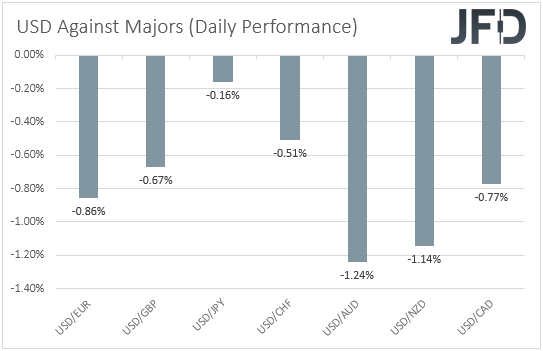
The US dollar traded lower against all the other major currencies on Thursday and during the Asian session Friday. It lost the most ground against the risk-linked AUD, NZD, and CAD, and the least against the safe-haven JPY, which suggests that the financial community may have traded in a risk-on fashion.
Indeed, turning our gaze to the equity world, we see that major EU indices traded in the green, with the only exception being Spain’s IBEX 35, which traded virtually unchanged. UK markets were closed due to a Bank holiday. Appetite improved during the US session, and stayed supported in Asia today, though China remained closed due to the Dragon Boat Festival.
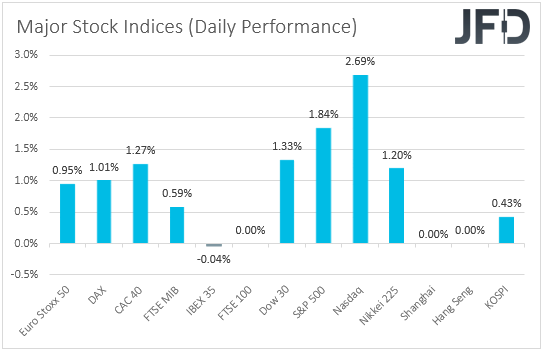
With no clear catalyst behind the rebound, at least in Europe, we suspect that investors may have decide to proceed with some sort of short covering ahead of the official US employment report for May, due out later today. That said, the steeper gains during the US session and the slide of the dollar may have been the result of the miss in the ADP report. The report showed that, during the month of May, the private sector has gained 128k jobs, a slowdown from a downwardly revised 202k in April, and well below the forecast of 300k.
Though the ADP report has a poor record in predicting the private payrolls of the official report, due to a different calculation methodology, the miss may have revived some speculation that the Fed could slow down its rate-hike process after the summer. However, we remain reluctant to say that this could indeed be the case. Remember that Fed Governor Waller said early this week that he would support 50bps hikes until inflation comes down, while Vice Chair Brainard said that “it’s very hard to see the case” for a pause. Having all that in mind, and also taking into account Chair Powell’s remarks he wants to keep raising rates until there is clear and convincing evidence that inflation is coming down, we don’t believe that just a private jobs report is enough for them to change their mind.
However, before we say any big words, we prefer to wait for the official employment data today. Nonfarm payrolls are expected to slow to 320k from 428k, while the unemployment rate is expected to have ticked down to 3.5% from 3.6%. Average hourly earnings are forecast to have accelerated to +0.4% mom from +0.3%, taking though the yoy rate down to 5.2% from 5.5%.
In our view, this is a very good report. Despite a slowdown, adding 320k jobs at a time when the unemployment rate is falling to 3.5% is nothing but positive. However, the fact that wages are expected to slow may add some validity to the view expressed in the minutes of the latest FOMC meeting that inflation is not expected to worsen.
Overall, we believe that such numbers are a double-edged sword. On the one hand, the positive jobs growth and unemployment rate numbers could ease fears over a potential slowdown and thereby allow some dollar buying as this means the Fed could continue tightening without being afraid of causing a recession. On the other hand, slowing wages on a yoy basis could prompt some to sell as this may be seen as another sign of inflation cooling somewhat in the next months, and thus, more participants may become convinced that the Fed may need to pause, or at least slow, its hiking process after summer.
Our own view is that the former group may prevail, as it is too early to say with certainty that inflation will not accelerate again. After all, in the minutes of the latest FOMC gathering it was also revealed that policymakers agreed that it is too early to be confident that inflation has already peaked. So, this and the aforementioned hawkish remarks by Fed officials are likely to keep the US dollar relatively supported. Now, in case we see a big miss compared to the current forecasts, the US dollar is very likely to slide.
EUR/USD – Technical Outlook
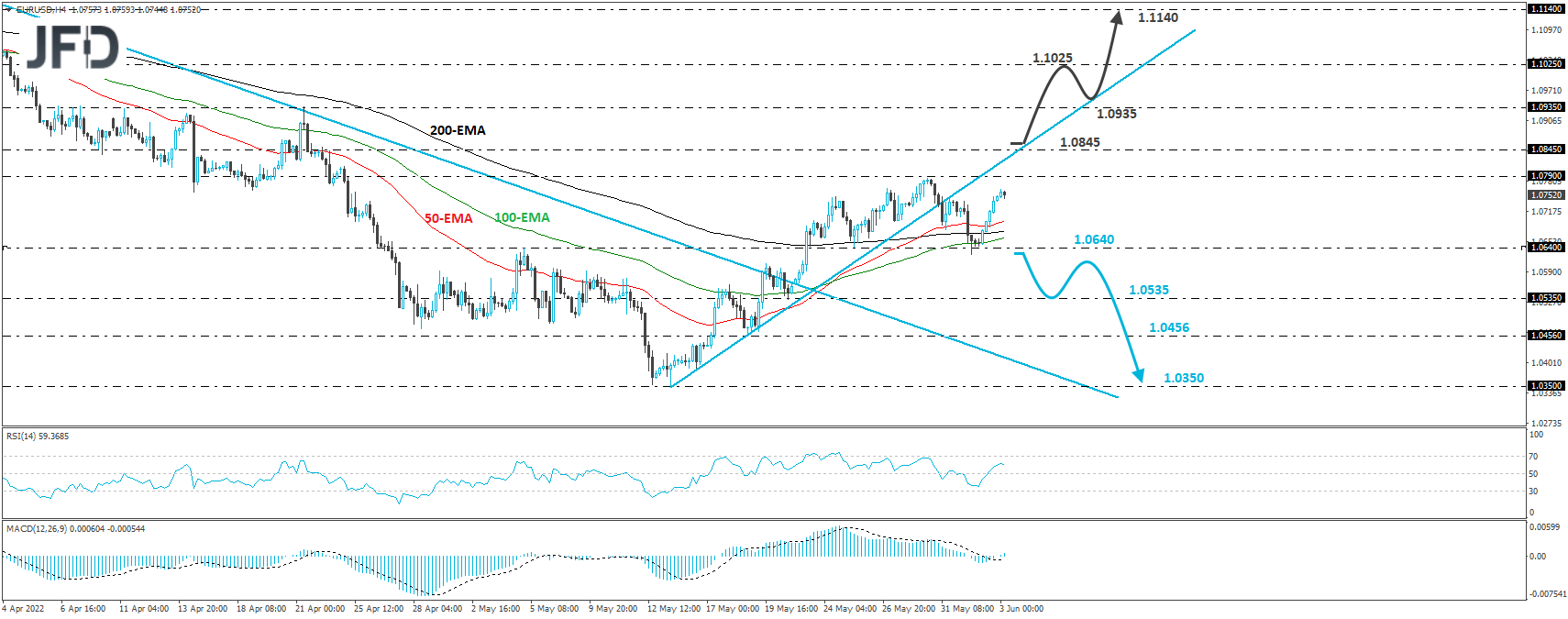
EUR/USD traded notably higher yesterday, after hitting support near the 1.0640 zone, which was already marked as a support, by the inside swing high of May 5th. Yet, it remains below the 1.0790 area, marked by the prior peak, formed on May 30th, as well as below the prior upside support line taken from the low of May 13th. Thus, we would still see chances for the bears to jump back into the action again.
That said, we will get more confident on further declines if we see a clear dip below 1.0640. This will confirm a forthcoming lower low on the 4-hour chart and may allow the bears to dive towards the low of May 20th, at around 1.0535. If they are not willing to stop there either, then we may see them pushing towards the low of May 18th, at around 1.0456, where another break could carry extensions towards the low of May 13th, at around 1.0350.
On the upside, we would like to see the recovery extending above 1.0845, before we start examining whether the bulls have regained full control. This could signal the rate’s return back above the aforementioned upside line and we may see the bulls pushing towards the 1.0935 zone, which acted as a key resistance between April 6th and 21st. If they don’t stop there, then we may see them climbing towards the 1.1025 area, or even the 1.1140 territory, marked by the high of March 17th.
GBP/USD – Technical Outlook
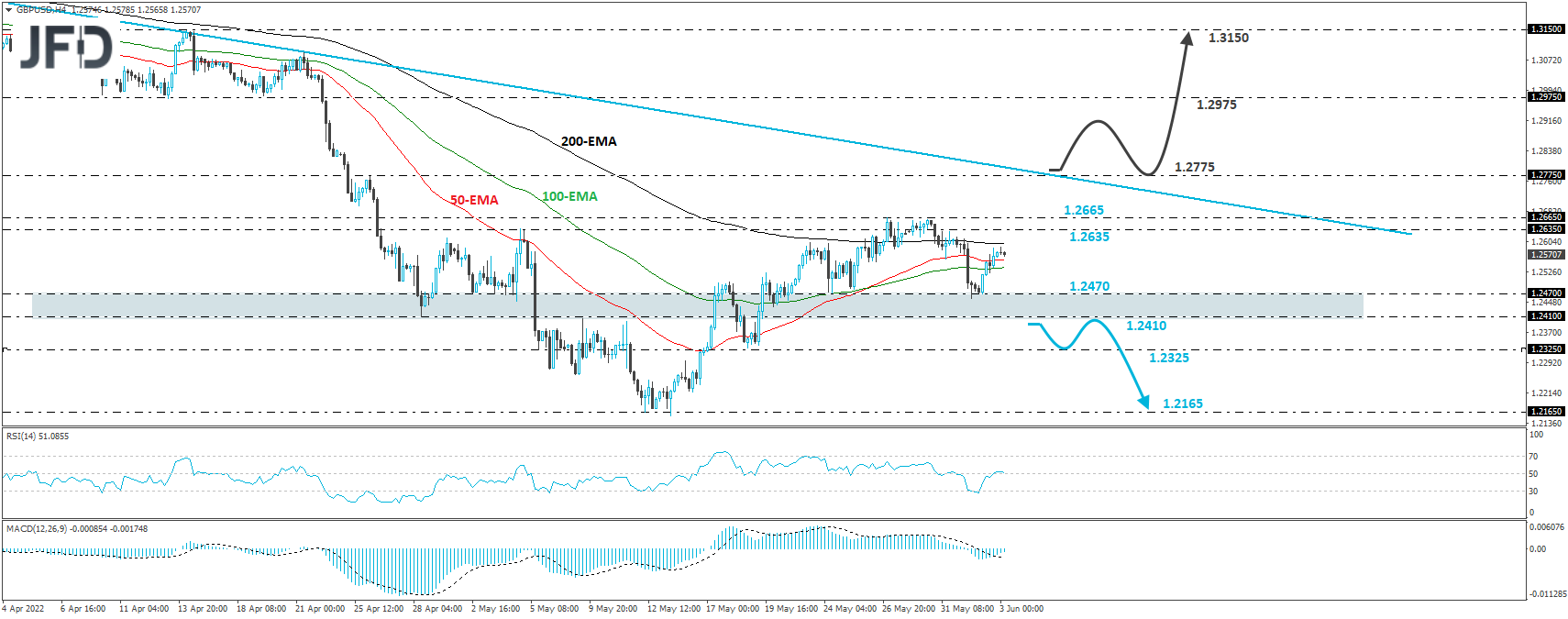
GBP/USD traded higher as well, after hitting support at 1.2470, a support already marked by the low of May 24th. However, the pair remains below the downside line taken from the high of March 23rd, and as with EUR/USD, we see decent chances for the bears to take charge again at some point soon.
This could happen from near the 1.2635/65 zone, marked by the highs of May 31st and 27th. But we will get more confident on the downside if we see the bears pushing below the 1.2410 hurdle, marked by the inside swing high of May 9th and the low of April 28th. This could allow declines towards the low of May 18th, at 1.2325, the break of which could carry extensions towards the 1.2165 territory, which provided strong support on May 12th and 13th.
On the upside, we would like to see a clear and decisive break above 1.2775 before we get confident on the bullish case. This could confirm the break above the downside line taken from the high of March 23rd, and may encourage advances towards the 1.2975 zone, which provided strong support between April 8th and 19th. A break higher could encourage more bulls to join in, who could help the pair hit the 1.3150 level, defined as a resistance by the high of April 14th.
The content we produce does not constitute investment advice or investment recommendation (should not be considered as such) and does not in any way constitute an invitation to acquire any financial instrument or product. The Group of Companies of JFD, its affiliates, agents, directors, officers or employees are not liable for any damages that may be caused by individual comments or statements by JFD analysts and assumes no liability with respect to the completeness and correctness of the content presented. The investor is solely responsible for the risk of his investment decisions. Accordingly, you should seek, if you consider appropriate, relevant independent professional advice on the investment considered. The analyses and comments presented do not include any consideration of your personal investment objectives, financial circumstances or needs. The content has not been prepared in accordance with the legal requirements for financial analyses and must therefore be viewed by the reader as marketing information. JFD prohibits the duplication or publication without explicit approval.
CFDs are complex instruments and come with a high risk of losing money rapidly due to leverage. 72.99% of retail investor accounts lose money when trading CFDs with the Company. You should consider whether you understand how CFDs work and whether you can afford to take the high risk of losing your money. Please read the full Risk Disclosure.
Copyright 2022 JFD Group Ltd.