

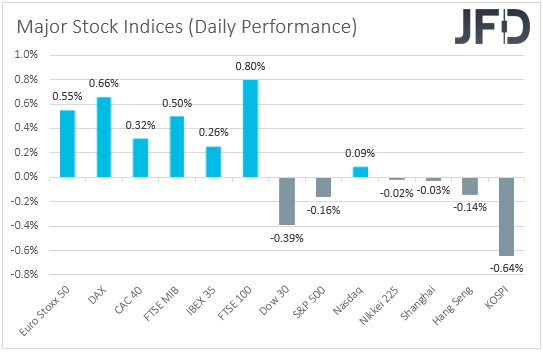
Major EU indices traded in the green yesterday, but the US and Asian ones slid as investors may have adopted a cautious stance ahead of today’s FOMC decision. Following the most recent surge in US Treasury yields, some market participants may be on the lookout on any comments on that front, whether the Fed is considering reacting, and if so, how.
Equities Pull Back as Investors Turn Cautious Ahead of Fed
The US dollar traded mixed against the other G10 currencies on Tuesday and during the Asian session Wednesday. It gained ground against NOK, NZD, EUR, and AUD in that order, while it underperformed versus CAD, SEK, CHF, and GBP. The greenback was found virtually unchanged against JPY.
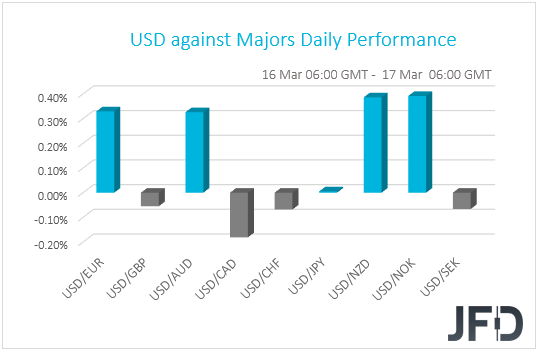
The weakening of the risk-linked Kiwi and Aussie, combined with the strengthening of the safe-haven franc, suggests that markets traded in a risk-off fashion yesterday and today in Asia. Indeed, looking at the performance in the equity world, we see that, although major EU indices were a sea of green, risk appetite softened during the US session and remained soft in Asia today. With no clear catalyst behind the change in market sentiment, we believe that investors may have adopted a cautious stance ahead of the FOMC monetary policy decision later in the day.
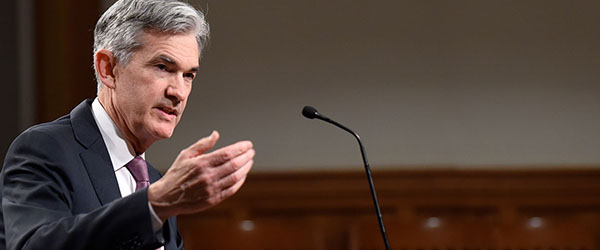
Following the most recent surge in US Treasury yields, some market participants may be on the lookout on any comments on that front, whether the Fed is considering reacting, and if so, how. While the rally in yields was fueled by speculation that the Fed may have to tighten policy sooner than previously anticipated due to surging inflation, we don’t expect policymakers to add to such expectations. After all, when testifying before Congress, Fed Chair Powell clearly noted that they will look beyond any temporary spikes in prices and that it may take more than three years for inflation to reach the Fed’s goal. Remember that the Fed wants inflation to rise above 2% for some time, something, which according to the minutes of the latest Fed gathering, is expected to happen in the years after 2023.
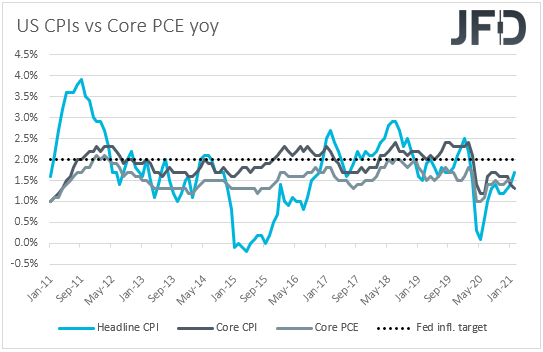
Now, on the other hand, there may be some investors waiting to see whether the Fed will follow the footsteps of the ECB and accelerate its bond purchases in order to avoid any unwarranted tightening in financial conditions due to the rise in bond yields. However, several Fed officials have noted that the rally in borrowing costs just reflects the optimism over a rapid recovery, brushing aside concerns about a return to the dysfunction in markets that dominated the early days of the coronavirus pandemic. Thus, we don’t expect the Fed to ease further either, especially with market sentiment improving towards the end of last week.
With all that in mind, both groups of investors are likely to get disappointed and thus, we don’t expect the US dollar to react much at the time of the event. It could gain slightly if officials present upside revisions to their economic forecasts due the covid vaccinations proceeding at a fast pace, as well as due to President Biden’s massive fiscal stimulus package being signed into law. That said, we stick to our guns that the greenback is likely to come back under selling pressure as inflation fears continue to ease, while equities are likely to continue to trend north.
Nasdaq 100 – Technical Outlook
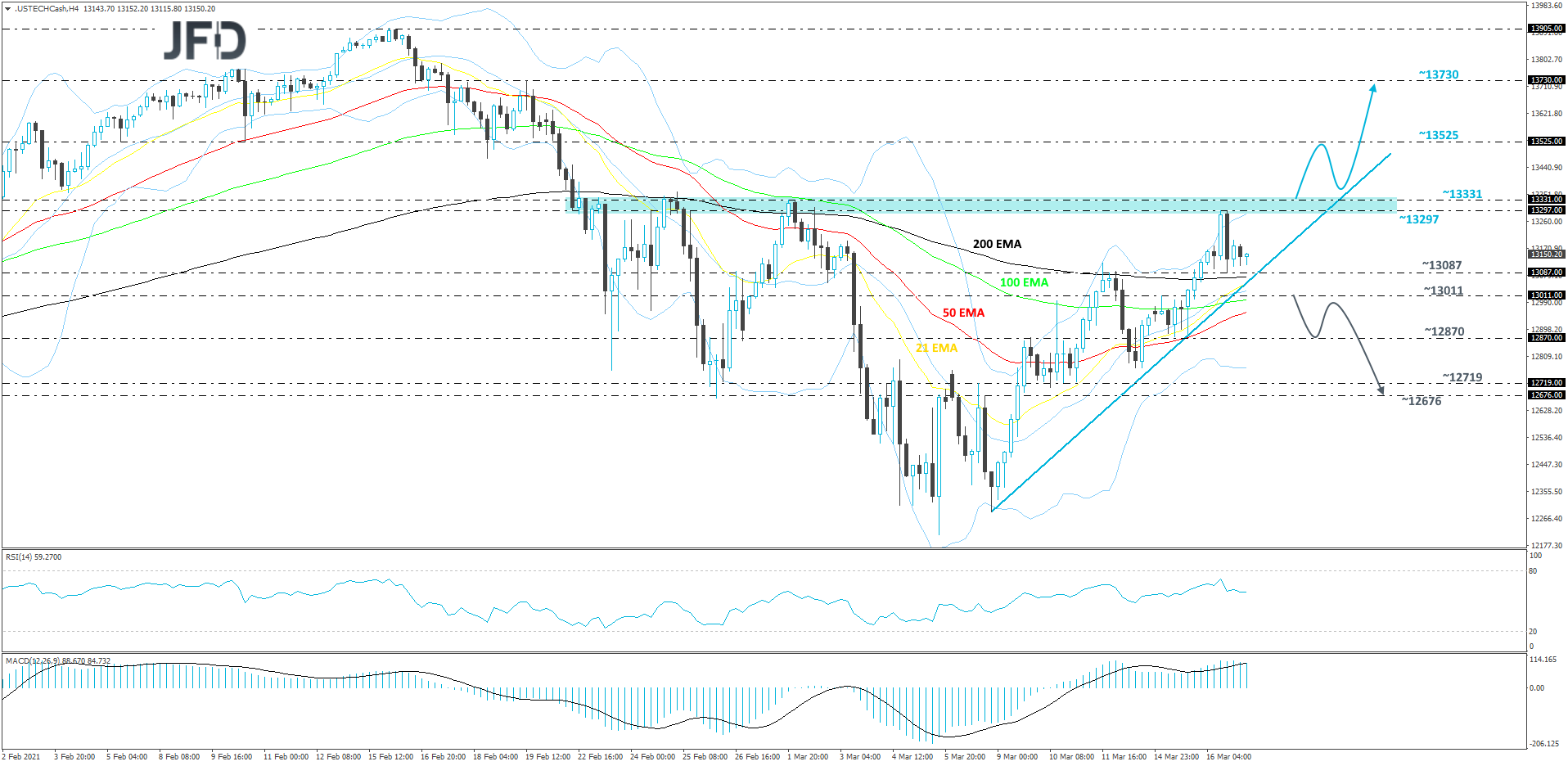
After the reversal to the upside in the beginning of March, Nasdaq 100 is now slowly grinding higher, while trading above a short-term tentative upside support line drawn from the low of March 8th. That said, we can see that, so far, the price is struggling to overcome one of its resistance zones between the 13297 and 13331 levels, marked by the yesterday’s high and the current highest point of March. In order to aim for higher areas, a break above those levels is needed. Until then, we will take a somewhat-positive approach.
A push above the 13331 barrier would confirm a new high for March, potentially setting the stage for further advances. Nasdaq 100 might climb to the 13525 obstacle, or even to the 13730 level, marked by the high of February 19th, which could halt the acceleration for a bit.
Alternatively, if the aforementioned upside line breaks and the price drops below the 13011 hurdle, marked by an intraday swing high of March 15th, that might spook new buyers from the arena for a while. Nasdaq 100 could then slide to the 12870 obstacle, marked near the low of March 15th, where the index may stall for a bit. That said, if the sellers remain active, they might push the price towards the 12719 level, marked by an intraday swing low of March 10th and the low of March 11th. Slightly below it sits another possible support hurdle, at 12676, which is marked by an intraday swing high of March 8th.
USD/CHF – Technical Outlook
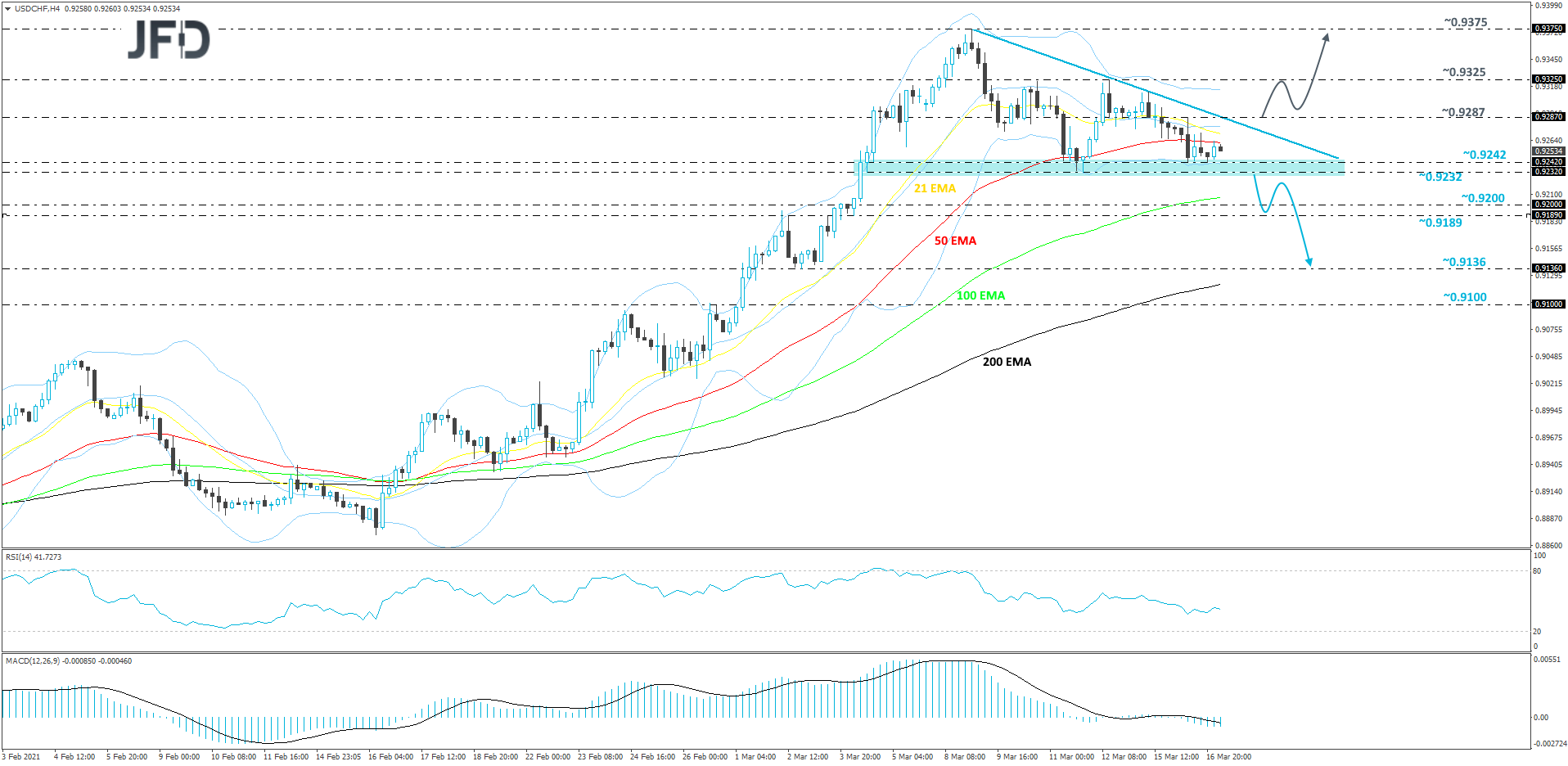
After hitting resistance near the 0.9375 hurdle in the beginning of March, USD/CHF started drifting lower and it is now seen trading below a short-term tentative downside resistance line taken from the high of March 9th. That said, for the pair to move lower, it would have to overcome one of its strong support areas between the 0.9232 and 0.9342 levels, marked by the lows of March 11th and 16th. From the shorter-term perspective, it seems that USD/CHF is forming a potential descending triangle pattern, which, according to all TA rules, tends to break to the downside. For now, we will take a somewhat-bearish approach.
If, eventually, the rate does fall below the 0.9232 hurdle, that would confirm a forthcoming lower low, possibly clearing the path to some lower areas. We will then aim for the 0.9200 obstacle, or the 0.9189 zone, marked by the low of March 4th. Initially, the pair might stall there for a bit, however, if the sellers are still feeling comfortable, they may continue applying pressure on USD/CHF and they could force the pair to drift to the 0.9136 level, which is the low of March 2nd. Slightly below it sits the 200 EMA, which might provide additional support.
On the other hand, if USD/CHF breaks the aforementioned downside line and then makes its way above the 0.9287 barrier, marked by yesterday’s high, that may invite more buyers into the arena. Such a move could open the way towards the 0.9325 obstacle, a break of which may set the stage for a push to the 0.9375 barrier, marked by the current highest point of March.
As for the Rest of Today’s Events
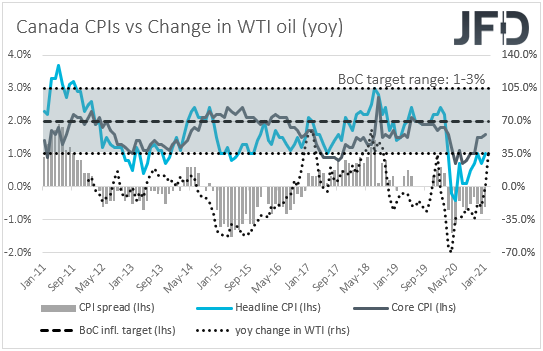
On the data front, the most important one seems to be Canada’s CPIs for February. The headline rate is expected to have risen to +1.3% yoy from +1.0%, but the core one is anticipated to have slid to +1.4% yoy from +1.6%. At last week’s gathering, the BoC stood pat, noting that the economic recovery continues to require extraordinary monetary policy support, and that the 2% inflation goal is not expected to be sustainably achieved until into 2023, which means that any QE tapering may be unlikely in the next months. Although officials kept the door on that front open, a rising headline CPI combined with a sliding core rate would mean that any increase in consumer prices may be due to the rise in oil prices and thus, it may be temporary. This will confirm the Bank’s view and may lessen even more the tapering likelihood.
Eurozone’s final CPIs for February are also coming out and they are expected to confirm their preliminary estimates, while in the US, we get building permits and housing starts for the same month, with the forecasts pointing to small declines.
As for tonight, during the Asian session Thursday, New Zealand’s GDP for Q4 is due to be released, with the forecast pointing to a slowdown to +0.1% qoq from +14.0%, something that would, however, take the yoy rate up to +0.5% from +0.4%. A few hours later, we get Australia’s employment report for February. The unemployment rate is forecast to have ticked down 6.3% from 6.4%, while the net change in employment is anticipated to show that the Australian economy has gained 30.0k jobs after adding 29.1k in January.
Disclaimer:
The content we produce does not constitute investment advice or investment recommendation (should not be considered as such) and does not in any way constitute an invitation to acquire any financial instrument or product. The Group of Companies of JFD, its affiliates, agents, directors, officers or employees are not liable for any damages that may be caused by individual comments or statements by JFD analysts and assumes no liability with respect to the completeness and correctness of the content presented. The investor is solely responsible for the risk of his investment decisions. Accordingly, you should seek, if you consider appropriate, relevant independent professional advice on the investment considered. The analyses and comments presented do not include any consideration of your personal investment objectives, financial circumstances or needs. The content has not been prepared in accordance with the legal requirements for financial analyses and must therefore be viewed by the reader as marketing information. JFD prohibits the duplication or publication without explicit approval.
CFDs are complex instruments and come with a high risk of losing money rapidly due to leverage. 79.07% of retail investor accounts lose money when trading CFDs with the Company. You should consider whether you understand how CFDs work and whether you can afford to take the high risk of losing your money. Please read the full Risk Disclosure.
Copyright 2021 JFD Group Ltd.