

1. Rising Demand & Large U.S. Inventory Drawdowns
U.S. crude inventories dropped by 3.2 million barrels, suggesting either stronger demand or lower production.
→ This temporarily pushed WTI prices higher.
2. Optimism from Global Trade Negotiations
Progress in U.S.-Japan trade deals and U.S.-EU talks sparked hopes for economic stimulus and increased demand.
3. Ongoing Geopolitical Tensions
The Middle East remains highly volatile, especially with the Iran-Israel conflict and the potential closure of the Strait of Hormuz.
→ Such risks tend to push oil prices higher in the short term.
4. OPEC+ Production Strategy
Despite announcing production increases starting in August, many OPEC+ countries are hesitant to ramp up output quickly – some are delaying supply.
→ This postpones potential oversupply, providing short-term price support.
5. Warnings About Oversupply
TotalEnergies warns of a looming oversupply due to elevated OPEC+ output and weakening global demand.
→ This is a bearish factor for long-term pricing.
6. U.S. Policy: Russian Oil Sanctions Remain Unclear
Trump’s threats of 100% secondary tariffs on buyers of Russian oil have not yet been enforced.
→ Markets expect a moderate impact – not a major disruption.
7. Economic Concerns & Trade Risks
Rising tensions in U.S.–EU trade relations may dampen global growth expectations and thus oil demand.
8. Analyst Expectations & Forecasts
The EIA forecasts an average WTI price of around $66 this year, with a drop to $59 by December.
J.P. Morgan cut its 2025 forecast to ~$62, and for 2026 to ~$53.
Summary
| Factor | Impact on WTI |
|---|---|
| U.S. inventory drawdowns & trade optimism | Bullish |
| Geopolitical tensions | Short-term bullish |
| Delayed OPEC+ output ramp-up | Supportive |
| Oversupply risks & weak growth | Bearish |
| Unclear Russia sanctions | Neutral to slightly bullish |
| Bearish analyst forecasts | Mid- to long-term bearish |
Conclusion:
WTI is currently trading between $65 and $67 per barrel with notable volatility. Key drivers include geopolitical risks, inventory data, and uncertainty around OPEC+ production pace.
Despite occasional upward price movements, the medium-term outlook leans bearish due to rising global supply and cautious demand growth.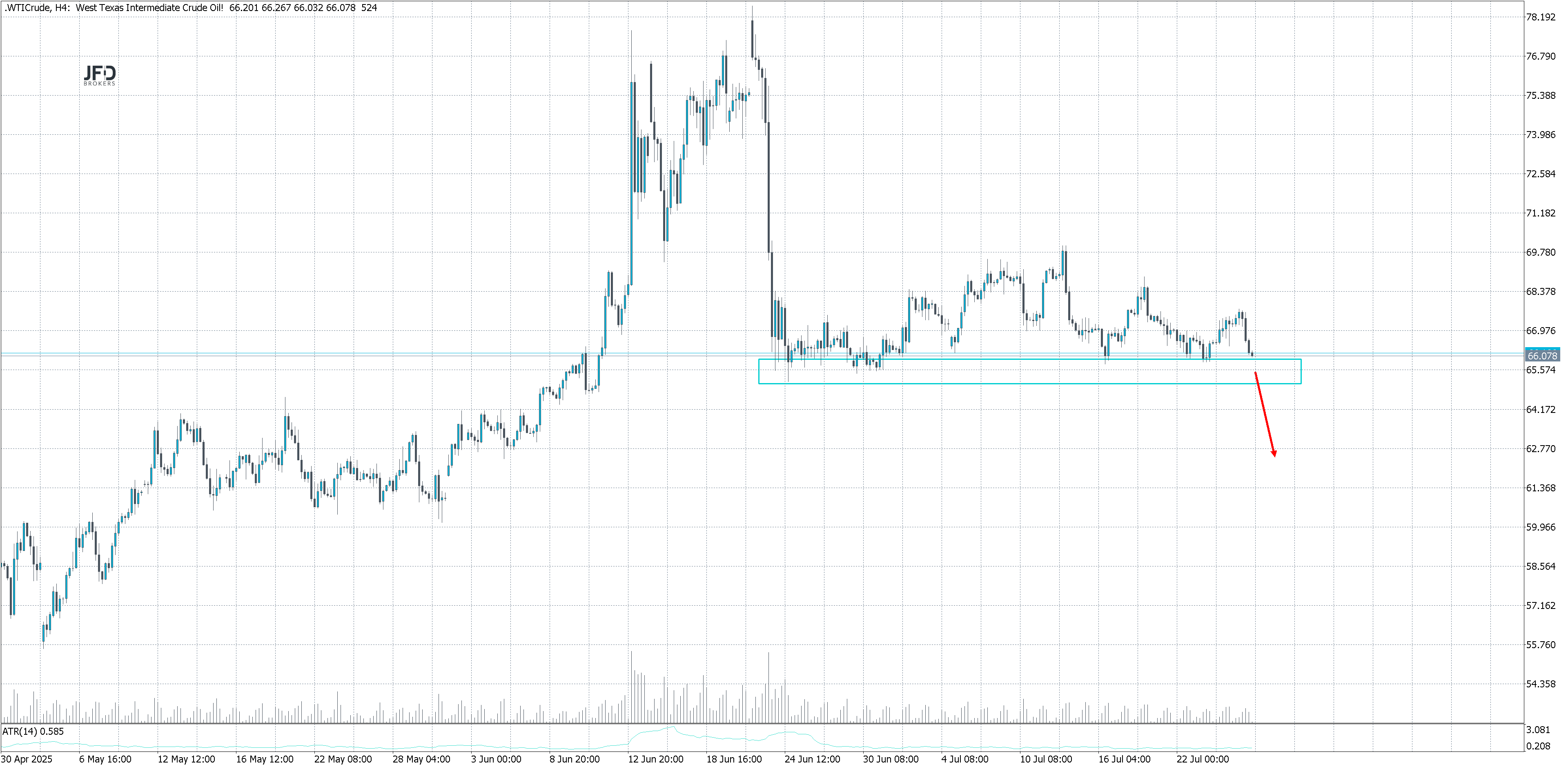
Disclaimer:
The content we produce does not constitute investment advice or investment recommendation (should not be considered as such) and does not in any way constitute an invitation to acquire any financial instrument or product. The Group of Companies of JFD, its affiliates, agents, directors, officers or employees are not liable for any damages that may be caused by individual comments or statements by JFD analysts and assumes no liability with respect to the completeness and correctness of the content presented. The investor is solely responsible for the risk of his investment decisions. Accordingly, you should seek, if you consider appropriate, relevant independent professional advice on the investment considered. The analyses and comments presented do not include any consideration of your personal investment objectives, financial circumstances or needs. The content has not been prepared in accordance with the legal requirements for financial analyses and must therefore be viewed by the reader as marketing information. JFD prohibits the duplication or publication without explicit approval.
There are risks involved with trading of cash equities. Past performance is not indicative of future results. You should consider whether you can tolerate such losses before trading. Please read the full Risk Disclosure (https://www.jfdbrokers.com/en/legal/risk-disclosure).
Copyright 2024 JFD Group Ltd.