


Is Gold on Its Way to $4,000? What 2025 and 2026 Might Hold
Gold continues to soar in 2025. Prices have already broken record highs this year – fueled by geopolitical tension, trade risks, and growing fears of a global recession.
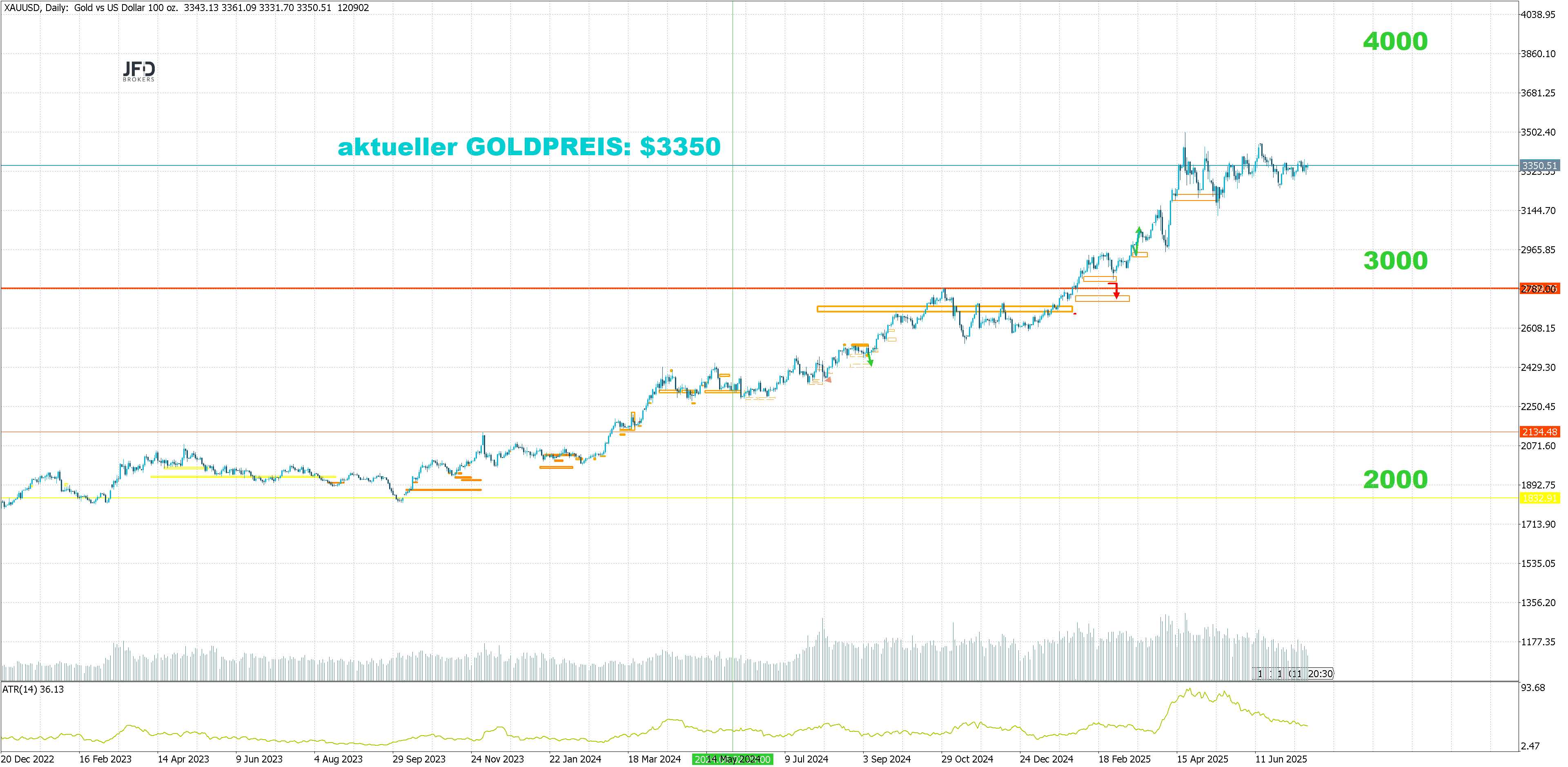
In April, gold peaked at $3,500 per ounce, marking a 30% gain year-to-date – well above earlier projections from JFD-Brokers. Now the big question is: Is $4,000 next?
📈 What do the forecasts say?
According to JFD-Brokers Research, gold is expected to average $3,675 in Q4 2025, with a move toward $4,000 by Q2 2026. Several factors are supporting this outlook:
-
Ongoing uncertainty around U.S. economic and trade policy
-
Inflation and recession risks
-
Rising geopolitical instability
-
A structural shift in demand for gold
Why gold remains in focus for investors
Gold is still the go-to safe haven asset. While it doesn’t pay interest, it offers:
-
Low correlation with equities and bonds
-
Protection against currency debasement
-
A strong hedge against stagflation, geopolitical shocks, and recession
This unique profile is making gold attractive again – for both institutional and private investors.
So who’s buying all this gold?
🔹 Central banks: The silent giants
Central banks have been buying gold at historic levels – and that trend continues. In 2025 alone, J.P. Morgan expects 900 tonnes of central bank purchases. Why?
-
Growing desire to diversify away from the U.S. dollar
-
Rising geopolitical uncertainty
-
A need for more stable reserves
According to IMF data, central banks now hold nearly 20% of their official reserves in gold – up from 15% in 2023. The U.S., Germany, France, and Italy alone hold nearly half of the world’s official gold reserves.
In 2024, major buyers included Poland, Turkey, India, China, Czechia, and others – each acquiring 20+ tonnes.
🔹 Investors: Private and institutional
Investors globally have also been increasing their exposure to gold. The total holdings across bars, coins, ETFs, and futures now stand at around 49,400 tonnes, with 45,400 tonnes held in physical form (bars and coins), according to the World Gold Council.
ETF demand has spiked sharply in 2025, with 310 tonnes added year-to-date – driven by a 70% increase in Chinese holdings and nearly 10% in U.S. holdings.
What’s driving this? Beyond falling real yields, gold is being used as a hedge against the combined risks of inflation and stagnating growth – a key concern for 2025 and 2026.
Bottom Line: Is $4,000 realistic?
If the current dynamics continue – strong central bank demand, ETF inflows, rising global tension, and economic headwinds – then a move toward $4,000/oz by 2026 is entirely plausible.
Gold is back in the spotlight. And it’s becoming more than just a crisis asset – it’s a strategic reserve in an increasingly unstable world.
-----------------------------------------------------------------------------------------------------
Disclaimer:
The content we produce does not constitute investment advice or investment recommendation (should not be considered as such) and does not in any way constitute an invitation to acquire any financial instrument or product. The Group of Companies of JFD, its affiliates, agents, directors, officers or employees are not liable for any damages that may be caused by individual comments or statements by JFD analysts and assumes no liability with respect to the completeness and correctness of the content presented. The investor is solely responsible for the risk of his investment decisions. Accordingly, you should seek, if you consider appropriate, relevant independent professional advice on the investment considered. The analyses and comments presented do not include any consideration of your personal investment objectives, financial circumstances or needs. The content has not been prepared in accordance with the legal requirements for financial analyses and must therefore be viewed by the reader as marketing information. JFD prohibits the duplication or publication without explicit approval.
There are risks involved with trading of cash equities. Past performance is not indicative of future results. You should consider whether you can tolerate such losses before trading. Please read the full Risk Disclosure (https://www.jfdbrokers.com/en/legal/risk-disclosure).
Copyright 2024 JFD Group Ltd.