


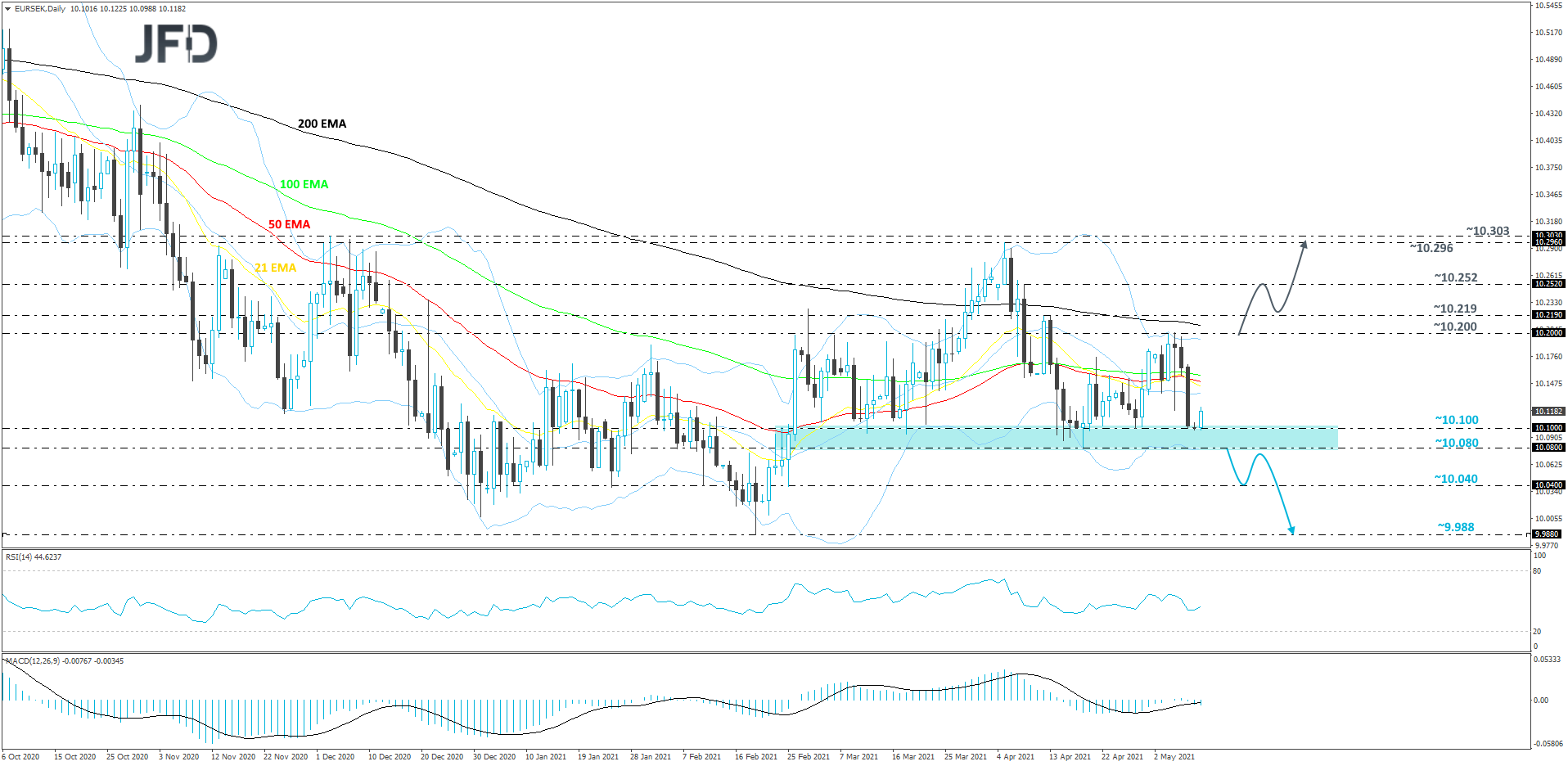
The technical picture of EUR/SEK on our daily chart shows that from around the end of February, the pair is forming a possible head-and-shoulders pattern. Currently, the rate is trading near the so-called “neckline” of that pattern, which is between the 10.080 and 10.100 levels, marked by the lows of April 19th and 28th respectively. In addition to all that, the pair is trading below all of the EMAs, which could also be seen as a bearish indication. Although there are strong signs that further declines might be possible, we would prefer to wait for a rate-drop below the “neckline” first, before examining a further move lower.
If, eventually, the pair breaks below the 10.080 zone, this will confirm a forthcoming lower low, potentially opening the door towards lower areas. EUR/SEK may then drift to the 10.040 hurdle, marked by the low of February 25th, which if fails to provide support and breaks, might set the stage for a move to the 9.988 level. That level is the current lowest point of this year, reached in February.
Despite the RSI currently pointing a bit higher, it remains below 50. The MACD is pointing lower, while sitting below zero and its trigger line. The two indicators suggest negative price momentum, which come in line with the idea discussed above.
Alternatively, in order for us to move away from the bearish scenario, we would like to see a move above the 10.200 barrier, marked near the current highest point of May. At the same time, the rate would push above the 200-day EMA, this way inviting more bulls into the field. EUR/SEK could travel to the 10.219 obstacle, or even to the 10.252 zone, marked by the high of April 8th, where a temporary hold-up may occur. That said, if the buyers continue to dominate the arena, they might easily lift the pair to its next resistance area between the 10.296 and 10.303 levels, which mark the highest points of April and December.
Disclaimer:
The content we produce does not constitute investment advice or investment recommendation (should not be considered as such) and does not in any way constitute an invitation to acquire any financial instrument or product. The Group of Companies of JFD, its affiliates, agents, directors, officers or employees are not liable for any damages that may be caused by individual comments or statements by JFD analysts and assumes no liability with respect to the completeness and correctness of the content presented. The investor is solely responsible for the risk of his investment decisions. Accordingly, you should seek, if you consider appropriate, relevant independent professional advice on the investment considered. The analyses and comments presented do not include any consideration of your personal investment objectives, financial circumstances or needs. The content has not been prepared in accordance with the legal requirements for financial analyses and must therefore be viewed by the reader as marketing information. JFD prohibits the duplication or publication without explicit approval.
CFDs are complex instruments and come with a high risk of losing money rapidly due to leverage. 75.05% of retail investor accounts lose money when trading CFDs with the Company. You should consider whether you understand how CFDs work and whether you can afford to take the high risk of losing your money. Please read the full Risk Disclosure.
Copyright 2021 JFD Group Ltd.