


Today, the spotlight will turn on the FOMC decision, as market participants are eager to find out whether officials are indeed planning to start scaling back their QE purchases later this year, and when the timing of beginning the process will be. If the Committee indeed hints a November start, it would also be interesting to see whether this could translate to earlier rate hikes as well.
Will the FOMC Hint that it Could Start QE Tapering in November?
The US dollar traded higher against most of the other major currencies on Tuesday and during the Asian session Wednesday. It lost ground only versus CHF and JPY, while it eked out the most gains versus AUD and CAD.
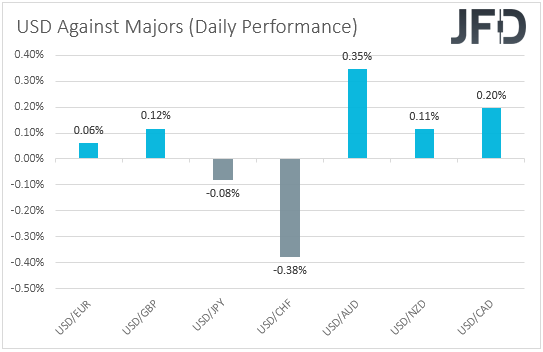
The strengthening of the US dollar and the other safe havens yen and franc, combined with the weakening of the risk-linked currencies, suggests that markets may have continued trading in a risk-off fashion yesterday and today in Asia. However, looking at the performance in the equity world, we see that major EU indices rebounded, perhaps due to short-covering after Monday’s steep tumble. That said, appetite was more subdued during the US and Asian sessions, with their respective indices trading mixed.
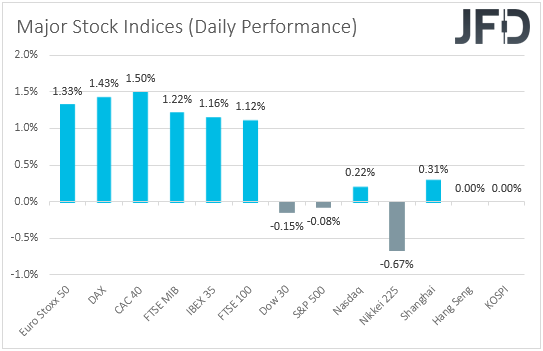
Maybe some investors stayed careful due to the FOMC decision later today, despite Evergrande announcing overnight that it would pay some bond interest due on Thursday. That said, the default risks are far from diminished. They are still well on the table. The developer missed interest payments on Monday to at least two of its largest bank creditors, and a failure to do so within 30 days would put the bond in default. The same could happen to other bonds as well, if no solution is found soon. Therefore, we believe that the Evergrande saga may continue being a headache for market participants, at least for a while more.
Now, as far as the FOMC decision is concerned, this is one of the bigger meetings, which will be accompanied by updated economic projections and a new “dot plot”. Following the weaker-than-expected August employment report, market participants scaled back their expectations that the Fed could indeed start tapering its QE purchases this year. However, a couple of weeks ago, several policymakers signalled that they still expect to begin the process before the end of this year, despite the slowdown in jobs growth seen in August, reviving hopes on that front. What’s more, the CPIs for August slowed somewhat, but remained well above the Fed’s objective of 2%, keeping questions on whether the inflation surge is transitory, well on the table.
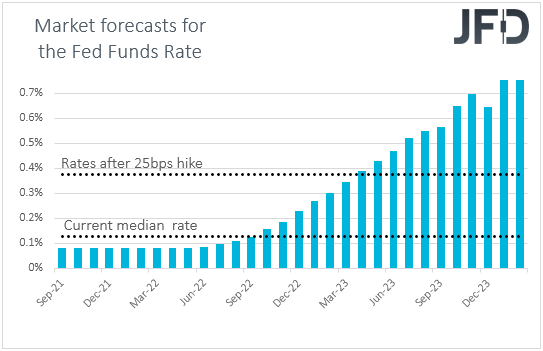
Thus, with that in mind, it would be interesting to see whether this is the opinion held by the majority of policymakers and whether there will be any strong clues on the possible timing of beginning the tapering process. In our view, anything pointing to a November start may support the US dollar further and perhaps extend the latest setback in equities. Market participants may also be eager to find out whether this could also result in earlier rate hikes. The June “dot plot” revealed that interest rates are likely to start rising in 2023, with 13 members seeing higher rates through that year, and the median dot sitting at 0.6%, which means two quarter-point hikes. However, 7 officials saw at least one hike in 2022, and if that number grows, it could consist of another reason for more USD strengthening, and further retreat in stock indices, as, according to the yields of the Fed funds futures, market participants currently expect the first 25bp hike to be delivered in April 2023.
Ahead of the FOMC decision, during the Asian session today, we had another central bank deciding on monetary policy and this was the BoJ. This Bank kept all its policy settings steady, but offered a bleaker view on exports and output, saying that "Exports and factory output continue to increase, although they are partly affected by supply constraints." In July, officials just noted that exports and output "continued to increase steadily." In our view, this reinforces the case for the Bank to maintain its policy extra loose even as other major Banks are discussing ways to start scaling back some of the crisis-related support.
S&P 500 – Technical Outlook
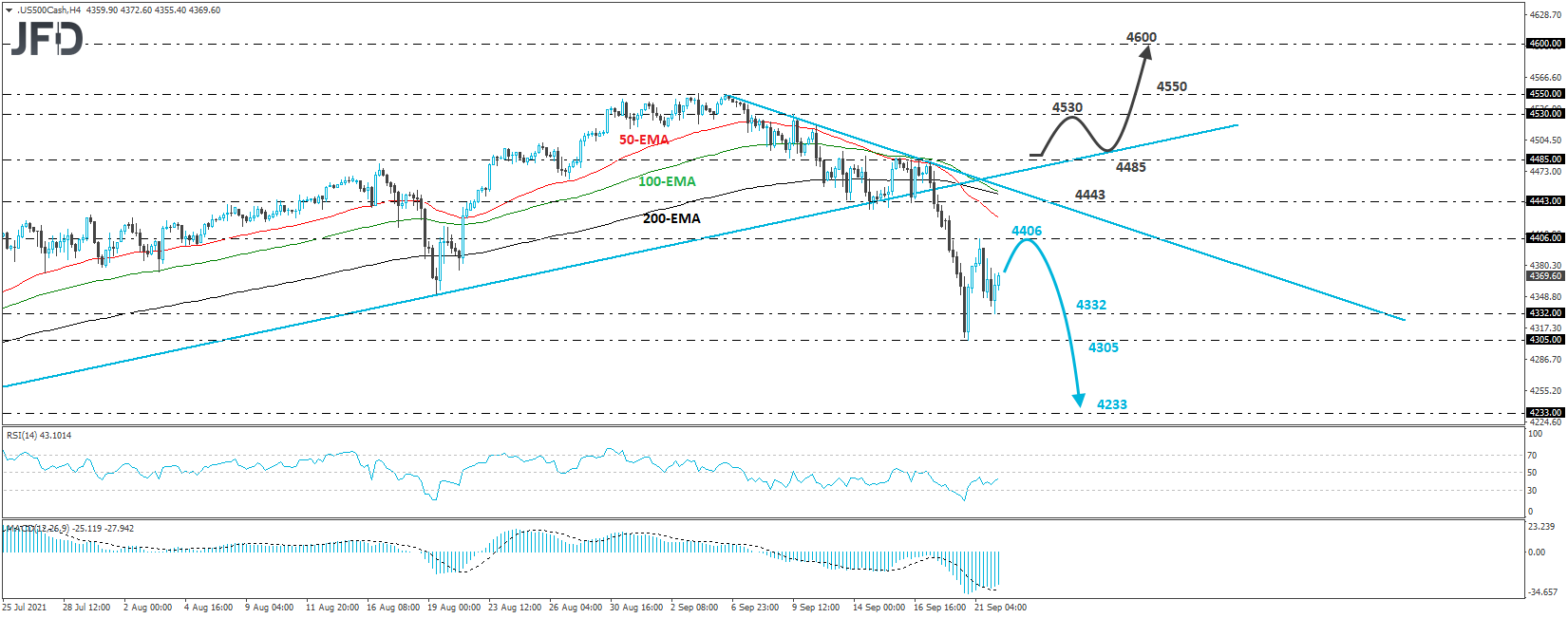
The S&P 500 cash index traded lower yesterday, after hitting resistance at 4406. However, it quickly found support at 4332 and then, it rebounded. Overall, the index remains below the prior upside support line drawn from the low of June 21st, as well as below the downside line taken from the high of September 6th. So, with these technical signs in mind, we will consider the short-term outlook to be negative for now.
Even if the latest rebound continues for a while more, we see decent chances for the bears to take charge again from near the 4406 barrier, and push the action back down, towards Monday’s low, at 4305. If they don’t stop there, then we may experience extensions towards the low of July 19th, at 4233.
In order to start examining whether the outlook has turned back to positive, we would like to see a strong recovery back above 4485, a territory that provided strong resistance on September 15th and 16th. This will take the price above both the aforementioned diagonal lines and may pave the way towards the 4530 zone, marked by the high of September 9th, or the all-time high of 4550, hit on September 3rd. A break higher would take the index into the uncharted territory and perhaps pave the way towards the round figure of 4600.
EUR/USD – Technical Outlook
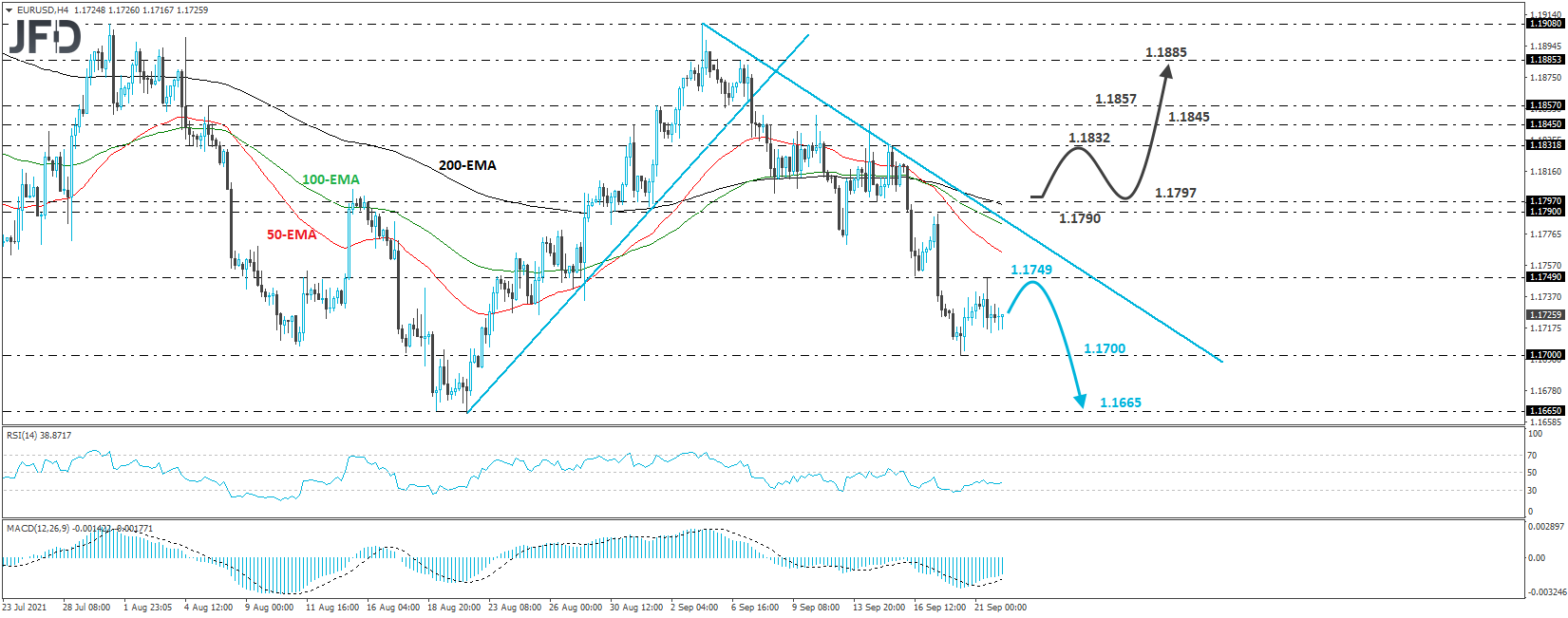
EUR/USD traded lower yesterday, after hitting resistance at 1.1749. However, it started consolidating before even reaching Monday’s low of 1.1700. Overall, the pair remains below the downside resistance line taken from the high of September 3rd, and thus, we would still see a negative near-term picture.
Initially, the rate could rise a bit, but we see the case for the recovery to stay limited near the 1.1749 level again, or, at least, below the pre-mentioned downside line. A forthcoming slide may result in another test at 1.1700, the break of which would confirm a forthcoming lower low and perhaps see scope for extensions towards the 1.1665 territory, which supported the pair on August 19th and 20th.
On the upside, the move that could wake up the bulls may be a break above 1.1797. This could confirm the break above the downside line and may pave the way towards the 1.1832, 1.1845, or 1.1857 barriers, marked by the highs of September 15th and 14th and the inside swing low of September 6th, respectively. If none of those hurdles is able to halt the advance, then we could see extensions towards the peak of September 7th, at 1.1885.
As for the Rest of Today’s Events
Besides the Fed decision, we also have the US existing home sales for August, which are expected to have slid somewhat, as well as the EIA (Energy Information Administration) report on crude oil inventories for last week. The forecast points to a 1.190mn barrels slide, after the 1.688mn decline the week before. However, bearing in mind that the API (American Petroleum Institute) reported a 6.108mn barrels tumble yesterday, we would consider the risks surrounding the EIA number as tilted to the downside.
As for the speakers, besides Fed Chair Powell, who will hold a press conference after his Bank’s decision, we will also get to hear again by ECB Supervisory Board Chair Andrea Enria.
Disclaimer:
The content we produce does not constitute investment advice or investment recommendation (should not be considered as such) and does not in any way constitute an invitation to acquire any financial instrument or product. The Group of Companies of JFD, its affiliates, agents, directors, officers or employees are not liable for any damages that may be caused by individual comments or statements by JFD analysts and assumes no liability with respect to the completeness and correctness of the content presented. The investor is solely responsible for the risk of his investment decisions. Accordingly, you should seek, if you consider appropriate, relevant independent professional advice on the investment considered. The analyses and comments presented do not include any consideration of your personal investment objectives, financial circumstances or needs. The content has not been prepared in accordance with the legal requirements for financial analyses and must therefore be viewed by the reader as marketing information. JFD prohibits the duplication or publication without explicit approval.
CFDs are complex instruments and come with a high risk of losing money rapidly due to leverage. 73.90% of retail investor accounts lose money when trading CFDs with the Company. You should consider whether you understand how CFDs work and whether you can afford to take the high risk of losing your money. Please read the full Risk Disclosure.
Copyright 2021 JFD Group Ltd.