


European shares rebounded on Monday, perhaps as ECB President Lagarde pushed against expectations over a July hike by the ECB, but Wall Street continued to slide, as Friday’s better-than-expected US jobs data encouraged market participants to add to bets over faster tightening by the Fed. With the calendar staying light today and tomorrow as well, market participants may be sitting on their hands in anticipation of the US CPIs for January, due out on Thursday.
EU Shares Gain, Wall Street Slides Amid Light Economic Agenda
The US dollar traded mixed against the other major currencies on Monday and during the Asian session Tuesday. It gained only versus EUR and JPY, while it underperformed against AUD, CAD and NZD in that order. The greenback was found virtually unchanged versus GBP and CHF.
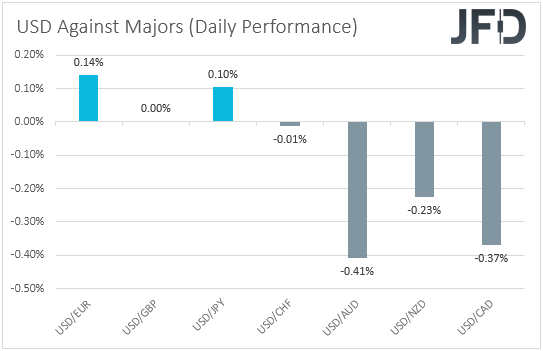
The weakening of the Japanese yen and the strengthening of the commodity-linked Aussie, Loonie and Kiwi suggest that markets may have traded in a risk-on fashion yesterday and today in Asia. Turning our gaze to the equity world, we see that, indeed, most major EU indices traded in the green, but during the US session, appetite softened. Both the S&P 500 and the Nasdaq slid, while the Dow Jones finished virtually unchanged. Sentiment improved again today in Asia, with only Hong Kong’s Hang Seng losing ground. All other indices under our radar traded in the green.
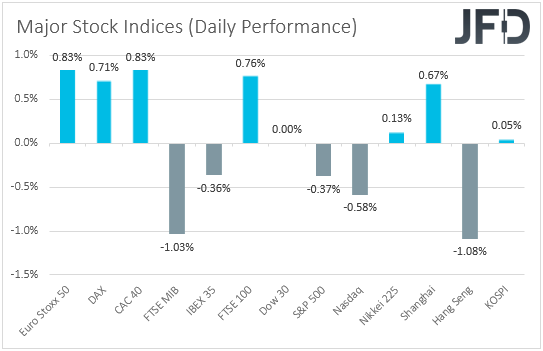
European shares rebounded, perhaps due to remarks by ECB President Christine Lagarde, who pushed against expectations over a July rate hike by the ECB. Specifically, the ECB Chief said that there were no signs that measurable monetary policy tightening would be required. Yes, last week, she opened the door for a rate increase later this year, but maybe this could happen during the last quarter, a view expressed by ECB member Klaas Knot.
Having said all that, Wall Street investors may have continued reducing their risk exposures, perhaps after Friday’s better-than-expected employment data. Although this adds more credence to the strong performance of the US economy, combined with accelerating wages, it encourages market participants to add to their bets over faster tightening by the Fed. According to the Fed funds futures, investors anticipate five quarter-point rate increases by the end of this year, and accelerating inflation on Thursday could prompt them to add more. Something like that could support the US dollar and may result in another setback in risky assets.
EUR/USD – Technical Outlook
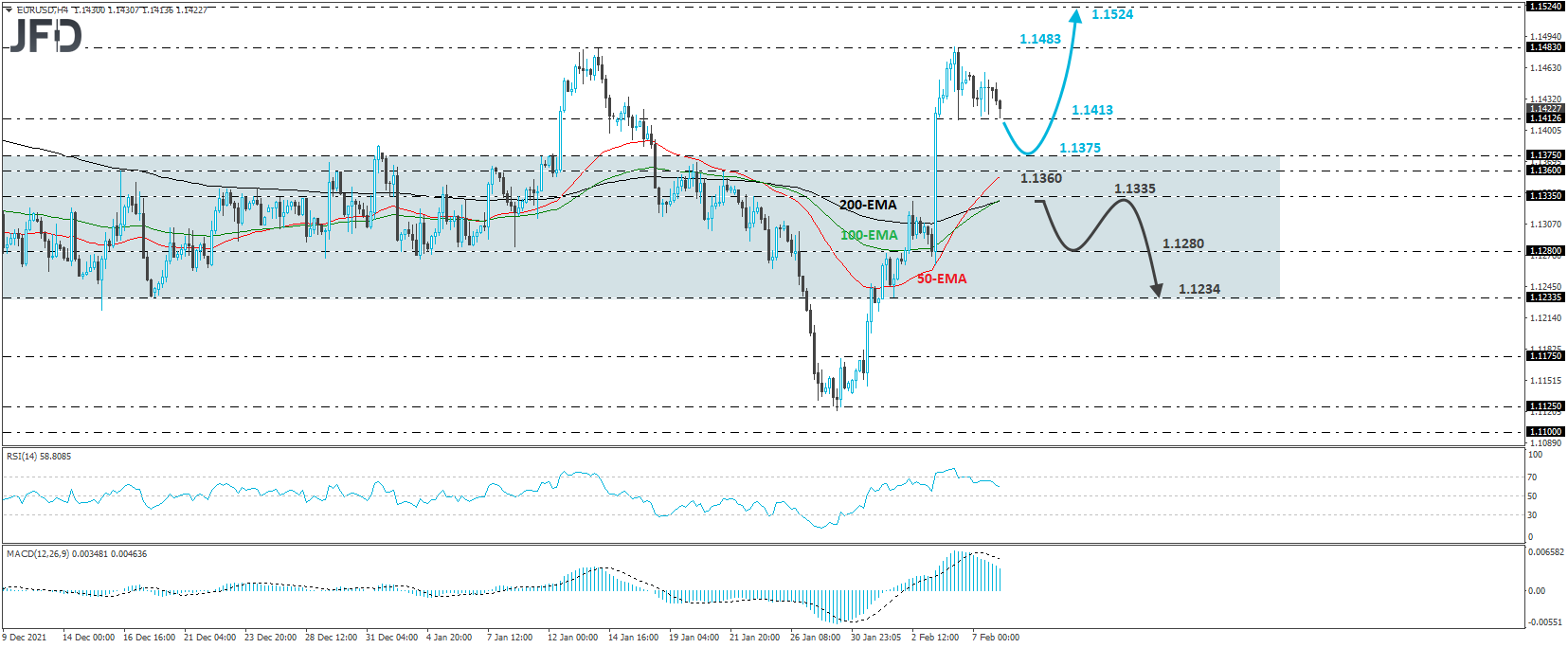
EUR/USD traded lower on Monday, after it hit resistance at 1.1483 on Friday. At the time of writing, the rate is testing Friday’s low of 1.1413, but it still stays above the key zone of 1.1375, which acted as the upper bound of the range that continued the price action between November 26th and January 12th. Thus, we would still see chances of a potential rebound.
Even if the slide continues below 1.1413, as we already noted, the bulls could take charge from near the 1.1375 barrier, which could result in a rebound and another test at the 1.1483 zone, which was tested, not only on Friday, but on January 13th and 14th as well. If the buyers are not willing to stop there this time around, we could see them pushing towards the 1.1524 zone, marked by the inside swing lows of October 12th and November 4th respectively.
Now, in order to totally abandon the bullish case, we would like to see a dip back below 1.1335. This may confirm the rate’s return within neutral waters and could initially allow declines towards the 1.1280 territory, near which the pair rebounded last week after the ECB decision. If that zone fails to provide support this time around, we may see the fall extending towards the 1.1234 area, which was the lower end of the aforementioned range.
AUD/JPY – Technical Outlook
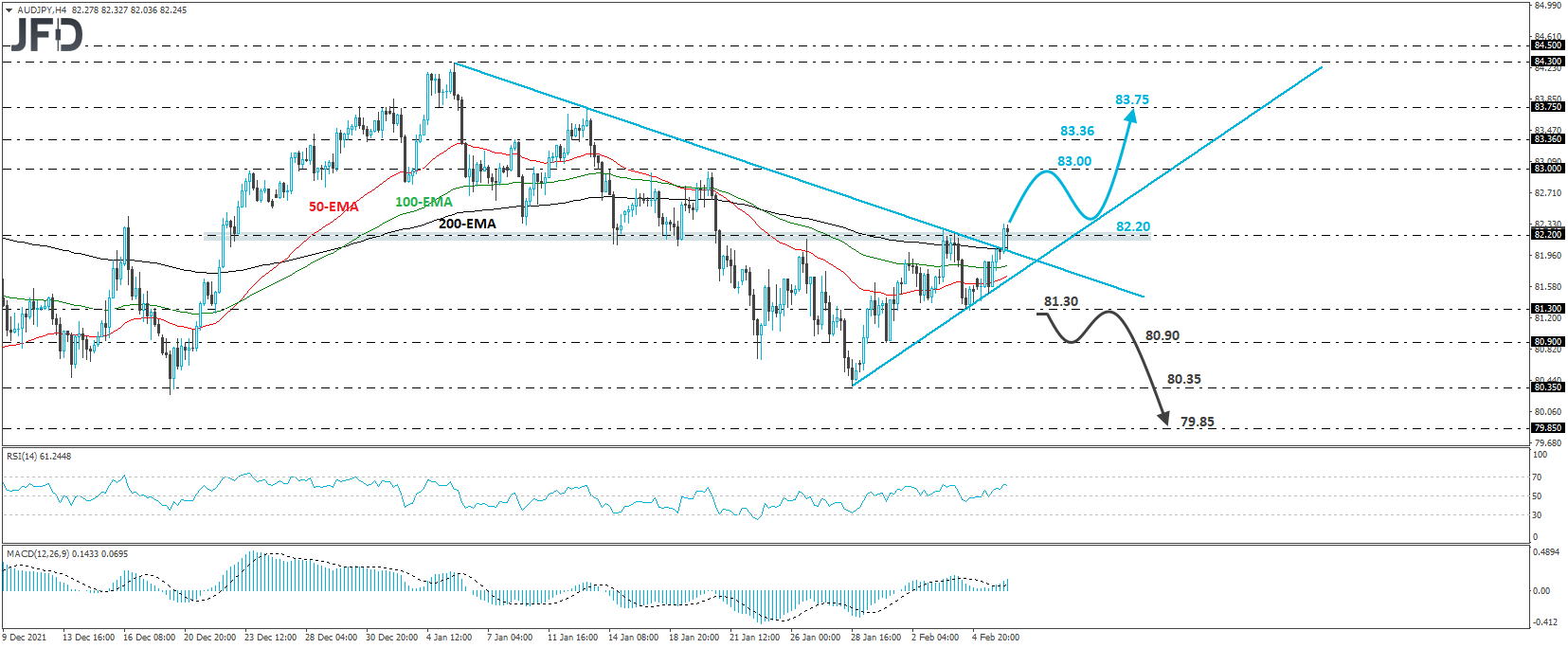
AUD/JPY edged north today during the Asian session, breaking above the downside resistance line drawn from the high of January 5th, as well as above the key barrier of 82.20. This, combined with the fact that the rate is now trading above a newly-established upside line drawn from the low of January 28th, paints a positive short-term picture.
In our view, the break above 82.20 may have opened the way for advances towards the 83.00 area, near the peaks of January 18th and 20th. If the bulls are not willing to stop there, then we may see them climbing towards the 83.36 or 83.75 zone, defined as resistances by the highs of January 10th and 13th respectively.
The outlook could turn negative again, upon a dip below the 81.30 zone, marked by the low of February 4th. The rate will be back below both the aforementioned diagonal lines, and it will also confirm a forthcoming lower low on the 4-hour chart. The bears could then get encouraged to push the action to the 80.90 barrier, marked by the low of February 1st, or the 80.35 zone, marked by the low of January 28th. If they don’t stop there either, we may see them diving towards the low of December 6th, at 79.85.
As for Today’s Events
We have the US NFIB small business optimism index for January and Canada’s trade balance for December. No forecast is available for the NFIB index, while Canada’s trade surplus is expected to have decreased to CAD 2.62bn from CAD 3.13bn.
Disclaimer:
The content we produce does not constitute investment advice or investment recommendation (should not be considered as such) and does not in any way constitute an invitation to acquire any financial instrument or product. The Group of Companies of JFD, its affiliates, agents, directors, officers or employees are not liable for any damages that may be caused by individual comments or statements by JFD analysts and assumes no liability with respect to the completeness and correctness of the content presented. The investor is solely responsible for the risk of his investment decisions. Accordingly, you should seek, if you consider appropriate, relevant independent professional advice on the investment considered. The analyses and comments presented do not include any consideration of your personal investment objectives, financial circumstances or needs. The content has not been prepared in accordance with the legal requirements for financial analyses and must therefore be viewed by the reader as marketing information. JFD prohibits the duplication or publication without explicit approval.
CFDs are complex instruments and come with a high risk of losing money rapidly due to leverage. 73.82% of retail investor accounts lose money when trading CFDs with the Company. You should consider whether you understand how CFDs work and whether you can afford to take the high risk of losing your money. Please read the full Risk Disclosure.
Copyright 2022 JFD Group Ltd.