


EU indices traded in the red yesterday, the US ones finished their session mixed, while today, Asian markets were up, with all this suggesting that investors are finding it hard to assume a clear direction. Yesterday, we also had a BoE gathering, with the Bank expanding its QE, but signaling that it will now proceed with a slower purchase pace. The SNB and the Norges Bank also announced their decisions, without proceeding with any policy changes.
EU stocks Slide, Asian Ones Gain on Indecisive Trading
The dollar traded higher against all but two of the other G10 currencies on Monday and during the Asian morning Friday. It gained the most versus GBP and SEK, while it was found nearly unchanged against JPY and NOK.
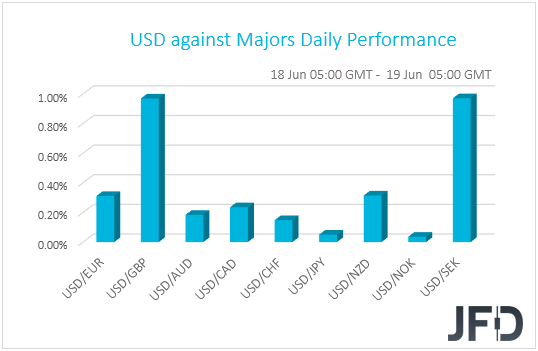
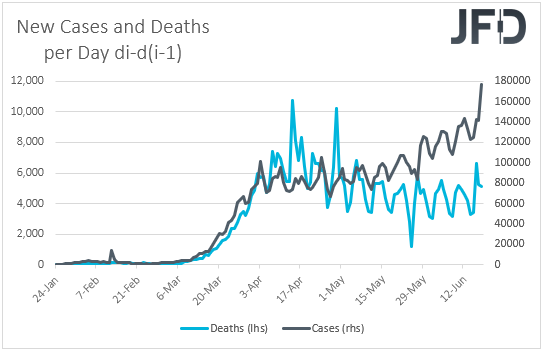
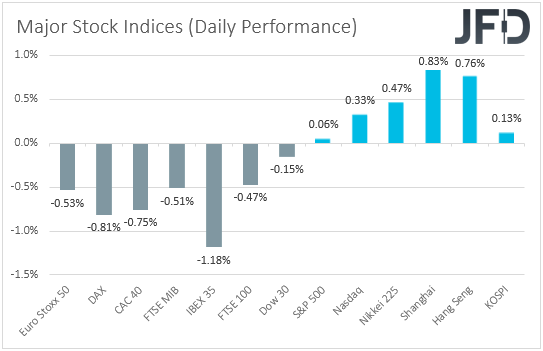
The strengthening of the dollar and the yen suggests that market participants continued trading in a risk-off fashion. Turning our gaze to the equity world, we see that major EU indices closed in the negative territory, perhaps due to fresh fears of a second wave in coronavirus infections worldwide. At this point, it is worth mentioning that infected cases surged yesterday, hitting a new daily record. Another negative for the European markets may have been Wirecard’s plunge of 61.8% after the company’s auditor refused to sign off the 2019 accounts due to a missing USD 2.1mn.
The US session finished with Wall Street’s main indices on the mixed side. Dow slid 0.15%, the S&P closed virtually unchanged, while Nasdaq gained 0.33%. In Asia today, things were a bit brighter, with Japan’s Nikkei 225 and China’s Shanghai Composite gaining 0.47% and 0.83% respectively.
The overall picture of the equity market enhances our view that investors are finding it hard to assume a clear direction. As we noted yesterday, it seems that there is a battle between those who are optimistic over an economic recovery as lockdown measures continue to be lifted around most of the world, and those who are concerned over a second wave of coronavirus infections, after the new flare-up in China, as well as the surging cases in several US states. We still see decent chances for the broader appetite to improve if most governments around the globe continue to ease their restrictive measures, but until we get clear indications of further recovery, we prefer to stay sidelined. We repeat that in order to start examining the bearish case, we need to see more governments re-introducing restrictions, something that could result in a second hit to the global economy.
DAX – Technical Outlook
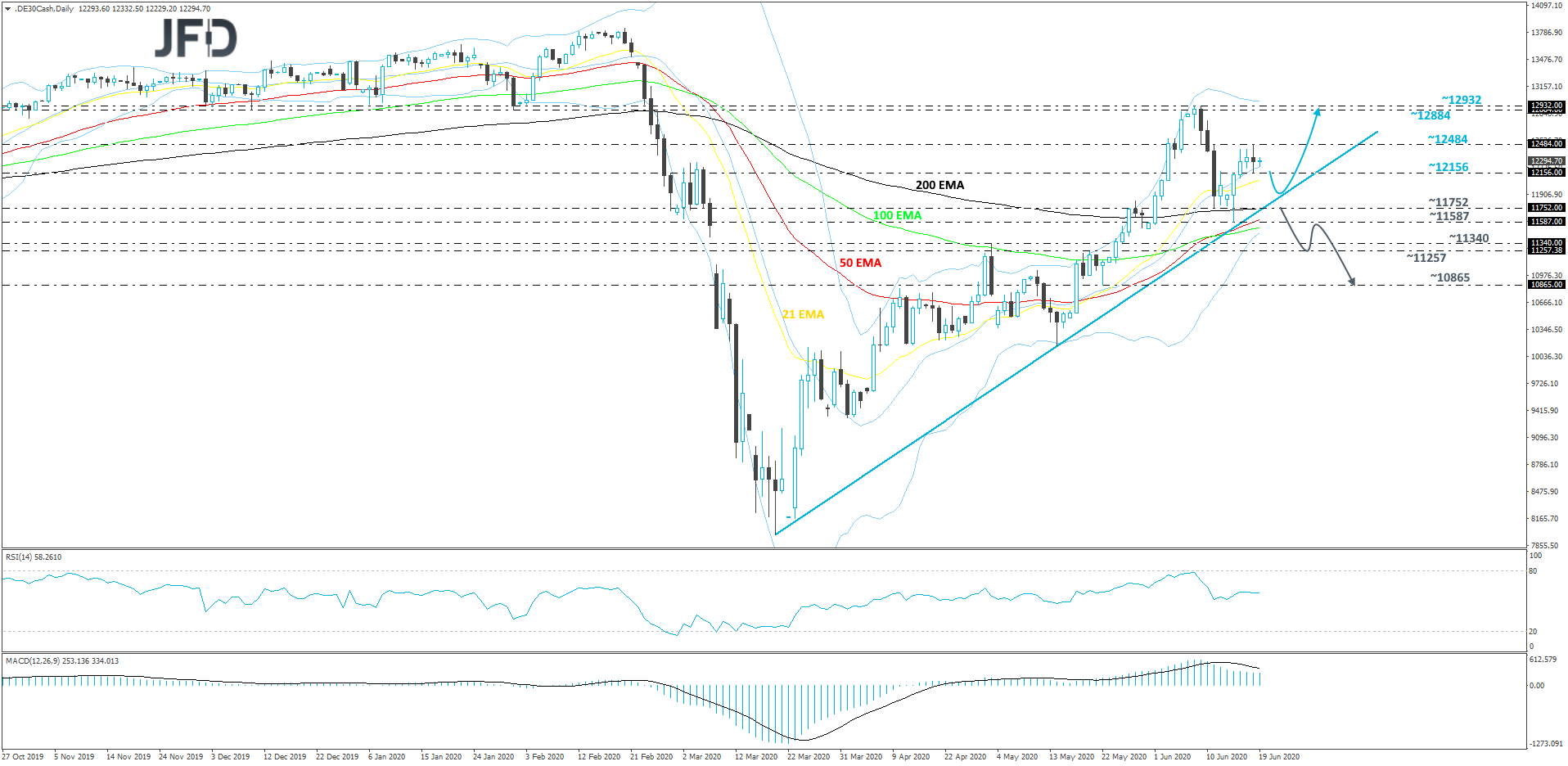
Although, yesterday, DAX formed a new high for this week, the German index corrected lower after that and ended the trading day slightly in the red. This morning we are seeing that the cash index is struggling with the upside and is closer to yesterday’s low. If the bulls won’t have enough steam to push the price above yesterday’s high, we might get a small setback. However, that move lower could still be seen as a temporary correction, especially if DAX remains above its short-term upside support line taken from the low of March 19th. For now, we will take a cautiously-bullish approach.
If the German index does eventually slide a bit lower, but stays above the aforementioned upside line, the bulls might take advantage of the lower price and try to lift it again. If so, DAX may travel back to the 12156 obstacle, a break of which could clear the way to the 12484 hurdle, marked by the current high of this week. If the buyers don’t stop there and continue sitting behind the steering wheel, a further uprise could bring the index closer to the 12884 and 12932 levels, marked by the lowest point of January and the current highest point of June respectively.
Alternatively, if the previously-discussed upside line fails to hold the price from falling and breaks, that could possibly signal a change in the short-term trend. More sellers might join in if the price slides below the 11752 zone, marked by the low of June 11th. At the same time, DAX would be placed below its 200-day EMA and some traders may see it as a sign, which could strengthen the bearish case. The index might then drop to the low of this week, at 11587, a break of which could clear the way to the next possible support area between the 11257 and 11340 levels, marked by the highs of May 20th and April 30th respectively. The price may stall there for a bit, or even retrace back up. That said, if DAX finds it difficult to get back above the aforementioned upside line, the sellers may step in again and drive the price down. A fall below the 11257 zone may clear the path towards the 10865 level, marked by the low of May 22nd.
BoE Expands QE, But the Pace Slows
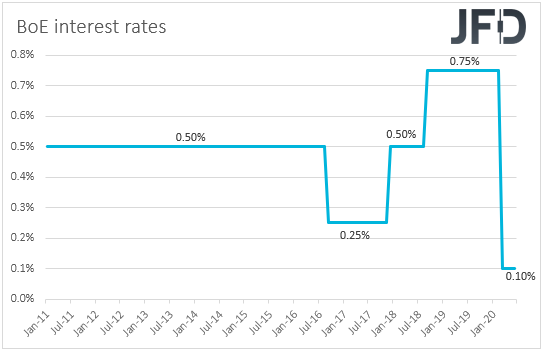
Back to the currencies, the pound was one of the two biggest losers among the G10s, despite a somewhat more-hawkish-than-expected BoE yesterday. The Bank kept interest rates unchanged at 0.10% and via an 8-1 vote, it expanded its QE purchases by another GBP 100bn through year-end. The increase was largely anticipated, but the fact that purchases will continue until the end of the year suggests that they may be carried out at a somewhat slower pace than previously. On top of that, in the aftermath of the decision, BoE Governor Bailey said that at this gathering, policymakers did not discuss negative interest rates, neither a yield curve control.
The pound spiked up in both instances – BoE decision and Bailey’s comments – but the overall daily trend stayed negative. Today, we got the UK retail sales for May, with both the headline and core rates rebounding by more than anticipated. Still, the pound did not react. It seems that GBP-traders are more concerned with the political scene, and specifically Brexit, rather than monetary policy and data. With the BoE decision now out of their way, they may lock their gaze on headlines surrounding the EU leader’s summit which started yesterday. With the EU and the UK making no progress in the latest round of talks and the UK insisting that everything should be sorted out before the end of the year, anything suggesting that the two sides are very distant in finding common ground may add extra pressure to the British currency.
Apart from the BoE, we had two more central banks deciding on monetary policy yesterday: The SNB and the Norges Bank. The SNB meeting proved to be a non-event, as officials kept interest rates unchanged at -0.75% and repeated that they remain willing to intervene more strongly in the FX market. They also reiterated the notion that the Swiss franc remains highly valued, with President Jordan saying that they made substantial interventions since March, and that there is no specific limit to that. With regards to the Norges Bank, policymakers of this Bank kept interest rates unchanged at 0.0%, repeating that they will stay at that level for some time ahead. That said, they appeared somewhat more optimistic than previously, saying that since the prior meeting, activity has picked up faster than expected, the unemployment has fallen more than anticipated, and oil prices have risen. NOK spiked higher at the time of the announcement but erased those gains later in the day, to be found virtually unchanged against its US counterpart this morning.
GBP/AUD – Technical Outlook
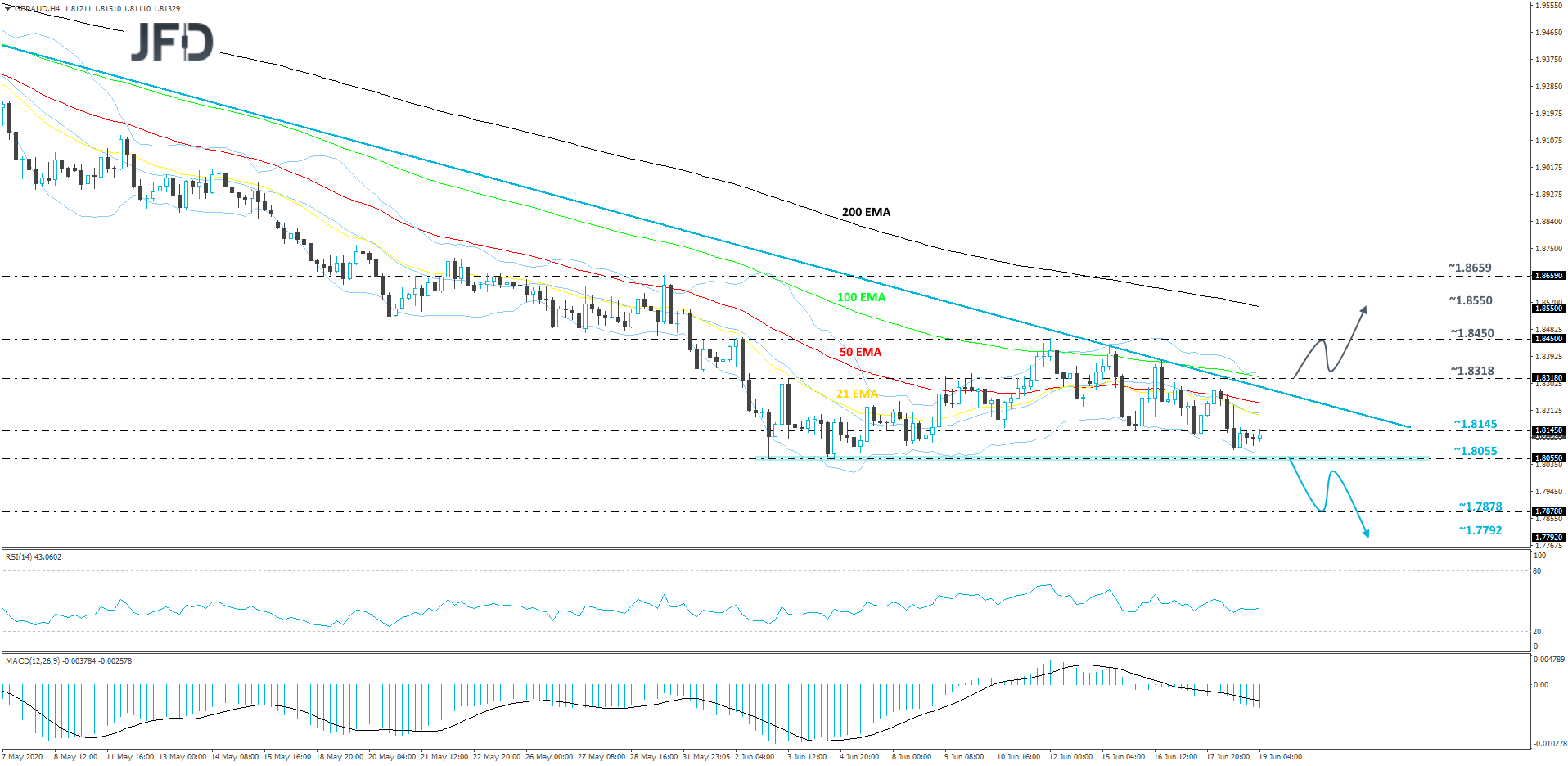
GBP/AUD continues to trade below its short-term tentative downside resistance line taken from the high of May 4th. That said, from the beginning of this month, the pair is struggling to overcome its key support area at 1.8055, which is currently the lowest point of June. Although this morning we are seeing the pair moving slightly to the upside, we will still remain somewhat bearish, as long as the above-discussed downside line stays intact.
We will get even more bearish, if the rate suddenly falls below the 1.8055 zone, marked by the lows of June 3rd, 4th and 5th. Such a move would confirm a forthcoming lower low and more sellers may jump into the action. GBP/AUD might then travel to the 1.7878 obstacle, a break of which may set the stage for a test of the 1.7792 area, which is the lowest point of September 2019.
On the upside, if the previously-mentioned downside line breaks and the rate climbs above the 1.8318 barrier, marked by yesterday’s high, that may be a signal of an end of the current downtrend. More bulls could be joining then, who might help lift GBP/AUD higher. We will then target the 1.8450 hurdle, marked by the high of June 12th, a break of which could open the door for another higher high. The pair may then drift to the 1.8550 level, marked near the highest point of June, which could stall the rate temporarily. Around there, GBP/AUD might also test the 200 EMA on the 4-hour chart, which also could provide additional resistance.
As for the Rest of Today’s Events
During the European morning, Eurozone’s current account balance for April is coming out, but no forecast is currently available. Later in the day, we get Canada’s retails sales for April. Both the headline and core rates are expected to have declined to -15.1% and -13.5% from -10.0% and -0.4% respectively.
We also have three Fed speakers on today’s schedule: Chair Jerome Powell, Boston President Eric Rosengren and Board Governor Randal Quarles.
Disclaimer:
The content we produce does not constitute investment advice or investment recommendation (should not be considered as such) and does not in any way constitute an invitation to acquire any financial instrument or product. The Group of Companies of JFD, its affiliates, agents, directors, officers or employees are not liable for any damages that may be caused by individual comments or statements by JFD analysts and assumes no liability with respect to the completeness and correctness of the content presented. The investor is solely responsible for the risk of his investment decisions. Accordingly, you should seek, if you consider appropriate, relevant independent professional advice on the investment considered. The analyses and comments presented do not include any consideration of your personal investment objectives, financial circumstances or needs. The content has not been prepared in accordance with the legal requirements for financial analyses and must therefore be viewed by the reader as marketing information. JFD prohibits the duplication or publication without explicit approval.
CFDs are complex instruments and come with a high risk of losing money rapidly due to leverage. 83% of retail investor accounts lose money when trading CFDs with the Company. You should consider whether you understand how CFDs work and whether you can afford to take the high risk of losing your money. Please read the full Risk Disclosure.
Copyright 2020 JFD Group Ltd.