

Yesterday, equities across the globe took a beating, as the financial world became more concerned over the Omicron variant. From Australia, the RBA kicked off the morning by delivering the minutes from the meeting held earlier in December. Another set of economic data for Tuesday, which will be monitored carefully, are the UK’s core and headline retail sales figures for the month of November on a MoM and YoY basis.
Fear Ran The Equity World Yesterday
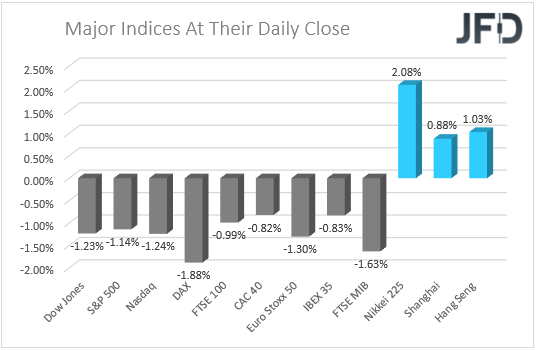
Yesterday, equities across the globe took a beating, as the financial world became more concerned over the Omicron variant. But probably, it is the possible responses from the governments of the developed countries, what worries investors more. The potential lockdowns and restrictions that started taking place again, are forcing businesses to re-think their strategies, in order to stay afloat. Although consumer spending has been on a rise for a few months in the developed countries, it is believed that all the recent gains could be set aside by businesses for their own contingency. This also means that business growth could suffer in the near future, and dividend pay-outs might get halted for a while. Hence we are seeing some investors taking parts of their profits off the table. That said, we are not sounding the alarm yet, as this move could just be seen as a measure of precaution and the indices may still reverse higher in the near term.
Nikkei 225 – Technical Outlook
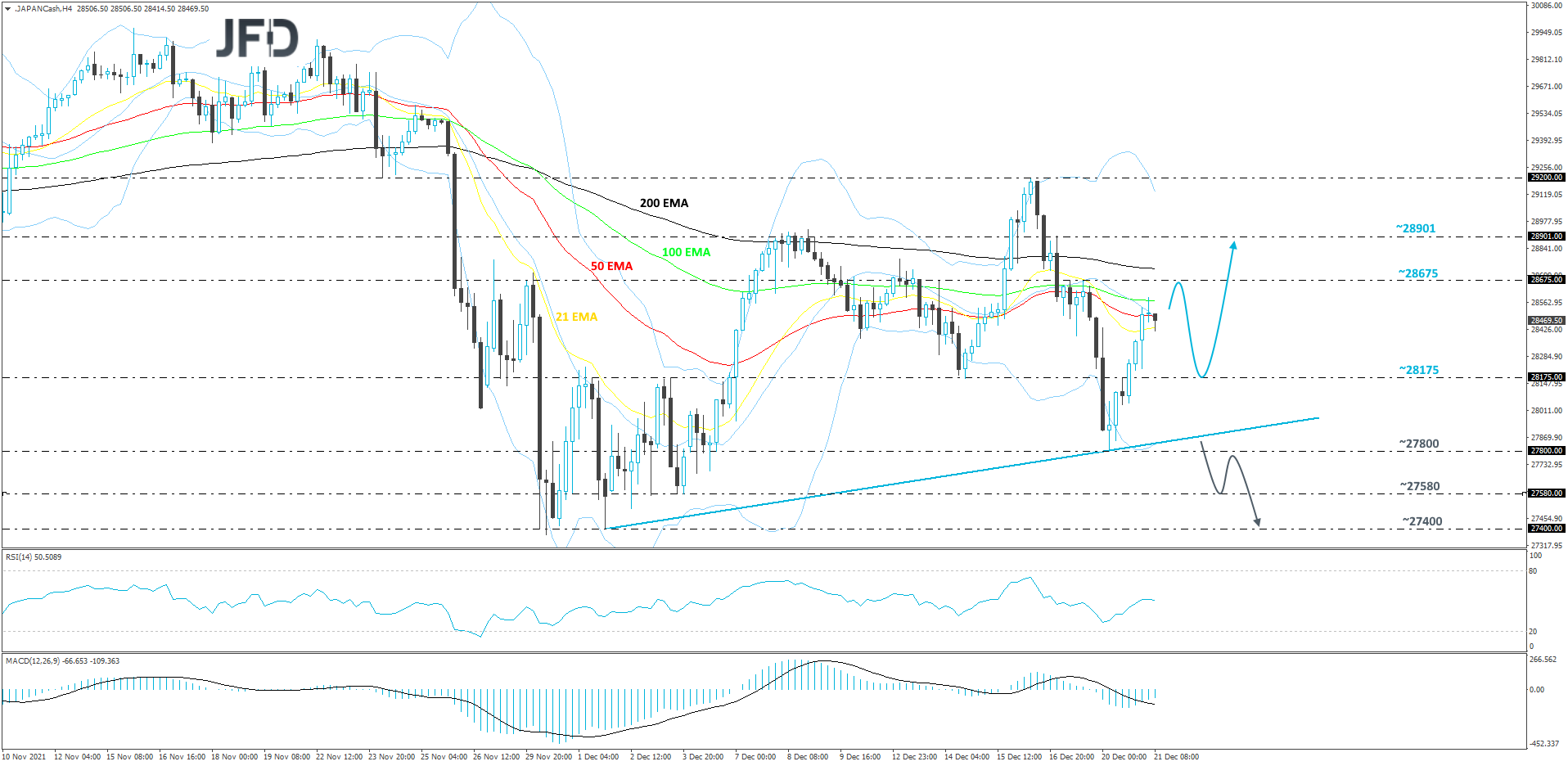
Yesterday, the Nikkei 225 index got picked up by the bulls near the 27800 hurdle and is now seen moving up again. The price is now trading above a short-term tentative upside support line drawn from the low of December 1st. As long as the index continues to trade above that trendline, we will stay positive, at least with the near-term outlook.
Nikkei 225 may travel a bit higher and test the 28675 hurdle, marked by an intraday swing high of December 17th, where a temporary hold-up might occur. Even if the price retraces slightly lower from there, as long as the index stays somewhere above that upside line, the buyers could step in again. If so, they may shoot back to the 28675 obstacle, a break of which could lead to a test of the 28901 level, marked by the high of December 17th.
Alternatively, if the index ends up breaking the aforementioned upside line and then falls below the 27800 hurdle, which is yesterday’s low, this might open the door to some lower areas. Nikkei 225could then slide to the 27580 hurdle, or even to the 27400 level, marked by the current lowest point of December.
Yesterday, in the US, the sectors that took the biggest hits were consumer cyclicals, financials and basic materials. From the consumer cyclicals, companies such as Ralph Laurent Corp. (NYSE: RL), Nike Inc. (NYSE: NKE) and Tesla Inc. (NASDAQ: TSLA) were among the biggest losers. Among the financials, banks like Citigroup Inc. (NYSE: C) and Wells Fargo & Co. (NYSE: WFC) were seen losing around 2%, but the credit card companies like Mastercard Inc. (NYSE: MA) and Capital One Financial Corp. (NYSE: COF) lost more than 3.5%, mainly due to concerns of possible decline in consumer spending.
Although all sectors were in negative territories overall, there were still some individual companies that showed good performances. The least worst performing sector was the utility sector, followed by consumer defensive and healthcare. Companies like the American Electric Power Company Inc. (NASDAQ: AEP) and Dominion Energy Inc. (NYSE: D) were seen among the biggest gainers. From the consumer defensive sectors, general store companies like The Kroger Co. (NYSE: KR) enjoyed decent gains yesterday. This is understandable, as shoppers are doing their last purchases before Christmas. In the healthcare sector, Pfizer Inc. (NYSE: PFE), for obvious reasons, enjoyed a 2.59% gain. AbbVie Inc. (NYSE: ABBV) and Merck & Co Inc. (NYSE: MRK) have gained around a percent.
RBA Meeting Minutes And Canada’s Retail Sales
The RBA kicked off the morning by delivering the minutes from the meeting held earlier in December. During that meeting, the Bank decided to maintain the cash rate target at 10 basis points and to continue purchasing government securities at the rate of $4bln a week until at least mid-February 2022. Australian employment looks strong and job advertisements are at their highest. Although inflation is high, it remains at maintainable levels. The Bank stated that it will keep the interest rate at the current level, until Australia’s actual inflation is sustained between the 2% and 3% target range.
Another set of economic data for Tuesday, which will be monitored carefully, will be Canada’s MoM core and headline retail sales for October. Currently, both numbers are expected to have improved quite significantly. The headline one is believed to have risen from -0.6% to +1.0% and the core reading is forecasted to have improved from -0.2% to +1.6%.
AUD/CAD – Technical Outlook
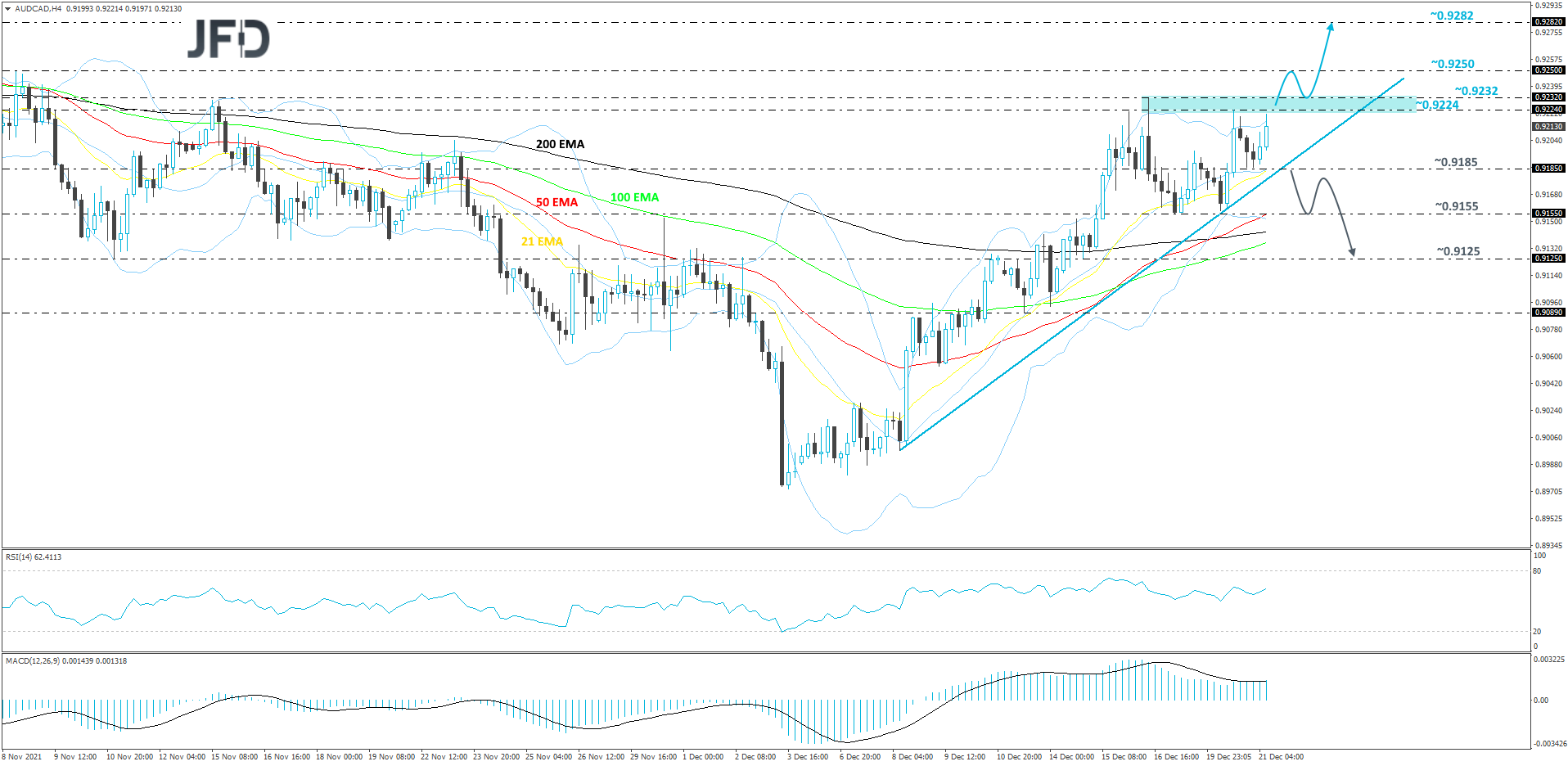
AUD/CAD continues to balance above a short-term tentative upside support line taken from the low of December 8th. That said, in order to get a bit more comfortable with the upside, a push above the current highest point of December would be needed, which is at 0.9232.
If, eventually, we do see a pop above the 0.9232 barrier, this will confirm a forthcoming higher high and more buyers could join in. AUD/CAD might then rise to the 0.9250 obstacle, a break of which may clear the path to the 0.9282 zone, marked near an inside swing low of November 1st.
On the downside, if the pair breaks the previously mentioned upside line and then falls below the 0.9185 zone, marked near the current low of today, that could result in a change in the direction of the current short-term trend. AUD/CAD may send the rate to the 0.9155 territory, or even to the 0.9125 level, marked by an intraday swing low December 14th.
As For The Rest Of Today’s Events
UK will deliver its CBI industrial trends orders for December. The number is believed to have declined quite significantly, going from 26 to 13.
Disclaimer:
The content we produce does not constitute investment advice or investment recommendation (should not be considered as such) and does not in any way constitute an invitation to acquire any financial instrument or product. The Group of Companies of JFD, its affiliates, agents, directors, officers or employees are not liable for any damages that may be caused by individual comments or statements by JFD analysts and assumes no liability with respect to the completeness and correctness of the content presented. The investor is solely responsible for the risk of his investment decisions. Accordingly, you should seek, if you consider appropriate, relevant independent professional advice on the investment considered. The analyses and comments presented do not include any consideration of your personal investment objectives, financial circumstances or needs. The content has not been prepared in accordance with the legal requirements for financial analyses and must therefore be viewed by the reader as marketing information. JFD prohibits the duplication or publication without explicit approval.
CFDs are complex instruments and come with a high risk of losing money rapidly due to leverage. 68.02% of retail investor accounts lose money when trading CFDs with the Company. You should consider whether you understand how CFDs work and whether you can afford to take the high risk of losing your money. Please read the full Risk Disclosure.
Copyright 2021 JFD Group Ltd.