


EU and US shares continued to slide yesterday, as investors remained concerned that high energy prices could lead to higher inflation, and thereby, faster tightening by major central banks. Today, participants may lock their gaze on the US CPIs for September, where another round of elevated rates could prompt investors to increase their tightening bets. Tonight, during the Asian session Thursday, Australia’s employment report for September is due to be released.
US CPIs and AU Jobs Data Under the Limelight
The US dollar traded higher or unchanged against most of the other major currencies on Tuesday and during the Asian session Wednesday. It gained slightly against CHF, AUD, and JPY, while it underperformed against CAD and GBP. The greenback was found virtually unchanged against NZD and EUR.
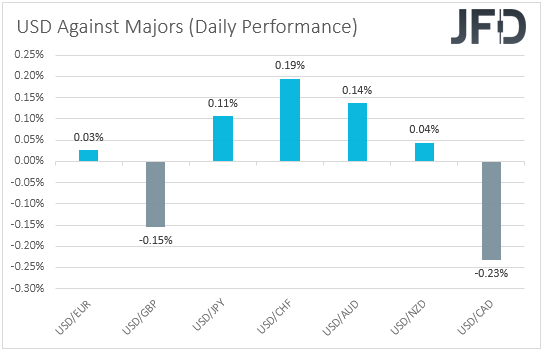
Once again, the performance in the FX world paints a blurry picture with regards to the broader market sentiment and thus, we prefer to turn our gaze to the equity world. There, all but two of the major EU indices finished their session in the red, with Wall Street sliding somewhat as well. Appetite improved during the Asian session today. China’s Shanghai Composite and South Korea’s KOSPI traded in the green, while Hong Kong’s Hang Seng was found virtually unchanged. Only Japan’s Nikkei 225 was down.
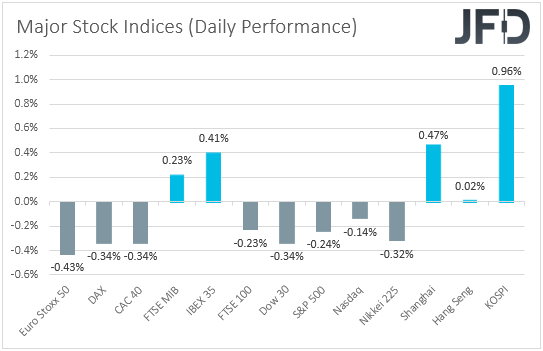
Although EU and US equities slid less than on Monday, this still suggests that investors remain reluctant to increase their risk exposure, and with no fresh catalyst to drive the market, we believe that their concerns are those we discussed yesterday, the day before, and even last week. Energy prices remain elevated, which heightens concerns over further acceleration in inflation, and thereby, faster tightening by central banks. What’s more, Evergrande missed a third round of bond payments in three weeks, which brings a potential default a step closer.
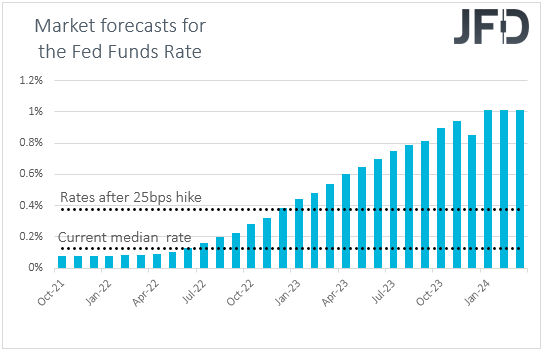
With inflation being the main driver for the markets recently, today, participants are likely to lock their gaze on the US CPI data for September. Both the headline and core CPI rates are expected to have held steady at 5.3% and 4.0% respectively, well above the Fed’s objective of 2%. Although the US employment report revealed a disappointing number of added jobs during the month of September, Fed officials remained willing to start scaling back their QE purchases soon, with yesterday remarks by Fed Vice Chair Richard Clarida, Atlanta Fed President Raphael Bostic, and St. Louis Fed President James Bullard endorsing a November move. Bullard even expressed a preference for interest rates to start rising in the spring or summer of 2022. This encouraged investors to bring forth their rate-hike bets. According to the Fed funds futures, they now fully price in a 25bps increase to be delivered in December, next year.
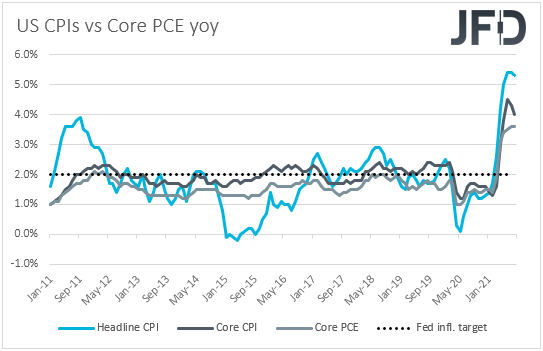
This suggests that market participants don’t need inflation to accelerate further in order to increase their tightening bets. Even staying unchanged and not pulling back may be enough, as this will add credence to their view that the surge in consumer prices may, eventually, not be as transitory as the Fed has initially expected. We may get more hints and clues as to how likely a November tapering may be, from the minutes of the latest FOMC meeting, which come out later in the day. Therefore, anything cementing the November tapering case could prompt USD-traders to add to their long positions, and stock investors to reduce their exposure even more.
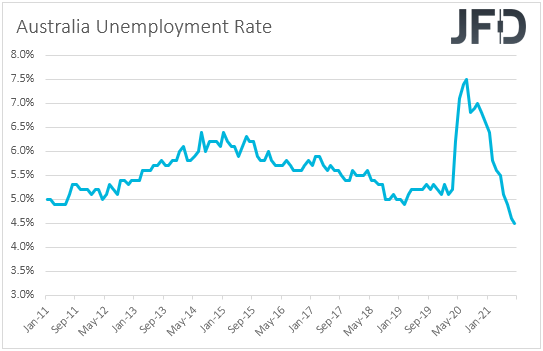
Now flying from the US to Australia, tonight, during the Asian session Thursday, we get the nation’s employment report for September. The unemployment rate is expected to have risen to 4.8% from 4.5%, while the net change in employment is anticipated to show that the economy has lost 137.5k jobs, after losing 146.3k in August. At last week’s gathering, the RBA kept all its policy settings unchanged with officials repeating that they will continue to purchase government securities at the current pace until at least mid-February and maintaining the view that interest rates are unlikely to rise before 2024. We believe that a soft employment report may add more credence to the RBA’s dovish stance and may push the Aussie somewhat lower, especially against its Canadian counterpart, which has been enjoying decent gains recently due to the rally in energy prices. Friday’s better than expected employment report may have also been a reason to buy Loonies, as it increases the probability for further tapering by the BoC at its upcoming monetary policy gathering.
Nasdaq 100 – Technical Outlook
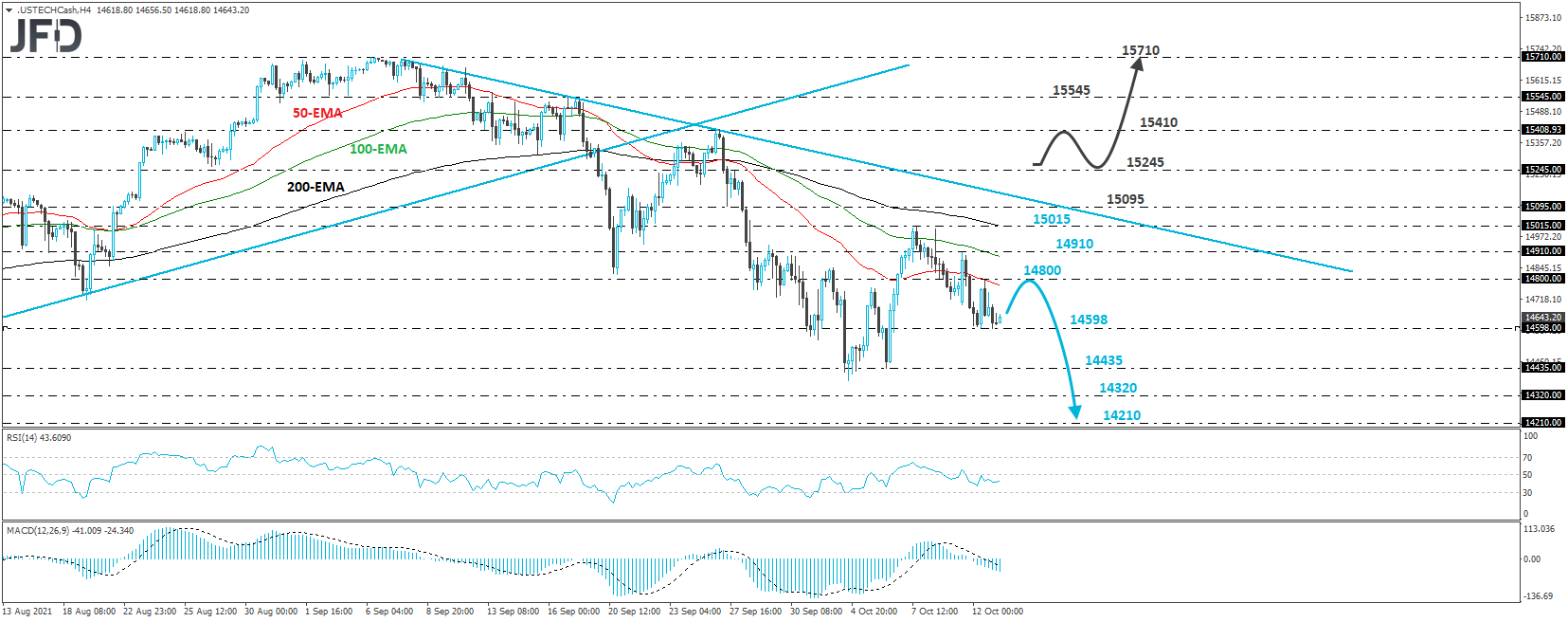
The Nasdaq 100 cash index traded lower yesterday, after it hit resistance at 14800. That said, the slide was stopped near 14598. Overall, the index continues to trade below the downside resistance line taken from the high of September 7th and thus, we will consider the short-term outlook to be negative.
A clear dip below 14598 could initially target the 14435 zone, which provided support on October 4th and 6th. That said, if market participants are willing to let the index slide further, we could see a test near the 14320 level, marked by the low of June 25th, or near the 14210 territory, defined by the inside swing high of June 18th.
We will start examining the bullish case, only if we see a recovery above 15245. This could confirm the break above the aforementioned downside line and may initially target the peak of September 27th, at 15410. Another break, above that level may encourage participants to take the action to the 15545 zone, which provided resistance between September 13th and 17th, and acted as a support between August 31st and September 9th. If they are not willing to stop there, we could see them climbing towards the index’s record of 15710, hit on September 6th.
AUD/CAD – Technical Outlook
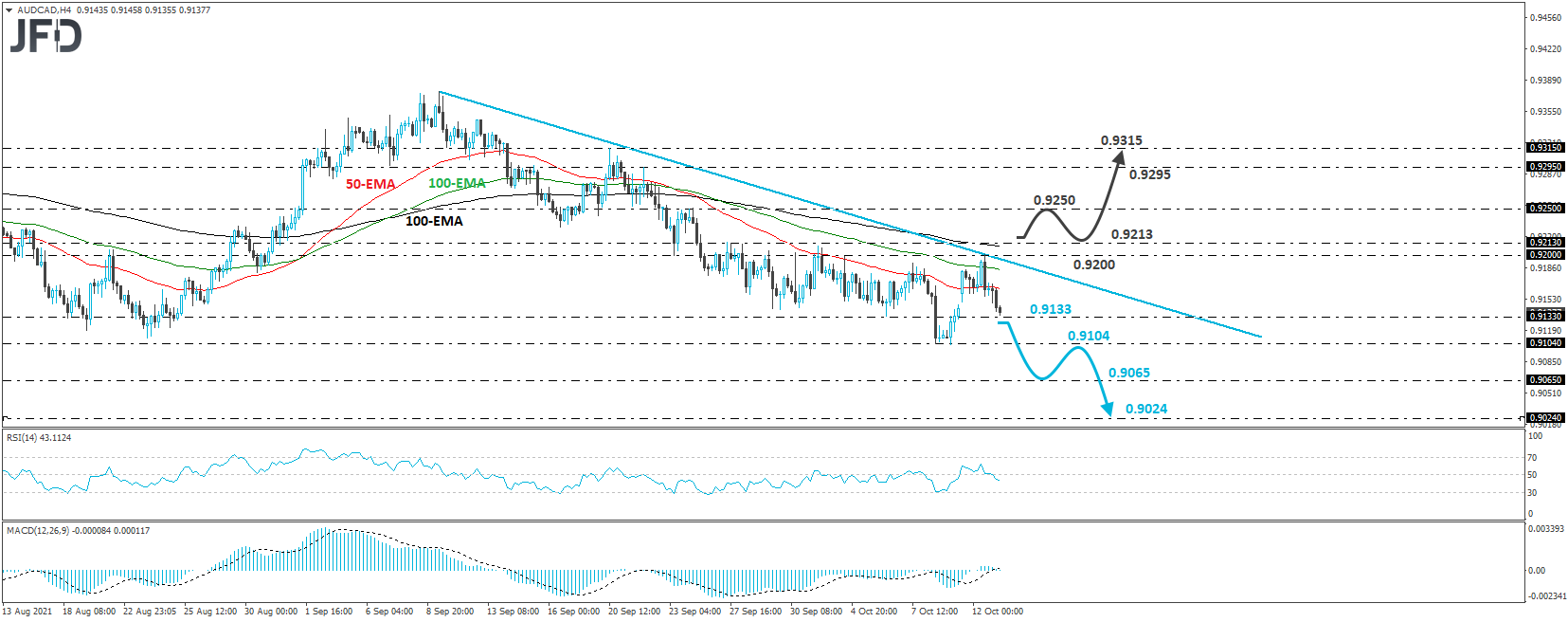
AUD/CAD edged south yesterday, after hitting resistance at 0.9200, to stop near the 0.9133 zone, marked by the low of October 6th as well. Overall, the pair continues to trade below the downside line drawn from the high of September 9th, which, in our view, keeps the short-term bias to the downside.
If the bears are strong enough to push the action below the 0.9133 level, we could soon see them aiming for the 0.9104 barrier, marked by the lows of Friday and Monday. Another dip, below 0.9133, would confirm a forthcoming lower low and perhaps pave the way towards the 0.9065 hurdle, marked by the low of May 27th, 2020, the break of which could extend the fall towards the low of May 15th of that year, at 0.9024.
On the upside, we would like to see a rebound back above 0.9213 before we start examining whether the bulls have stolen the bears’ swords. This could confirm the break above the downside line taken from the high of September 9th, and may allow advances towards the 0.9250 territory, marked by the high of September 24th. Another break, above 0.9250, could extend the gains towards the peak of September 22nd, at 0.9295, or the high of September 20th, at 0.9315.
As for the Rest of Today’s Events
During the early European morning, we already got the monthly UK GDP for August, which accelerated slightly less than expected. However, the industrial and manufacturing production rates came in better than their own forecasts suggested. In any case, as yesterday, the pound barely reacted to the data, confirming our view that the currency may be more linked to developments surrounding the broader market sentiment for now. After all, a hawkish BoE may already be priced in.
From the Eurozone, we get the bloc’s industrial production for August and the forecast points to a 1.6% mom slide after a 1.5% mom increase in July. This is likely to take the yoy rate down to +4.7% from +7.7%.
With regards to the energy market, we have the API (American Petroleum Institute) report on crude oil inventories for last week, but as it is always the case, no forecast is available.
As for the speakers, we will get to hear from BoE Deputy Governor for Financial Stability Jon Cunliffe and Fed Board Governor Lael Brainard.
Disclaimer:
The content we produce does not constitute investment advice or investment recommendation (should not be considered as such) and does not in any way constitute an invitation to acquire any financial instrument or product. The Group of Companies of JFD, its affiliates, agents, directors, officers or employees are not liable for any damages that may be caused by individual comments or statements by JFD analysts and assumes no liability with respect to the completeness and correctness of the content presented. The investor is solely responsible for the risk of his investment decisions. Accordingly, you should seek, if you consider appropriate, relevant independent professional advice on the investment considered. The analyses and comments presented do not include any consideration of your personal investment objectives, financial circumstances or needs. The content has not been prepared in accordance with the legal requirements for financial analyses and must therefore be viewed by the reader as marketing information. JFD prohibits the duplication or publication without explicit approval.
CFDs are complex instruments and come with a high risk of losing money rapidly due to leverage. 73.90% of retail investor accounts lose money when trading CFDs with the Company. You should consider whether you understand how CFDs work and whether you can afford to take the high risk of losing your money. Please read the full Risk Disclosure.
Copyright 2021 JFD Group Ltd.