


Traditionally, earnings season places the S&P 500 at the centre of market attention, with corporate profits shaping risk appetite and capital allocation. However, as 2026 unfolds, markets are facing a rare convergence of geopolitical tension and institutional uncertainty that is challenging this long-standing dynamic. President Trump’s renewed tariff threats surrounding the Greenland dispute, combined with a Department of Justice investigation into Federal Reserve Chair Jerome Powell, have undermined two of the market’s core stabilising pillars: trade predictability and monetary independence.
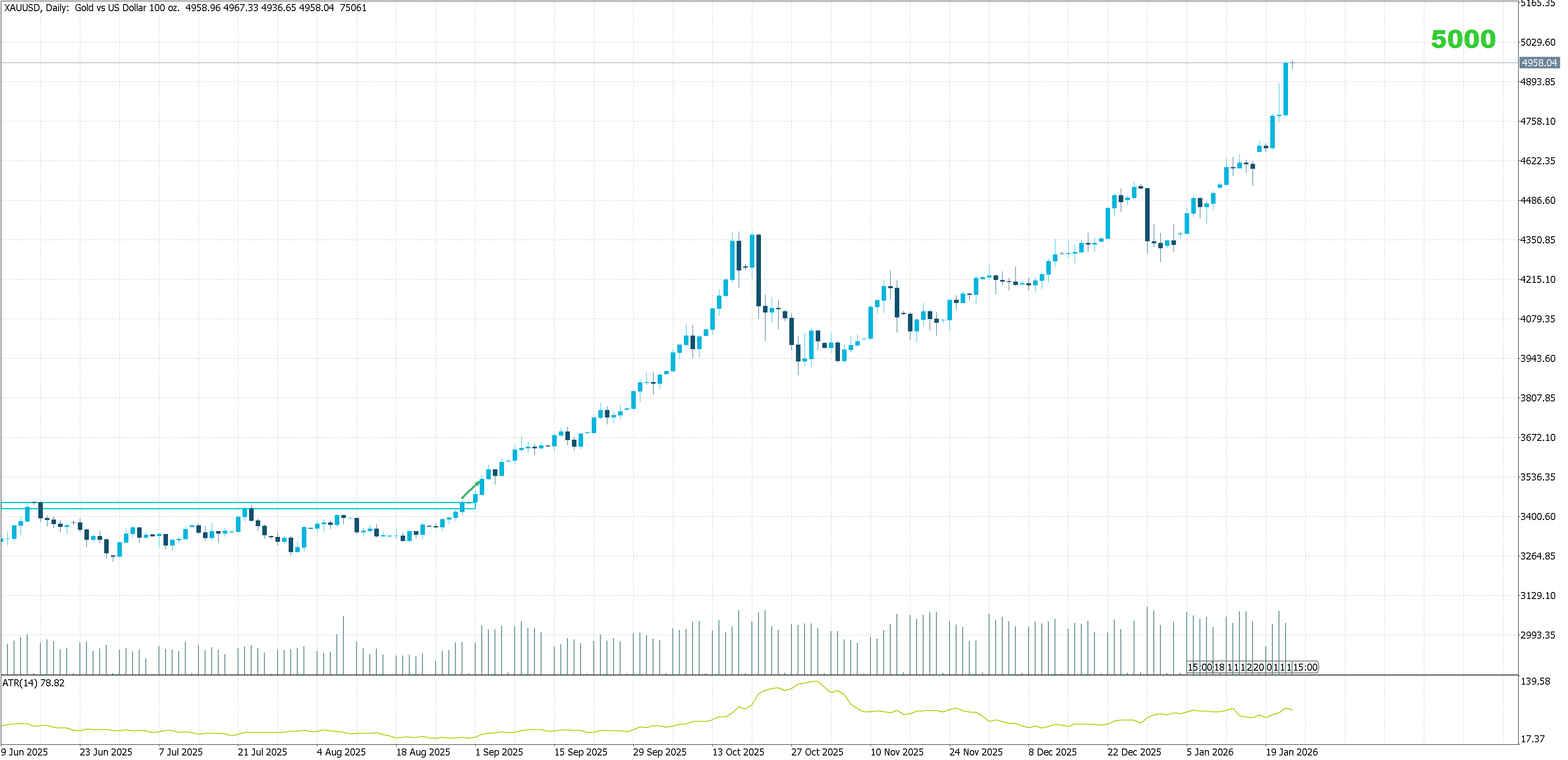
Against this backdrop, gold has surged to a new all-time high of $4,923 before stabilising above the $4,840 level. What stands out is not merely the price move itself, but the role gold is now playing. It has evolved from a defensive asset into the market’s primary outlet for systemic stress across asset classes.
This shift is clearly visible in the S&P 500-to-Gold ratio, which has fallen to multi-year lows near 1.4. Despite strong earnings expectations driven by the so-called “Magnificent Seven,” equities are struggling with a broader “Sell America” sentiment. Even short-term equity rebounds, fuelled by the postponement of immediate tariff hikes, have failed to reverse the structural decline in this ratio. Capital is increasingly favouring liquidity and macro sensitivity over pure growth exposure.
Geopolitical shocks are acting as powerful accelerants. The January military operation in Venezuela has injected uncertainty into global energy flows and maritime security, reinforcing longer-term de-dollarisation trends. At the same time, escalating tariff rhetoric toward European allies has reminded investors that trade routes can quickly become political tools, pushing earnings guidance into the background.
Adding to this environment is a visible rotation within equity markets. Technology, the most crowded trade of 2025, is showing signs of fatigue as valuations compress and financing conditions tighten. Even strong earnings are no longer sufficient to maintain leadership when guidance hints at margin pressure. Capital is gradually rotating toward sectors with more stable cash flows, while gold benefits from both declining confidence and shifting rate expectations.
In this context, gold is emerging as a momentum asset rather than a passive hedge. As questions around the US dollar, interest rates, and institutional credibility intensify, the metal continues to absorb risk that equity markets increasingly struggle to price. For traders and investors navigating 2026, the key signal is no longer a single earnings beat, but gold’s ability to remain bid in the face of systemic uncertainty – a development that keeps the $5,000 discussion firmly on the table.
Disclaimer:
The content we produce does not constitute investment advice or investment recommendation (should not be considered as such) and does not in any way constitute an invitation to acquire any financial instrument or product. The Group of Companies of JFD, its affiliates, agents, directors, officers or employees are not liable for any damages that may be caused by individual comments or statements by JFD analysts and assumes no liability with respect to the completeness and correctness of the content presented. The investor is solely responsible for the risk of his investment decisions. Accordingly, you should seek, if you consider appropriate, relevant independent professional advice on the investment considered. The analyses and comments presented do not include any consideration of your personal investment objectives, financial circumstances or needs. The content has not been prepared in accordance with the legal requirements for financial analyses and must therefore be viewed by the reader as marketing information. JFD prohibits the duplication or publication without explicit approval.
There are risks involved with trading of cash equities. Past performance is not indicative of future results. You should consider whether you can tolerate such losses before trading. Please read the full Risk Disclosure (https://www.jfdbrokers.com/en/legal/risk-disclosure).
Copyright 2024 JFD Group Ltd.