


With no clear catalyst, investors’ morale improved yesterday and during the Asian morning today, with most major global indices closing in positive territory. It may have been due to rebalancing of portfolios, or due to the easing efforts of central banks and governments. As for today, the main event on the agenda may be Eurozone’s inflation data for March. It would be interesting to see whether slowing inflation would raise speculation for more stimulus by the ECB.
Investors’ Risk Appetite Improves Again
The dollar rebounded on Monday and during the Asian morning Tuesday, trading higher against most of the other G10 currencies. It gained the most versus CAD, SEK and JPY, while it underperformed only against AUD and NOK.
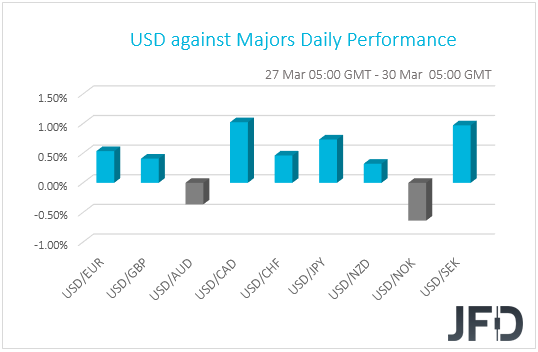
The fact that the dollar and the Aussie were among the main gainers, combined with the Loonie and the yen being among the main losers, paints a very confusing picture with regards to the broader market sentiment. Thus, in order to clear things up, we will turn our gaze to the equity world. There, most major EU and US indices closed positive, with Wall Street accelerating, aided by healthcare stocks. The only exception was Spain’s IBEX 35, which slid 1.74%. The positive atmosphere rolled over into the Asian session as well, but eased somewhat. At the time of writing, both Hong Kong’s Hang Seng and South Korea’s KOSPI are up 0.56% and 1.77% respectively, but Japan’s Nikkei and China’s Shanghai are down 1.24% and 0.07%.
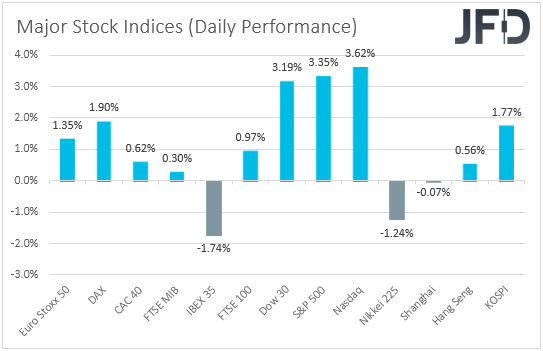
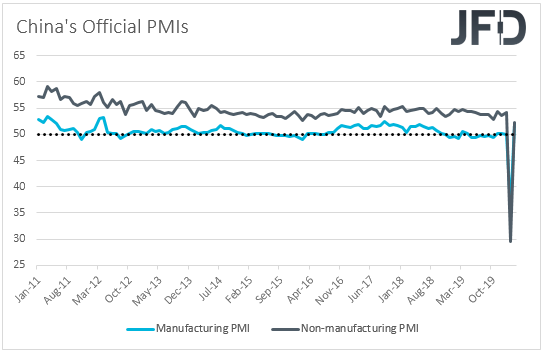
With no clear catalyst behind the improved appetite, we suspect that it may have been due to end-of-month rebalancing of investors’ portfolios. Those who sold stocks heavily in favor of bonds and cash may be now buying back some stocks, which they believe that they’ve become cheap enough. It could also be due to the latest easing efforts by the Fed and other major central banks, as well as by US Parliament’s approval of a USD 2 trillion fiscal stimulus package. The rebound in both the Chinese manufacturing and non-manufacturing PMIs back above the 50 boom-or-bust zone may have also helped somewhat. Yesterday, we noted that recoveries in these PMIs may not be enough to boost market sentiment, but expectations were for rebounds still within the contractionary territory. The return to expansion was a surprise.
In any case, we stick to our guns that even if risk appetite continues to improve for a while more, it is still too early to trust a long-lasting recovery. Coronavirus cases and deaths accelerated again yesterday, with new deaths hitting a new record. All this suggests that the virus could continue spreading at a fast pace, with the damages lasting longer than many have previously anticipated. As we have repeatedly noted, monetary and fiscal stimulus may not be enough to revive global growth if nations around the globe stay in a lockdown mode for a few more months. Thus, when this is reflected in economic data, investors may once again abandon risk-linked assets in favor of the safe-havens. In order to change our view, a vaccine has to be ready for distribution, and the vaccine in this case is not fiscal spending, neither monetary policy easing.
With regards to the energy market, oil prices rebounded overnight, with both WTI and Brent gaining 5.67% and 18.59% respectively, after US and Russian Presidents Trump and Putin agreed to discuss ways to stabilize energy prices.
DAX – Technical Outlook
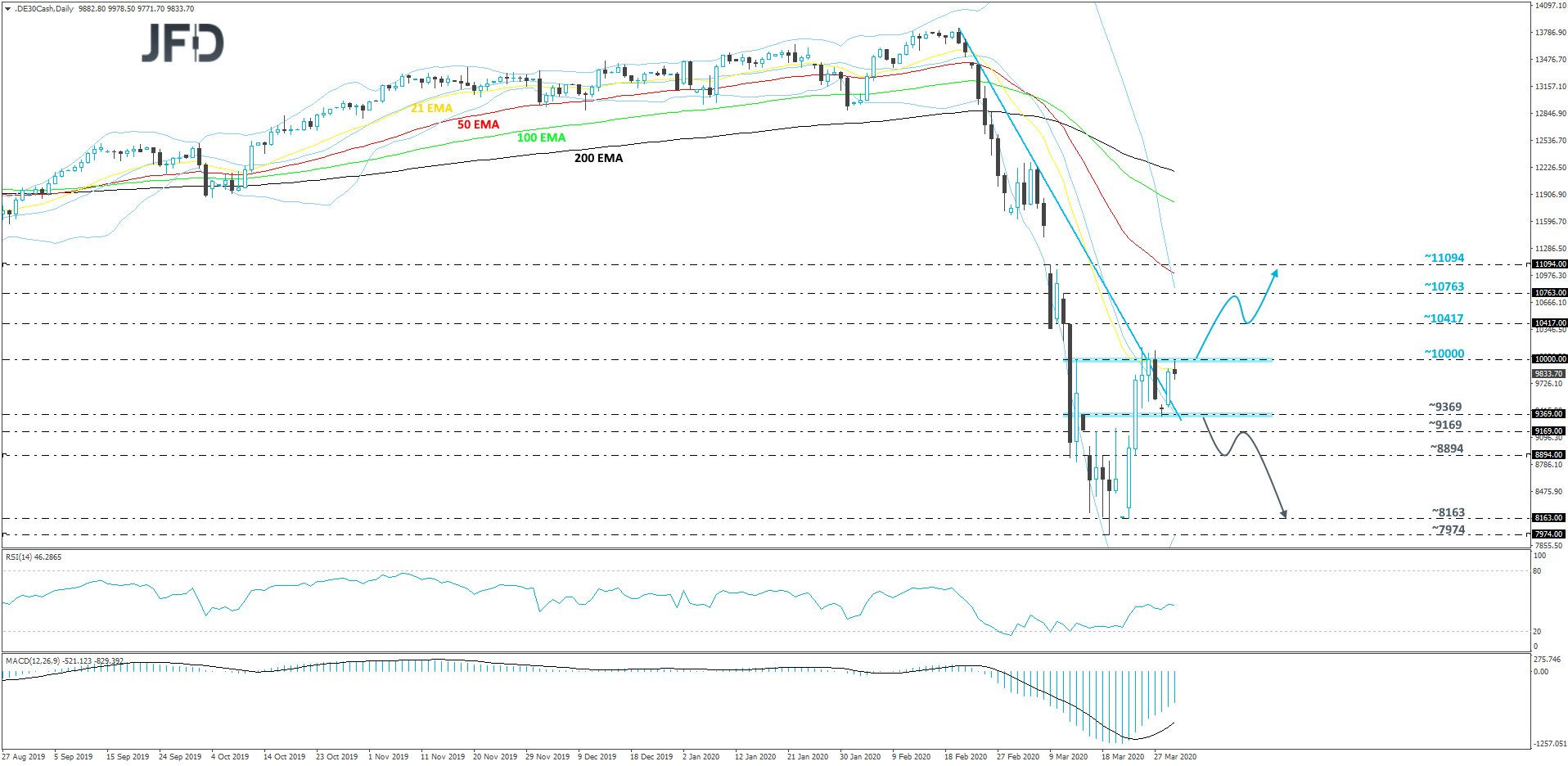
We can see that DAX had recently violated its short-term downside resistance line drawn from the high of February 20th. Now the index seems to be stuck in a small range between the 9369 and 10000 levels. For now, we will stay slightly on the neutral side and wait for a daily close outside the range in order to consider a further short-term directional move.
If we see a daily candle closing above the psychological 10000 barrier, which is also the upper side of the above-discussed range, we might then get a bit more comfortable with higher areas. This is when the bulls may push the price to the 10417 obstacle, a break of which could send the German index to the 10763 zone, marked by the high of March 11th. Initially, DAX could receive a hold-up there, or even correct a bit lower. That said, if the bulls are still feeling more comfortable, they might easily lift the price above the 10763 area and aim for the 11094 level, which is the high of March 9th.
On the downside, if the price falls below the lower side of the aforementioned range, at 9369, this might spook the bulls from the field temporarily. DAX could slide to the 9169 obstacle, a break of which may lead to a test of the 8894 area, which is the low of March 24th. The German index might rebound from there slightly, however if it struggles to move back above the 9369 barrier, this could result in another round of selling, potentially overcoming the 8894 zone and aiming for the 8163 level, marked by the low of March 23rd.
Will Slowing Inflation Result in More ECB Action?
As for today, the main event on the agenda may be Eurozone’s preliminary inflation data for March. The headline rate is expected to have declined to +0.8% yoy from +1.2%, something supported by the declines in both the German CPI and HICP rates. No forecast is available for the core rate, but we see the case for a slide here as well. March was marked with lockdowns in most member states of the bloc and thus, with people staying home and refraining from spending, consumer prices in several products may have come under pressure. The exceptions may be pharmaceuticals and essential products, like food.
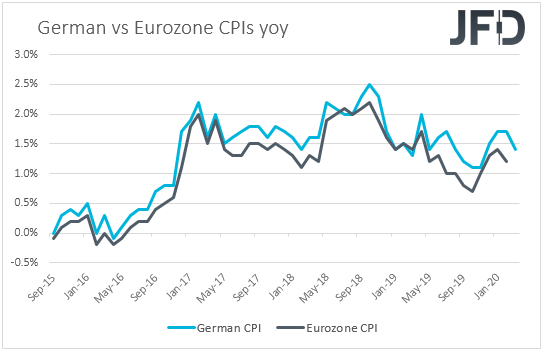
Although the ECB has not cut rates, with the Euro-area economy hit by the virus outbreak, it adopted a range of emergency stimulus measures, including very cheap loans to banks and asset purchases worth of EUR 1.1 trillion. Last Monday, Governing Council member Ignazio Visco said that the adopted measures are sufficient and effective but he and his colleagues stand ready to do more if necessary. So, having that in mind and following the disappointment in the preliminary PMIs for March, declining CPI rates, well below the Bank’s objective of “below but close to 2%”, may increase the chances of more stimulus. Officials may decide to increase the size of their bond purchases or even cut the deposit rate further into the negative territory. Although the former appears more likely, with the Bank’s Chief, Christine Lagarde, saying “There are no limits to our commitment to the euro”, we cannot totally rule out the latter.
EUR/NZD – Technical Outlook
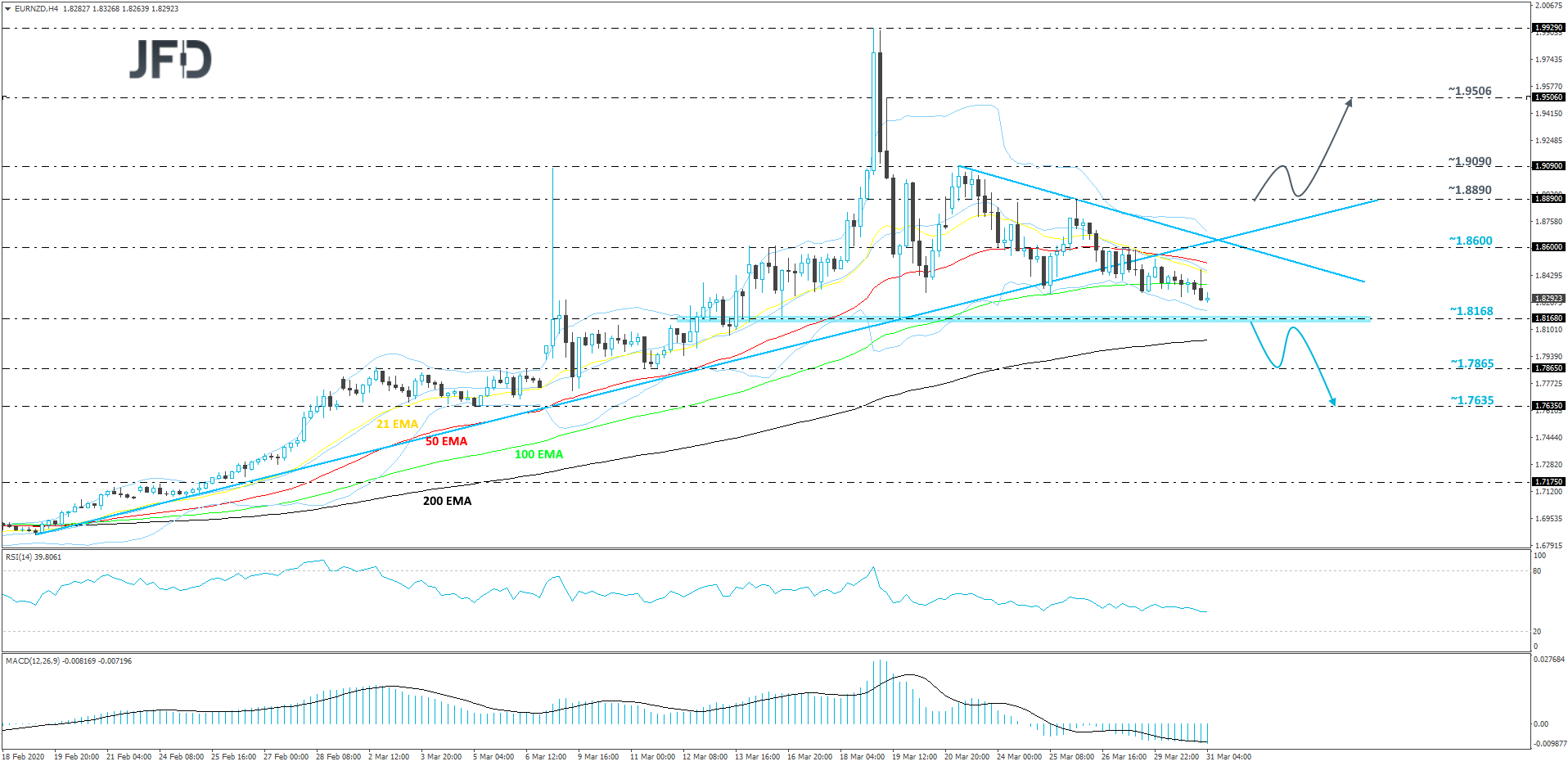
Since peaking sharply in mid-March, EUR/NZD continued to slide gradually, which led to a break of a short-term upside support line taken from the low of February 19th. In addition to the slight negativity, we can draw a short-term downside resistance line taken from the high of March 23rd, which if stays intact, could continue showing the direction for a while. However, in order for us to get a bit more comfortable with lower areas, we would like to see a drop below the 1.8168 area first, hence why we will take a cautiously-bearish approach for now.
As mentioned above, a drop below the 1.8168 hurdle would confirm a forthcoming lower low and more sellers may see it as a good opportunity to step in. That’s when we will target the 1.7865 obstacle, a break of which could set the stage for a move to the 1.7635 level, marked by the lowest point of March.
Alternatively, if EUR/NZD climbs back up and breaks above both of the aforementioned lines, the downside and the upside ones, this may give hope to more bulls that the pair has a good chance of drifting further north. Especially if the rate travels above the 1.8890 barrier, marked by the high of March 26th, this could invite more buyers into the game and send EUR/NZD higher. The next resistance zone to consider could be the 1.9090 obstacle, a break of which may set the stage for a test of the 1.9506 level, marked by an intraday swing high of March 19th.
As for the Rest of Today’s Events
During the early European morning, we already got the UK final GDP, business investment and current account data, all for Q4. The final GDP print confirmed its preliminary estimate, namely that the British economy stagnated during the last three months of 2019 after growing 0.4% qoq in Q3, while business investment accelerated to +1.8% yoy from +0.9%, beating expectations of a 0.6% slide. The nation’s current account deficit narrowed to GBP 5.6bn from GBP 15.9bn. Given that these releases refer to a period before the coronavirus fast spreading, the pound barely reacted.
Later in the day we have more GDP data, this time from Canada and for the month of January. Expectations are for the monthly rate to have slowed to +0.1% mom from +0.3% in December. To be honest, we don’t expect this release to prove a major market mover either. The Bank of Canada has already slushed rates to 0.25%, the lowest level in a decade, in order to safeguard the Canadian economy from the coronavirus pandemic. We believe that February and March data may be much more important, as they will reveal to which extent did the virus spreading affected the Canadian economy, which is a major oil exporter. If the hit proves much more than anticipated, BoC policymakers may not hesitate to cut rates to zero.
From the US, we get the Conference Board consumer confidence index for March, which is expected to have declined to 112.0 from 130.7.
Tonight, during the Asian trading Wednesday, Japan’s Tankan survey for Q1 is coming out. Both the large manufacturers and non-manufacturers indices are expected to have declined to -10 and +2 from +5 and +18 respectively. This may be the first set pointing to how the Japanese economy may have performed during the first quarter of this year, and thus, following the contraction in Q4 2019, bad numbers may raise more concerns with regards to a technical recession and may also increase speculation with regards to more stimulus by the BoJ.
China’s Caixin manufacturing PMI for March is also coming out and expectations are for a rebound to 45.5 from 40.3.
Disclaimer:
The content we produce does not constitute investment advice or investment recommendation (should not be considered as such) and does not in any way constitute an invitation to acquire any financial instrument or product. The Group of Companies of JFD, its affiliates, agents, directors, officers or employees are not liable for any damages that may be caused by individual comments or statements by JFD analysts and assumes no liability with respect to the completeness and correctness of the content presented. The investor is solely responsible for the risk of his investment decisions. Accordingly, you should seek, if you consider appropriate, relevant independent professional advice on the investment considered. The analyses and comments presented do not include any consideration of your personal investment objectives, financial circumstances or needs. The content has not been prepared in accordance with the legal requirements for financial analyses and must therefore be viewed by the reader as marketing information. JFD prohibits the duplication or publication without explicit approval.
CFDs are complex instruments and come with a high risk of losing money rapidly due to leverage. 76% of retail investor accounts lose money when trading CFDs with the Company. You should consider whether you understand how CFDs work and whether you can afford to take the high risk of losing your money. Please read the full Risk Disclosure.
Copyright 2020 JFD Group Ltd.