


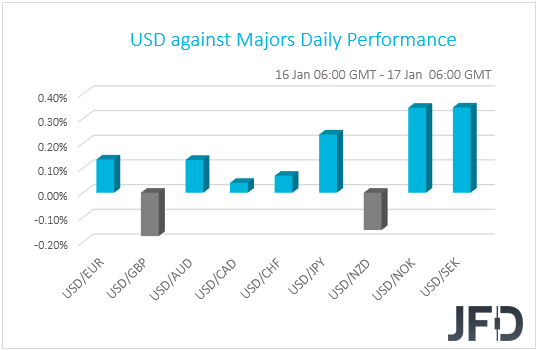
The dollar traded higher against most of the other G10 currencies yesterday, perhaps due to decent US data, including retail sales for December. The pound was the first inline winner, with its traders awaiting the UK retail sales, due out today. The Kiwi was the second-best performer, aided by the broader market sentiment as well as by the decent Chinese data released overnight.
USD Rebounds on Decent Data, GBP Awaits Retail Sales
The dollar traded slightly higher against all but two of the other G10 currencies on Thursday and during the Asian morning Friday. It gained the most against NOK, SEK and JPY in that order, while it underperformed only against GBP and NZD.
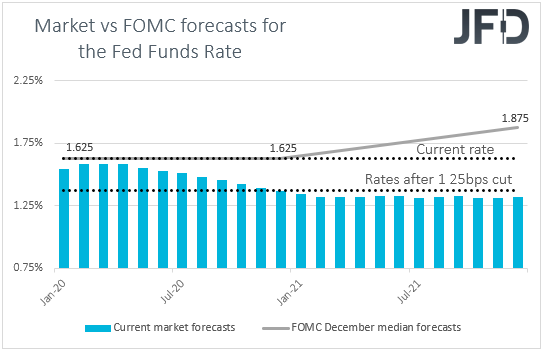
The greenback may have got aided by some decent US data we got yesterday. Retail sales for December rose 0.3% as expected, but the core rate jumped to +0.7% mom from +0.1%, while the forecast was for a rise to +0.5%. What’s more, initial jobless claims slid for the fifth straight week, suggesting that the US labor market continues to be strong, while the Philly Fed noted notable improvement in the manufacturing sector for the month of January. Specifically, the index rose to 17.0 from 2.4, at a time when the forecast was for an increase to 3.8. That said, the data did little to alter market expectations over another cut by the Fed. Despite the Fed signaling that it has done cutting rates, according to the Fed funds futures, market participants are almost fully pricing another quarter-point reduction to be delivered in November.
The pound was the main gainer, with Cable hitting a weekly high. With no clear catalyst behind the advance, perhaps sellers decided to take a break after adding to bets that the BoE will soon decide to hit the cut button. Remember that last week, BoE Governor Mark Carney hinted that a rate cut could be delivered if weakness in the economy persists, with MPC member Silvana Tenreyro saying that the economy is more likely to undershoot than overshoot the Bank’s latest projections. What’s more, on Sunday, MPC member Gertjan Vlieghe said that he will vote for a rate cut if data continue to show sluggish economic performance.
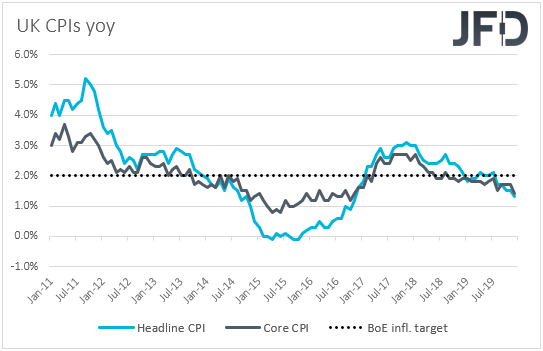
On Monday, monthly GDP data for November, as well as industrial and manufacturing production for the month, disappointed, while on Wednesday, both the headline and core CPIs for December slowed further below the BoE’s objective of 2%. Specifically, the headline rate slid to +1.3% yoy from +1.5%, while the core one fell to +1.4% yoy from +1.7%. With Michael Saunders and Jonathan Haskel already at the dissenting camp, hints that others could join in, combined with the aforementioned disappointing data, may have been the driver behind the increasing bets over a rate cut soon, perhaps even as early as at the upcoming gathering.
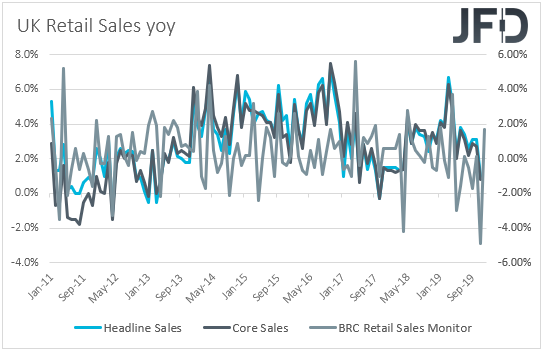
Today, GBP traders could turn their attention to the UK retail sales for December. Both the headline and core sales are expected to have rebounded 0.5% mom and 0.7% mom respectively, after both sliding 0.6% in November. This would drive the yoy rates up to +2.6% and +2.9%, from +1.0% and +0.8%. The case for a higher yoy rates is also supported by the BRC retail sales monitor for the month, the yoy rate of which surged to +1.7% from -4.9%. Upbeat retail sales could ease the urgency for officials to act at the upcoming gathering, and thereby allow the pound to recover some more. However, ahead of the Bank’s meeting, we have the preliminary PMIs for January, which could provide a clearer picture on how policymakers may decide to proceed.
GBP/USD – Technical Outlook
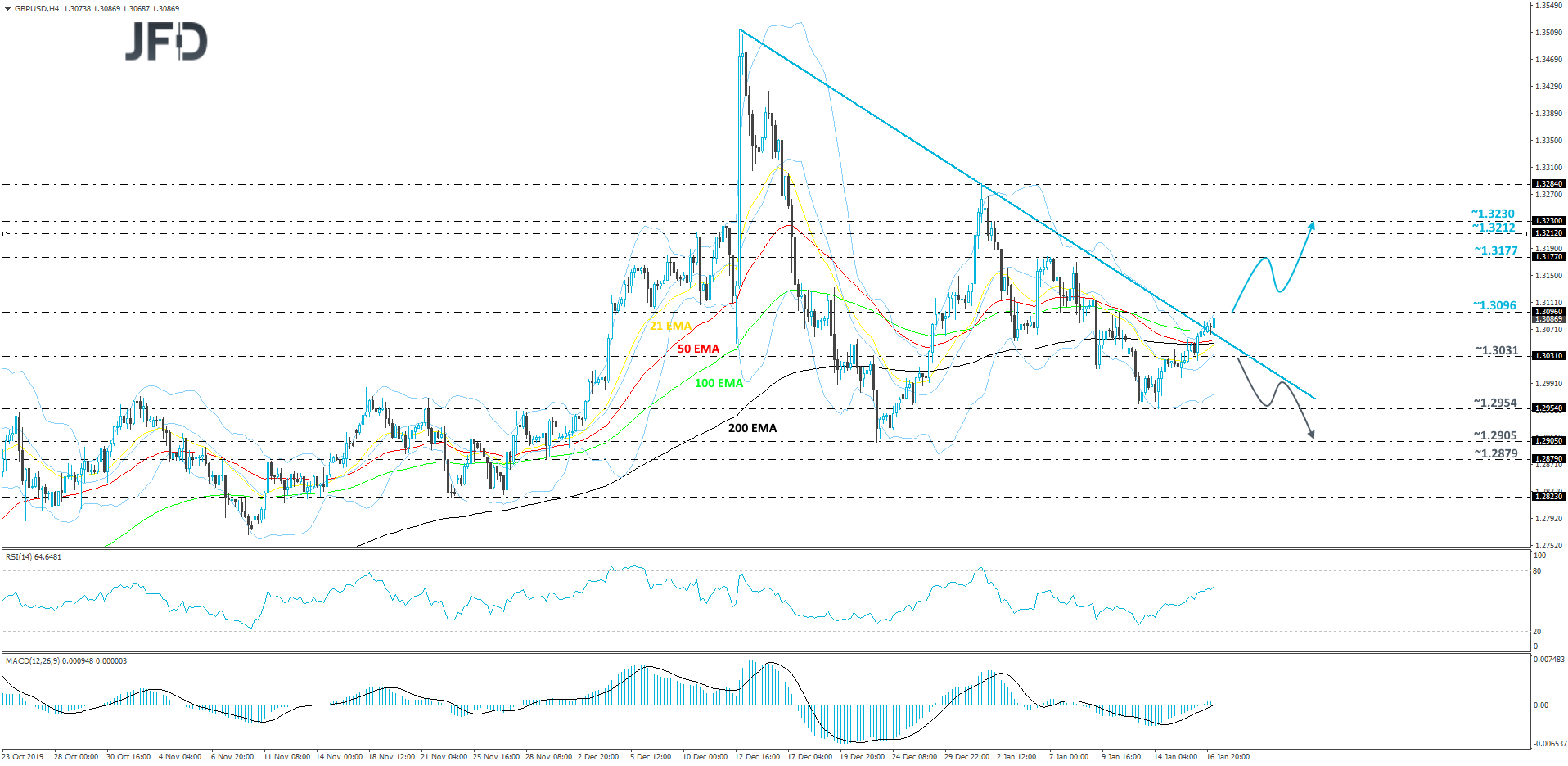
Till the early hours of the Asian morning today, GBP/USD was still trading below its short-term downside resistance line taken from the high of December 12th. But now we can see that the pair has moved above that line, which means this may attract the attention of more bulls. We will now take somewhat of a bullish approach but wait for a break above one of our key resistance barriers first, before getting a bit more comfortable with the upside.
If GBP/USD rises above the 1.3096 hurdle, which is the high of January 10th, this could open the door for a further move towards the 1.3177 zone. That zone is marked near the high of January 6th, which if fails to withstand the bull pressure, could break and send the rate even higher. This is when we will consider a potential test of the 1.3212 area, or the 1.3230 level, marked by the high of January 7th and by an intraday swing high of January 2nd.
On the other hand, if the rate suddenly falls back below the aforementioned downside line, slides below the 200 EMA and breaks the 1.3031 hurdle, which is an intraday swing low of January 16th, this could make the bulls worry and allow more bears to step in. GBP/USD could then drift all the way back to the current low of January, at 1.2954, a break of which may set the stage for a test of the low of December 23rd, at 1.2905.
NZD Supported by Sentiment and Chinese Data, Stocks Drift North as Well
The second winner in line was the New Zealand dollar. The Kiwi has been in an advance mode throughout the whole day, perhaps as investors continued to add to their risk exposures in the aftermath of the US-China “Phase One” deal and received another boost after the relatively decent Chinese data. While China’s GDP for 2019 rose at its slowest pace in 29 years, in the midst of the trade war with the US, it was in line with market expectations and within the government’s official target. What’s more, fixed asset investment accelerated to 5.4% yoy in December, instead of holding at 5.2%, while industrial production grew 6.9% yoy vs 6.2% in November, at a time when the forecast was for a slowdown to 5.9%. Retail sales for the month rose 8.0% yoy, at the same pace as in November, but more than the 7.8% forecast.
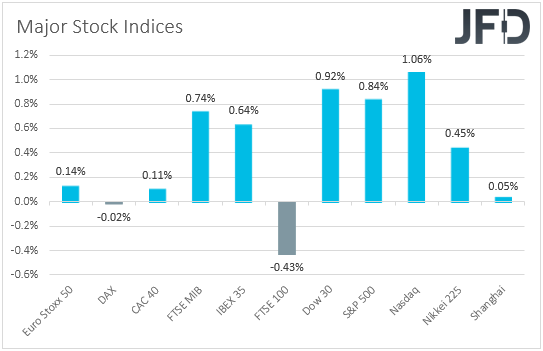
In the equity world, the next day after the signing of a “Phase One” deal between the world’s two largest economies, found most major EU indices closing in the green. The exceptions were the German DAX which was virtually unchanged, and the UK FTSE 100, which slid 0.43% perhaps due to the pound’s strength. In the US, all three indices hit new record highs, maybe also aided by the decent US data. The Chinese data helped the upbeat morale to extend into the Asian morning today.
As for our view though, it remains the same as yesterday. Equity indices could continue sailing north for a while more, but we are reluctant to call for a long-lasting recovery, as there are still several risks ahead of us. No one can say that the road towards a final trade accord between the US and China would be a smooth one, while the US appears to have now turned its tariff guns against the EU. What’s more, this year we have the US elections as well as the Brexit transition period, which could add to the element of uncertainty.
NZD/USD – Technical Outlook
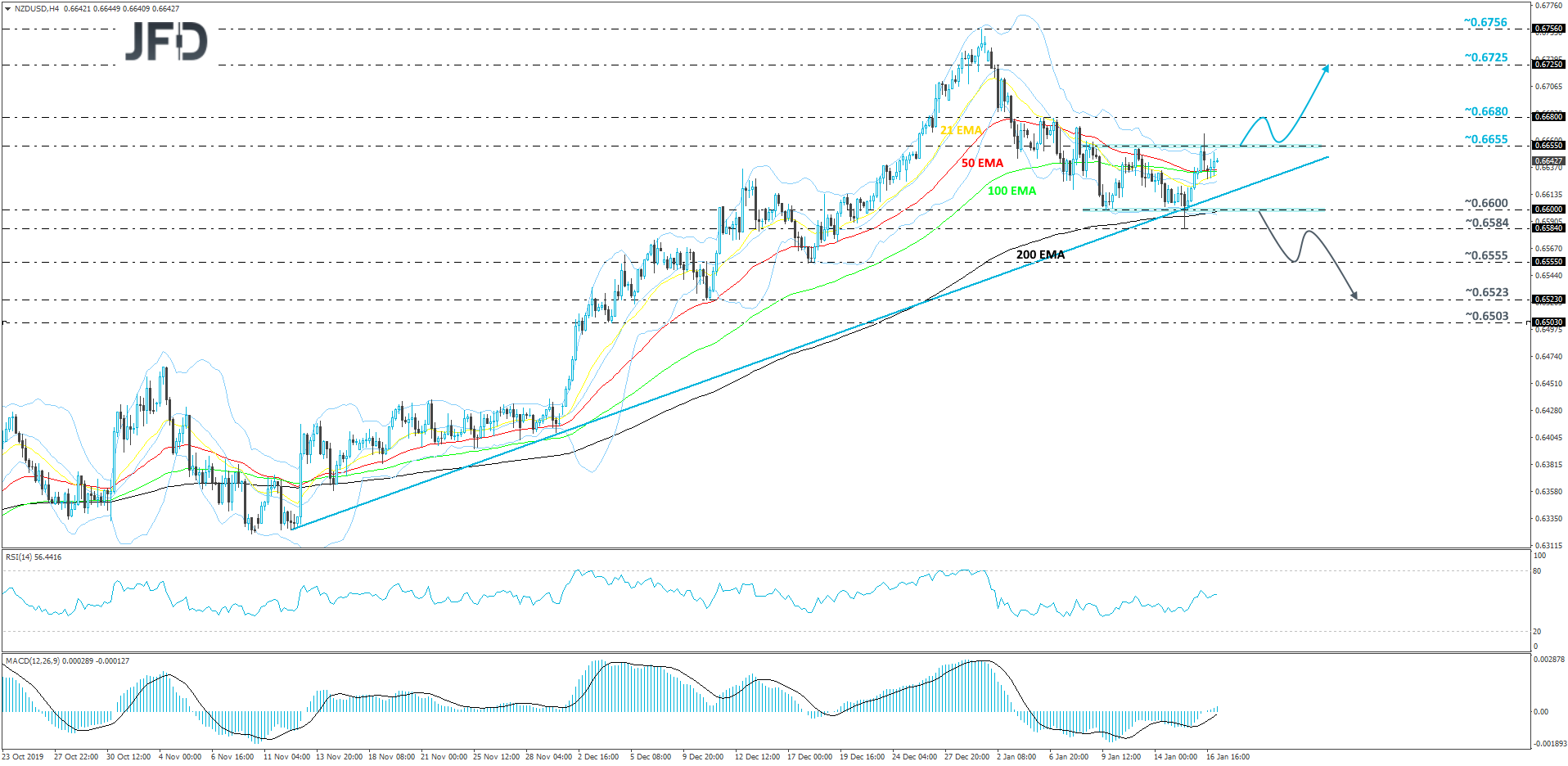
Overall, NZD/USD is trading above its short-term upside support line drawn from the low of November 12th. Recently, the pair tested that line once again and rebounded from it, but remained stuck in a short-term range, roughly between the 0.6600 and 0.6655 levels. Our oscillators, the RSI and the MACD, are showing willingness to make their move higher, which supports the overall trend. But until we see a clear break above the upper bound of that range, we will stay cautiously bullish, at least for now.
If we do see a push above the aforementioned 0.6655 barrier, this might attract more buyers into the game and the rate could rise to the next possible resistance mark, at 0.6680, which is the high of January 6th. NZD/USD may stall around there, or correct back down slightly, but if it stays above the previously mentioned upside line, this could still help the bulls to remain in the field. If the buyers decide to take advantage of the lower rate again, they may give NZD/USD a boost, which could bring it back to the 0.6680 hurdle. If this time that area fails to withstand the bull pressure and breaks, it could clear the way to the 0.6725 level, marked by an intraday swing low of December 31st and an intraday swing high of January 2nd.
Alternatively, for us to examine the downside, we would need to see, not only a break of the aforementioned upside line, but also a rate-drop below the 0.6600 zone, which is the low of the previously discussed range. At the same time the pair would be placed below its 200 EMA on the 4-hour chart and more sellers could see this as an attractive spot to jump in. We will then aim for the 0.6584 obstacle, a break of which may lead to the 0.6555 hurdle, marked by the low of December 18th. NZD/USD could get a hold-up around there, or even rebound back up a bit. That said, if the rate continues to float below the 200 EMA, then the bears might jump in again and drive the pair back down towards the 0.6555 hurdle. If that hurdle gets broken, the next support level to consider may be the low of December 11th, at 0.6523.
As for the Rest of Today’s Events
During the European day, besides the UK retail sales, we also get Eurozone’s current account balance for November, where no forecast is available, and the bloc’s final CPIs for December, which are expected to match their initial estimates.
In the US, building permits are expected to have slid somewhat in December, while housing starts for the same month are anticipated to have increased slightly. Industrial and manufacturing production rates are expected to have declined to -0.1% mom and -0.2% mom respectively, after both growing 1.1% in November. The JOLTs job openings for November are seen slightly lower than October, while the preliminary UoM consumer sentiment index for January is forecast to have held steady at 99.3.
As for the speakers, we have two scheduled today: Philadelphia Fed President Patrick Harker and Fed Board Governor Randal Quarles.
Disclaimer:
The content we produce does not constitute investment advice or investment recommendation (should not be considered as such) and does not in any way constitute an invitation to acquire any financial instrument or product. The Group of Companies of JFD, its affiliates, agents, directors, officers or employees are not liable for any damages that may be caused by individual comments or statements by JFD analysts and assumes no liability with respect to the completeness and correctness of the content presented. The investor is solely responsible for the risk of his investment decisions. Accordingly, you should seek, if you consider appropriate, relevant independent professional advice on the investment considered. The analyses and comments presented do not include any consideration of your personal investment objectives, financial circumstances or needs. The content has not been prepared in accordance with the legal requirements for financial analyses and must therefore be viewed by the reader as marketing information. JFD prohibits the duplication or publication without explicit approval.
CFDs are complex instruments and come with a high risk of losing money rapidly due to leverage. 78% of retail investor accounts lose money when trading CFDs with the Company. You should consider whether you understand how CFDs work and whether you can afford to take the high risk of losing your money. Please read the full Risk Disclosure.
Copyright 2020 JFD Group Ltd.