


The pound was once again the main gainer among the G10 currencies, getting another boost by headlines suggesting that the differences between the EU and the UK have continued to narrow. The Kiwi was among the main losers despite New Zealand’s better-than-expected inflation data for Q3, while the Loonie was the second winner in line, with its traders awaiting Canada’s CPIs for September.
Pound and Risk Appetite Boosted by More Brexit Deal Hopes
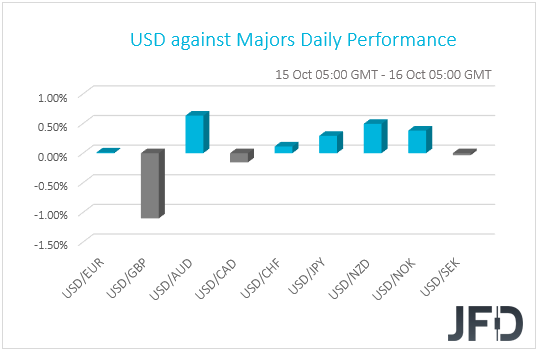
The dollar traded higher against most of the other G10 currencies on Tuesday and during the Asian morning Wednesday. It gained the most against AUD, NZD and NOK, while it underperformed against the pound and slightly against CAD. The greenback was found virtually unchanged versus EUR and SEK.
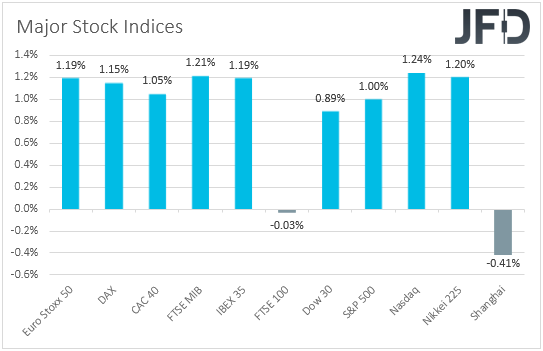
The pound remained in the spotlight and was once again the main winner on the G10 dashboard. Optimism surrounding a Brexit deal continued to build up, with headlines suggesting that the differences between the EU and the UK have continued to narrow. What was different this time around is that Brexit-related reports have not affected the pound only, but also the broader market sentiment, with investors sidelining any US-China headlines. Major EU and US indices closed in the green, with most of them gaining more than 1%. The exception was the UK FTSE 100, which was kept down by the strong pound. Remember that many companies of the index generate profits in other currencies, so in a strengthening GBP environment, if those profits are converted into pounds, they worth less.
That said, EU Brexit negotiator Michel Barnier said yesterday that a legal text by the end of the day was needed in order to get a deal by this week’s summit. Still, markets are waiting for the outcome of talks that dragged beyond midnight. In any case, our view remains the same as yesterday. The pound may continue gaining on headlines suggesting that the two sides are getting closer into finding a deal However, they may not be able to do it by the end of this week, which would mean more negotiations and perhaps some profit-taking in the pound. Even if they shake hands by Friday, still, for a deal to take flesh, the UK Parliament would have to say yes, perhaps at a special session on Saturday. That’s why we are still reluctant to trust a long-lasting recovery in the British currency.
With regard to the US-China saga, overnight, China threatened to proceed with “strong countermeasures” in case the US passes a bill that supports protesters in Hong Kong. The bill was approved in the House of Representatives yesterday, but it would need Senate’s approval for becoming law. Although Japan’s Nikkei 225 closed 1.20% up, the news may have weighed on Chinese markets, with Shanghai’s Composite index sliding 0.41%.
GBP/JPY – Technical Outlook
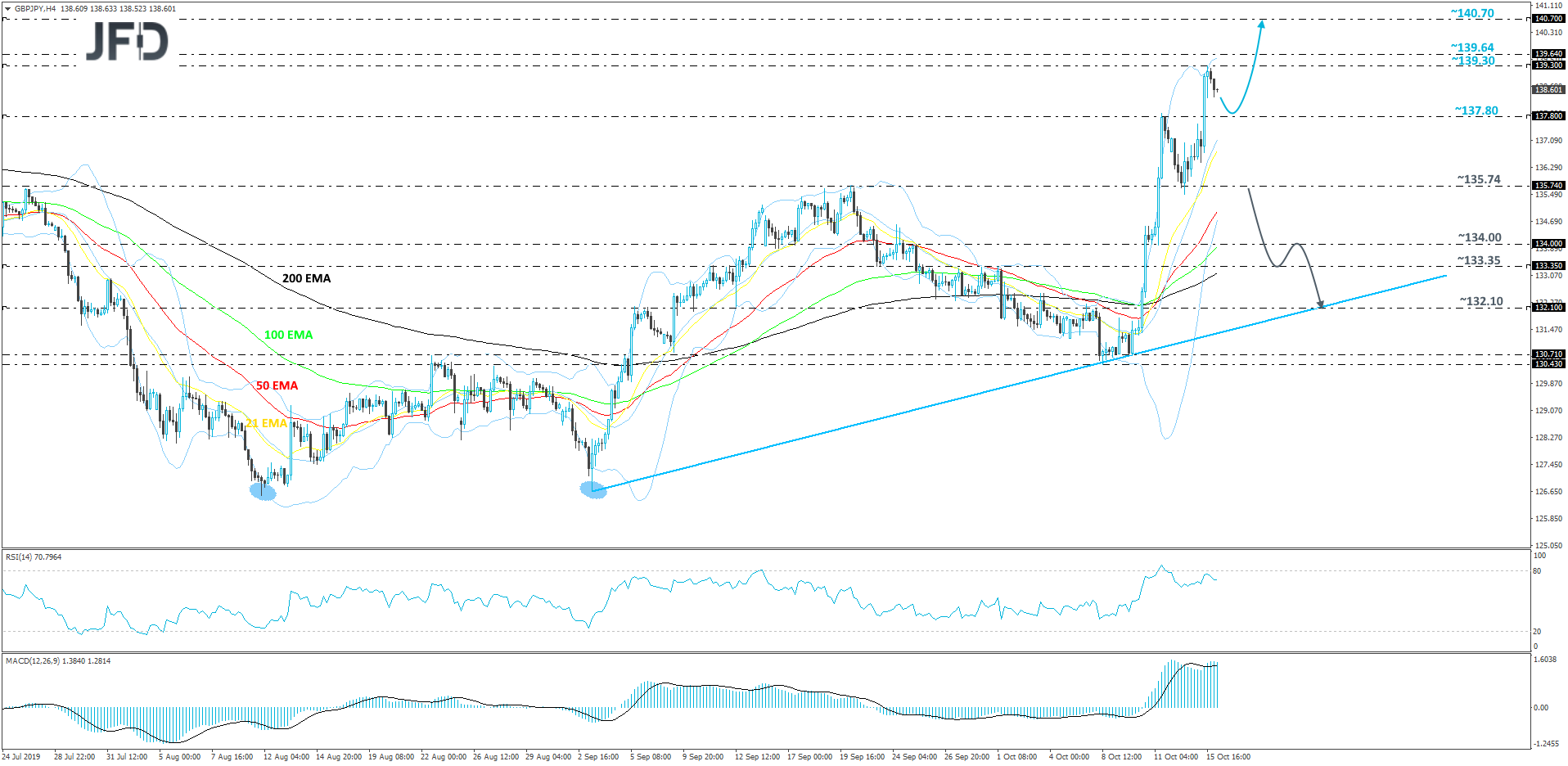
Yesterday, GBP/JPY had another great run to the upside, breaking above its key resistance barrier, at 137.80. The pair got held near the 139.30 zone, from which it is now correcting back down a bit. Given the sharp uprises that we saw already over the past few days, the rate could correct a bit more, but if it stays above the 137.80 hurdle, this may result in another round of buying. As long as the rate continues to print higher highs and higher lows, we will remain cautiously bullish, at least for now.
As mentioned above, if the rate slides slightly lower, but struggles get below the 137.80 zone, we may see the bulls joining in again and potentially driving the pair to the aforementioned 139.30 hurdle, which marks the yesterday’s high. Slightly above it sits another possible resistance, at 139.64, which is the high of May 27th. If both of these levels are not able to keep GBP/JPY down, a break of the last one could open the door for a further move higher, potentially aiming for the 140.70 barrier, marked by the high of May 22nd.
Alternatively, if the previously-discussed 137.80 hurdle fails to hold and breaks, this would put us into a neutral spot, where we will wait for the pair’s further actions. However, if the rate slides below the 135.74 area, which is the highest point of September and is not far from this week’s low, this could attract more sellers into the game. We may see GBP/JPY moving further down and aiming for the 134.00 obstacle, or even the 133.35 zone, marked near the highs of September 30th and October 1st. If there is no stopping of the bears there, a drop below the 133.35 hurdle could send the pair to test the short-term tentative upside support line drawn from the low of September 3rd.
NZD Down Despite Better CPIs, Canada’s Inflation Data in Focus
The Kiwi was the second loser in line, despite New Zealand’s better-than-expected inflation data for Q3. The qoq rate ticked up to +0.7% from +0.6%, instead of staying unchanged as the forecast suggested, something that pushed the yoy rate down to +1.5% from +1.7%. The forecast was for the yoy rate to slide to +1.4%. The Kiwi gained as soon as the numbers were out but was quick to give back those gains and to trade even lower. It seems that, despite the yoy rate coming above the RBNZ’s latest projection for the quarter, which was at +1.3% yoy, market participants remained well convinced that this Bank will cut interest rates at its upcoming gathering. Indeed, according to New Zealand’s OIS (Overnight Index Swaps), the probability for a quarter-point reduction next month stands at around 94%.
Flying to Canada, the Loonie performed well yesterday, taking the second place among the G10s, still well behind the pound. Today, CAD-traders are likely to pay close attention to Canada’s CPIs for September, where the headline rate is anticipated to have ticked up to +2.0% from +1.9%, and the core one to have stayed unchanged at +1.9% yoy.
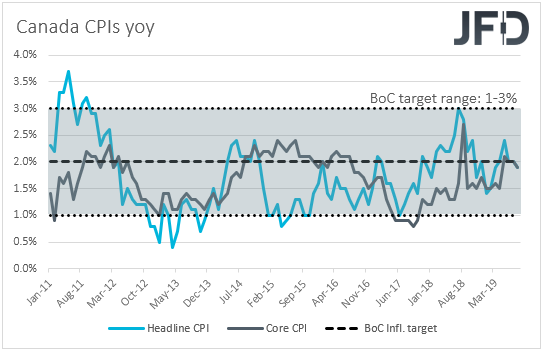
At its latest meeting, the BoC kept interest rates unchanged at +1.75%, reiterating that the current degree of monetary policy stimulus remains appropriate and thereby, staying among the very few major central banks that have not turned their eyes to the cut button yet. Thus, following the better-than-expected employment report for September, decent inflation numbers, around the Bank’s 2% objective, may allow Canadian policymakers to stay sidelined for a while more.
NZD/CAD – Technical Outlook
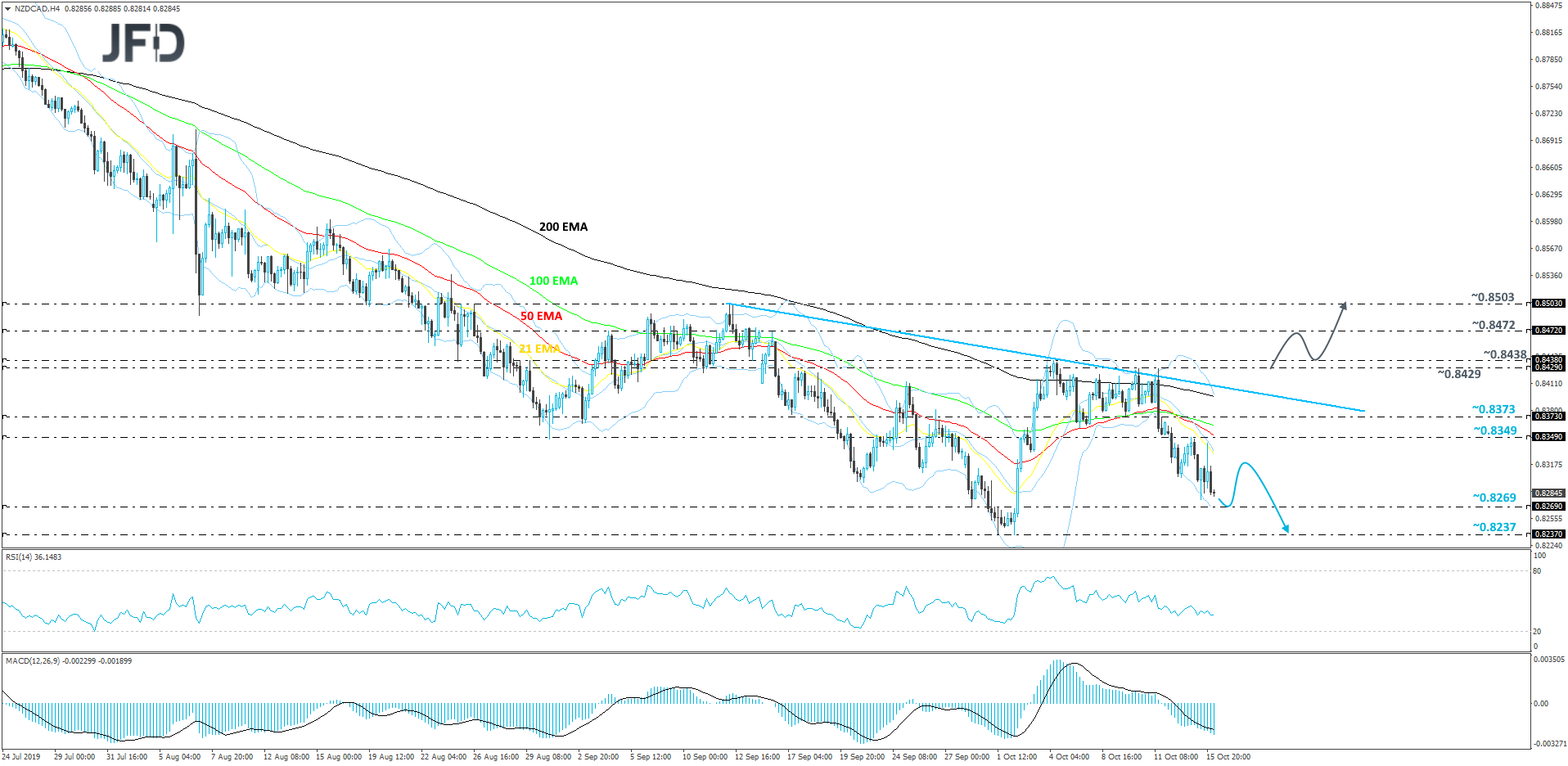
NZD/CAD continues to drift lower, while trading below its short-term tentative downside resistance line drawn from the high of September 12th. The pair seems to be aiming for the current low of October, near the 0.8237 hurdle, but before it might end up traveling there, we could see a small pullback, as the rate had already depreciated quite a bit over the past few days. Our oscillators, the RSI and the MACD, are also supporting the idea of some declines in the near term, hence why we will stay bearish, at least for now.
A small move lower may test one of the pair’s support zones, at 0.8269, which marks the low September 30th and an intraday swing high of October 1st. The rate might stall around there, or even correct back up again. That said, if NZD/CAD struggles to travel above the 0.8349 zone, this could result in another round of selling, possibly bringing the rate back to the 0.8269 area. If this time it fails withstand the bear-pressure, a break of it could clear the way to the long-awaited aforementioned 0.8237 level, marked by the current low of October.
In order for us to get comfortable with the upside, we will wait until we see a clear push above the previously-mentioned downside line and a rate-move above the 0.8438 barrier, marked by the high of October 4th, which is also the current highest point of October. Only then that we will target the next potential resistance area, at around 0.8472, a break of which may send NZD/CAD to the 0.8503 level, marked by the high of September 12th. That level is also the highest point of September.
As for the Rest of Today’s Events
Apart from Canada’s inflation data, we get CPIs for September from the UK and the Eurozone. In the UK, both the headline and core CPI rates are expected to have risen to +1.8% yoy and +1.7% yoy, from +1.7% and +1.5% respectively, something that may allow the BoE to maintain its hiking bias. However, how officials will decide to move forward will mainly depend on the Brexit outcome. In Eurozone, we get the final prints for the month, and as it is usually the case, they are expected to confirm their preliminary estimates.
In the US, we have retail sales for September, with the headline rate expected to have slid to +0.3% mom from +0.4%, but the core one to have increased to +0.2% mom from 0.0%. According to the Fed funds futures, market participants assign a 75% chance for the FOMC to cut interest rates again at its upcoming gathering, scheduled for the end of this month, and a disappointment in this data set may prompt them to push that percentage higher.
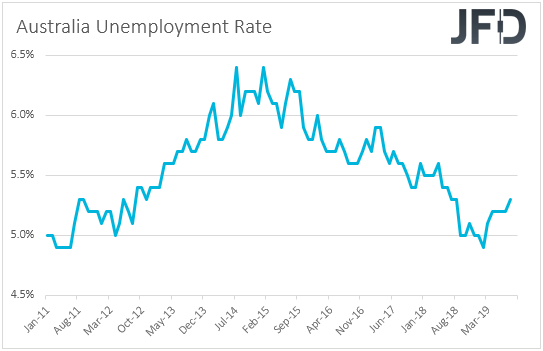
As for tonight, during the Asian session Thursday, Australia’s employment report for September is due to be released. The unemployment rate is forecast to have remained unchanged at 5.3%, well above the 4.5% mark, which the RBA believes it would start generating inflationary pressures, while the net change in employment is forecast to show a slowdown to 15k from 37.7k in August. A weak employment report is likely to keep Australian policymakers’ hands around the cut button, and may prompt market participants to bring forth the timing of when they expect the next quarter-point decrease to be delivered. According to the ASX 30-day interbank cash rate futures implied yield curve, investors are currently fully pricing in another 25bps reduction by the RBA in February.
With regards to the speakers, we have four on today’s agenda: BoE Governor Mark Carney, ECB Governing Council member Jens Weidmann, Chicago Fed President Charles Evans and Fed Board Governor Lael Brainard.
Disclaimer:
The content we produce does not constitute investment advice or investment recommendation (should not be considered as such) and does not in any way constitute an invitation to acquire any financial instrument or product. The Group of Companies of JFD, its affiliates, agents, directors, officers or employees are not liable for any damages that may be caused by individual comments or statements by JFD analysts and assumes no liability with respect to the completeness and correctness of the content presented. The investor is solely responsible for the risk of his investment decisions. Accordingly, you should seek, if you consider appropriate, relevant independent professional advice on the investment considered. The analyses and comments presented do not include any consideration of your personal investment objectives, financial circumstances or needs. The content has not been prepared in accordance with the legal requirements for financial analyses and must therefore be viewed by the reader as marketing information. JFD prohibits the duplication or publication without explicit approval.
75% of the retail investor accounts lose money when trading CFDs with this provider. You should consider whether you can afford to take the high risk of losing your money. Please read the full Risk Disclosure.