


It’s the turn of three more central banks to decide on monetary policy this week: The BoC, the FOMC and the BoJ. Both the BoC and the BoJ are expected to stand pat, while the FOMC is largely anticipated to cut rates by 25bps, despite the September “dot plot” suggesting that no more cuts are on the table. As for the data, we get Australia’s and Eurozone’s CPIs, the 1st estimate of Q3 GDP from the Euro-area and the US, as well as the US employment report for October.
Monday is a relatively light day in terms of economic releases and indicators, so all eyes will probably stay locked on the Brexit landscape. Last week, UK PM Boris Johnson called for an early election to take place on December 12th, in an attempt to break the impasse, and today, UK lawmakers are set to vote on that call. However, Labor leader Jeremy Corbyn said that he would like to wait for the EU’s decision with regards to the requested extension before deciding how to vote, adding that he will support an election only when the risk of a disorderly exit is vanished. Thus, given that the motion needs the support of two-thirds in Parliament in order to take flesh, we believe that Johnson is likely to suffer another defeat. As for the EU, they agreed that there should be an extension, but have yet to decide on the exit date.
On Tuesday, Asian time, the Tokyo CPIs for October are coming out. No forecast is available for the headline rate, while the core one is anticipated to have risen to +0.7% yoy from +0.5%. Later in the day, the US Conference Board consumer confidence index for October is expected to have risen to 127.4 from 125.1, while US pending home sales for September are forecast to have slowed to +0.5% mom from +1.6%.
On Wednesday, we have two central bank decisions on the agenda, from the BoC and the FOMC. Getting the ball rolling with the BoC, its latest decision was to keep interest rates unchanged at 1.75%, with officials noting that the US-China trade conflict weighed more heavily on global economic momentum than the Bank has previously projected. Nevertheless, they maintained their neutral stance with regards to interest rates, reiterating that the current degree of monetary policy stimulus remains appropriate.
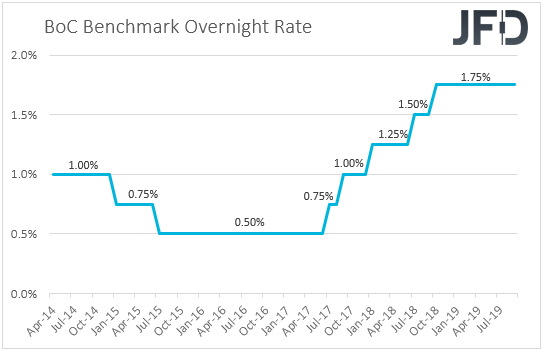
Since then, employment data for both August and September came in better than expected, with the unemployment rate sliding to 5.5% last month, from 5.7%. Both the headline and core CPIs slid to just a tick below 2% in August, and stayed there in September, but the trimmed CPI held steady at 2.1% yoy. What’s more, according to the BoC’s quarterly Business Outlook Survey, the Bank saw a slight improvement in business sentiment. So, in our view, all these may allow policymakers to stay sidelined, despite other major central banks taking the easing road.
Moving from Canada to the US, at its latest policy meeting, the FOMC decided to cut rates by 25bps, with the updated “dot plot” pointing to no more cuts this year and the next. That said, despite the 2019 median dot suggesting that there are no more rate reductions on the table, the Committee was largely divided, with only 5 members supporting that view. Seven still believed that another quarter-point reduction may be appropriate by year end, while the remaining 5 argued that the latest cut was not needed.
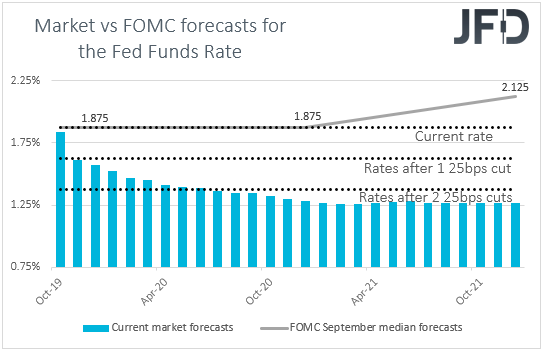
After that meeting, the ISM revealed that the manufacturing activity in the US fell to a 10-year low in September, as the prolonged trade conflict between the US and China weighed on US exports, adding to fears of further economic slowdown during the third quarter. This combined with comments from Chair Powell that the Committee will “act as appropriate” and that policy is never on a pre-set course, allowed investors to stay well convinced that officials will deliver another quarter-point cut at this week’s gathering. According to the Fed funds futures, there is a 93% chance for that to happen, while another one is fully factored in for June next year. So, having all this in mind, a 25bps cut by itself is unlikely to prove a market mover. If that’s the case, investors will quickly turn attention to hints as to whether policymakers are willing to act again if needed.
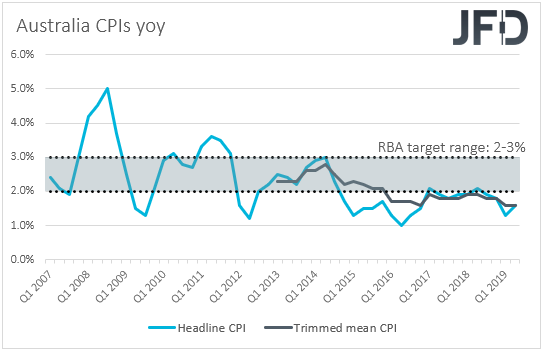
As for Wednesday’s data, during the Asian morning, we get Australia’s CPIs for Q3. The headline rate is forecast to have ticked up to +1.7% yoy from +1.6%, but the trimmed mean rate is expected to have remained unchanged at +1.6% yoy. At its latest policy meeting, the RBA cut interest rates by 25bps and reiterated that they will continue to monitor developments, including in the labor market, and ease policy further if needed. The employment report for September showed that the unemployment rate ticked down to 5.2% from 5.3%, which is certainly a move in the desired direction, but still distant from the 4.5% mark which the RBA believes it may start generating inflationary pressures. This allowed market participants to keep bets with regards to further easing well on the table, fully pricing in the next quarter-point decrease in May next year. With inflation staying below the lower end of the Bank’s target range of 2-3%, they may be tempted to bring that timing slightly forward.
In Europe, we get Germany’s preliminary CPIs for October. Both the CPI and HICP rates are expected to have declined to +1.0% yoy and +0.8% yoy, from +1.2% and +0.9% respectively. This could raise speculation that the Euro-area inflation numbers, due out on Thursday, may move in a similar fashion.
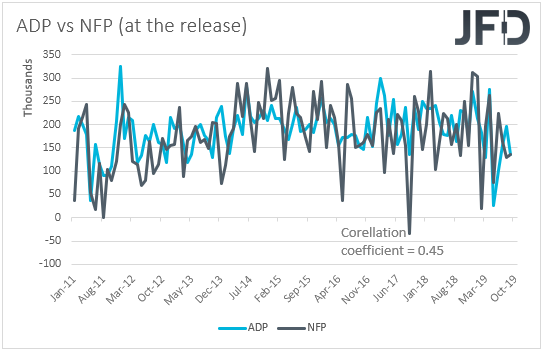
From the US, we have the ADP employment report for October and the first estimate of GDP for Q3. The ADP report is expected to show that the private sector has gained 120k jobs in October, slightly less than the 135k in September. This could spark bets that the NFP number, which comes out on Friday, may also come below its September print. That said, we repeat for the umpteenth time that the ADP report is far from a reliable predictor of the NFPs. Taking into account data from January 2011, the correlation between the two time-series at the time of the release (no revisions are considered) stands at 0.45.
With regards to the first estimate of the GDP, it is expected to show that economic growth slowed to +1.7% qoq SAAR in Q3 from +2.0% in Q2. Despite the slowdown, this would keep the average for 2019 slightly above the FOMC’s projections, and thus, it is unlikely to alter much expectations with regards to the Fed’s actions after the cut expected to be delivered later in the day. Investors may prefer to wait for the meeting signals before they adjust their bets.
On Thursday, the central bank torch will be passed to the BoJ. Last time, Japanese policymakers refrained from acting, maintaining the forward guidance that the current extremely low levels of interest rates are likely to stay unchanged “at least through spring 2020”. They also reiterated that they will not hesitate to take additional easing measures if momentum towards achieving the inflation target is lost.
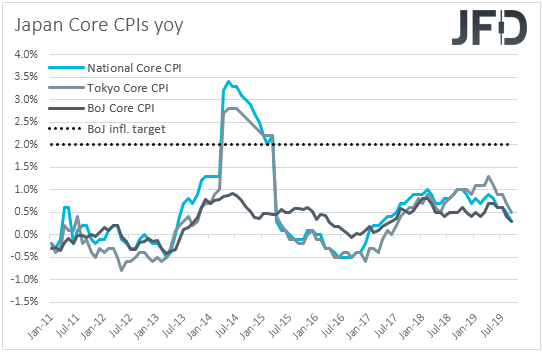
Inflation in Japan continued slowing, with both the headline and core National CPI rates declining to +0.2% yoy and 0.5% yoy, from +0.3% and 0.6% respectively. Even the Bank’s own core metric ticked down to +0.3% yoy from +0.4%. This increases the chances of more stimulus by the BoJ, but a recent report said that officials are thinking to refrain from adopting new easing measures this week. However, the same report noted that they may introduce a new way to show their readiness to do so. Therefore, investors may be on the lookout of how they will provide such signals, and whether further action may be in the works for the months to come. As for our view, with little space to ease further, the Bank may decide to wait for a while longer and perhaps rely on its dovish signals to do the work for now.
As for the data, during the Asian morning, China’s manufacturing and non-manufacturing PMIs for October are coming out. The manufacturing index is expected to have remained unchanged at 49.8, while no forecast is available for the non-manufacturing one.
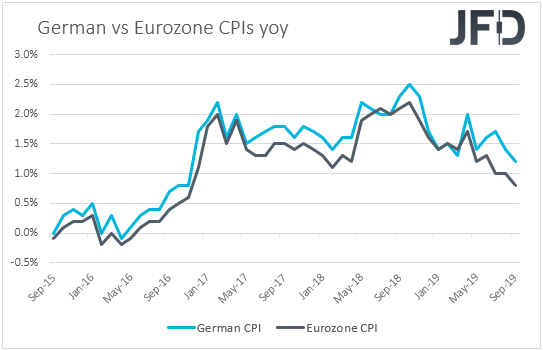
Later in the day, we have Eurozone’s preliminary CPIs for October as well as the initial estimate of Q3 GDP. Both the headline and core CPI rates are expected to have remained unchanged at +0.8% yoy and +1.0% yoy, while the qoq GDP rate is forecast to have ticked down to +0.1% from +0.2%. This would drive the yoy rate down to +1.1% from +1.2%. Coming on top of the disappointing preliminary PMIs for October, inflation rates still well below the ECB’s target of “below, but close to 2%” and an economy flirting with stagnation are likely to encourage market participants to add to their bets with regards to further stimulus by the ECB. However, given that we will have a new Chief from the upcoming meeting, and this would be Christine Lagarde, monetary policy may stay on hold for a while, as she would prefer to evaluate the situation better herself before she and her colleagues start examining whether (or not) more measures are needed.
In the US, personal income and spending for September are due to be released, as well as the core PCE index for the month. Income is expected to have slowed to +0.3% mom from +0.4%, while spending is forecast to have accelerated somewhat, to +0.2% from +0.1%. With regards to the core PCE index, the yoy rate is anticipated to have slid to +1.7% from +1.8%. From Canada, we get the monthly GDP for August, which is expected to have held steady at +0.2% mom.
Finally, on Friday, the main events on the agenda are likely to be the US employment report for October, and the ISM manufacturing PMI for the month. With regards to the employment data, the unemployment rate is expected to have ticked up to 3.6%, while nonfarm payrolls are anticipated to have slowed to 90k from 136k in September. Average hourly earnings are expected to have slowed to +0.3% mom from +0.4%, which barring any revisions to the prior monthly prints, would drive the yoy rate up to +3.0% from +2.9%. The ISM manufacturing index is expected to have risen somewhat, but to have remained below the 50 boom-or-bust zone. Specifically, it is expected to have increased to 48.8 from 47.8. A slowdown in employment growth and another contraction in the manufacturing activity may increase the chances for more cuts by the Fed, beyond the one expected to be delivered on Wednesday.
Elsewhere, we get Switzerland’s CPIs and the UK manufacturing PMI, both for October. The Swiss CPI is expected to have accelerated somewhat, to +0.3% yoy from +0.1%, while the UK manufacturing PMI is forecast to have slid to 48.1 from 48.3.
Disclaimer:
The content we produce does not constitute investment advice or investment recommendation (should not be considered as such) and does not in any way constitute an invitation to acquire any financial instrument or product. The Group of Companies of JFD, its affiliates, agents, directors, officers or employees are not liable for any damages that may be caused by individual comments or statements by JFD analysts and assumes no liability with respect to the completeness and correctness of the content presented. The investor is solely responsible for the risk of his investment decisions. Accordingly, you should seek, if you consider appropriate, relevant independent professional advice on the investment considered. The analyses and comments presented do not include any consideration of your personal investment objectives, financial circumstances or needs. The content has not been prepared in accordance with the legal requirements for financial analyses and must therefore be viewed by the reader as marketing information. JFD prohibits the duplication or publication without explicit approval.
75% of the retail investor accounts lose money when trading CFDs with this provider. You should consider whether you can afford to take the high risk of losing your money. Please read the full Risk Disclosure.