


Yesterday, major indices across the globe ended their trading sessions mixed, as the media continued to report on the ongoing geopolitical tensions in the eastern part of Ukraine. However, the Fed minutes managed to ease off the tension slightly, but traders were still worried about future rate increases. In Europe, the main gainers were IBEX 35, FTSE MIB and the Euro Stoxx 50. DAX, FTSE 100 and CAC 40 closed slightly in the negative territory.
Fed Minutes Help Markets Recover A Bit
In the U.S., after a negative start of the trading day yesterday, the top three indices managed to recover some of their losses and end the session somewhat flat. The boost came after the Fed released the minutes from its last gathering where they have noted that rates could be increased already in March, but not with the same aggressiveness, as it was anticipated earlier. This helped boost investor morale giving them an opportunity to take advantage of the situation, when the rates are still lower. As we understand, higher interest rates are not seen as a positive for the equities, due to higher borrowing costs.
The first increase by 25 bps is already expected in March, with further hikes expected during May and June meetings. However, how drastic would further hikes be, only time will tell.
DJIA – Technical Outlook
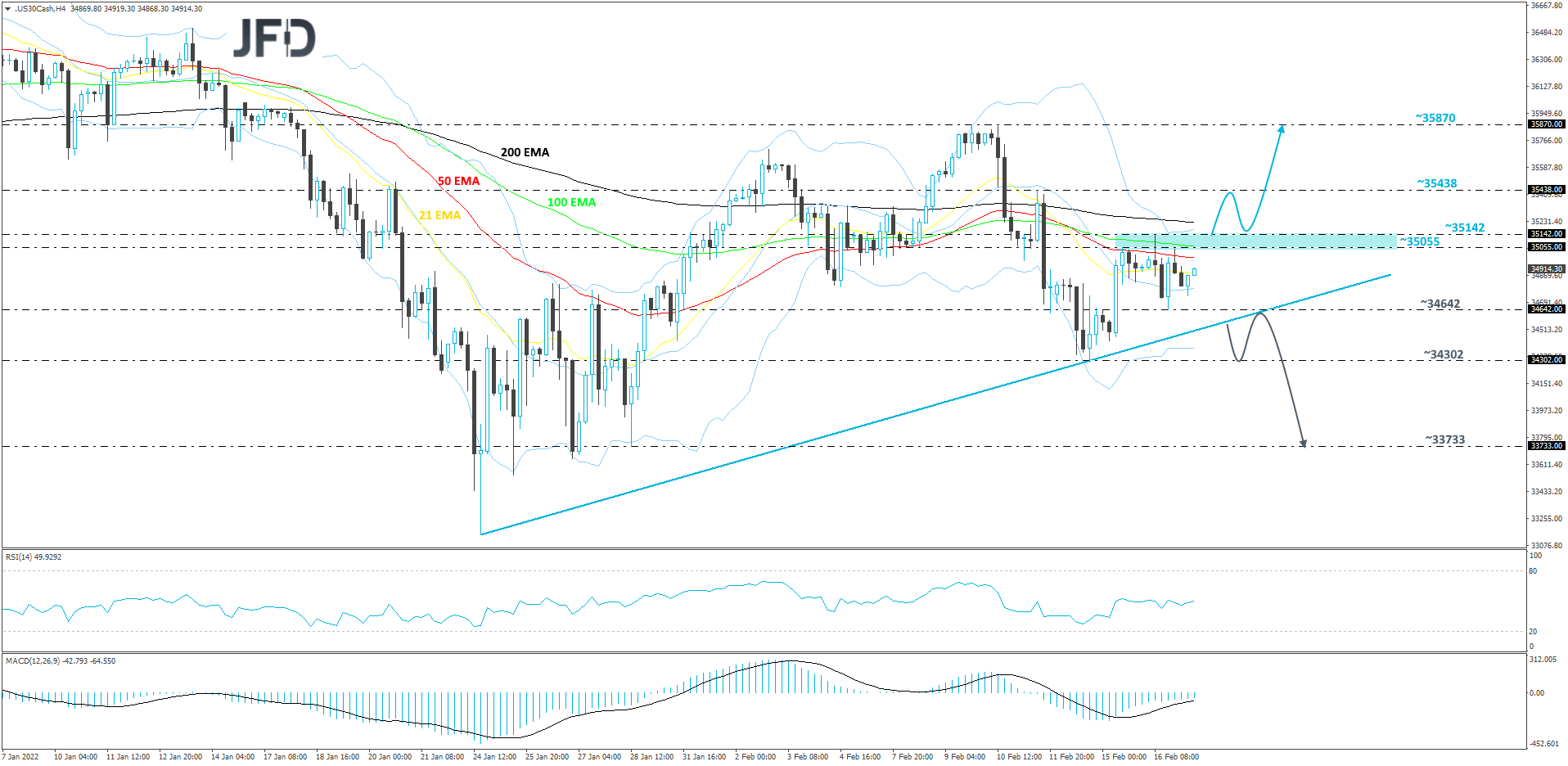
DJIA is now seen trading above a newly-established short-term tentative upside support line drawn from the low of January 24th. That said, the index seems to be struggling with a resistance area between the 35055 and 35142 hurdles, marked by the highs of February 15th and 16th respectively. In order to aim for slightly higher levels, we prefer to wait for a strong break above that resistance area first.
If, eventually, the index pops above the above-discussed resistance area, this will confirm a forthcoming higher high. More buyers might join in and drag the price towards the 35438 hurdle, marked by the high of February 11th. If that obstacle is not able to slow down the bulls, the next potential target could be at 35870, which is the current highest point of February.
On the downside, a break of the previously discussed upside line may open the door to some lower levels. DJIA could then drift to the current lowest point of February, at 34302, where the index might receive a temporary hold-up. If that hurdle breaks, this could open the door to the next possible support target, at 33733, which is the low of January 28th.
Australia’s Employment Numbers Come Out On The Modest Side
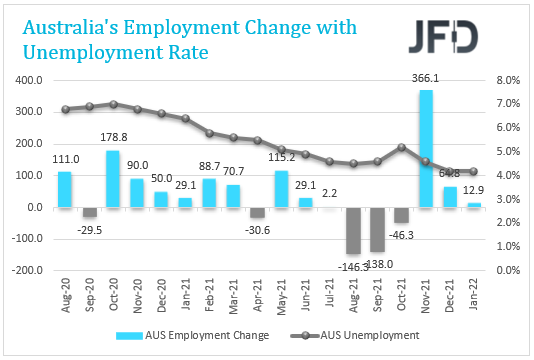
During the Asian morning we have received the Australian jobs numbers for the month of January. The participation rate improved by a tenth of a percent from the previous one, showing up at 66.2%. Although the employment change number came out at 12.9k, which is better than the initial forecast of -15.0k, the previous reading was at 64.8k. Unemployment rate remained at the same level, at 4.2%. Overall, the report was not bad, which may keep RBA away from raising rates for a while.
AUD/CHF – Technical Outlook
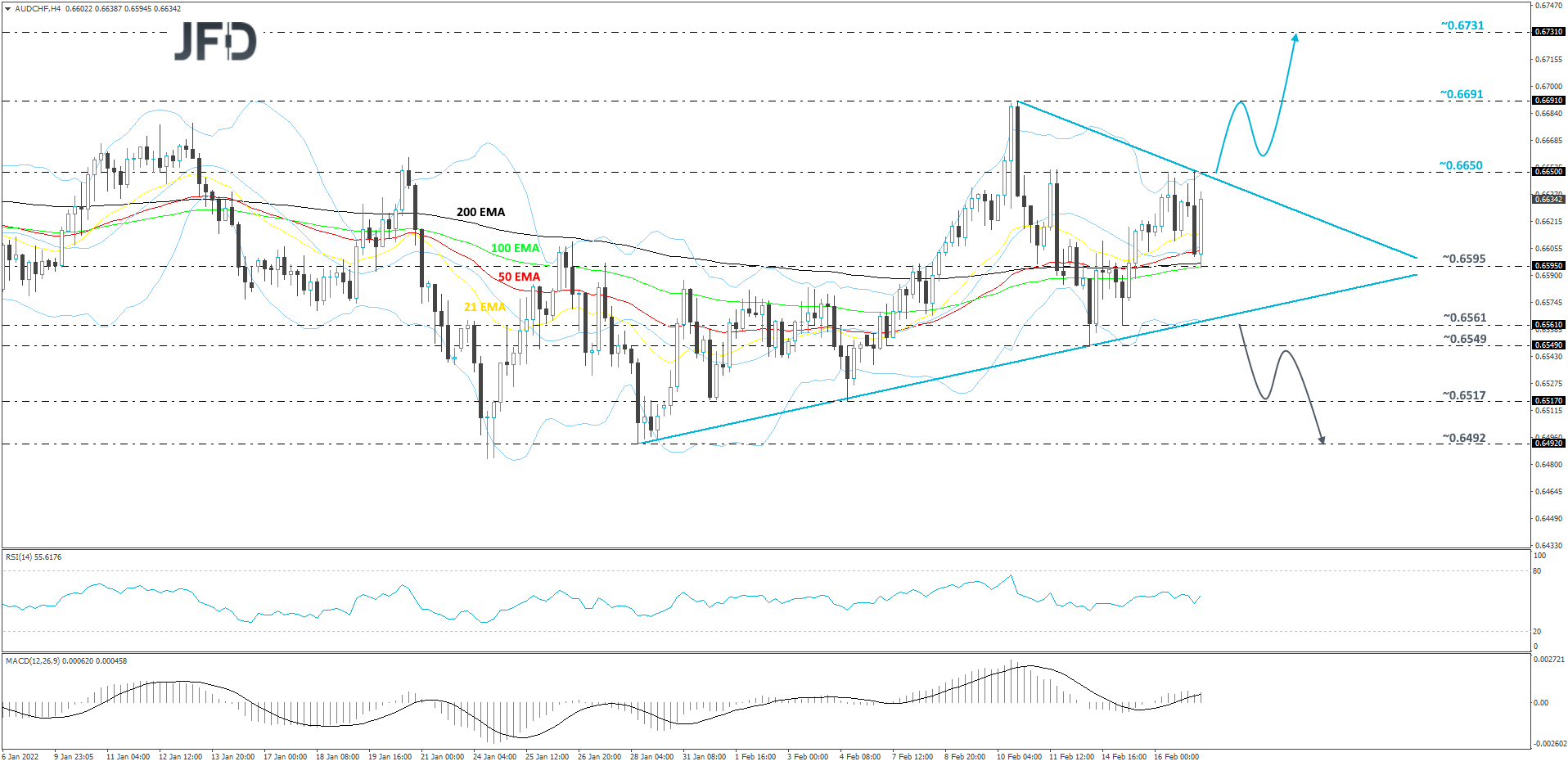
Currently, AUD/CHF is trading between two short-term trendlines, an upside one taken from the low of January 28th and a downside one taken from the high of February 10th. In order to consider the next short-term directional move, a break of through one of those lines is needed.
A push above the aforementioned downside line might strengthen the idea of seeing a further rise, especially if the rate climbs above the current high of today, at 0.6650. Such a move could attract a few extra buyers into the arena, potentially leading the pair towards the current highest point of February, at 0.6691. AUD/CHF may stall there for a bit, however, if the buying doesn’t stop, a break of that hurdle would confirm a forthcoming higher high and might lead the pair towards the 0.6731 level, marked by the high of November 25th.
Alternatively, if the previously discussed upside line breaks and the rate falls below the 0.6549 hurdle, marked by the current lowest point of this week, that might spook some bulls from the field temporarily. AUD/CHF could drift to the 0.6517 obstacle, a break of which may open the door for a move to the 0.6492 level, marked by the low of January 28th.
US Data In Focus
Later on, the U.S. will release a few sets of data for market participants to digest today. January’s building permits will be released and the current expectation is for a decline from 1.885mln to 1.760mln. If so, this would be the first month that the figure would be below forecast, after three straight months of gains.
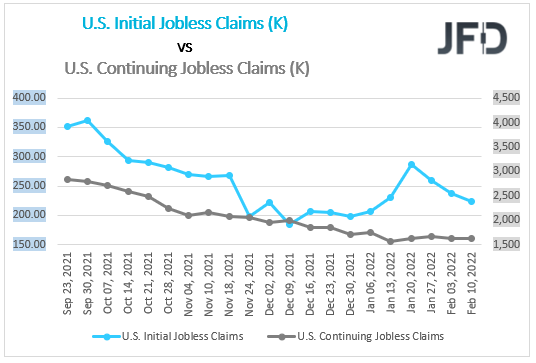
U.S. initial and continuing jobless claims are on the agenda as well. Both readings are expected to decline slightly. The initial claims are believed to have dropped from 223k to 219k. The continuing ones are forecasted to slide from 1621k to 1605k.
As For The Rest Of Today’s Events
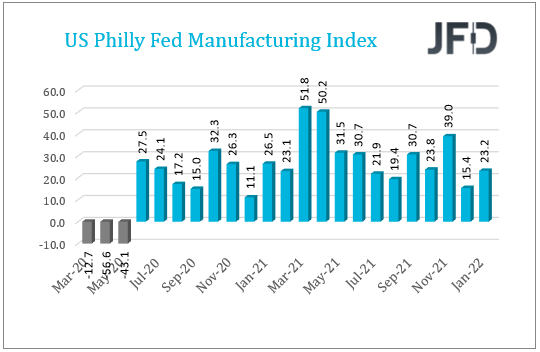
Another piece of economic data from the U.S. that will be delivered today will be the Philadelphia Fed Manufacturing index for February. The current expectation is for the reading to show up at 20.0. If so, this would be lower from the previous 23.2. Since March of last year, the figure is on a steady decline. In order to beat the March 2021 number, we would need to see the actual figure coming out above 51.8. However, for now, it seems unlikely, as current higher inflation reduces the variety and quantity of goods that a household can purchase, forcing the consumer to choose one good over another. This means that production levels in certain sectors might slow down a bit.
Disclaimer:
The content we produce does not constitute investment advice or investment recommendation (should not be considered as such) and does not in any way constitute an invitation to acquire any financial instrument or product. The Group of Companies of JFD, its affiliates, agents, directors, officers or employees are not liable for any damages that may be caused by individual comments or statements by JFD analysts and assumes no liability with respect to the completeness and correctness of the content presented. The investor is solely responsible for the risk of his investment decisions. Accordingly, you should seek, if you consider appropriate, relevant independent professional advice on the investment considered. The analyses and comments presented do not include any consideration of your personal investment objectives, financial circumstances or needs. The content has not been prepared in accordance with the legal requirements for financial analyses and must therefore be viewed by the reader as marketing information. JFD prohibits the duplication or publication without explicit approval.
CFDs are complex instruments and come with a high risk of losing money rapidly due to leverage. 73.82% of retail investor accounts lose money when trading CFDs with the Company. You should consider whether you understand how CFDs work and whether you can afford to take the high risk of losing your money. Please read the full Risk Disclosure.
Copyright 2022 JFD Group Ltd.