


US Federal Reserve Governor Michael Barr has signaled a cautious stance regarding for further interest rate cuts in the near term. His remarks underscore that the Fed’s policy focus remains firmly on inflation control and economic stability for now. US Federal Reserve Governor Michael Barr on Tuesday in New York indicated a reluctance to continue the rate-cutting cycle rapidly. Given the current data environment, he said it would likely be appropriate to keep interest rates unchanged for some time. Before any further easing steps could be considered, he wants to see convincing evidence that inflation—particularly in goods prices—is declining in a sustainable manner.
Barr stated that the risk of inflation remaining persistently above the Federal Reserve’s two-percent target is still significant. This requires a cautious and data-dependent monetary policy that is not driven by political or market pressure. Additional price pressure is currently coming, among other factors, from US trade policy, where tariffs have slowed the previously observed decline in inflation.
Although the Fed cut interest rates by a total of 0.75 percentage points last year to support a weakening labor market, policymakers have recently opted to leave rates unchanged. Barr emphasized that a pause in rate cuts should not be interpreted as inaction, but rather as a phase of careful reassessment. A prerequisite for further rate reductions appears to be not only a clear decline in inflation but also a stable labor market, which is currently balanced yet vulnerable to negative shocks.
This stance may have implications for US equity markets. In an environment of stable but relatively elevated interest rates, defensive sectors and companies with strong narrates, defensive rate relative resilience. Technology-focused indices such as the Nasdaq, which are generally more sensitive to interest rate expectations, may experience continued volatility if lower discount rates do not materialize. By contrast, indices with greater exposure to industrial and value-oriented companies, such as the Dow Jones, have historically shown relative stability in higher-for-longer rate environments.
Barr’s comments on artificial intelligence are consistent with this broader outlook. While he expects AI to contribute to productivity and living standards over the long term, he does not view current developments in the sector as a justification for near-term rate reductions. Investment activity in the sector appears relatively resilient to short-term interest rate movements, aligning with the Federal Reserve’s cautious policy stance. Overall, Barr’s remarks suggest a monetary policy approach characterized by patience, data dependence, and a continued focus on inflation dynamics rather than market expectations for faster rate adjustments.
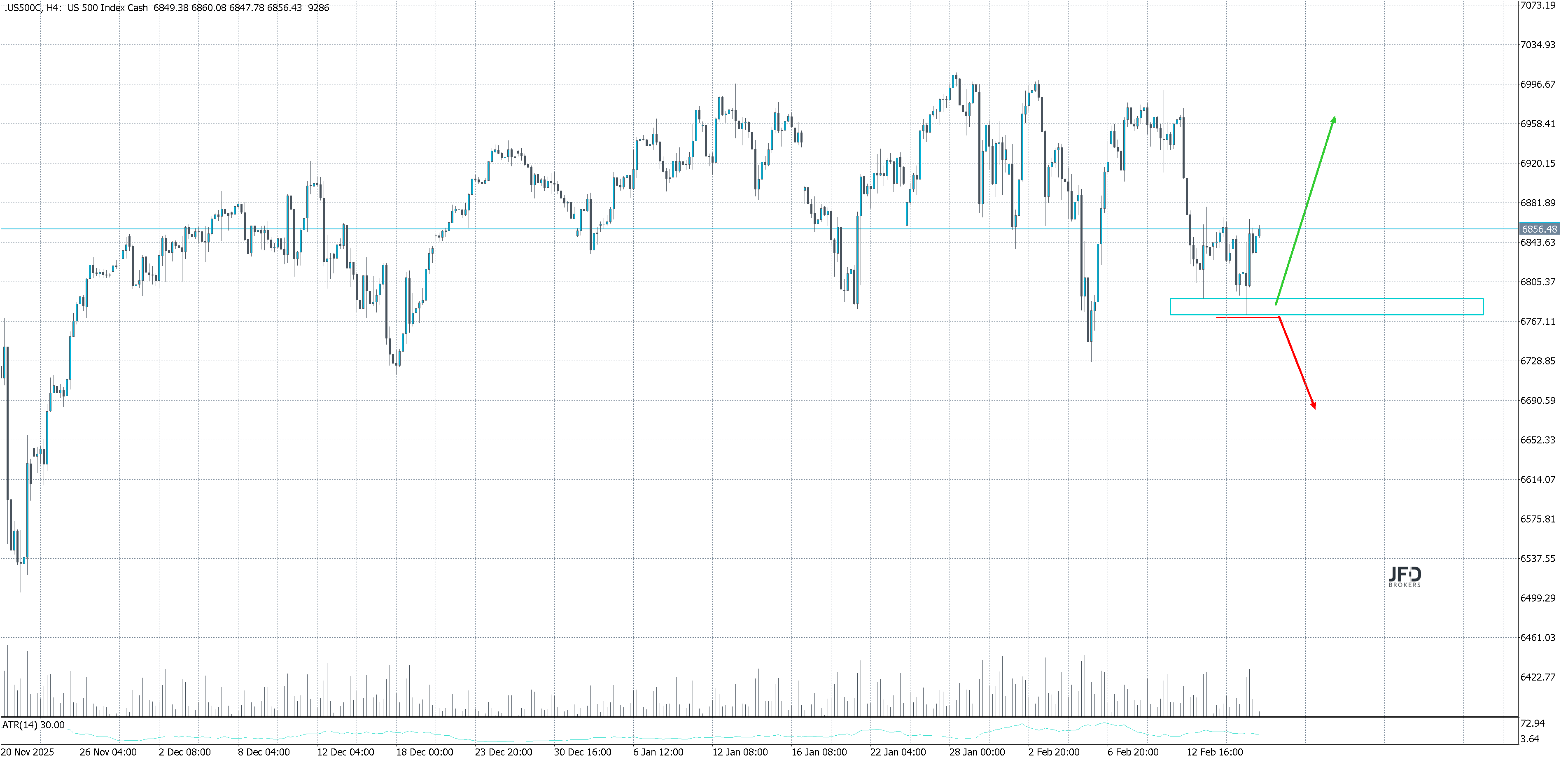
Chart Disclaimer: The chart above is provided for illustrative and informational purposes only. Any highlighted levels, scenarios, or directional indications represent hypothetical technical observations and do not constitute investment advice, a personal recommendation, or a solicitation to buy or sell any financial instrument.
Risk warning:
This is a marketing communication. The content is provided for informational purposes only and does not constitute investment advice, investment research, or a personal recommendation, nor should it be construed as an offer or solicitation to buy, sell, or hold any financial instrument. This communication has not been prepared in accordance with legal requirements designed to promote the independence of investment research.
The information presented does not take into account your individual investment objectives, financial situation, or needs. You should assess whether any investment is appropriate for you.
Investors are solely responsible for any investment decisions and should consider obtaining independent professional advice tailored on to their personal financial situation, investment objectives and risk tolerance before taking any investment decision. Duplication, distribution or publication of this content is prohibited without explicit approval.
59.18% of retail investor accounts lose money when trading CFDs with this provider. You should consider whether you understand how CFDs work and whether you can afford to take the high risk of losing your money.
Any forward-looking statements or scenario analyses presented reflect current market observations and are subject to change without notice.
Trading in cash equities involves risk. The value of investments may go down as well as up. Past performance is not a reliable indicator of future results. Please read the full Risk Disclosure available on our website.