


The main event on this week’s agenda may be Fed Chair Powell’s semi-annual testimony before Congress on Tuesday and Wednesday. In our view, given last week’s rise in Treasury yields, market participants may look for hints with regards to QE tapering. On Wednesday, we also have an RBNZ monetary policy decision. We believe that the Bank will stand pat and thus, all the attention may fall to the language over its future plans.
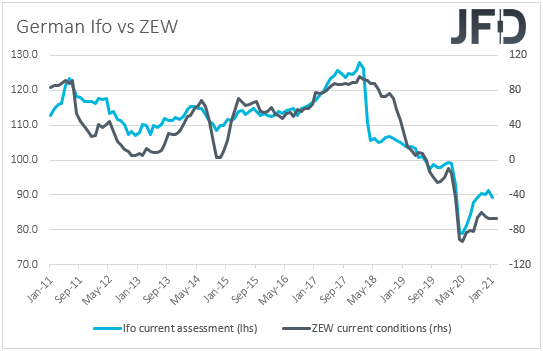
Monday appears to be a light day, with the only release on the agenda worth mentioning being the German Ifo survey for February. The current assessment index is forecast to have slid fractionally, to 89.0 from 89.2, while the expectations one is anticipated to have risen to 91.8 from 91.1. This is likely to drive the business climate index slightly higher, to 90.5 from 90.1. Last week, the ZEW current conditions index fell by more than expected, while the economic sentiment one rose by more than anticipated. This shifts the risks for the Ifo current assessment index to the downside and for the expectations one to the upside. In our view, a better-than-expected Ifo expectations index is likely to add more credence to ECB President Lagarde’s view that the downside risks to Eurozone’s economic outlook are now “less pronounced”, and thereby, it may lessen even further the chances for more easing by the ECB. Thus, it may prove positive for the euro.
On Tuesday, the main event may be Fed Chair Powell’s semi-annual testimony. He will appear before the Senate Banking Committee, while on Wednesday, he will present the same testimony before the House Financial Services Committee. Last week’s rise in Treasury yields suggests that market participants may be looking for clues as to when the Fed is considering to begin scaling back its QE purchases.
However, we don’t expect Powell to add fuel to tapering expectations. At the press conference following the latest FOMC decision, he clearly stated that it’s too early to focus on tapering dates, while in a more recent speech, he stayed on the dovish side. He noted that the improvement in the labor market has stalled in recent months, and even if we do see a strong labor market soon, they will not tighten monetary policy solely in response to that. He affirmed that they will keep interest rates at current levels until the economy has reached maximum employment and inflation stayed above 2% for some time, something that, according to the minutes of the latest meeting, is expected to happen in the years after 2023.
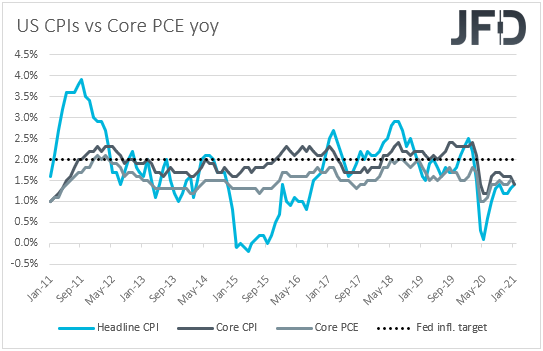
With all that in mind, a reiteration of his dovish stance may be the base case scenario, and thus, if this is the case, we are unlikely to see a huge market reaction. Equities may trade somewhat higher, while the dollar is likely to slid slightly. The risk to this event is for Powell to sound more hawkish and start hinting when tapering may start. This is likely to trigger a tumble in equities and a strong rebound in the US dollar.
As for Tuesday’s economic releases, during the Asian morning, we get New Zealand’s retail sales for Q4, which are forecast to have slid 0.5% qoq after surging 28.0% in Q3. Following such a rally, a small pullback appears more than normal to us and thus, it is very unlikely to revive expectations over negative interest rates by the RBNZ.
During the early European morning, we get the UK employment data for December. The unemployment rate is expected to have ticked up to 5.1% from 5.0%, while the net change in employment is forecast to show that the economy has lost 30k jobs in the three months to December, after losing 88k in the three months to November. Average weekly earnings, both including and excluding bonuses, are expected to have accelerated to +4.2% yoy and +4.0% yoy respectively, from +3.6%.
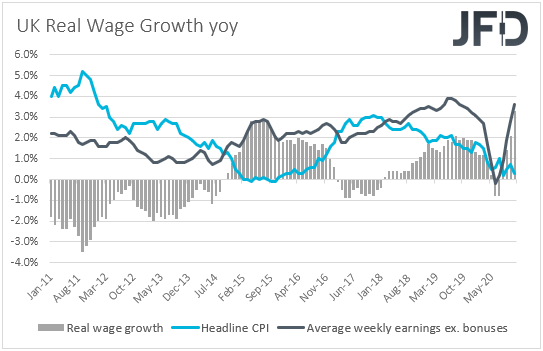
Following last week’s better than expected CPI data for January, this is unlikely to add to speculation for more easing by the BoE. At its latest gathering, the BoE pushed back the idea of negative interest rates, which combined with the fact that the UK is going further ahead in the covid vaccination race, encouraged GBP-traders to buy more of the British currency. In our view, the same catalysts are likely to continue supporting the pound, and bearing in mind that we see market appetite staying supported in the foreseeable future, sterling may perform better against the safe-havens.
We also get Eurozone’s final CPIs for January, which are expected to confirm their preliminary estimates, as well as the US Conference Board consumer sentiment index for February, which is forecast to have risen to 90.0 from 89.3.
On Wednesday, during the Asian morning, the RBNZ decides on monetary policy. Back in November, this Bank decided to keep its official cash rate and its Large-Scale Asset Purchase program unchanged, with Governor Adrian Orr saying that domestic activity since August has been more resilient than previously assumed.
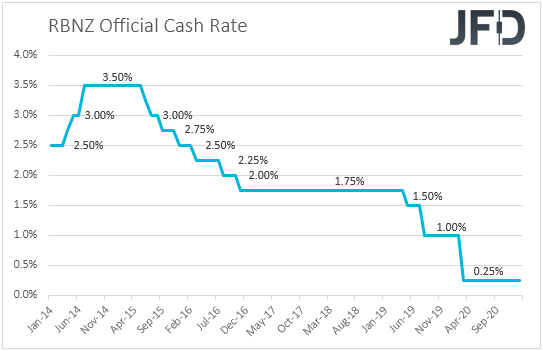
Q4 inflation stayed unchanged at +1.4% yoy, within the Bank’s target range of 1-3%, while the employment data for the quarter showed that the unemployment rate dropped to 4.9% from 5.3% and that the employment change rebounded 0.6% qoq after falling 0.8% in Q3. In our view, this data diminishes further the probability for negative interest rates and it even increases the chances for policymakers to sound more sanguine than they did in November. A more optimistic language is likely to prove positive for the Kiwi, which we also expect to stay supported by an improved broader market sentiment.
As for Wednesday’s data, during the Asian session, Australia’s wage price index for Q4 is due to be released, and expectations are for the yoy rate to have declined to +1.1% from +1.4%. Later in the day, Germany’s final GDP for Q4 is forecast to confirm its preliminary estimate of 0.1% qoq, while in the US, new home sales for January are expected to have accelerated to +2.1% mom from +1.6%.
Thursday’s agenda is relatively light. We only get the 2nd estimate of the US GDP for Q4, the durable goods orders for January and the pending home sales for the same month. The 2nd GDP estimate is forecast to reveal a minor revision to 4.1% qoq SAAR from 4.0%, while durable goods orders are expected to have accelerated to +1.1% mom from +0.5%. However, the core rate is anticipated to have declined to +0.7% mom from +1.1%. Pending home sales are expected to have slid 0.1% mom after declining 0.3% in December.
Finally, on Friday, during the Asian morning, Tokyo’s CPIs for February are coming out, with the core rate expected to have held steady at -0.4% yoy. No forecast is currently available for the headline rate. Japan’s preliminary industrial production for January is also due to be released and the forecast is for a 4.0% mom rebound after a 1.0% slide in December.
Later in the day, we get the US personal income and spending data for January, alongside the core PCE index for the month. Personal income is expected to have surged 9.9% mom after rising 0.6% in December, while spending is anticipated to have rebounded 2.5% mom after sliding 0.2%. The core PCE index is expected to have ticked down to +1.4% yoy from +1.5%. The final UoM consumer sentiment index for February is also coming out and the forecast is for a small upside revision to 76.5 from 76.2.
Disclaimer:
The content we produce does not constitute investment advice or investment recommendation (should not be considered as such) and does not in any way constitute an invitation to acquire any financial instrument or product. The Group of Companies of JFD, its affiliates, agents, directors, officers or employees are not liable for any damages that may be caused by individual comments or statements by JFD analysts and assumes no liability with respect to the completeness and correctness of the content presented. The investor is solely responsible for the risk of his investment decisions. Accordingly, you should seek, if you consider appropriate, relevant independent professional advice on the investment considered. The analyses and comments presented do not include any consideration of your personal investment objectives, financial circumstances or needs. The content has not been prepared in accordance with the legal requirements for financial analyses and must therefore be viewed by the reader as marketing information. JFD prohibits the duplication or publication without explicit approval.
CFDs are complex instruments and come with a high risk of losing money rapidly due to leverage. 79.07% of retail investor accounts lose money when trading CFDs with the Company. You should consider whether you understand how CFDs work and whether you can afford to take the high risk of losing your money. Please read the full Risk Disclosure.
Copyright 2021 JFD Group Ltd.