


Equities traded lower yesterday, perhaps as investors became again worried over aggressive tightening by major central banks after Euro-area inflation accelerated by more than anticipated, and following Monday remarks by Fed Governor Christopher Waller, who said that he will support 50bps hikes until inflation comes down. As for today, the BoC decides on monetary policy, and expectations are for another 50bps hike. So, if this is the case, investors will quickly turn their attention to the accompanying statement.
Inflation Continues to Accelerate in the Euro Area, BoC to Deliver Another Double Hike
The US dollar traded higher against all but one of the other major currencies on Tuesday and during the Asian session Wednesday. The only currency against which the greenback did not record any gains, and instead was found virtually unchanged, was CAD. The dollar gained the most ground versus JPY and NZD, with EUR well behind, taking the third place.
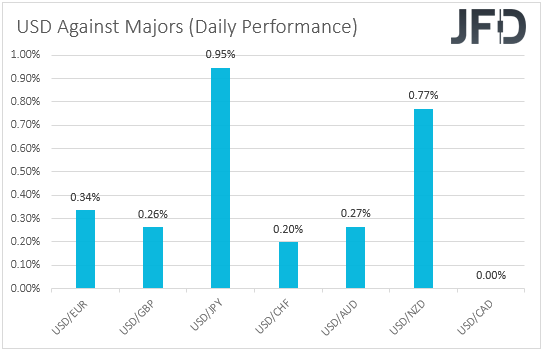
In our view, the strengthening of the US dollar and the weakening of the Kiwi point to a risk-off trading activity, but the fact that the yen was the main loser points otherwise. Thus, in order to clear things up, we prefer to turn our gaze to the equity world. There, we see that most major European indices traded in the red, with Wall Street following suit. Today in Asia, things were a little bit better, but not much. Yes, Japan’s Nikkei gained, but China’s Shanghai Composite and Hong Kong’s Hang Seng slid. South Korea’s KOSPI remained closed.
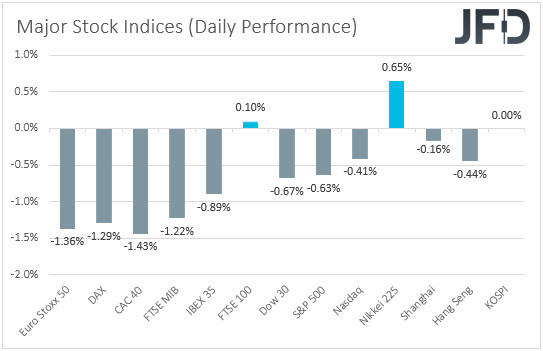
On Monday we saw that investors’ appetite improved due to news that China is planning to remove several COVID-related restrictions. However, we stayed reluctant for a long-lasting recovery, and this was due to the risks of accelerating inflation in the Eurozone, as well as the latest hawkish remarks by Fed Governor Christopher Waller, who said that he is advocating for 50bps hikes at each of the upcoming Fed gatherings until there is substantial reduction in inflation. “Until we get that, I don’t see the point of stopping,” Waller clearly added. It appears that we were somewhat right. Equities slid on renewed concerns of aggressive tightening by major central banks.
With regards to Eurozone’s inflation data, the headline rate jumped to 8.1% from 7.4%, at a time when the forecast was at 7.7%, while the core rate rose to +3.8% from 3.5%. Last week, ECB President Christine Lagarde said that the ECB is likely to take its deposit interest rate out of the negative territory by the end of September and could lift it further if needed. Given that the deposit rate is at -0.50%, we initially believed that this means two quarter-point liftoffs, one in July and one in September, and actually, some other ECB officials also supported that view. However, we believe that the more-than-anticipated acceleration in inflation may have increased speculation of more aggressive action by the ECB, perhaps that the size of the July hike may be 50bps. Even if the officials hike by 25bps in July, they could hint a bigger increase for September.
In any case, speculation of a more aggressive ECB could keep the euro supported, but we doubt that it can keep outperforming its US counterpart, especially after Waller’s remarks. After all, the US economy is in a better shape than the Eurozone, which could allow Fed officials to keep delivering double hikes, despite some worries over a slowdown recently. More Fed officials supporting Waller’s view of no break after summer could help the dollar to recover more.
As for today, the most important event on the agenda may be the BoC interest rate decision. Expectations point to another double hike and thus, if indeed this is the case, we believe that investors will quickly turn their attention to the accompanying statement for clues and hints as to how this Bank is planning to move forward.
Last time, officials of the BoC decided to hike rates by 50bps as was expected, noting that interest rates will need to rise further. Governor Macklem specifically said, “We need higher rates, and the economy can handle them”, adding that they are prepared to move as forcefully as needed to get inflation on target. With data since then keep adding credence to that view, we believe that policymakers will maintain a hawkish language, which could support further the Canadian dollar.
EUR/USD – Technical Outlook
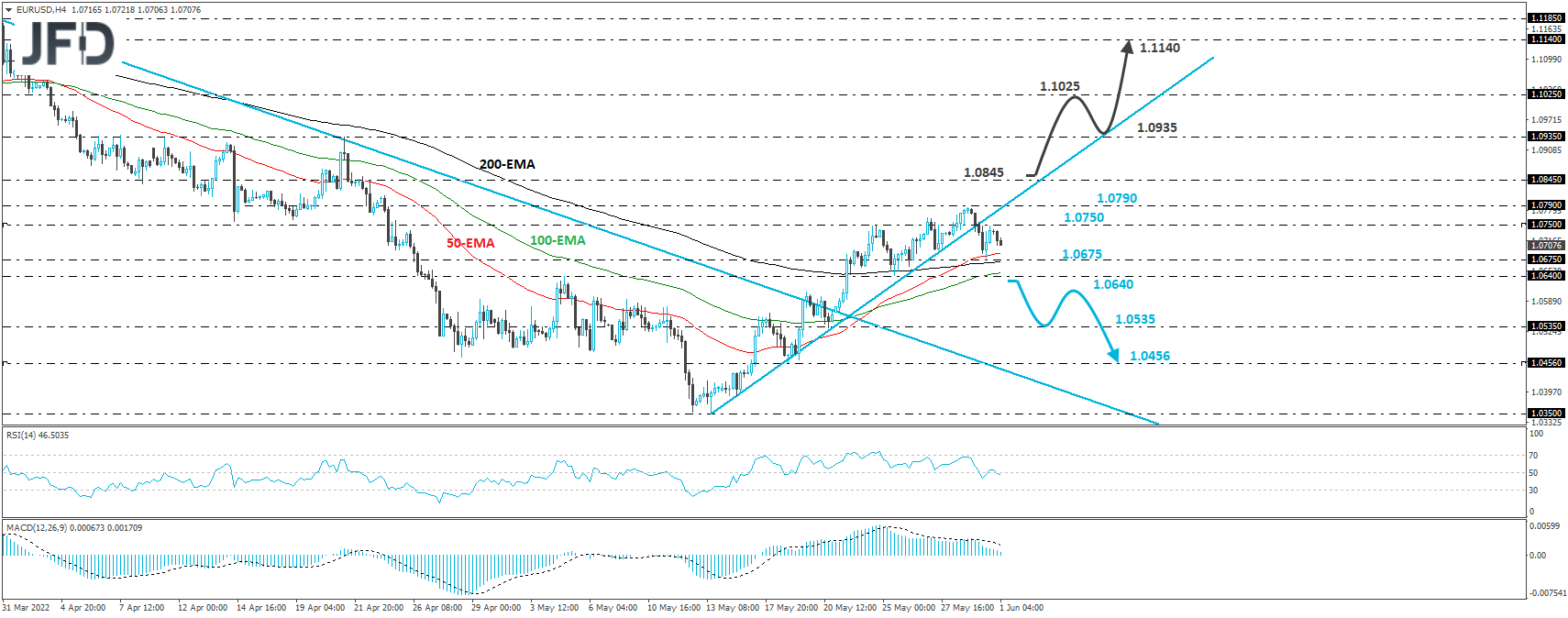
EUR/USD slid yesterday, breaking below the upside support line drawn from the low of May 13th. Then, it consolidated between 1.0675 and 1.0750. The break below that upside line has increased the chances for some further declines, but we will get more confident on that upon a break below 1.0640, which is the low of May 25th.
Such a break may invite more bears into the game, who may dive towards the low of May 20th, at around 1.0535, and if they don’t stop there, we may experience extensions towards the 1.0456 barrier, defined as a resistance by the low of May 18th.
In order to start examining the bullish case again, we would like to see a clear rebound back above the 1.0845 barrier, marked by the high of April 22nd. This may confirm the rate’s return above the upside line taken from the low of May 13th, and could allow advances towards the 1.0935 territory, which acted as a key resistance between April 6th and 21st. A break higher, may carry extensions towards the 1.1025 zone, marked by the inside swing low of April 1st, the break of which could target the 1.1140 barrier, marked by the high of March 17th.
USD/CAD – Technical Outlook
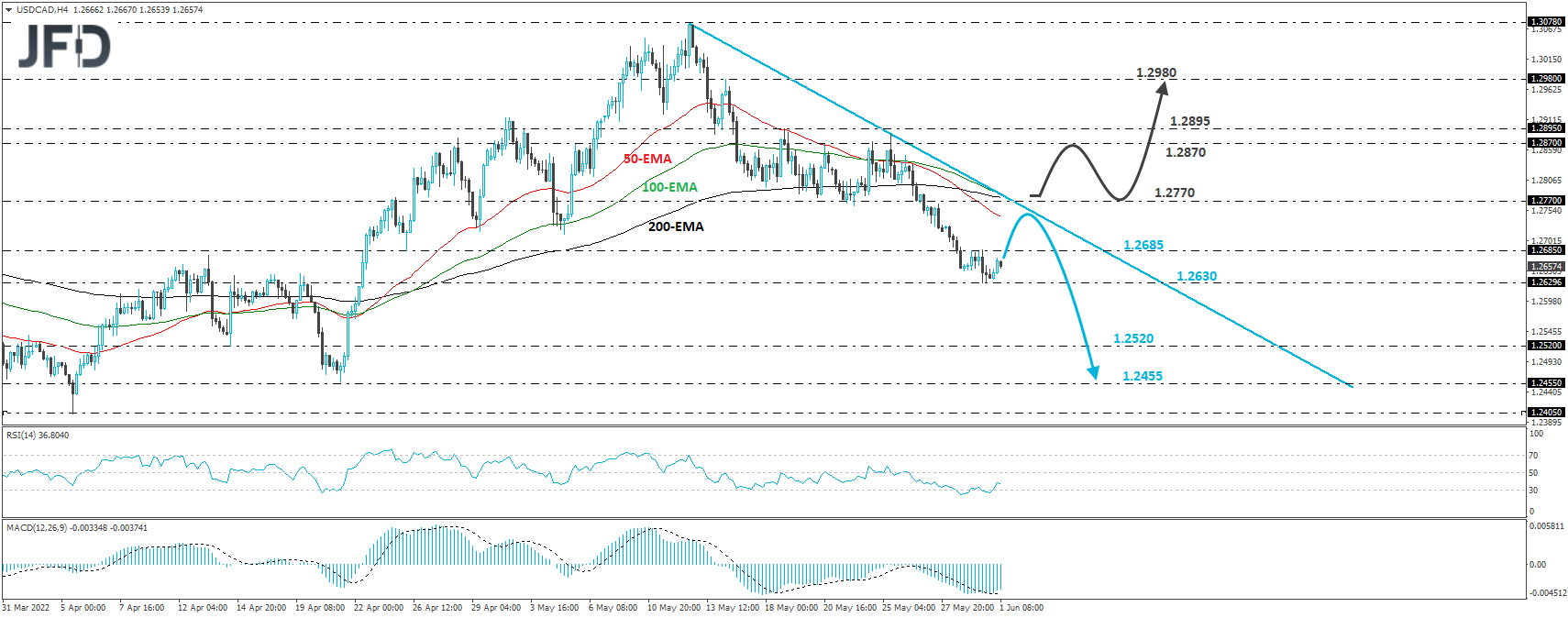
USD/CAD traded in a quiet mode yesterday, staying between 1.2630 and 1.2685. Overall though, the pair remains below the downside resistance line taken from the high of May 12th, and thus, we would consider the near-term picture to still be negative.
A clear dip below 1.2630 would confirm a forthcoming lower low and may open the path all the way down to the 1.2520 area, marked by the low of April 14th. If the bears are not willing to stop there, then we could see them pushing towards the low of April 21st, at around 1.2455.
On the upside, we would like to see a clear break above 1.2770 before we start examining whether the bulls have gained the upper hand. This may confirm the break above the downside line and may encourage the buyers to push towards the 1.2870 or 1.2895 territories, marked by the highs of May 20th and 18th, respectively. If they don’t stop there though, we may see the pushing towards the peak of May 16th, at around 1.2980.
As for the Rest of Today’s Events
From the US, we get the ISM manufacturing PMI for May, with the forecast pointing to a slide to 54.5 from 55.4. This could confirm somewhat worries over a slowdown in the US economy, but we doubt that it would revive speculation over a pause by the Fed after the summer, especially after Waller’s remarks. After all, on Friday, we get the official employment report for May, which may be of more importance for market participants in adjusting their bets with regards to the Fed’s future course of action.
Disclaimer:
The content we produce does not constitute investment advice or investment recommendation (should not be considered as such) and does not in any way constitute an invitation to acquire any financial instrument or product. The Group of Companies of JFD, its affiliates, agents, directors, officers or employees are not liable for any damages that may be caused by individual comments or statements by JFD analysts and assumes no liability with respect to the completeness and correctness of the content presented. The investor is solely responsible for the risk of his investment decisions. Accordingly, you should seek, if you consider appropriate, relevant independent professional advice on the investment considered. The analyses and comments presented do not include any consideration of your personal investment objectives, financial circumstances or needs. The content has not been prepared in accordance with the legal requirements for financial analyses and must therefore be viewed by the reader as marketing information. JFD prohibits the duplication or publication without explicit approval.
CFDs are complex instruments and come with a high risk of losing money rapidly due to leverage. 72.99% of retail investor accounts lose money when trading CFDs with the Company. You should consider whether you understand how CFDs work and whether you can afford to take the high risk of losing your money. Please read the full Risk Disclosure.
Copyright 2022 JFD Group Ltd.