


Following a volatile Friday, where stock indices tumbled and safe-havens surged due to further escalation in the US-China trade war, this week appears to be a relatively light one, at least in terms of scheduled events and economic indicators. We get the German and Eurozone’s preliminary inflation data for August, where soft prints could add to speculation that the ECB would indeed proceed with a strong stimulus package in September. From the US, we get the core PCE index for July and 2nd estimate of GDP for Q2. We get GDP data for Q2 from Canada and Norway as well.
On Monday, during the European morning, we get Germany’s Ifo survey for August. The current assessment index is expected to have declined to 98.6 from 99.4 in July, which was the first dip below 100 since March 2010. The expectations print is forecast to have fallen as well, to 91.5 from 92.2, while the business climate index is anticipated to have slid to 95.1 from 95.7. The case for lower Ifo indices is supported by the ZEW survey for the month, the indices of which slid by more than anticipated.
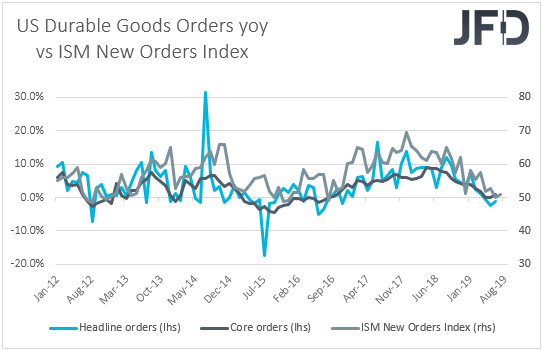
Later in the day, the US durable goods orders for July are due to be released. The headline rate is anticipated to have slid to +1.0% mom from +1.9% in June, while the core one is forecast to have declined to +0.2% mom from +1.0%. However, these numbers would drive the headline yoy rate up to 0.9% from -1.3% and keep the core yearly rate unchanged at +1.0%. The case for improvement, at least in the headline yoy rate, is supported by the New Orders Sub-index of the ISM manufacturing PMI for the month, which rose to 50.8 from 50.0.
On Tuesday, the only releases worth mentioning are the second estimate of the German GDP for Q2, which is expected to confirm that Eurozone’s economic powerhouse contracted 0.1% qoq, and the US Conference Board consumer confidence index for August, which is forecast to have slid to 130.0 form 135.7.
On Wednesday, we have no major events or indicators on the agenda.
On Thursday, during the European morning, we get Norway’s GDP for Q2. No forecast is available for the headline qoq print, but the mainland rate is anticipated to have risen to +0.8% qoq from +0.3%. At its latest meeting, the Norges Bank reiterated that the policy rate would most likely be increased further in the course of 2019 and added that new information indicates that the policy rate outlook is little changed since June. That said, Governor Olsen also said that the global risk outlook entails greater uncertainty about policy rates going forward. A +0.8% qoq GDP rate would be inline with the Bank’s latest projections and thus, it may keep the door for further tightening this year open.
From Germany, we get the preliminary inflation prints for August. The HICP rate is expected to have ticked up to +1.2% yoy from +1.1%, but the CPI print is forecast to have declined to +1.5% yoy from +1.7%. The nation’s unemployment rate for the month is also coming out and it is expected to have remained unchanged at 5.0%.
Later in the day, the second estimate of the US GDP for Q2 is due to be released and expectations are for a small downside revision to +2.0% qoq SAAR from +2.1%. That said, bearing in mind that we already have models suggesting how the economy has been performing during Q3, barring any major deviations from the forecast, we will treat this release as outdated. According to the Atlanta GDPNow model, the US economy grew 2.2% qoq SAAR in Q3, while the New York Nowcast points to a growth rate of +1.8%. The pending home sales for July are also due to be released and the forecast suggests a slowdown to +0.1% mom from +2.8% in June.
On Friday, during the Asian morning, we get the usual end-of-month data dump from Japan. The unemployment rate is anticipated to have ticked up to 2.4% in July from 2.3% in June, while the jobs-to-applications ratio is expected to have remained unchanged at 1.61. The preliminary industrial production for July is forecast to show an increase of 0.3% mom after sliding 3.3% the month before, while retail sales are expected to have slid 0.8% yoy after rising 0.5% in June. The core Tokyo CPI rate for August is anticipated to have declined to +0.7% yoy from +0.9%, but no forecast is currently available for the headline rate. This could raise speculation that the core National CPI rate for the month will also drift lower. In July, the core National rate stood at +0.6% yoy.
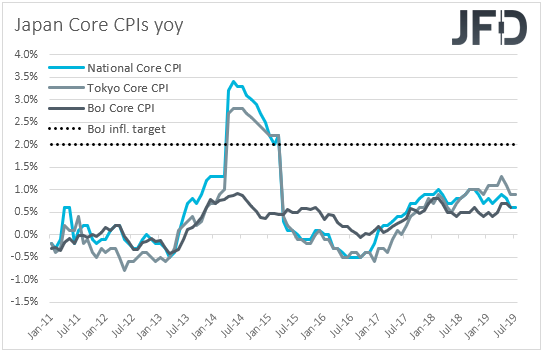
At their latest meeting, BoJ policymakers kept their ultra-lose policy unchanged and maintained the forward guidance that the current extreme low levels of interest rates are likely to stay unchanged “at least through around spring 2020”. They also added that they “will not hesitate to take additional easing measures if there is a greater possibility that the momentum towards achieving the price stability target will be lost”. Thus, further slowdown in inflation, already well below the BoJ’s objective, could increase the chances for additional easing.
Later, during the European day, Eurozone’s preliminary CPIs for August are coming out. The headline CPI rate is expected to have remained unchanged at +1.0% yoy, while the core one is forecast to have ticked up to +1.0% yoy from +0.9%. Although underlying inflation is expected to move in the desired direction, both rates would still be well below the ECB’s objective of “below, but close to 2%”.
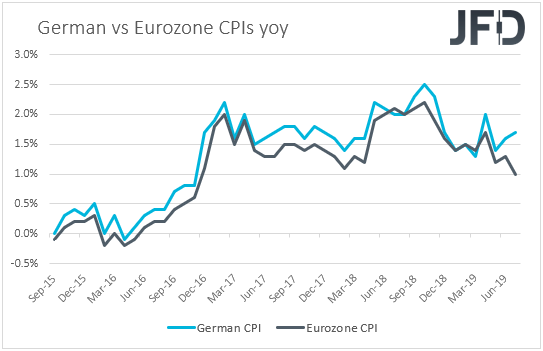
At their latest policy gathering, ECB policymakers officially opened the door to lower rates and added that additional measures, such as a potential QE restart, may also be introduced. According to Eurozone money markets, following recent comments by ECB member Olli Rehn, who said that “it is important that we come up with a significant and impactful policy package”, investors are now pricing in more than a 10bps cut in the deposit rate for the upcoming gathering, despite the better-than-expected PMIs for August. Thus, another set of soft inflation data could add to speculation that the ECB would indeed proceed with a strong stimulus package in September.
In the US, personal income and spending for July are coming out, alongside the core PCE index for the month. Personal income is anticipated to have slowed to +0.3% mom from +0.4%, while personal spending is forecast to have accelerated to +0.5% mom from +0.3%. Bearing in mind that the monthly earnings rate for July remained unchanged, we would consider the risks surrounding the income forecast as tilted somewhat to the upside. The case for accelerating spending is supported by the acceleration in retail sales for the month.
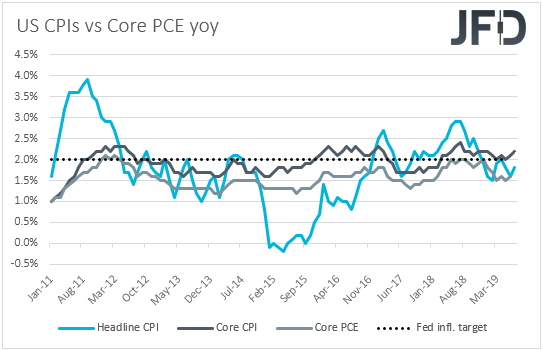
Passing the ball to the core PCE index, the Fed’s favorite inflation metric, the forecast suggests that the yoy rate ticked up to +1.7% from +1.6%. The case for accelerating core PCE is supported by the core CPI rate for the month, which moved in a similar fashion. That said, although this would bring the PCE index closer to the Fed’s 2% objective, we doubt that it could derail policymakers from pushing the cut button when they meet next. On Friday, the US-China trade saga escalated even further, with both nations announcing fresh tariffs on each other’s goods. This may have raised more concerns with regards to the performance of the global economy and adds more credence to the cut case. At Jackson Hole, even Chair Powell himself repeated that they would “act as appropriate” to keep economic expansion on track, remarks suggesting that he is indeed leaning towards a September action.
From Canada, we have GDP data for June and Q2. The monthly rate for June is forecast to have ticked down to +0.1% mom from +0.2%, but the annualized qoq rate for the whole Q2 is anticipated to have surged to +3.0% from +0.4%. At their latest meeting, BoC policymakers kept interest rates unchanged and noted that the degree of accommodation provided by the current rate remains appropriate, staying among the very few major central banks that have not turned their eyes to the cut button, although they appeared concerned with regards to the US-China trade conflict.
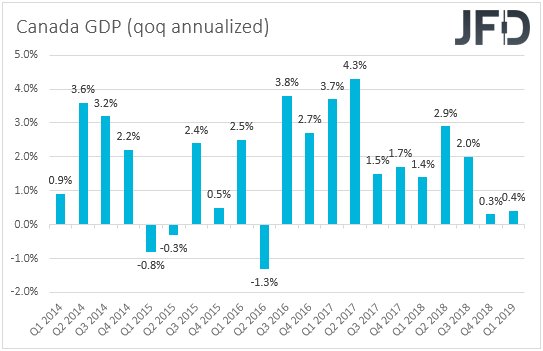
The last employment report disappointed, with the unemployment rate rising to 5.7% in July from 5.5% in June, and the employment change pointing to a 24.2k job loss, but inflation data for the month came in better than expected. Although a strong annualized GDP rate would suggest that Canadian policymakers could maintain their neutral stance for a while more, the escalating tensions between China and the US raise doubts on that front and this is evident by Canada’s OIS (Overnight Index Swaps), according which market participants see a 75% chance for a rate cut by the end of the year.
Finally, on Saturday, China’s official PMIs for August are due to be released. Both the manufacturing and non-manufacturing indices are expected to have ticked down to 49.6 and 53.6, from 49.7 and 53.7 respectively.
Disclaimer:
The content we produce does not constitute investment advice or investment recommendation (should not be considered as such) and does not in any way constitute an invitation to acquire any financial instrument or product. The Group of Companies of JFD, its affiliates, agents, directors, officers or employees are not liable for any damages that may be caused by individual comments or statements by JFD analysts and assumes no liability with respect to the completeness and correctness of the content presented. The investor is solely responsible for the risk of his investment decisions. Accordingly, you should seek, if you consider appropriate, relevant independent professional advice on the investment considered. The analyses and comments presented do not include any consideration of your personal investment objectives, financial circumstances or needs. The content has not been prepared in accordance with the legal requirements for financial analyses and must therefore be viewed by the reader as marketing information. JFD prohibits the duplication or publication without explicit approval.
75% of the retail investor accounts lose money when trading CFDs with this provider. You should consider whether you can afford to take the high risk of losing your money. Please read the full Risk Disclosure.