


The euro gained decently yesterday following the ECB decision, as President Lagarde noted that inflation could stay elevated longer than previously thought. Despite Lagarde trying to push back expectations over a rate increase next year, market participants stayed adamant that high inflation could indeed lead to earlier hikes. Today, Eurozone’s preliminary inflation data for October are coming out, and further acceleration could strengthen investors’ opinion.
ECB’s Lagarde Fails to Cool Hike Expectations, EZ Inflation Data on the Agenda
The US dollar traded lower against all but one of the other G10 currencies on Thursday and during the Asian session Friday. It lost the most ground versus SEK, NOK, CHF, and EUR, while it gained slightly only against JPY.
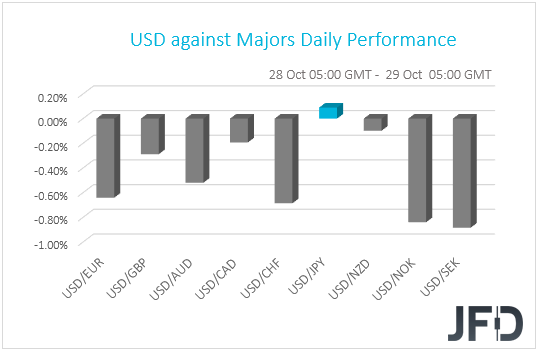
The weakening of the greenback and the yen suggests that markets may have traded in a risk-on manner yesterday, but the strengthening of the franc points otherwise. Therefore, in order to get a clearer picture with regards to the broader market sentiment, we prefer to turn our gaze to the equity world. There, all but two of the major EU and US indices traded in the green, with the exceptions being Germany’s DAX and the UK FTSE 100. That said, appetite softened during the Asian session today. Although Japan’s Nikkei 225 and China’s Shanghai Composite gained, Hong Kong’s Hang Seng and South Korea’s KOSPI fell.
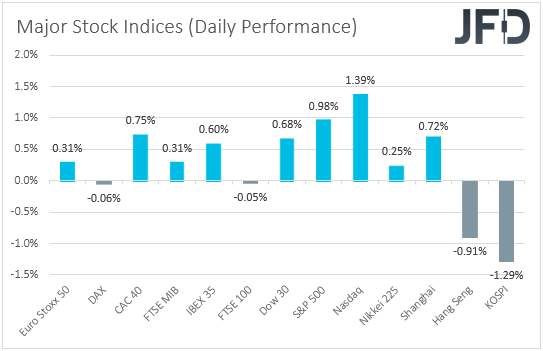
It seems that better than expected earnings remained the main driver behind the equity markets yesterday, despite the economic agenda including an ECB decision. European stocks were buoyed by food and technology stocks, with beer brewer Anheuser-Busch InBev surging after a surprise rise in third-quarter profit, and French IT services provider Capgemini adding 6.0% on strong earnings and outlook. Later, in the US, the S&P 500 and the Nasdaq hit fresh record highs partly aided by gains in tech giants Apple and Amazon, which reported earnings after the closing bell, as well as by solid results from firms including Caterpillar and Merck. Having said that though, both Apple and Amazon slid in after hours, due to investors’ disappointment after their earnings announcements.
As we already noted, yesterday, we had an ECB monetary policy decision. The Bank kept its policy settings unchanged as was widely anticipated, while there was no material change in the accompanying statement. However, at the press conference following the decision, ECB President Lagarde highlighted that although the surge in inflation is still expected to be temporary, it is now anticipated to last longer than previously expected. She also said that, in her view, PEPP will end in March, but we believe that a more formal announcement on that may come in December. Nonetheless, she added that “Our analysis certainty does not support that the conditions of our forward guidance are satisfied at the time of liftoff as expected by markets, nor any time soon thereafter.”, trying to push back expectations over an interest rate increase next year.
Having said all that though, it seems that she failed to do so, and this is evident by the spike higher in the euro, which gained more than 100 pips against the US dollar during the press conference. Perhaps market participants focused more on the comment that inflation could stay elevated more than previously thought, and judged that this will eventually force Lagarde and her colleagues to push the hike button earlier than they now anticipate.
Today, euro-traders will turn their attention to Eurozone’s preliminary CPIs for October. The headline rate is expected to have risen to +3.7% yoy from +3.4%, while the HICP excluding energy and food rate is forecast to have stayed unchanged at 1.9%, just a tick below the ECB’s objective of 2%. In our view, such numbers will add credence to the view that inflation could stay elevated for longer than previously thought and may encourage euro-traders to add to bets with regards to an earlier rate hike. This could keep the euro supported for a while more, especially against the yen, and the reason is because in the midst of generally rising bond yields around the globe, the BoJ still keeps a lid on its own government bond yields. However, we are reluctant to call for a long-lasting recovery against the US dollar and the British pound, as both the Fed and the BoE meet next week, with market participants eager to find out whether the Fed will taper and signal that interest rate hikes could take place next year, and whether the BoE will indeed push the hike button at that gathering, or at least before year end.
EUR/JPY – Technical Outlook
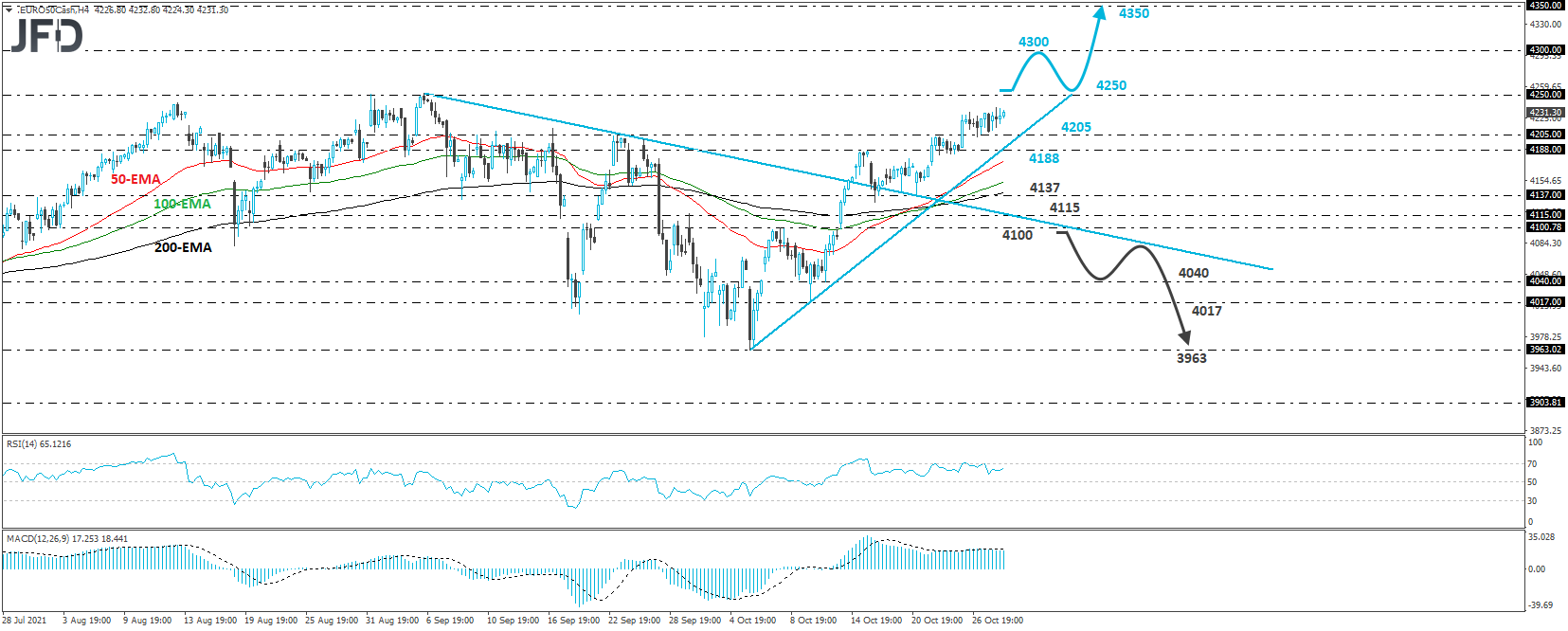
EUR/JPY spiked higher yesterday, after it hit support at 131.55. The rate emerged above the 132.15 zone, but hit resistance slightly below 132.95. In our view, yesterday’s spike may have brought an end to the downside correction started on October 20th, but in order to get confident on larger advances, we would like to see a clear move above the 132.95 barrier.
Such a break could encourage the bulls to aim for the high of October 20th, at 133.48, the break of which would confirm a forthcoming higher high and perhaps carry larger bullish implications, perhaps paving the way towards the peak of June 1st, at around 134.12.
On the downside, we would like to see a strong dip below 131.30, a support marked by the inside swing high of October 12th, before we start examining whether the bears have regained full control. This will confirm a forthcoming lower low and may pave the way towards 130.75 zone, marked by the low of October 12th and the inside swing high of September 3rd, or towards the 130.50 area, near the inside swing high of September 29th. If neither barrier is able to halt the slide, then we may experience extensions towards the round number of 130.00, which is near the inside swing high of September 30th.
Euro Stoxx 50 – Technical Outlook
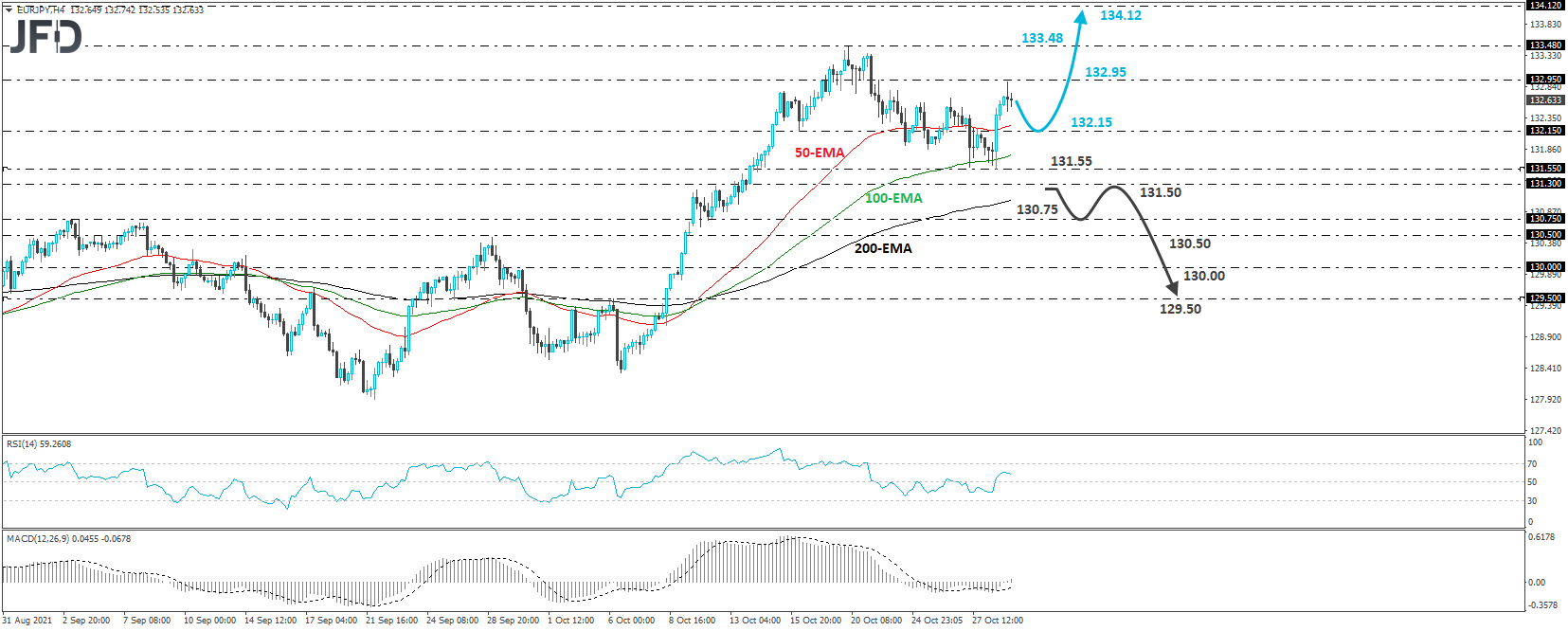
The Euro Stoxx 50 cash index traded somewhat higher, staying above the upside support line taken from the low of October 6th, as well as above the prior downside resistance line taken from the high of September 6th. In our view, as long as this is the case, we would consider the near-term outlook to be positive.
We believe that market participants could soon challenge again the peak of September 6th, at around 4250, the break of which would take the index into territories last seen in January 2008. The next stop may be at 4300, the break of which could pave the way towards the next relatively psychological zone, at around 4350.
The move that would make us start assessing whether the bears have gained full control again is a dip below 4100, a barrier marked by the inside swing high of October 8th. This could mean the return below both the aforementioned diagonal lines and could pave the way towards the 4040 or 4017 zones, marked by the low of October 13th and the low of October 12th respectively. If the bears are not willing to stop there, then we may see extensions towards the low of October 6th, at 3963.
As for the Rest of Today’s Events
In the US, personal income and spending for September are coming out, alongside the core PCE index for the month, while from Canada, we have the monthly GDP for August. Personal income is expected to have declined somewhat, while spending is anticipated to have increased, but at a slower pace than in August. The core PCE index, the Fed’s favorite inflation metric, is forecast to have ticked up to +3.7% yoy form +3.6%, something that could add more cement to the case of a tapering start by the Fed at next week’s gathering. As for Canada’s GDP, the forecast points to a +0.7% mom rebound, after a 0.1% slide in July.
Disclaimer:
The content we produce does not constitute investment advice or investment recommendation (should not be considered as such) and does not in any way constitute an invitation to acquire any financial instrument or product. The Group of Companies of JFD, its affiliates, agents, directors, officers or employees are not liable for any damages that may be caused by individual comments or statements by JFD analysts and assumes no liability with respect to the completeness and correctness of the content presented. The investor is solely responsible for the risk of his investment decisions. Accordingly, you should seek, if you consider appropriate, relevant independent professional advice on the investment considered. The analyses and comments presented do not include any consideration of your personal investment objectives, financial circumstances or needs. The content has not been prepared in accordance with the legal requirements for financial analyses and must therefore be viewed by the reader as marketing information. JFD prohibits the duplication or publication without explicit approval.
There are risks involved with trading of cash equities. Past performance is not indicative of future results. You should consider whether you can tolerate such losses before trading. Please read the full Risk Disclosure.
Copyright 2021 JFD Group Ltd.