


EU and US stock indices rebounded yesterday, perhaps as some investors saw Monday’s tumble as an opportunity to buy again. However, Asian shares fell today, perhaps after RBNZ gave them a reality check. The Bank hiked rates by 25bps and signaled that more will follow, raising concerns that other major Banks may follow suit.
Stock Indices Gain Tuesday, but RBNZ Gives a Reality Check
The dollar traded higher against most of the other major currencies on Tuesday and during the Asian session Wednesday. It gained the most versus JPY, CHF, and NZD, while it underperformed slightly only against GBP and CAD.
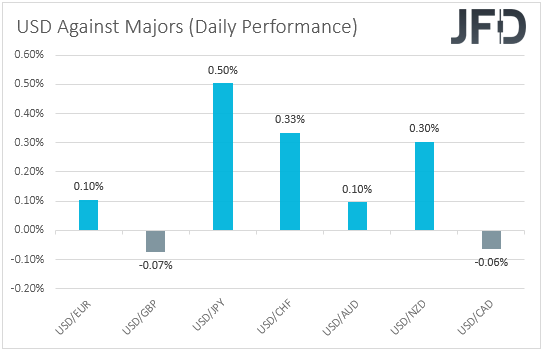
The weakening of the Japanese yen and the Swiss franc suggests that market sentiment may have improved somehow yesterday and today in Asia. However, the weakening of the risk-linked Kiwi points otherwise. Therefore, in order to clear things up, we prefer to turn our gaze to the equity world. There, we see that major EU and US indices were a sea of green, rising on average 1.3% each. However, the optimism disappeared during the Asian session. Japan’s Nikkei 225, Hong Kong’s Hang Seng and South Korea’s KOSPI, all traded in negative waters.
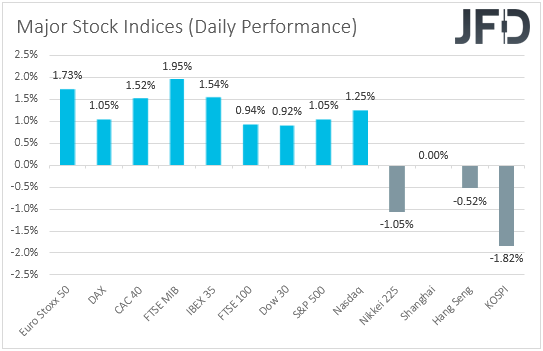
EU and US indices were driven higher by a rebound in beaten-down technology companies, perhaps as some market participants saw Monday’s selloff as an opportunity to buy the dip. That said, in our view, this is far from a positive reversal, especially in growth stocks, as concerns over persistently high inflation and central bank tightening remain elevated, and in our view, this is evident by the strength in the US dollar, as well as the pullback in equities during the Asian session today. But what triggered that response? What was the event that brought inflation and central bank tightening concerns back to surface?
We believe that it may have been the RBNZ decision, and we will explain why just now. The Bank raised interest rates by 25bps as was widely expected, and while some may have been anticipating a slightly more cautious language in the accompanying statement, officials appeared rather optimistic, noting that further removal of monetary policy stimulus is expected over time, and that economic activity will recover quickly as alert level restrictions ease. The fact that policymakers confidently signaled more hikes in the foreseeable future, encouraged some Kiwi buying.
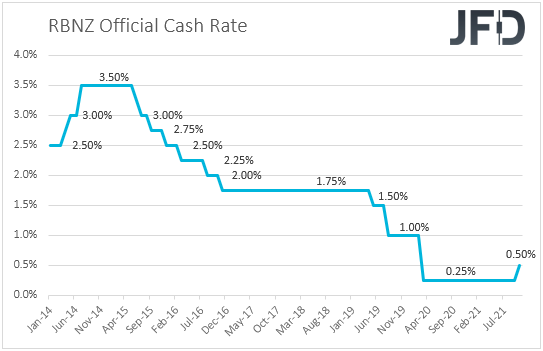
However, the currency was quick to reverse the gains and trade even lower. Without anything of dovish nature in the RBNZ statement, we believe that the Bank’s language may have raised concerns that other major central banks may also dismiss as temporary the latest economic slowdown and proceed with faster tightening. What’s more, the latest central bank commentary suggests that officials are now more concerned over high inflation. Remember that among others, Fed Chair Powell recently said that inflation remains elevated for longer than they have estimated. As a risk-linked currency, that’s why the Kiwi may have quickly reversed south, and that’s perhaps why equities fell today.
DAX – Technical Outlook
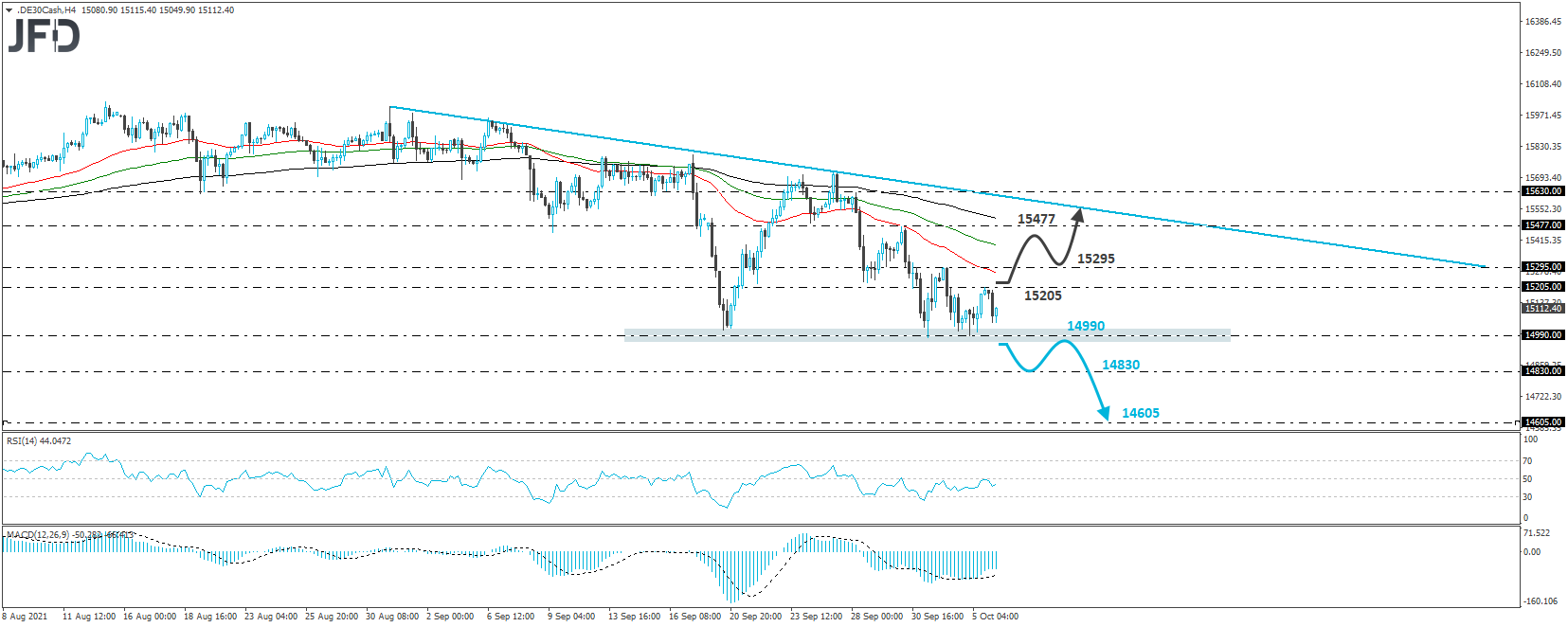
The German DAX cash index traded higher yesterday, but hit resistance at 15205, and today in Asian, it pulled back. Overall, the index remains below the downside resistance line taken from the high of August 31st, which keeps the near-term outlook somewhat bearish.
However, in order to get confident on larger declines, we would like to see a dip below the key support zone of 14990, which is marked by Friday’s and yesterday’s lows. Such a move will confirm a forthcoming lower low and may initially target the 14830 zone, which supported the index on May 4th and 15th. If market participants are not willing to jump back into the action near that zone, a break lower could extend the fall towards the 14605 territory, defined as a support by the inside swing high of March 25th.
We will start examining the case of a decent corrective recovery, only if we see a break back above 15205. This may initially target the 15295 territory, marked by Monday’s high, the break of which could encourage more buying, perhaps towards the peak of September 30th, at 15477, or the downside resistance line taken from the high of August 31st.
EUR/USD – Technical Outlook
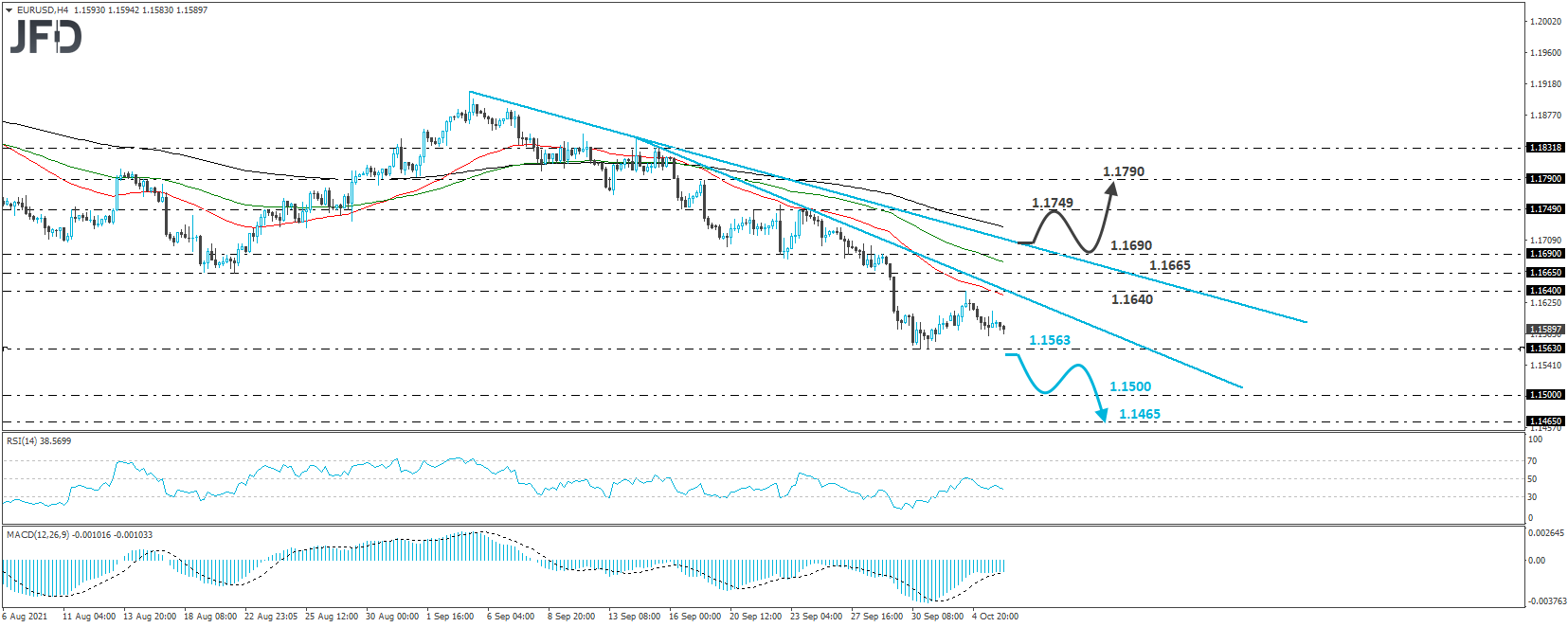
EUR/USD has been trading in a sliding mode since Monday, when it hit resistance at 1.1640. Overall, the pair continues to print lower lows and lower highs below the downside resistance line taken from the high of September 3rd, but also below the downside line drawn from the high of September 14th. In our view, all this keeps the short-term outlook negative.
A dip below Friday’s low of 1.1563 will confirm a forthcoming lower low and may see scope for declines towards the low of July 22nd, 2020, near the psychological round figure of 1.1500. If the bears are not willing to stop there either, then we could see the fall extending towards the inside swing high of July 20th, 2020, at around 1.1465.
On the upside, a break above the downside line taken from the high of September 3rd, could be a sign of trend reversal. The bulls may feel free to take the action up to the 1.1749 zone, which provided strong resistance between September 21st and 23rd, the break of which could allow extensions towards the high of September 17th, at around 1.1790.
As for the Rest of Today’s Events
Today, we have Eurozone’s retail sales for August and the US ADP report for September. Eurozone’s retail sales are expected to have rebounded 0.8% mom after sliding 2.3%, while in the US, the ADP report is expected to show that the private sector has gained 430k jobs, less than August’s 374k. Although the ADP is far from a reliable predictor of the NFPs, it is the only major gauge we have for the official statistic, and thus, it could raise some speculation that the NFPs could also come in slightly better than in August.
With regards to the energy market, the EIA (Energy Information Administration) report on crude oil inventories for last week is coming out and expectations are for a 0.418mn barrels slide after a 4.578mn barrels increase the week before. However, bearing in mind that, yesterday, the API reported a 0.951mn inventory build, we would consider the risks surrounding the EIA forecast as tilted to the upside.
On the political front, the US Senate will vote on a plan proposed by Democrats to suspend the US debt ceiling, according to yesterday remarks by a key lawmaker.
As for the speakers, we will get to hear from Atlanta Fed President Raphael Bostic and ECB Supervisory Board member Elizabeth McCaul.
Disclaimer:
The content we produce does not constitute investment advice or investment recommendation (should not be considered as such) and does not in any way constitute an invitation to acquire any financial instrument or product. The Group of Companies of JFD, its affiliates, agents, directors, officers or employees are not liable for any damages that may be caused by individual comments or statements by JFD analysts and assumes no liability with respect to the completeness and correctness of the content presented. The investor is solely responsible for the risk of his investment decisions. Accordingly, you should seek, if you consider appropriate, relevant independent professional advice on the investment considered. The analyses and comments presented do not include any consideration of your personal investment objectives, financial circumstances or needs. The content has not been prepared in accordance with the legal requirements for financial analyses and must therefore be viewed by the reader as marketing information. JFD prohibits the duplication or publication without explicit approval.
CFDs are complex instruments and come with a high risk of losing money rapidly due to leverage. 73.90% of retail investor accounts lose money when trading CFDs with the Company. You should consider whether you understand how CFDs work and whether you can afford to take the high risk of losing your money. Please read the full Risk Disclosure.
Copyright 2021 JFD Group Ltd.