


The US dollar rallied, while global equities slumped yesterday and today in Asia, as US Treasury yields kept marching north. It may have been a blend of concerns surrounding inflation, a possible US government shutdown, as well as Evergrande’s payments. All this paints a negative short-term picture in our view, but we will not hold the same stance regarding the long run. We prefer to take things step by step and reevaluate our outlook when we judge necessary.
Inflation, Debt Ceiling, and Evergrande Concerns Weigh on Sentiment
The US dollar traded higher against all the other major currencies on Tuesday and during the Asian session Wednesday. The currencies it outperformed the most are GBP, NZD, and AUD, while it eked out the least gains versus EUR.
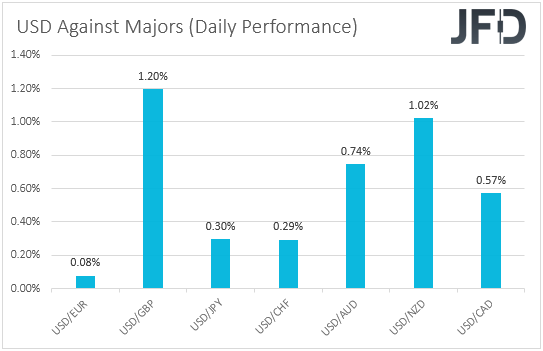
The rally of the US dollar across the board, especially against the commodity-linked currencies Aussie and Loonie, as well as against the pound, which has been acting as a risky asset lately, suggests that market sentiment deteriorated again yesterday. Indeed, turning our gaze to the equity world, we see that major global indices were a sea of red, tumbling on average nearly 2%, as US Treasury yields kept marching north. The only exception was Hong Kong’s Hang Seng, which is up 0.51%.
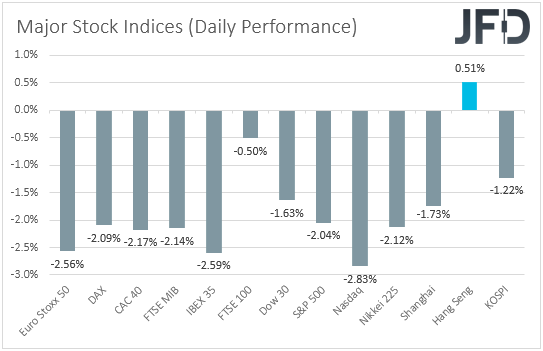
In our view, it was not just a single trigger that resulted in yesterday’s bloodbath. It was a blend of ongoing developments. First of all, US Treasury yields may have kept rising on speculation that the surge in inflation is not as transitory as the Fed initially suggested, something that could lead to a November tapering move and earlier rate hikes after the program is ended. Second, there is an ongoing battle in the US Congress, with Republicans appearing set to strike down Democrats’ efforts to extend the government’s borrowing authority and avoid a potential government shutdown. Third, we have the Evergrande saga, with the firm facing its next challenge today as it is the deadline for another bond coupon payment to offshore investors. Another failure could revive fears that this could affect China’s financial system and even have an impact to the rest of the world. Last but not least, widening power shortages in China have halted production in numerous factories.
Moving ahead, we see decent chances for equities to extend their declines. Even if we see some small rebounds, we will treat them as corrective bounces. We believe that the aforementioned developments gave investors ample reasons to abandon stocks that were already considered overvalued. That said, we stick to our guns that when the sun shines again, and all these problems are resolved or forgotten, equity indices, at least in the US, could rebound and march north, despite the Fed keep withdrawing monetary policy support. All this may already be priced in by the current fall and any extensions of it, and, after all, tightening policy means desired economic performance. In other words, we stay somewhat bearish in the short term, but we don’t hold the same stance for the longer run. Actually, we are cautiously positive. In any case, we will take things step by step and reevaluate our view when we judge necessary.
Nasdaq 100 – Technical Outlook
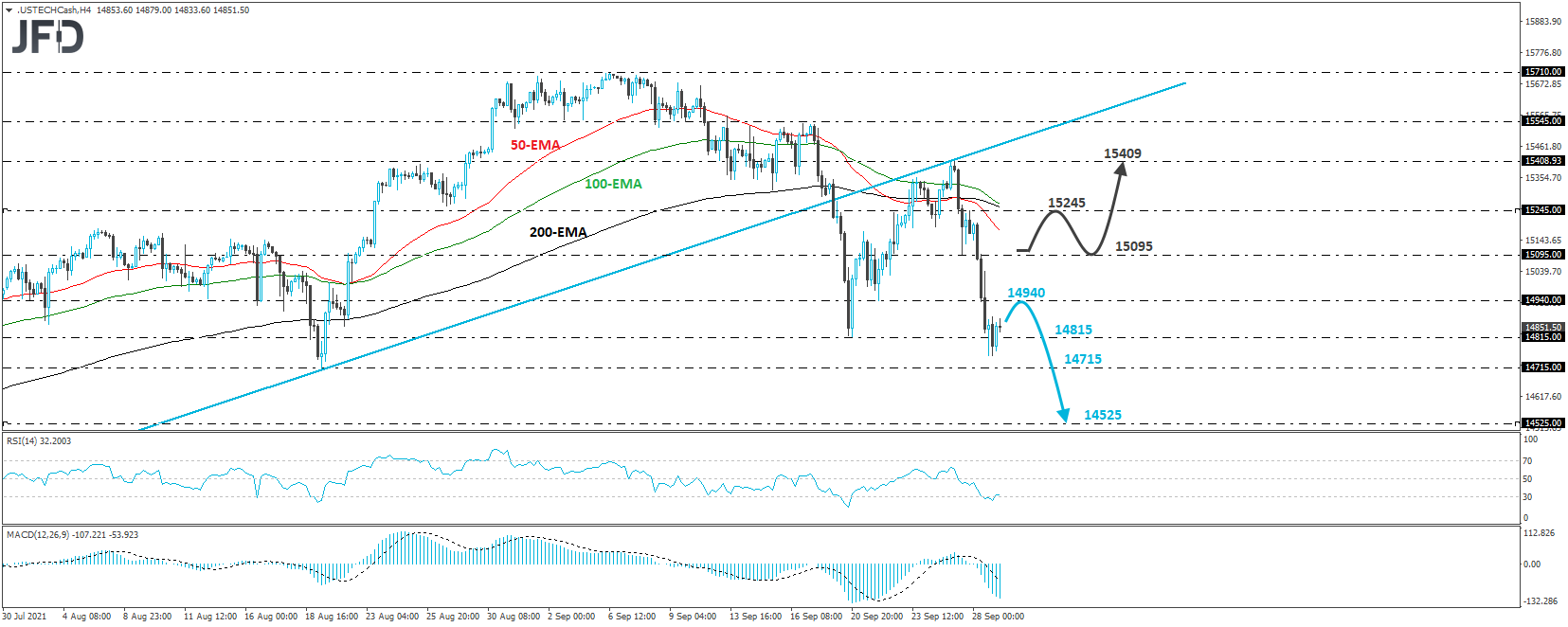
The Nasdaq 100 cash index fell sharply yesterday and briefly dipped below the low of September 20th, at 14815. That said, the index rebounded somewhat during the Asian session today, returning back above that level. Overall, the index remains below the prior upside support line drawn from the low May 19th, and thus, we would consider the short-term outlook to be negative.
Even if we see some more recovery today, we see decent chances for the bears to jump back into the action from near the low of September 22nd, at 14940. This could result in another slide and perhaps a test at the 14715 barrier, marked by the low of August 19th, the break of which could extend the fall towards the 14525 zone, defined as a support by the low of July 20th.
We will start examining the case of a larger positive correction, only if we see a rebound back above 15095. Although the index would still be below the aforementioned upside line, market participants could still drive the action towards the 15245 barrier, or even Monday’s peak, at 15409.
NZD/USD – Technical Outlook
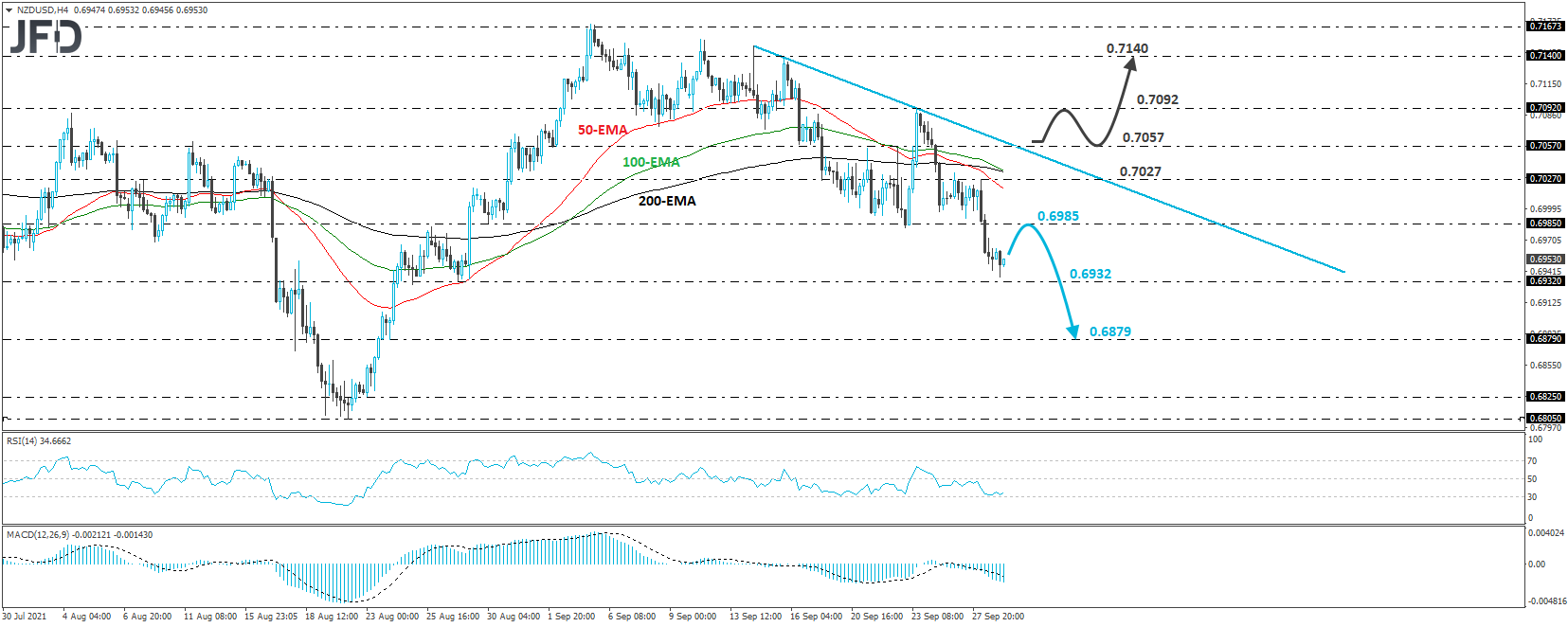
NZD/USD slid yesterday, breaking below the key support (now turned into resistance) zone of 0.6985. This confirmed a forthcoming lower low on the 4-hour chart, and probably the continuation of the short-term downtrend marked by the downside line taken from the peak of September 4th. Thus, we will keep a negative stance.
The rate is currently resting slightly above the 0.6932 level, marked by the low of August 27th. A small rebound is possible, perhaps to test the 0.6985 zone as a resistance this time, but the bears may jump in again and push the action back down to the 0.6932 area. A break lower will confirm another lower low and may extend the trend towards the 0.6879 level, marked by the low of August 24th.
On the upside, we would like to see a break above 0.7057 before we start examining the case of a bullish reversal. This will also take the rate above the aforementioned downside line and may initially allow advances towards the high of September 23rd, at 0.7092. A break higher could encourage the bulls to climb towards the high of September 15th, at 0.7140.
As for Today’s Events
As we noted yesterday, we have several central bank chiefs speaking at the ECB’s forum on central banking, including ECB President Christine Lagarde, Fed Chair Powell, BoE Governor Andrew Bailey, and BoJ Governor Haruhiko Kuroda. On top of that, it is the second day of Fed Chair Powell’s testimony. He will speak before the House Financial Services Committee. It would be interesting to hear what officials have to say about monetary policy, and whether they will provide any clues or hints with regards to their future plans.
During the Asian day, we had the leadership elections of Japan’s ruling Liberal Democratic Party (LDP), with former foreign minister Fumio Kishida securing victory. Kishida will succeed Yoshihide Suga as a Prime Minister, but he may not hold that position for long as he must call for national elections by November 28th.
As for the data, we do have Germany’s retail sales for August and the US pending home sales for the same month.
Tonight, during the Asian session Thursday, Japan’s preliminary industrial production and retail sales, both for August, are coming out. Industrial production is expected to have slid again, but at a slower pace than in July, while retail sales are forecast to have fallen 1.0% mom, after rising 2.4% the month before. China’s official PMIs for September are also due to be released, but we only have a forecast for the manufacturing index, which is expected to have ticked up to 50.2 from 50.1.
Disclaimer:
The content we produce does not constitute investment advice or investment recommendation (should not be considered as such) and does not in any way constitute an invitation to acquire any financial instrument or product. The Group of Companies of JFD, its affiliates, agents, directors, officers or employees are not liable for any damages that may be caused by individual comments or statements by JFD analysts and assumes no liability with respect to the completeness and correctness of the content presented. The investor is solely responsible for the risk of his investment decisions. Accordingly, you should seek, if you consider appropriate, relevant independent professional advice on the investment considered. The analyses and comments presented do not include any consideration of your personal investment objectives, financial circumstances or needs. The content has not been prepared in accordance with the legal requirements for financial analyses and must therefore be viewed by the reader as marketing information. JFD prohibits the duplication or publication without explicit approval.
CFDs are complex instruments and come with a high risk of losing money rapidly due to leverage. 73.90% of retail investor accounts lose money when trading CFDs with the Company. You should consider whether you understand how CFDs work and whether you can afford to take the high risk of losing your money. Please read the full Risk Disclosure.
Copyright 2021 JFD Group Ltd.