


Major global stock indices traded mixed yesterday and today during the Asian session following conflicting headlines over a potential coronavirus-aid bill in the US. The pound was the main loser among the G10 currencies, falling on increased fears over a no-deal Brexit at the end of the year. The ECB expanded its PEPP program, but the euro gained, perhaps as many participants were waiting for the Bank to deliver more.
USD Slides, Global Stocks Trade Mixed
The US dollar traded lower against all but one of the other G10 currencies on Thursday and during the Asian session Friday. It underperformed only versus GBP, while it gained the most against AUD, NZD, NOK, and CAD in that order.
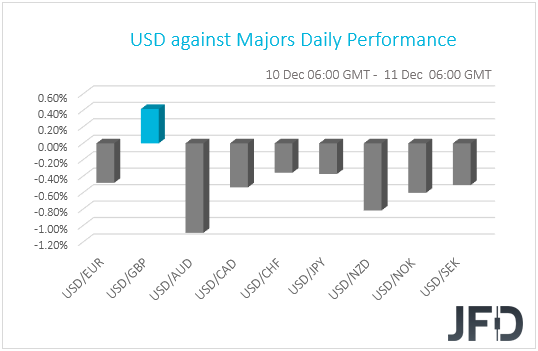
The weakening of the US dollar and the strengthening of the commodity-linked Aussie, Kiwi and Loonie suggest that markets turned risk-on at some point yesterday. However, taking a look at the performance of major global stock indices, we see that the picture is more of a mixed one. In the EU, the sole gainer was the FTSE 100, which gained due to the tumbling of the pound. Remember that many companies of the index generate profits in other currencies, so in a weakening GBP environment, if those profits are converted to pounds, they worth more.
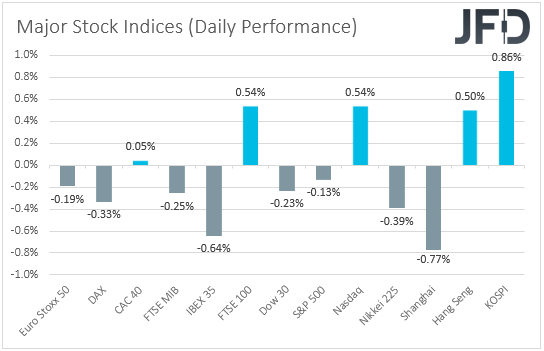
In the US, the Dow Jones and the S&P 500 slid 0.23% and 0.13% respectively, but Nasdaq gained 0.54%. The somewhat soft sentiment in the US may have been the result of the US initial jobless claims spiking to 853k, which is the highest level since mid-September. This has underscored the need for fresh stimulus measures to support the world’s largest economy. That said, Wall Street came off its lows after UUS Treasury Secretary Steven Mnuchin said talks between Republican and Democratic senators on COVID-19 relief were making “a lot of progress” with more discussions expected in the day.
Nevertheless, later in the day, House Speaker Nancy Pelosi said that wrangling over a coronavirus-aid package could drag on through Christmas. Maybe that’s why Asian indices were mixed as well, instead of gaining on Mnuchin’s upbeat remarks. Japan’s Nikkei 225 and China’s Shanghai Composite fell 0.39% and 0.77% respectively, while Hong Kong’s Hang Seng and South Korea’s KOSPI gained 0.50% and 0.86%.
UK PM Johnson Pushes GBP Lower, EUR Gains After ECB
In the FX world, as we already noted, the pound was the sole loser against the US dollar, at least among the G10s, and this had to do once again with headlines surrounding Brexit. After failing to reach common ground with EU Commission President Ursula von der Leyen, UK PM Boris Johnson said yesterday that there was “a strong possibility” that the UK and the EU would fail to strike a trade deal. This may have sparked even more fears over the likelihood of a no-deal Brexit in three weeks, which is the deadline for the two sides to sign any accord. We repeat that the pound is likely to stay very sensitive to Brexit developments, with anything suggesting that the two sides find it hard to bridge their differences, having the potential to push the pound lower. For the pound to rebound, headlines that some sort of consensus is reached are needed.
Yesterday, we also had an ECB monetary policy decision, with the central bank expanding its Pandemic Emergency Purchase Programme (PEPP) by EUR 500bn and extending the scheme by nine months to March 2022. Although President Lagarde said at the press conference following the decision that the appreciation of the euro exercises downward pressure on prices and that they will monitor it very carefully, the common currency gained on the decision. Perhaps due to euro’s latest rally, many (including us) were expecting the Bank to deliver more. That’s why the outcome may have come as a disappointment and many traders may have closed their short positions, allowing the currency to drift higher.
GBP/NZD – Technical Outlook
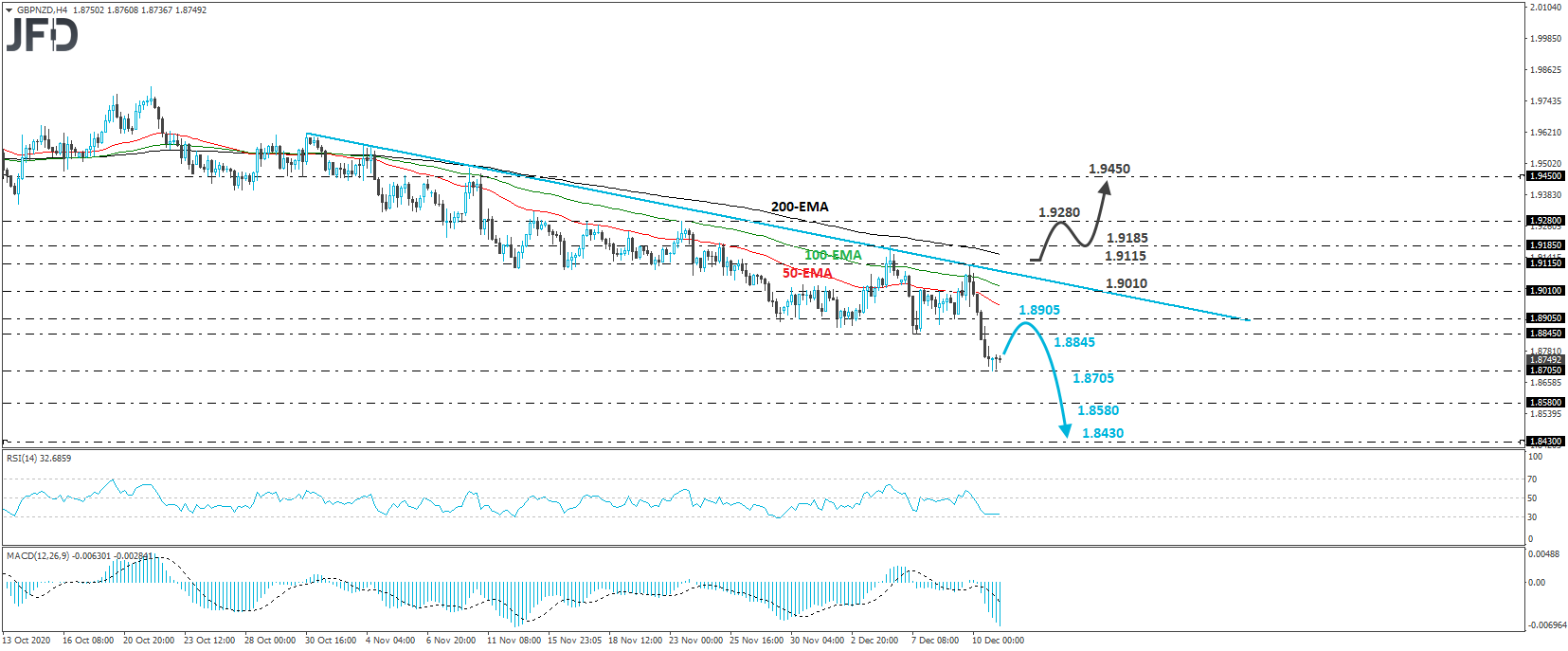
GBP/NZD tumbled yesterday, after hitting the downside resistance line drawn from the peak of October 30th. What’s more, the slide brought the rate below Monday’s low of 1.8845, thereby confirming a forthcoming lower low. All these technical signs paint a negative short-term picture in our view.
At the time of writing, the pair is trading near the 1.8705 level and shows signs that it could rebound somewhat. However, even if this is the case, as long as the rate would stay below the aforementioned downside line, we would still expect the bears to take charge again and aim for another test near the 1.8705 barrier. If they manage to overcome that zone, the next hurdle to consider may be the 1.8580 area, marked by the low of August 12th, 2019, where another break may extend the slide towards the low of August 5th, 2019, at around 1.8430.
On the upside, we would like to see a strong break above 1.9115 before we abandon the bearish case and start considering a bullish reversal. The rate would already be above the downside resistance line and the bulls may initially aim for the peak of December 4th, at 1.9185. A break higher could set the stage for the 1.9280 zone, marked by the high of November 23rd, a break of which could carry larger bullish extensions, perhaps towards the 1.9450 territory.
EUR/JPY – Technical Outlook
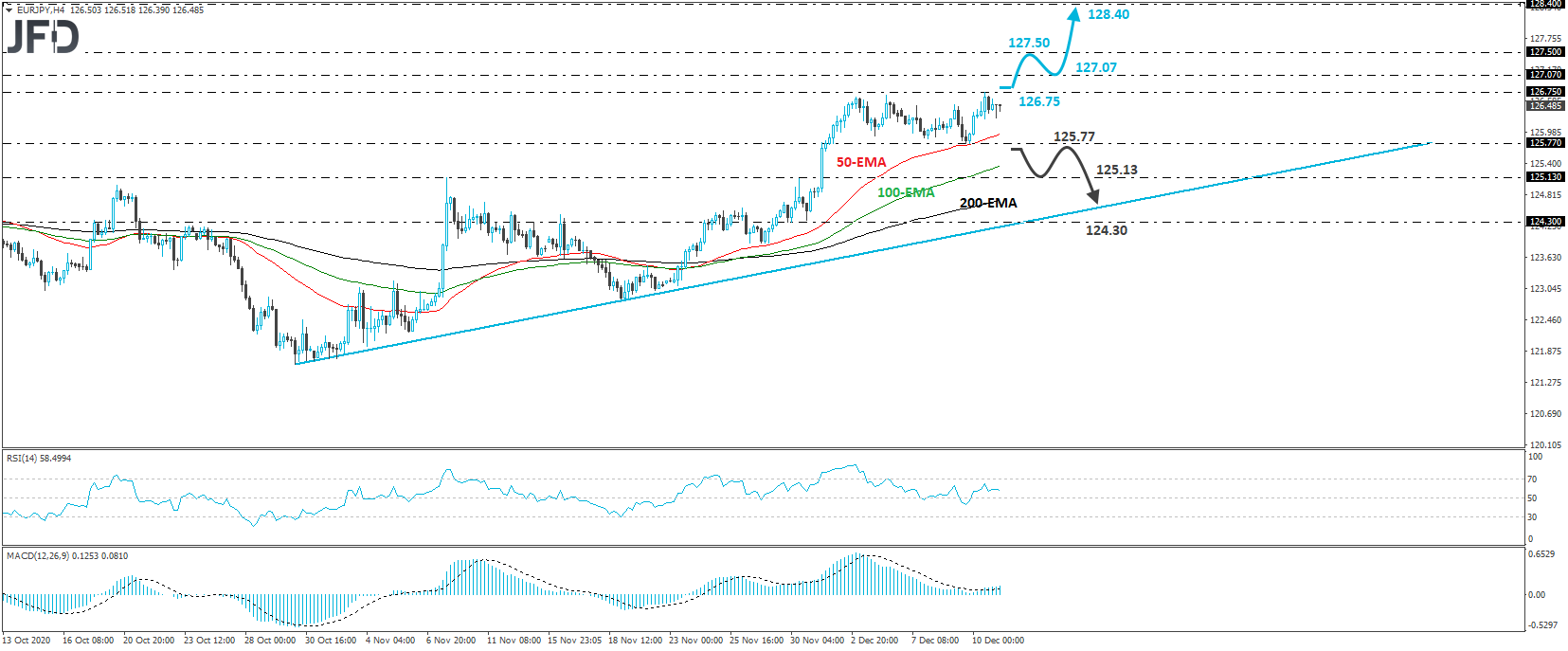
EUR/JPY has been moving in a sideways manner, between 125.77 and 126.75, since December 1st. Nonetheless, in the bigger picture, the rate continues to trade above the upside support line drawn from the low of October 30th, and thus, we would see a mildly-positive picture.
If the bulls take charge again soon and push the rate above the upper end of the pre-mentioned range, at 126.75, we may see them targeting the high of September 1st, at 127.07. If they don’t stop there, we are likely to see a test at 127.50, which is marked as a resistance by the peak of March 1st, 2019. Another move higher, above 127.50, could extend the rally towards the highs of December 19th and 20th, 2018, at around 128.40.
Now in case we see a dip below 125.77, this could signal the beginning of a corrective move lower. We may initially see declines towards the 125.13 area, which is defined as a support by the inside swing highs of November 9th and 30th. If that zone fails to halt the slide, the next stop may be the upside support line taken from the low of October 30th.
As for Today’s Events
Germany’s final CPIs for November are expected to confirm their preliminary estimates, while in the US, the preliminary UoM consumer sentiment index for December is forecast to have declined fractionally, to 76.5 from 76.9.
Disclaimer:
The content we produce does not constitute investment advice or investment recommendation (should not be considered as such) and does not in any way constitute an invitation to acquire any financial instrument or product. The Group of Companies of JFD, its affiliates, agents, directors, officers or employees are not liable for any damages that may be caused by individual comments or statements by JFD analysts and assumes no liability with respect to the completeness and correctness of the content presented. The investor is solely responsible for the risk of his investment decisions. Accordingly, you should seek, if you consider appropriate, relevant independent professional advice on the investment considered. The analyses and comments presented do not include any consideration of your personal investment objectives, financial circumstances or needs. The content has not been prepared in accordance with the legal requirements for financial analyses and must therefore be viewed by the reader as marketing information. JFD prohibits the duplication or publication without explicit approval.
CFDs are complex instruments and come with a high risk of losing money rapidly due to leverage. 72.57% of retail investor accounts lose money when trading CFDs with the Company. You should consider whether you understand how CFDs work and whether you can afford to take the high risk of losing your money. Please read the full Risk Disclosure.
Copyright 2020 JFD Group Ltd.